
There is a visitor arriving at your website right now who is unlike any visitor your site was designed to receive.
They did not find you through a search result. They did not click an ad. They did not follow a link from a social post. They had a conversation. With ChatGPT, Perplexity, Gemini, or one of the dozens of AI tools now embedded into how people research, compare and decide. That conversation answered their initial questions. It compared you against alternatives. It may have asked them what they needed, what their budget was, or what problem they were trying to solve. And then, at the end of it, it mentioned your brand. They follow a link clicked through, searched for your brand on Google or typed in your brand in their browser.
They are not at the beginning of a buying journey. They are at the end of one.
The question is whether your website, and specifically, what happens when they land on it, is built to receive them properly? For most companies, the answer is no. Because most websites were designed for a fundamentally different visitor: someone arriving early in the research process, needing to be educated, nurtured through a funnel, and guided slowly toward a decision. The AI-seaarch-referred visitor has already done all of that. They are arriving in conversation mode, with high intent, often outside business hours, looking to validate a decision they have effectively already made.
The asset best suited to receive this visitor, the one that continues the conversation, rather than breaking it, is not a landing page. It is not a contact form. It is not an email sequence that kicks off 24 hours after they fill in their details.
It is livechat staffed with human experts in conversational conversion, powered by AI. And in the age of Answer Engine Optimization, it has become the most important conversion infrastructure on your site.
A New Kind of Visitor Is Arriving
The numbers on AI-referred traffic quality are not subtle. Analysis of over 12 million website visits in 2025 found that traffic from AI platforms like ChatGPT, Claude, Grok and Perplexity converts at an average of 14.2%, compared to 2.8% for traditional Google organic search. That is a five-fold difference. Microsoft’s own Clarity platform, which analysed over 1,200 publisher and news websites, found that Copilot-referred visitors converted at 17 times the rate of direct traffic, and 15 times the rate of search traffic.

The engagement metrics are equally striking. Adobe’s analysis of AI referral traffic, tracking data from July 2024 to February 2025, found that AI-referred visitors had a 23% lower bounce rate than all other traffic, generated 12% more page views, and spent 41% longer on site. These are not visitors who bounce and leave. They read. They explore. They are genuinely interested.
And then look at what is happening in the industries most relevant to companies with high-value, considered purchase cycles. Adobe’s Q2 2025 data showed that AI-referred traffic to travel sites grew 33 times from July 2024 to May 2025. Traffic to banking and financial services sites grew 28 times over the same period. For insurance and automotive, categories defined by comparison-heavy, high-consideration buying behaviour, LLMs have become the research engines of choice.
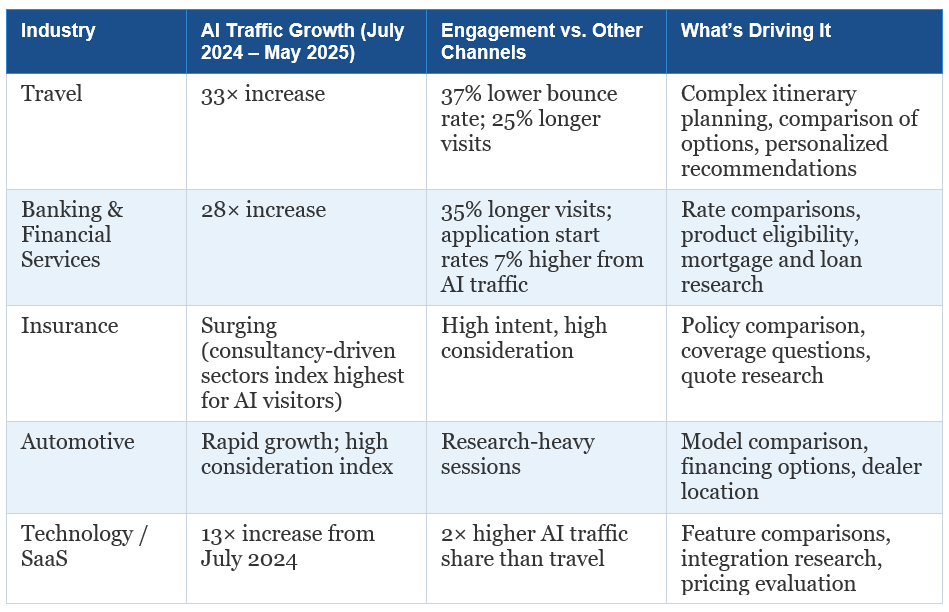
What these visitors share is not just high intent. They share a specific quality of intent. One that is conversational in origin. They arrived at your site after a dialogue, not after a search result. They were asked questions. They gave answers. They had their objections addressed before they ever saw your website.The journey that used to happen across multiple site visits, a few emails, and a sales call has, in many cases, already happened, inside an AI search conversation with a LLM.
Gartner’s longitudinal research puts the scale of this in perspective: 83% of the B2B buyer’s journey now happens before a buyer speaks to a salesperson. Forrester found that nearly 90% of B2B buyers now use generative AI tools during the purchase journey. The funnel has not collapsed. It has moved. It now lives, to a significant and growing degree, inside AI tools. What arrives at your website is not the top of the funnel. It is the bottom.
The Conversation Did Not End When They Clicked Through
This is the central insight that most website and conversion strategies have not yet absorbed.
When a user asks ChatGPT about the best insurance provider for a young family, or asks Perplexity to compare travel booking platforms, or uses Google’s AI Overview Mode to research car financing options, they are not conducting a search. They are having a conversation. That conversation has a structure: question, response, follow-up, refinement, recommendation. The AI learns their situation. They trust the output more than they would trust a search result, precisely because it felt personal.

When they click through to your site, that conversation is paused. But not finished. They have context. They have questions that the AI’s recommendation raised but did not fully resolve. They may want to know whether a specific feature applies to their situation. Whether the pricing they read about is accurate for their use case. Whether someone can confirm what the AI told them. Whether they can speak to a human to buy.
What do they find instead? A homepage built for a visitor who knows nothing yet. A value proposition written for someone who has never heard of you. A contact form asking them to submit their details and wait for a response within three business day. Maybe an AI-bot support chat that is trained on support data, but knows nothing about converting bottom funnel visitors to qualified leads.
The mismatch between what this visitor needs and what most websites offer is not a small gap. It is a structural failure. And it is costing companies a disproportionate share of their highest-value leads, because AI-referred visitors who do not get an immediate, contextual response do not wait. They go back to the LLM and ask again.
The Three Layers of the Problem
Understanding why AI-referred visitors need a different reception comes down to three compounding dynamics. Each one independently justifies better chat infrastructure. Together, they make a compelling and urgent case.
Layer 1: These Visitors Arrive at the Decision Stage, Not the Awareness Stage
The traditional marketing funnel assumes that most website visitors are in the early stages of research. They need to be educated about the problem, introduced to your brand, and slowly moved toward a decision through multiple touchpoints over days or weeks. This assumption shaped how most websites are designed today. With broad value propositions at the top, detailed product information in the middle, and contact forms or demo requests at the bottom.
The AI-referred visitor breaks this model. According to analysis by Lead Walnut, AI search generates leads at the decision stage, not the awareness stage. These users have already used AI to research options, compare alternatives, and narrow their choices. 73% of AI-referred visitors convert within their first session. Not their first visit, their first session. They are not coming back next week after more research. They are ready now.
A website optimized for the awareness stage, with long introductory sections, broad messaging, and gated content behind email forms , is the wrong environment for a visitor who arrived ready to decide. The landing page needs to meet them where they are, with specifics: case studies, pricing clarity, feature details, and proof points relevant to their stated situation. And ideally, a human being who can answer the one remaining question standing between them and a yes, and thus converting interest to a qualified lead.
Layer 2: Speed Destroys or Preserves the Opportunity
The data on response time and lead conversion is among the most consistent in sales research. A study from MIT and InsideSales, found that companies contacting leads within five minutes are 21 times more likely to qualify that lead than companies that wait 30 minutes. Responding within one minute increases conversion rates by 391% compared to longer delays. 78% of customers buy from the first company that responds to their inquiry.
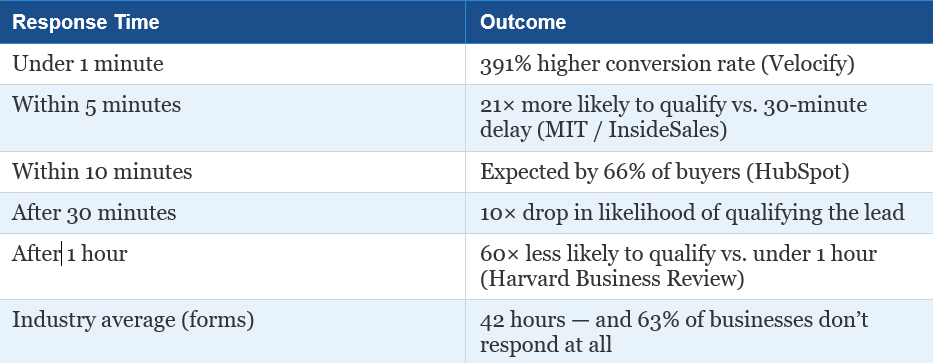
The brutality of these numbers is that they apply most severely to the highest-intent visitors, which is precisely what AI-referred traffic tends to be. A low-intent visitor who bounces after a 24-hour response delay was probably not going to convert regardless. A high-intent AI-referred visitor who submits a contact form at 9pm on a Sunday and receives an email Monday morning is not going to wait. They have other options. The AI that recommended you also recommended two alternatives.
The contact form, in this context, is not a lead capture tool. It is a lead delay mechanism. And for AI-referred visitors arriving with urgency and contextal ready built, delay is fatal. They came based on a conversation. You need to enable that conversation to continue on your site.
Layer 3: AI Search Has No Off Switch
Search behaviour has always had some time-of-day pattern. People are less likely to search for professional services at 2am than at 2pm. But AI search is collapsing even those patterns. People ask AI tools questions whenever questions arise, during commutes, in the evening, over weekends, during lunchbreaks. The research and comparison process that used to happen in deliberate desktop sessions is now woven into every moment of the day. Adobe’s data on AI referral traffic confirms what intuition suggests: 86% of AI-referred visits currently come from desktop, reflecting the research-heavy nature of AI-assisted decision-making. But the channel is still maturing. As AI becomes more integrated into mobile experiences, and as voice AI matures, the proportion of after-hours AI-referred traffic will grow. The pattern is not going to revert to business hours. It is going to become more distributed.A company that operates live chat Monday to Friday, 9 to 5, is capturing perhaps half of the AI-referred leads its website receives. The other half, who happened to complete their AI research at an inconvenient time for the company’s staffing schedule, leaves without a conversation. Some of them will come back. Most will not.
Why Live Chat Is the Natural Infrastructure for This Visitor
The case for live chat as a conversion tool is not new. Companies have known for years that chat-engaged visitors convert at dramatically higher rates than those who do not engage. Intercom’s analysis of 20 million live chat messages found that visitors who chat are 82% more likely to become customers, and their accounts are worth 13% more than those where no conversation occurred before signup. Just one reply in a live chat messenger increases the likelihood of conversion by 50%. Six exchanged messages makes a visitor 250% more likely to convert.
Chat-to-conversion rates across industries average 10 to 20% for engaged visitors, compared to 2 to 3% for traditional website forms. Weply, however, has demonstrated consistently, at chat-to-conversion rate of +30% for all visitors. This is due to its unique combination of trained human experts and AI trained on +10 million lead conversions chats. B2B companies consistently achieve 20 to 30% through chat-facilitated demo bookings and lead qualification. Proactive chat, where the chat is initiated by the company, rather than the visitor, delivers a 305% return on investment.
These are the existing numbers, before accounting for the specific and amplifying effect of AI-referred visitors. The point is that live chat was already the highest-converting reception mechanism for high-intent visitors. AI search is now systematically routing the highest-intent visitors on the internet to your site. The overlap between these two facts is not a coincidence. It is a structural opportunity.
Conversation Continuity: The New Argument for Chat
There is, however, an argument for live chat in the AEO era that goes beyond the existing data on conversion rates. It is the argument about conversation continuity.
An AI-referred visitor has just spent minutes in a dialogue. They have answered questions and received personalized answers. They have experienced, possibly for the first time, a research process that felt genuinely responsive to their specific situation rather than generic. They arrive at your website in a psychological state that is quite different from a visitor who clicked a search result.
They are in conversation mode. The AI created an expectation of responsiveness, of personalization, of dialogue. A static landing page breaks that expectation immediately. An AI chatbot that responds to “Hello” with “Hi there! How can I help you today?” and then fails to handle their first real question does even more damage. What they need is a continuation of the quality of conversation they just had. The ability to switch between a support chat and a leadable chat.
The AI that referred them was smart, contextual, and responsive. If the chat on your website is none of those things, you are not just failing to convert a lead. You are actively undermining the trust that AI built on your behalf. The AI that referred them was good at research. What you need now, is a chat that is brilliant at lead conversions, not support only.
This is the argument that makes human-in-the-loop chats specifically important in the AEO era, and not just any random AI chatbot solution. The AI-referred visitor is more sophisticated than average. They have already been through an intelligent conversation. They can detect generic, scripted responses faster than other visitors, and they react to them more negatively, because they have just experienced what good looks like. A chat agent who can meet them in context, who understands their likely questions, who can qualify their specific situation, who can answer the one remaining question standing between them and a commitment, is doing something transformative.
The Human + AI Model: Why It Matters More Now
There is a popular assumption that AI chat will eventually replace human agents for most customer-facing interactions. For AEO-referred traffic, this assumption is worth examining carefully.
The visitor who arrived via AI search has already interacted with AI. They found it useful for research. But when they click through to your site, they are moving from the research phase to the decision phase. Research and decision are different cognitive modes, and they respond to different kinds of engagement.
Research benefits from AI’s breadth and patience. Decision benefits from human judgment, trust, and the ability to handle the specific, nuanced question that no FAQ or chatbot script anticipated. The question that a support focused AI chatbot answers out-of-the-box as a support tool, may very well be showing a buying interest that a trained human expert can and should pick up, and guide towards a commitment and convert to a highly qualified lead.
What Makes a Human Chat Agent, Powered by AI, Irreplaceable for High-Intent Visitors
Lead identification in real time. The most valuable skill in a chat conversation with an AI-referred visitor is recognising when a question signals purchase intent. “Do you offer this in my region?” is a buying question, not a support question. “What’s the cancellation policy?” from someone who hasn’t mentioned buying yet is a buying question, not a support question. “I’m comparing you with [competitor]” is an explicit invitation to help. Identifying these signals and responding to them with appropriate urgency, this is a skill that trained human agents, using AI-in-the-loop, develop and that scripted bots consistently fail at.
Handling objections with judgment. The one remaining barrier between a high-intent AI-referred visitor and a conversion is often a specific, individual concern that no FAQ addresses. A human agent can hear that concern, assess it, respond to it directly, and either resolve it or escalate appropriately. This is the difference between a 20% close rate and an 80% close rate on high-intent conversations.
Building trust at the critical moment. The decision phase of a purchase, especially for high-value, considered categories like insurance, financial products, automotive, or travel as examples, involves a moment of trust transfer. The prospect needs to feel that they are making the right decision, with the right company, at the right time. A human agent who is calm, knowledgeable, and genuinely helpful delivers that trust in a way that automated responses cannot.
AI as Agent Enablement, Not Agent Replacement
The role of AI in a well-designed chat operation for AEO-referred traffic is not to handle the conversation autonomously. It is to make the human agent better. At Weply we use AI in-the-loop to make our human experts superhuman.
AI that surfaces the likely intent of an incoming conversation based on the page the visitor arrived from, the time of day, and the nature of their opening message, that makes the human agent faster and more contextually relevant from the first response. AI that suggests answers to common questions, that reduces handling time without reducing quality. AI that flags a conversation as high-intent so it is immediately prioritised in the queue, and ensures the right conversations get human attention within the critical five-minute window.
This is the human-and-AI model that delivers for the AI search era: the AI handles routing, context, and support. The human handles judgment, trust, and close. Neither alone is sufficient. Together, they create a reception experience that is genuinely worthy of the high-intent visitor that LLMs like ChatGPT are routing to your site.
What This Looks Like in Practice, by Industry
The dynamics above are universal. The specifics matter by industry, because the nature oft he AI-referred conversation, and the nature of the objection that chat must resolve, varies significantly.
Automotive
AI tools have become a primary research channel for car buyers. A consumer asking ChatGPT “What is the best family SUV under 40,000 EUR with low running costs?” receives a specific, ranked recommendation. When they click through to a dealer or manufacturer’s website, they are not browsing, they are evaluating. The specific questions they care about might be availability, pricing accuracy, trade-in values, and financing terms.
A chat agent who can answer “Is the [model] available in your inventory right now?”, who can discuss finance options without requiring a form submission, and who can help route a booking of a test drive frictionless to the company - that agent is doing what a static ‘Request a Quote’ button cannot do. Adobe’s data shows AI-referred retail traffic is highest in research-intensive categories.A utomotive is definitionally research-intensive. The visitor has done the research. They need the conversation. They need to be captured, with context, and be immediately contacted by the company.
Travel
Travel AI referral traffic grew 33 times between July 2024 and May 2025, making it one of the fastest-growing AI-referred categories of all. The nature of travel research is inherently conversational. AI excels at the kind of multi-criteria comparison and personalization that travel decisions require. A user who asked Perplexity “Best all-inclusive resorts in Greece for a honeymoon with a 5,000 EUR budget, good snorkelling, and an adults-only pool” received a highly specific recommendation. When they land on your booking site, they have context that is invisible to your page.
A chat agent who can meet that visitor with: “Are you looking at a specific destination or still comparing?” and then guide the conversation toward the specific property that matches their criteria is converting at a qualitatively different level than a static booking engine or an AI support chatbot. Travel is an emotional purchase. The decision moment is fragile. Human conversation at that moment captures qualified leads that forms and AI bots cannot.
Insurance
Insurance buying behaviour is particularly well-suited to AI research: complex, comparison-heavy, and typically involving a specific concern or triggering event. A user who asked an AI tool about life insurance coverage following a health diagnosis, or car insurance after a claim, arrives at your site carrying a specific and sensitive question. They are not price-shopping. They are looking for reassurance and clarity on whether your product applies to their situation.
This is exactly the type of conversation where a generic chatbot creates liability. The answer to “Will you cover me given my recent diagnosis?” requires a qualified human agent that can guide that conversation to the best representative from the insurance company. It also represents a visitor in a high-intent, emotionally engaged state who, if handled well, converts with high loyalty. These visitors are valuable. They require human engagement.
Financial Services
Banking AI referral traffic grew 28 times in under a year, and Adobe’s data shows that application start rates from AI-referred banking traffic are 7% higher than from other channels. These are visitors who arrived because AI recommended your institution for a mortgage, a savings product, or an investment account. They have read the comparison. They have a shortlist. They are evaluating final questions about eligibility, terms, and process.
Financial services is also the category where the response time stakes are highest. The combination of high intent, high consideration, and competitive alternatives makes 24/7 chat coverage in financial services not a premium but a baseline requirement.
The Infrastructure Implications
The argument above is not theoretical. It has specific implications for how chat operations need to be designed in 2026 and beyond. Here is what adequacy looks like. And what excellence looks like.
The Minimum: Availability When AI Sends Traffic
The starting point is coverage. If you have no chat on your website, you need to act today. Get one. If you run your own live chat and it is offline when AI-referred visitors arrive, and a meaningful proportion of them will arrive outside your current hours, you are converting the traffic at a fraction of its potential. 24/7 coverage, whether through external human experts, or a hybrid model, is the floor.
This is a more achievable requirement than it sounds. The volume of AI-referred traffic is currently small in absolute terms, even if its quality is exceptional. A modest out-of-hours operation or overflow model focused specifically on the highest-intent pages (pricing, product comparison), can capture the majority of after-hours value. However, the option of fully outsourcing to lead generation experts with AI-in-the-loop can 10x the amount of leads captured.
The Standard: Contextual Chat That Matches Visitor Intent
Beyond availability, the quality of the chat interaction needs to match the sophistication of the visitor.
Good chat infrastructure for AEO-referred traffic looks like this: the agent knows which page the visitor landed on, what product or service the visitor is likely evaluating, and what the most common decision-stage questions in that product category are. The chat agent is trained in lead generation and use specific AI trained on conversational conversion data. Combined with a RAG setup for retrieval of support-related answers when needed.
The Excellent: Lead Qualification Built Into the Conversation
The highest-performing chat operations in the AEO era do not just receive high-intent visitors and answer their questions. They systematically identify which conversations represent genuine qualified leads, guide those conversations toward conversion, and use Ai-in-the-loop to support queries to appropriate resolution paths without conflating the two.
This requires agents trained to distinguish between a visitor who has a product question and a visitor who has a buying question. It requires a conversation structure, propriety AI models, not a script, but a framework, that moves naturally from reception to qualification to conversion And it requires data: a record of what questions AI-referred visitors are asking, which questions (and answers) correlate with conversion, and which conversations are generating qualified leads versus support volume. It requires knowledge on when in the conversations yuu convert and how you do it.

The Metrics That Change
When AI-referred traffic becomes a meaningful part of your inbound mix, several of your standard website metrics will change, and some of the changes will look counterintuitive until you understand what is driving them.
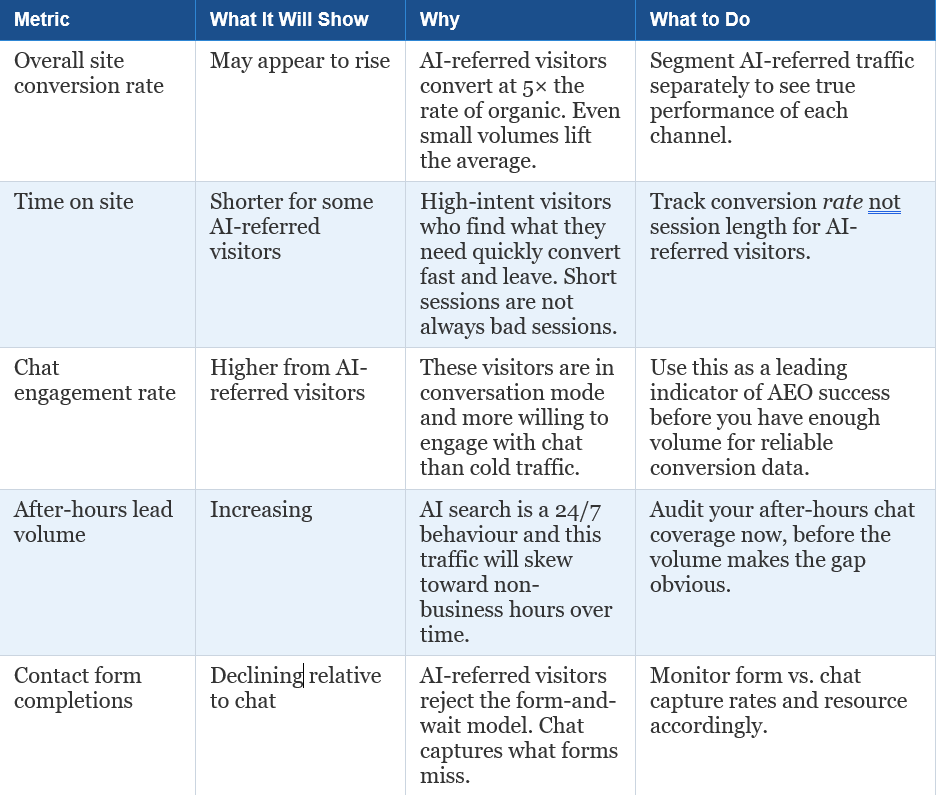
The most important metric change is the one that does not appear in your analytics at all. When an AI-referred visitor lands on your site outside business hours, finds no chat, a chat offline or a customer support AI bot, and leaves without converting, that event is invisible.There is no “lost lead” event in GA4. There is just a session that ended without conversion, indistinguishable in the data from a low-intent visitor who was never going to buy. The invisibility of these lost opportunities is one reason companies underestimate how much they cost.
What to Do Now
The practical implication of everything above is not complicated. It is a set of operational and infrastructure decisions that, taken together, ensure your website is built to receive the visitor AI search is sending.
Get (the right) chat on your website
In a conversational world it is a must to have a chat on your website. Choosing the right chat solution is potentially a much higher ROI decision that most other marketing decisions you make. Make sure you tailor you pick to the traffic you generate on your website. If more than 20% is expected to have a buying interest a solution that combines good support level with expertise in lead generation is likely your best option. Weply is such an option.
Upgrade your highest-intent pages first
Pricing pages, comparison pages, and product detail pages, are where AI-referred visitors land when they are closest to a decision. These are the pages where chat engagement is most valuable and where a proactive chattrigger, initiated within 30 seconds of a visitor arriving, is most likely to produce a conversion.
Separate your chat data by traffic source
Aggregate chat metrics mix high-intent AI-referred conversations with low-intent general traffic. This masks the true performance of chat for your most valuable visitors. Use source attribution in your chat platform to see separately: conversion rate, average conversation length, lead qualification rate, and support vs. sales conversation ratio for AI-referred visitors. This data will be the clearest argument for investment in extended coverage and chat agent quality.
Define your lead identification criteria for high-intent conversations
Work with your chat provider to define what a qualified lead looks like in a chat context. What questions signal purchase intent? What information do you need to capture to hand a conversation to sales? Whatis the specific next step you want to achieve in a chat conversation with a high-intent visitor — a booked call, contact information or osmehting else? Making these criteria explicit transforms chat from a reactive support channel into a proactive lead generation one.
The Opportunity Is Structural, Not Incremental
Live chat is not new. The argument that high-intent visitors convert better through conversation than through forms is not new. The data on response time and its effect on conversion is not new.
What is new is the visitor. AI search is creating a category of inbound traffic that is qualitatively different from anything websites have received before. Visitors who arrive at the decision stage, in conversation mode, with context already built, often outside business hours. The conventional website infrastructure, designed for top-of-funnel visitors who need education and nurturing, is not built for them.
The brands that recognise this first and invest accordingly will convert AI-referred traffic at rates that compound over time: better conversion rates produce better lead data, better lead data improves chat agent performance, better agent performance improves customer satisfaction, and better customer satisfaction generates the reviews and mentions that feed the AEO cycle and bring even more AI-referred visitors in the first place. The brands that succeed will know to not put a random AI support chatbot in front of their high-intent vistors.
The brands that do not recognise it will watch their AEO efforts, their Reddit presence, their structured content, their schema markup, their earned citations, produce traffic that converts at a fraction of its potential. They will invest in the top of the funnel and leave the bottom of it undefended.

![How to Get Your Brand Into Google AI Overviews [2026 update]](https://cdn.prod.website-files.com/687998866aa498f98160dbb6/69a6d966299d1892b3fc1f8c_Blog_post_header_AI_Overviews.png)
![LLM Seeding: The Complete Guide to Getting Your Brand Cited in AI Search Results [2026]](https://cdn.prod.website-files.com/687998866aa498f98160dbb6/6a8630ea63f85f3d690eeaab_llm-seeding-guide.png)