The right chat solution can turn your website traffic into paying customers and lift your customer support from reactive to proactive, or strengthen your lead generation and help grow your business. In the age of AI search having a chat solutions has become even more important. In this guide, we've reviewed the 10 best chat solutions available in 2026, including Weply, Intercom Fin, and Zendesk AI. We've looked at features, pricing, reviewsite ratings, and customer cases, so you don't have to. Here are our three top picks:

Looking for the best chat solution for your business?
Customers expect answers now. 63% of consumers prefer live chat over email or phone, and 46% of all leads are generated outside of normal business hours. With an ever-growing selection of solutions and increasing demands around GDPR compliance, data residency, and 24/7 availability, choosing the right chat solution has never been more important.
The right solution helps you:
- Convert anonymous visitors into named and qualified leads.
- Give customers immediate help, 24/7.
- Free up tiem for your team for other, more high-value interactions.
- Comply with GDPR and data handling requirements within the EU.
- Integrate with your existing CRM, helpdesk or e-com platform.
Why trust Weply?
We built Weply because we saw how businesses across Europe were losing potential customers on their websites, either because they had no chat at all, it was only availbale during operating hours, or because they put an AI support chat in front of high intent traffic and think it can convert it to qualified leads. Our platform combines trained chat consultants with AI and we generated over 250,000 qualified leads for more than 2,400 customers in 2025. We know this market inside out, from SMBs to enterprise. That gives us a unique position to evaluate which chat solutions actually deliver on the European and US markets. Finding the right solution is always about understanding your own needs first.
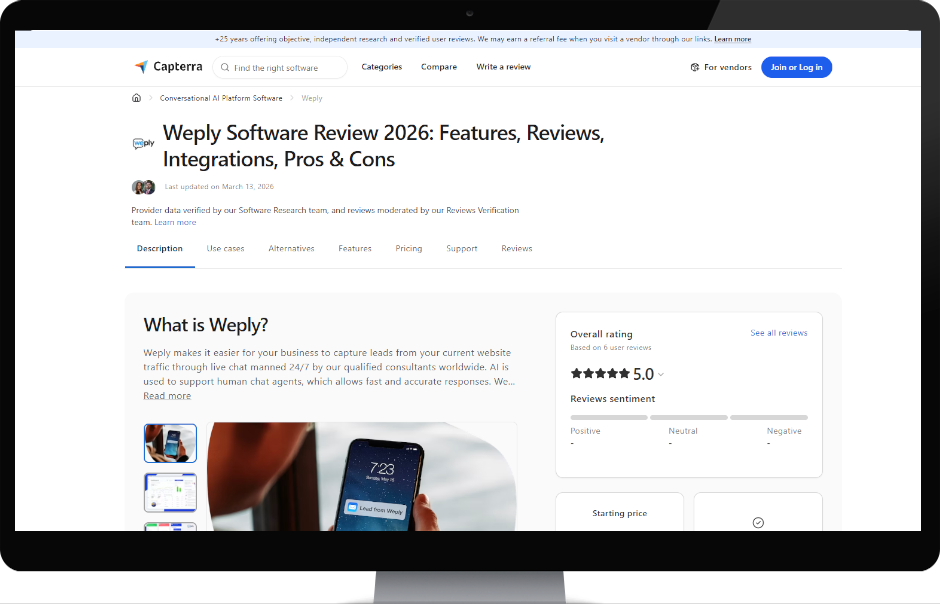
Here's how some of our customers rate us:
Now, let's take a look at the 10 best chat solutions for 2026.
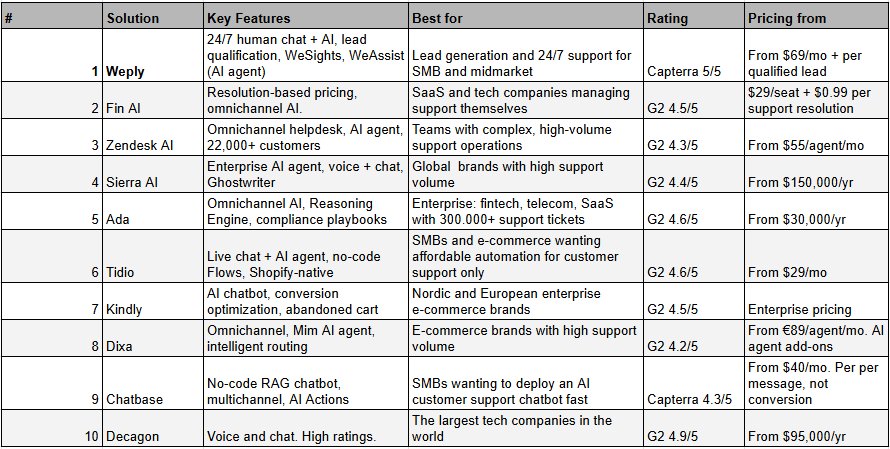
Now let's dive into each solution.
1. Weply

Weply is a Nordic 24/7 live chat solution that combines trained human chat consultants, lead conversion experts, with AI technology to generate and pre-qualify leads directly on your website. Founded in 2013 and headquartered in Copenhagen, Denmark, Weply has generated over 250,000 qualified leads for more than 2,400 customers in 2025, making it the largest Nordic operator in hybrid human-AI chat. Weply recently launched WeAssist, a support AI agent that chat consultants can activate for incoming support queries. What sets Weply apart from pure AI solutions is that your customers always interact with a real human being, backed by AI. That means meaningfully higher conversion rates and fewer missed interactions compared to fully automated chatbots. All support responses are also quality-checked by a human in real time, minimising the risk of AI hallucinations and ensuring answers are delivered with human empathy and nuance.
Key Features
- 24/7 Human Live Chat + AI (WeAssist): Trained chat consultants are available around the clock, complemented by WeAssist AI for standard support queries. You never miss a relevant customer interaction.
- Sales-qualified leads delivered to your inbox or CRM: Weply pre-qualifies visitors based on your criteria and delivers warm leads, with name, phone number, and relevant context, directly to your CRM or inbox.
- AI Co-pilot for internal chat agents: some customer run internal customer support agents using Weply outside normal opening hours or if overloaded, and those agents have access to AI WeAsssist co-pilot.
- WeSights our analytics platform: Gives you insight into chat volume, chat context, campaign data, and conversion patterns, so you can continuously optimise your digital marketing, web, and lead strategy.
- Dedicated Customer Success Manager: Every customer gets a dedicated CSM who helps with setup, optimisation, and ongoing strategy.
- GDPR-compliant and EU-hosted: Data is processed in accordance with GDPR, with servers in the EU and full compliance with the ISO and EU AI Act.
Pricing
Pricing consists of a small monthly subscription starting from €53/mo, covering up to 100 monthly support chats with the WeAssist AI agent included. Beyond that, you pay only for success, a fixed price per qualified lead Weply generates, based on your unique lead qualification criteria. Weply offers a fully free 7-day trial, where all generated leads and answered support queries are free.
Pros
- Human touch for your potential and existing customers 24/7, 365 days a year. Customers always talk to a real person, not just a bot.
- Experts in lead conversion. If you're already spending money and time driving potential customers to your website, Weply is the only specialist. Typically converts minimum 50–80% more chat visitors into qualified leads than AI chatbots.
- WeAssist is included in the subscription price, meaning you get an AI support chatbot verified in real time by humans. At a significantly lower cost than the alternatives.
- Plug-and-play setup with CRM integrations, live quickly.
- Dedicated Customer Success Manager always included.
- GDPR, AI Act, ISO. Verified with over 2,400 paying customers across the Nordics and Europe.
- You get AI where AI is strong (support, but verified by humans) and humans where they're best (qualified lead generation).
- Free 7-day trial, no credit card required, no commitment.
Cons
- WeSights, the unique chat analytics tool, is an add-on.
- Available as chat only, not yet on voice, email, or social channels.
- Not ideal for public institutions where all traffic is support-related, or for chat behind a login wall as inside a SaaS support tool.
Rating
Capterra: 5/5. Trustpilot 4.4/5. Businesses consistently highlight that Weply delivers significantly more leads and better lead quality than AI chatbots, alongside 24/7 availability, easy setup, and a very high level of customer service.
2. Intercom Fin
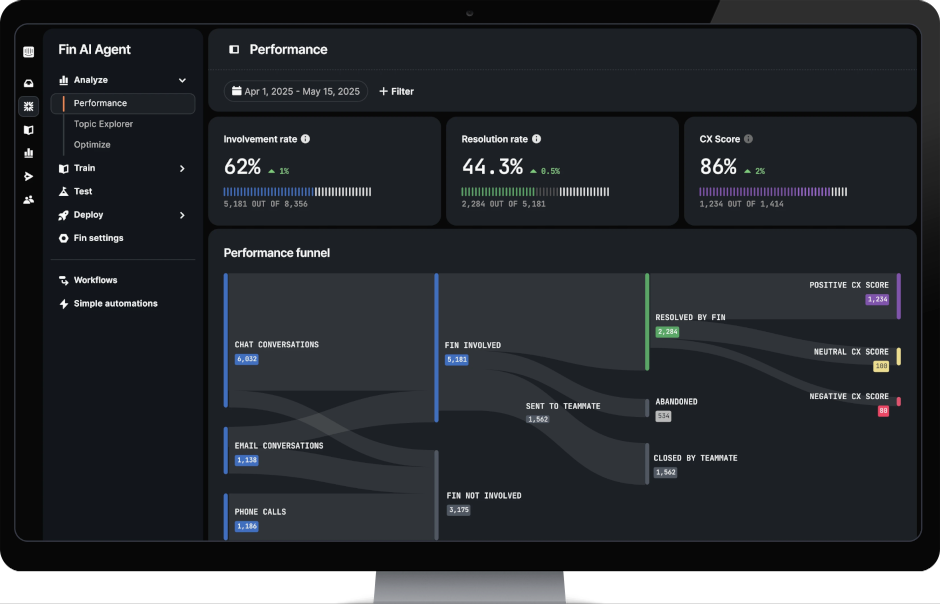
Intercom Fin is Intercom's AI agent, launched in 2023 and now one of the most widely deployed AI support platforms globally. Fin states it resolves an average of 60% of all queries automatically and supports all major channels: email, live chat, WhatsApp, Messenger, SMS, and voice.
Key Features
- Outcome-based AI agent: Fin receives queries, responds using your knowledge base, and escalates to your support team when needed.
- Omnichannel out-of-the-box: Fin works across email, live chat, WhatsApp, Messenger, SMS, and voice from a single platform.
- Fin Copilot (agent assist): AI assistant for human agents in the inbox, generates reply suggestions, summarises case history, and retrieves knowledge in real time. $35/user/mo add-on.
- AI-driven simulations and performance insights: Test Fin's performance against historical tickets before going live, and receive ongoing improvement recommendations.
- Integrations: 450+ integrations including Shopify, Salesforce, Zendesk, and HubSpot.
Pricing
- Fin AI Agent: $0.99 per resolution (min. 50 resolutions/mo = $49.50). Copilot is $35/user/mo as an add-on.
- Example: 1,000 Fin resolutions/mo = $990 on top of seat costs. For 10 agents on the Advanced plan ($85/seat), the monthly total is approximately $1,840.
Pros
- Outcome-based model is fair: you pay only for success.
- Works standalone alongside Zendesk, Intercom and Salesforce.
- Strong for SaaS and B2B support teams that manage their own helpdesk.
Cons
- Pricing scales aggressively at high volumes: 1,000 resolutions/mo = $990 in AI costs alone.
- Requires internal setup and optimisation. No dedicated CSM on lower plans.
- Not suited for active lead generation, only customer support.
- Fin Copilot is a paid add-on.
- Some G2 reviewers report that what Intercom counts as a "resolution" doesn't always match real-world outcomes.
Rating
G2: 4.5/5. Users praise the modern interface and automation rate. Most criticism: pricing scales unpredictably, and advanced features require expensive plans.
3. Zendesk AI
Zendesk is still the world's most widely used customer service platform, with 22,000+ support teams globally and a well-established enterprise presence. Zendesk's AI capabilities including AI agents (chatbots), Copilot for human agents, and intelligent triage, are layered on top of its core omnichannel helpdesk and have been significantly expanded since 2024. Zendesk is used by teams ranging from fast-growing SaaS companies to large enterprise organisations across every industry. Zendesk's core strength is organisational scale: it handles email, live chat, voice, WhatsApp, Instagram, Facebook Messenger, X, and web forms in a single agent workspace, and routes tickets intelligently across large agent pools.
Key Features
- AI agents and intelligent triage: Built-in AI agents handle common queries using your help centre content and can take basic actions.
- Omnichannel unified workspace: Email, live chat, phone, WhatsApp, social media, and web forms in a single agent view. Routing ensures tickets reach the right agent based on skills, language, and current load.
- Zendesk AI Copilot: Agent-side AI that suggests replies, surfaces relevant knowledge articles, and summarises long ticket threads in real time.
- Knowledge base and help centre: AI-powered content suggestions for help centre articles, and a self-service portal that deflects tickets before they reach your support team.
- Analytics and reporting: Pre-built dashboards and, on higher tiers, Explore for custom reports tracking response time, resolution rate, CSAT, and agent performance.
Pricing
- Suite Team: $55/agent/mo (annual). Basic multichannel ticketing, help centre, AI agents with limited resolutions.
- Suite Growth: $89/agent/mo (annual). Adds SLAs, multiple ticket forms, multilingual support, light agents.
- Suite Professional: $115/agent/mo (annual). Skills-based routing, community forums, HIPAA compliance, custom analytics.
- Suite Enterprise: From $169/agent/mo (annual, negotiated). Custom agent roles, sandbox, advanced data protection.
- Advanced AI add-on: ~$50/agent/mo extra. Required for Copilot, advanced triage, and generative AI features.
- AI Agent resolutions: $1.50 per automated resolution (committed volume) or $2.00 pay-as-you-go.
For a 20-agent team on Suite Professional with Advanced AI, total annual cost approaches $40,000 before implementation.
Pros
- The most established customer support platform globally. Deep integration ecosystem and proven enterprise track record.
- Strong at scale: skills-based routing, SLAs, and omnichannel work well for 15+ agent teams.
Cons
- Advanced AI features require a separate $50/agent/mo add-on.
- Own support quality criticised consistently on G2: slow response times and link-heavy replies.
- Some G2 reviewers describe being oversold during the buying process, real-world AI performance fell short of what was promised.
- Per-agent pricing model means costs scale directly with headcount, with no outcome-based option on core plans. Expensive option.
Rating
G2: 4.3/5 (6,800+ reviews). Satisfaction correlates strongly with team size: large, multi-channel support teams tend to find the cost justified; smaller teams often feel they're paying for features they don't use.
4. Sierra.ai
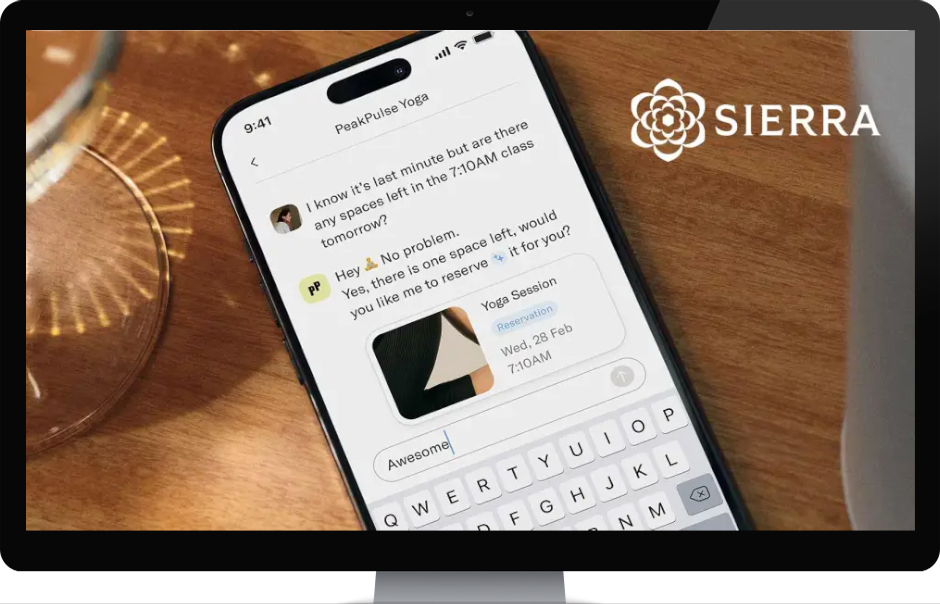
Sierra.ai is an American enterprise AI company founded in 2023 by Bret Taylor (former co-CEO of Salesforce and current chairman of OpenAI's board) and Clay Bavor. Sierra has raised $950 million to date and is one of the most discussed AI companies globally. Sierra's customers include Sonos, SiriusXM, Weight Watchers, ADT, and Casper. The platform is built for large consumer brands with high inbound support volume across chat and voice.
Key Features
- Empathetic AI agents: Sierra's agents are designed to mirror your brand's voice and tone precisely, handling complex interactions like returns, subscription changes, and account management autonomously.
- Agent Studio + Agent SDK: No-code workflow builder for CX teams (Agent Studio) and a developer-focused SDK for custom integrations.
- Ghostwriter: Automatically generates production-ready AI agents from SOPs, call transcripts, audio recordings, and whiteboard photos. Also runs an automatic improvement loop based on live interactions.
- Multi-model "Constellation" architecture: Uses multiple AI models in parallel for accuracy-checking, reducing hallucination, but can introduce latency (700ms+) in voice environments.
- Voice + chat across channels: Sierra's agents support web chat, mobile apps, and voice.
Pricing
Sierra publishes no pricing and has no pricing page. All contracts are enterprise agreements. Third-party estimates:
- Annual contracts from $150,000+.
- Implementation and onboarding fees: $50,000–$200,000.
- Outcome-based model: payment per successful resolution (rate confidential, but with minimum commitment volumes).
Pros
- One of the world's leading chat and voice agents for support.
- Ghostwriter significantly reduces time-to-deployment.
- Documented results at global consumer brands.
Cons
- Pricing makes it exclusive to the largest enterprises. SMBs and mid-market are entirely excluded.
- Long and technically complex implementation.
- Support only. No real lead generation capability.
Rating
G2: 4.4/5. Users praise the intuitive interface and empathetic AI interactions. Most common criticism: high price with unclear ROI, steep learning curve during onboarding.
5. Ada
Ada is an enterprise AI customer service platform founded in Toronto in 2016 by Mike Murchison and David Hariri. Ada has raised $200M+ and serves 350+ enterprise customers including Monday.com, Pinterest, Verizon, and YETI. The platform is built for high-volume, omnichannel AI deflection in industries including financial services, e-commerce, telecommunications, and SaaS. Ada's 2026 platform centres on its "Reasoning AI" which are agents that understand intent, follow compliance-sensitive playbooks, and execute multi-step workflows across chat, email, voice, SMS, and WhatsApp from a single platform.
Key Features
- Reasoning AI engine: Ada's agents understand customer intent and follow structured playbooks, including compliance-sensitive flows for regulated industries, rather than simple script logic. Claims to resolve 80%+ of inquiries automatically.
- Omnichannel coverage: Chat, email, voice, SMS, WhatsApp, and social messaging managed from a single platform. Handoff integrations with Zendesk, Salesforce, Freshworks, Genesys, Dixa, Gorgias, and more.
- Coaching and feedback loops: Platform managers can provide precise, surgical guidance to the AI agent through a coaching interface, and verify outcomes through test scenarios before going live.
- SOP-based playbooks: Ada can follow complex, multi-step workflows, including triggering refunds, extensions, or system updates, based on standard operating procedures. Well-suited to regulated industries.
- Enterprise security: SOC 2 Type II, HIPAA, GDPR, and PCI compliant. Zero Data Retention option with all LLM providers.
Pricing
Ada does not publish pricing. Estimates from third-party sources:
- Starting from ~$30,000/year.
- Pricing model: typically $1–$3.50 per AI resolution, based on resolved conversations.
Pros
- Strong omnichannel coverage across 10+ channels from a single platform.
- Enterprise-grade compliance: SOC 2, HIPAA, GDPR, PCI. Suitable for regulated industries.
- Coaching interface gives platform managers strong control over AI behaviour.
Cons
- Implementation timeline is measured in months.
- Only for large global enterprises.
- Pricing scales aggressively at high volume.
Rating
G2: 4.6/5. Platform administrators rate Ada highly for ease of use and coaching capability. Negative sentiment on Trustpilot: 1.8/5.
6. Tidio + Lyro
Tidio is a live chat and AI support platform primarily serving small businesses and e-commerce stores. Founded in Poland in 2013 and used by 300,000+ businesses globally, Tidio combines live chat, ticketing, a no-code chatbot builder and Lyro, its conversational AI agent, in a single platform. Tidio is particularly popular with Shopify merchants and SMBs that want to start with live chat and gradually layer in automation without switching tools.
Key Features
- Lyro AI agent: Conversational AI that answers common customer questions based on your support content. Handles handoff to human agents when needed.
- No-code Flows builder: Drag-and-drop chatbot builder for creating automated conversation paths: product recommendations, lead capture, FAQ automation, and more .
- Live chat with live typing preview: Agents can see what customers are typing before they hit send, allowing faster, more prepared responses.
- Multichannel inbox: Manages website chat, email, Instagram, Messenger, and WhatsApp in a single unified inbox.
Pricing
- Starter: From $29/mo (annual). Includes live chat, ticketing, basic automation.
- Growth: From $59/mo (annual). Includes Lyro AI conversations and advanced Flows.
- Advanced: $749/mo (annual). Higher conversation limits, custom branding, advanced analytics.
- Lyro AI add-on: Can be purchased separately from $39/mo for additional AI conversation quotas.
Pros
- Among the most affordable live chat + AI combinations on the market for SMBs.
- Conversation-based pricing is more predictable than per-seat models for smaller teams.
- Very fast to set up. Live in minutes. Strong Shopify native integration.
Cons
- Data processing: primarily EU-based, but some data is also transferred to the US.
- Not well-suited for complex enterprise workflows, SLA management, or large multi-team operations.
- Very limited lead generation capability. Can only be used for customer support.
Rating
G2: 4.6/5. Users consistently highlight ease of setup and Shopify integration. Most criticism relates to some agreesive prices increases.
7. Kindly
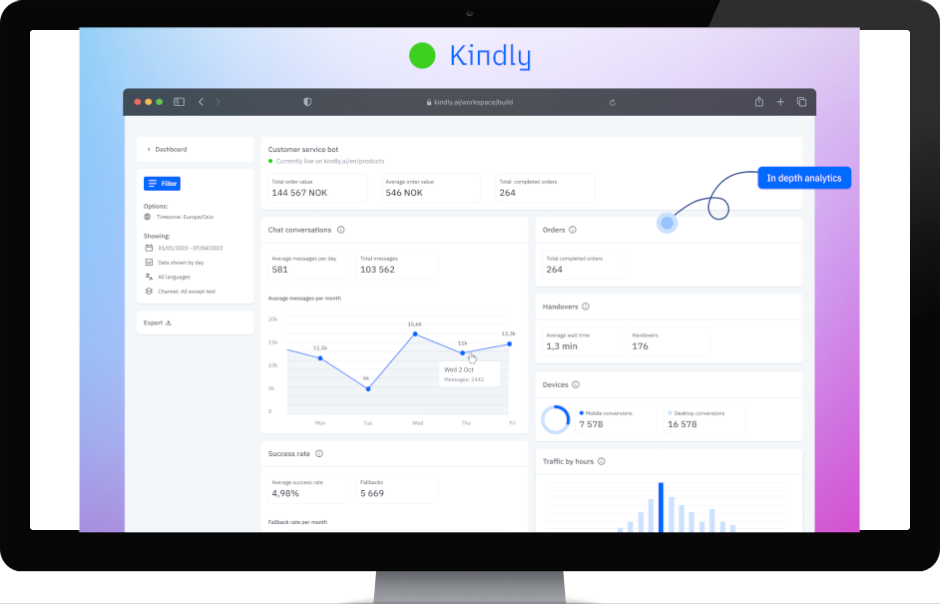
Kindly is a Nordic AI chatbot platform founded in Oslo in 2016 and one of Europe's leading conversational AI providers for enterprise e-commerce and customer service.
Key Features
- Generative AI chatbot with multilingual training: Train the chatbot in one language and it understands queries in 100+ languages automatically. Nordic language expertise is a core competency.
- Conversion optimisation and abandoned cart: Kindly's platform can increase conversion rates by up to 12% and automates abandoned cart messages.
- Visual product carousel in chatbot: Enables product search and displays products directly within the chat interface based on selections made in the chatbot.
- Simple customisation without coding: No code required to match the chatbot to your brand identity, tone, and layout.
- Support automation: Automates up to 80% of customer inquiries according to themselves.
Pricing
Kindly does not publish pricing. All agreements are reached via direct contact. Enterprise prices.
Pros
- Deep Nordic and European market presence with proven language expertise.
- Unique combination of AI chatbot, conversion optimisation, and support automation in one platform.
- Strong customer references: Elkjøp, Norwegian Air, Kahoot, Lindex, Hertz.
- E-commerce focused
Cons
- No public pricing. Expensive and only for enterprises.
- Primary focus on e-commerce. Not tailored for public sector or regulated industries.
- Only for customer support. Not suited for active lead generation.
Rating
G2: 4.9/5. Users highlight easy implementation, Nordic language expertise, and high automation rates.
8. Dixa
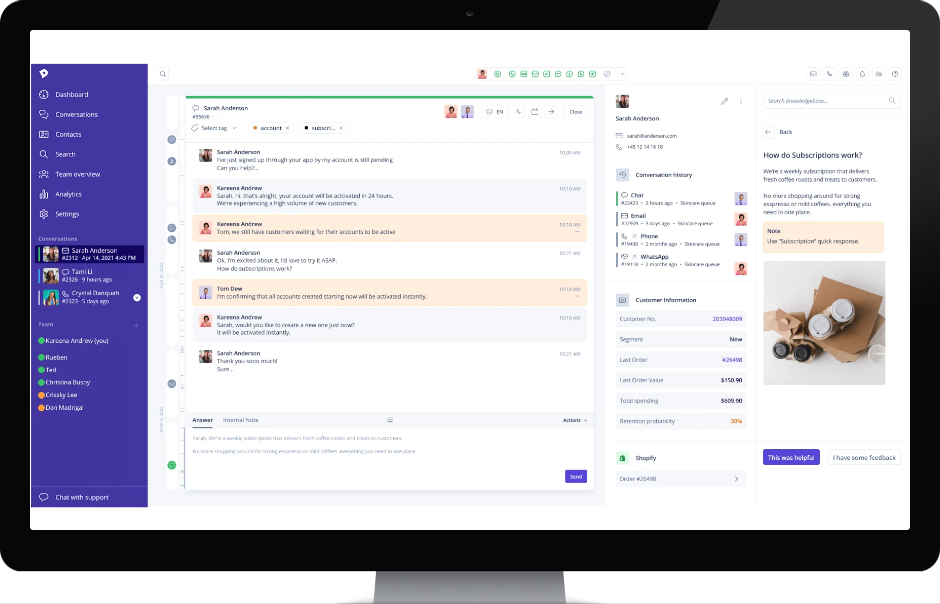
Dixa is a Danish-founded customer experience platform aimed at e-commerce brands that want to consolidate all customer communication in one system. Dixa is used by 850–1,000+ brands across 42 countries, including Rapha, Hobbii, Mejuri, and Miinto. In 2025, Dixa launched Mim, an agentic AI agent.
Key Features
- Mim AI Agent: Dixa's AI agent handles end-to-end customer interactions, including order lookup in Shopify and Magento, refunds, and self-service, with intelligent escalation to interrnal human agents.
- E-commerce focused: Built exclusively for e-commerce companies, with features and integrations tailored to these specific workflows.
- Omnichannel native: Phone, email, live chat, WhatsApp, Instagram, Facebook Messenger, and SMS in a single Team Hub.
- Intelligent routing and Flow Builder: Drag-and-drop routing engine that assigns interactions to the right agent based on skills, language, and workload.
- Shopify + Magento + WooCommerce integrations: Deep e-commerce integrations mean agents see order history directly within the conversation window.
Pricing
- Growth: From €89/agent/mo. All channels included.
- Ultimate: From €139/agent/mo. Adds various AI features.
- Prime: From €179/agent/mo. Enterprise functionality including SSO.
- Mim AI agent is an additional cost on all plans.
Pros
- All channels included as standard.
- Danish-founded with strong Nordic support and understanding of European data requirements.
- Mim AI Agent is one of the market's most mature agentic AI solutions for e-commerce.
Cons
- Built specifically for e-commerce brands. Limited or no relevance for other verticals.
- Mim AI agent access costs extra on top of the base subscription.
- AI copilot is also an add-on.
Rating
G2: 4.2/5. Users praise the user-friendly interface and customer support, but criticise long contracts and minimum seat requirements.
9. Chatbase
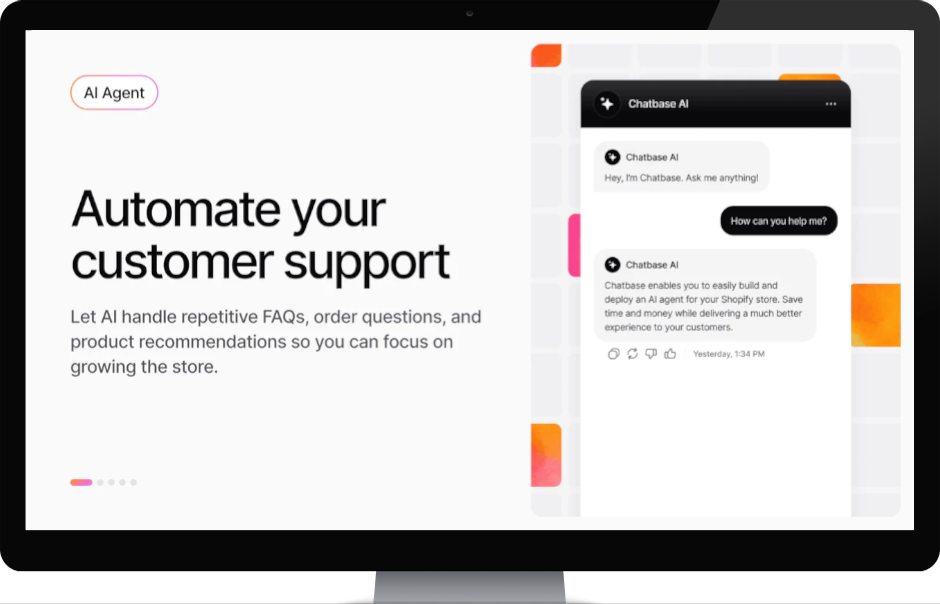
Chatbase is a no-code AI chatbot builder used by over 10,000 businesses globally. Chatbase lets you train an AI chatbot on your website, PDF documents, Notion pages, and internal knowledge sources, and deploy it on websites, Shopify, email, WhatsApp, Instagram, Facebook, and Slack. It is designed for SMBs and teams that want AI support without programming or developer resources.
Key Features
- RAG-based knowledge training: Upload PDFs, link to URLs, or Notion pages. Chatbase automatically builds a knowledge foundation and uses it to answer queries accurately with source references.
- Multichannel deployment: Deploy your chatbot on your website with a script tag, or connect to Shopify, WhatsApp, Instagram, Facebook Messenger, and Slack via native integrations.
- AI Actions: The chatbot can take real actions via API as booking meetings in Calendly, updating subscriptions in Stripe, and so on.
- Flexible AI model selection: Choose between economy LLM models (GPT-4o Mini, Claude Haiku) and premium models (Claude Sonnet) depending on quality and cost requirements.
Pricing
- Prices start from $40/mo. You pay additional credits when your usage exceeds the amount included in your plan.
- Note: Chatbase uses "messages" rather than "chat conversations" as its consumption metric. A single conversation can contain many messages, which can be difficult to control and therefore forecast costs. In theory one single chat can eat your entire budget.
Pros
- Fastest time-to-live of any solution in this guide.
- Multichannel deployment without any coding.
- Flexible model selection (GPT-4o, Claude Haiku/Sonnet/Opus).
Cons
- The free plan deletes the chatbot after 14 days of inactivity. Unreliable for production use.
- Limited workflow logic. Not suited for complex escalation flows or multi-step automation.
- Output quality depends heavily on which AI models you choose. The best models can make the solution expensive very quickly.
- Priced per message, not per conversation. Many add-ons may be required.
- Good for customer support. Not in the same league as Weply for active lead generation.
- Data is processed in the US. Not EU compliant for most EU-based companies.
Rating
Capterra 4.3/5. Users praise easy setup and quick deployment. Most common criticism: pricing climbs quickly on higher plans and workflow capabilities are limited compared to alternatives.
10. Decagon
Decagon is an American enterprise AI customer service platform founded in 2023. Decagon has raised $481M across five rounds, reaching a $4.5B valuation in January 2026, and was named to the Forbes AI 50 list. Its customer list includes 100+ enterprise customers to date. Decagon's core concept is that AI agents should work like employees, not tools.
Key Features
- Agent Operating Procedures (AOPs): Define agent workflows in natural language. A non-technical support manager can write instructions like "If a customer asks for a refund over $100, verify their purchase date and escalate to billing", and the AI follows that logic precisely, with full audit trails.
- Decagon Voice 2.0: Inbound and outbound voice with sub-second latency, customisable tone and speed, interruption handling, and branded caller IDs.
- Cross-channel memory: If a customer starts in chat and later calls, the voice agent already knows what was discussed. No information repeated, no disconnected experiences across channels.
- Continuous self-learning: Decagon agents learn from new tickets and human replies, updating their own knowledge without manual retraining.
- Enterprise security and version control: SOC 2 compliant, data residency options, strict guardrails for sensitive operations (identity verification, refunds).
Pricing
- Esitamted annual platform fee: ~$50,000/year, regardless of usage volume.
- Per-conversation fee: ~$0.99/conversation on top of the platform fee.
- Effective starting cost: ~$95,000/year total. Median enterprise spend is estimated at ~$400,000/year at scale.
- No public pricing page. All contracts are enterprise agreements with custom volume terms.
Pros
- Voice 2.0 with sub-second latency and outbound capabilities is a genuine differentiator vs Sierra and Ada.
- AOPs make complex workflow logic accessible to non-technical teams without sacrificing precision.
- Very strong customer references for SaaS and tech enterprises globally.
Cons
- Pricing makes it inaccessible for all but the largest tech enterprises.
- Deployment typically takes mulitple weeks.
- Support only. No lead generation capability.
Rating
Choosing the right chat solution for your business
The best chat solution depends on your company's size, industry, and primary purpose, whether that's lead generation, customer support, or both.
- Do you need lead generation, because some of the traffic you drive to your website is genuinely purchase-ready? Then Weply is the only solution on this list that specialises in it, offering 24/7 human-led lead qualification backed by AI.
- Are you a SaaS or tech company running your own helpdesk? Intercom Fin is a strong choice, with its outcome-based pricing and solid resolution rates.
- Is your business an international enterprise with high support volume? Sierra.ai or Decagon are the natural candidates.
- Are you an e-commerce brand wanting quick, affordable AI support? Tidio + Lyro is the best entry-level option.
- Most visitors to a live chat prefer talking to a human. If you want to satisfy both potential and existing customers on that dimension, Weply is the only solution offering a hybrid between real human experts and a controlled AI agent, for both lead generation and support.
Whatever you choose, the most important thing is to start. Try Weply free for 7 days, no credit card, no commitment, and see what it means for your conversion rate and customer support this week.
FAQ: Chat Solutions for Support and Lead Generation
What is the best chat solution for lead generation?
Weply is the only chat solution in this guide specifically built for lead generation. The platform combines trained human chat consultants with AI agents and is available 24/7, including outside business hours, where 46% of all leads arise. With 2,400+ customers and 250,000+ leads generated in 2025, it's the most documented solution for active lead generation in Europe.
How much does a chat solution cost for a business in 2026?
Pricing varies significantly depending on solution type. Solutions are typically priced as a combination of a subscription and an outcome-based fee (per qualified lead or per resolved conversation). Enterprise platforms like Sierra.ai and Ada start from $30,000–$150,000+/year. SMB solutions like Weply start from $69/mo + per lead, while Tidio starts from $29/mo and Chatbase from $40/mo.
What's the difference between an AI chatbot and a live chat solution?
An AI chatbot answers questions automatically based on pre-programmed rules or AI training from your content. A live chat solution connects visitors to real team members in real time. Hybrid solutions like Weply combine both: AI handles standard queries with human experts in the loop and as the sender of every message, while human consultants take over complex conversations and real lead qualification and lead capture. The human layer ensures empathy, nuance, and accuracy in every response, as well as outperform AI on lead generation by 2x.
Which chat solution is best for e-commerce brands?
For e-commerce, Dixa and Kindly are strong choices depending on scale and geography. Dixa is built exclusively for e-commerce with all channels included as standard and a mature AI agent (Mim). Kindly offers deep European language expertise and strong conversion optimisation tools, with proven results at Elkjøp across the Nordics. For e-commerce companies selling high-value products, where lead qualification matters as much as support, Weply is commonly used as a complement.
Are AI chatbots GDPR-compliant?
Most professional chat solutions are GDPR-compliant, but data residency varies. Weply, Dixa, and Kindly store data on EU servers and are built with European data requirements in mind. Intercom, Zendesk, Chatbase, and Tidio are also GDPR-compliant, but may process data in the US under standard contractual clauses unless EU hosting is specifically selected on enterprise plans. Ada and Sierra offer EU hosting on enterprise agreements.
Can a chat solution replace my customer service team?
No, and it shouldn't. The best chat solutions free your team from repetitive, low-value queries so they can focus on complex cases and relationship-building. The hybrid model , AI for volume, humans for value, consistently produces the highest customer satisfaction scores. Weply's approach takes this further: humans remain in the loop on every AI-assisted support response, ensuring quality and empathy at every touchpoint.

![How to Get Your Brand Into Google AI Overviews [2026 update]](https://cdn.prod.website-files.com/687998866aa498f98160dbb6/69a6d966299d1892b3fc1f8c_Blog_post_header_AI_Overviews.png)
![LLM Seeding: The Complete Guide to Getting Your Brand Cited in AI Search Results [2026]](https://cdn.prod.website-files.com/687998866aa498f98160dbb6/6a8630ea63f85f3d690eeaab_llm-seeding-guide.png)



.png)




.png)