
Insights from the conversion floor
Strategy, data and guidance on driving the right traffic, converting it, and making the most of every lead. From a team doing it every day across 2500+ BtB and BtC companies.
![How to Find Your Website's Lead Conversion Leaks with ChatGPT [including 8 prompts to use]](https://cdn.prod.website-files.com/687998866aa498f98160dbb6/6a86366654f54f6e36601151_your-website-leaking-leads.png)
How to Find Your Website's Lead Conversion Leaks with ChatGPT [including 8 prompts to use]
Quick Summary
Most businesses spend serious money driving traffic to their website and almost nothing auditing whether that website actually converts visitors into leads. This guide gives you 8 copy-paste prompts and a clear process. Run them against your own webpages using ChatGPT or Claude. No tools to buy, no agency to hire. By the end, you'll have a prioritised list of exactly where your website is losing leads and what to fix first.
The Problem Most Businesses Never Audit
Traffic goes up. Leads stay flat. You've tried new headlines, changed the button colour, maybe swapped the hero image. Nothing moves the needle. Here's what usually isn't happening: a proper audit of the full path a visitor takes from landing on your homepage to becoming a lead.
The average website converts 2 to 3 percent of its visitors. The top performers convert 8 to 15 percent. The gap between those two numbers is often not better traffic or smarter ads. It's fewer leaks in the conversion path. A leak is any point where a motivated visitor quietly exits without taking the action you need them to take.
Leaks hide in obvious places: a form with no clear next step, a contact page stripped of any reason to trust you, a service page that doesn't match what the homepage promised. They also hide in less obvious ones: a visitor arriving at 9 PM with a genuine need and nowhere to turn, or a buyer who just came from an AI search tool mid-conversation and landed on a static brochure page with a contact form at the bottom and a phonenumber in the menu bar.
Most businesses have never audited for these problems systematically. They've looked at individual pages. They haven't looked at the path. This guide changes that. Eight prompts, one conversation thread with an AI, your own screenshots.
Why Listen to Us?
Weply has in 2025 alone generated over 250,000 qualified leads on behalf of 2,400+ customers across the Nordics and Europe. We've been doing this since 2013, across industries ranging from dental chains to insurance companies to fast-growing scaleups, to telco enterprises and so on.
We know what breaks conversion paths because we watch them break in real time.
Our chat consultants, backed by AI, handle the questions visitors can't get answered on a website. They capture the leads that forms lose. Across our customer base, adding managed chat produces an average 12% lift in lead conversion, and one in three chat conversations becomes a qualified lead. That data is the foundation for everything you're about to audit.
Why Use AI for This, and What You'll Need
A conversion specialist can audit your website for between EUR 3,000 and 8,000. They'll spend four to six weeks on it and deliver a PDF. The audit will be thorough, and for complex e-commerce operations, it's probably worth every cent. For most service businesses, you can surface minimum 80% of the same findings in 30 minutes using an AI. Here's why it works: AI evaluates your pages the way a first-time visitor does, without the curse of knowledge. You've looked at your homepage so many times you no longer see it. AI reads it cold. It also audits paths as sequences, which means it catches the friction that lives between pages, not just on them.
One honest caveat: this works well for service and product businesses with a clear conversion path. If you're running a complex multi-product e-commerce operation, a full specialist audit will find things this process won't. For everyone else, 30 minutes is enough to find what's bleeding leads.
What you'll need:
- ChatGPT Plus, Team, or Claude Pro (the free tier works, with limitations on image uploads)
- A browser
- A full-page screenshot tool (GoFullPage for Chrome, Firefox's built-in screenshot function, or use mulitple screenshot directly from Claude)
- 30 minutes
- Optional: GA4 access for one advanced prompt
Before You Start: Four Preparation Steps
Step 1: Map your conversion path. For most businesses this is Homepage, Service/Product Page, Pricing Page, Contact Page. If you're unsure which pages matter most, open GA4, go to Explore, and check the path exploration report. Three to five pages is enough to work with.
Step 2: Take full-page screenshots of each page in sequence. Full-page, not just the top fold. You need the AI to see the whole page.
Step 3: Screenshot your lead form and your confirmation page. The confirmation page matters because it tells you, and the AI, what promise you make to someone after they submit.
Step 4: Open a new conversation in ChatGPT or Claude, upload all screenshots together, and add this context:
You are a senior conversion rate optimisation specialist with experience auditing business websites. These are screenshots of my website pages in the order a visitor would see them. My business is [type of business]. My goal is to generate [desired action: enquiries / consultations / quote requests]. I'll be asking you to audit specific aspects of these pages.
Set this context once at the start. Every prompt that follows builds on it.
The Prompt Library
Eight prompts. Run them in sequence in the same conversation thread. Each builds on what came before.
Prompt 1: The First-Impression Test (copy this exact prompt)
# First-Impression Audit
## Context
Visitors decide within 5 to 10 seconds whether to stay or leave.
This audit evaluates what's communicated before any scrolling.
## Your task
Look at the first screenshot only (homepage or landing page).
Based exclusively on what's visible above the fold, answer:
1. Clarity — What does this company do?
2. Audience — Who is it for?
3. Action — What should I do next?
4. Trust — Why should I believe them?
## Output format
| Question | Answered? (Y/N) | What's missing or unclear |
|----------|:---:|---------------------------|
| What do they do? | | |
| Who is it for? | | |
| What should I do next? | | |
| Why trust them? | | |
Above-fold score: X/10
What this reveals: The failure we see most often across service websites is in row three of that table: "What should I do next?" Businesses build strong hero sections explaining what they do, then offer no visible next step. No CTA above the fold. No invitation to start a conversation. The visitor who wants to engage has to scroll, navigate, and figure the path out alone. Every step of effort they have to put in is a point where you can lose them. The good news is this is the quickest fix in the whole audit. A clear, visible CTA above the fold costs nothing to add and almost always moves conversion numbers.
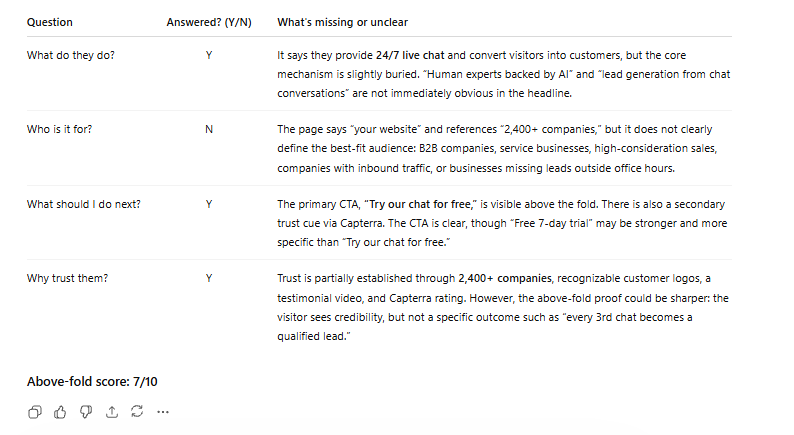
Now what we did was to run the full series of prompts on one of the most succesful current scaleups in Europe and one of the best at digital marketing, Flatpay.
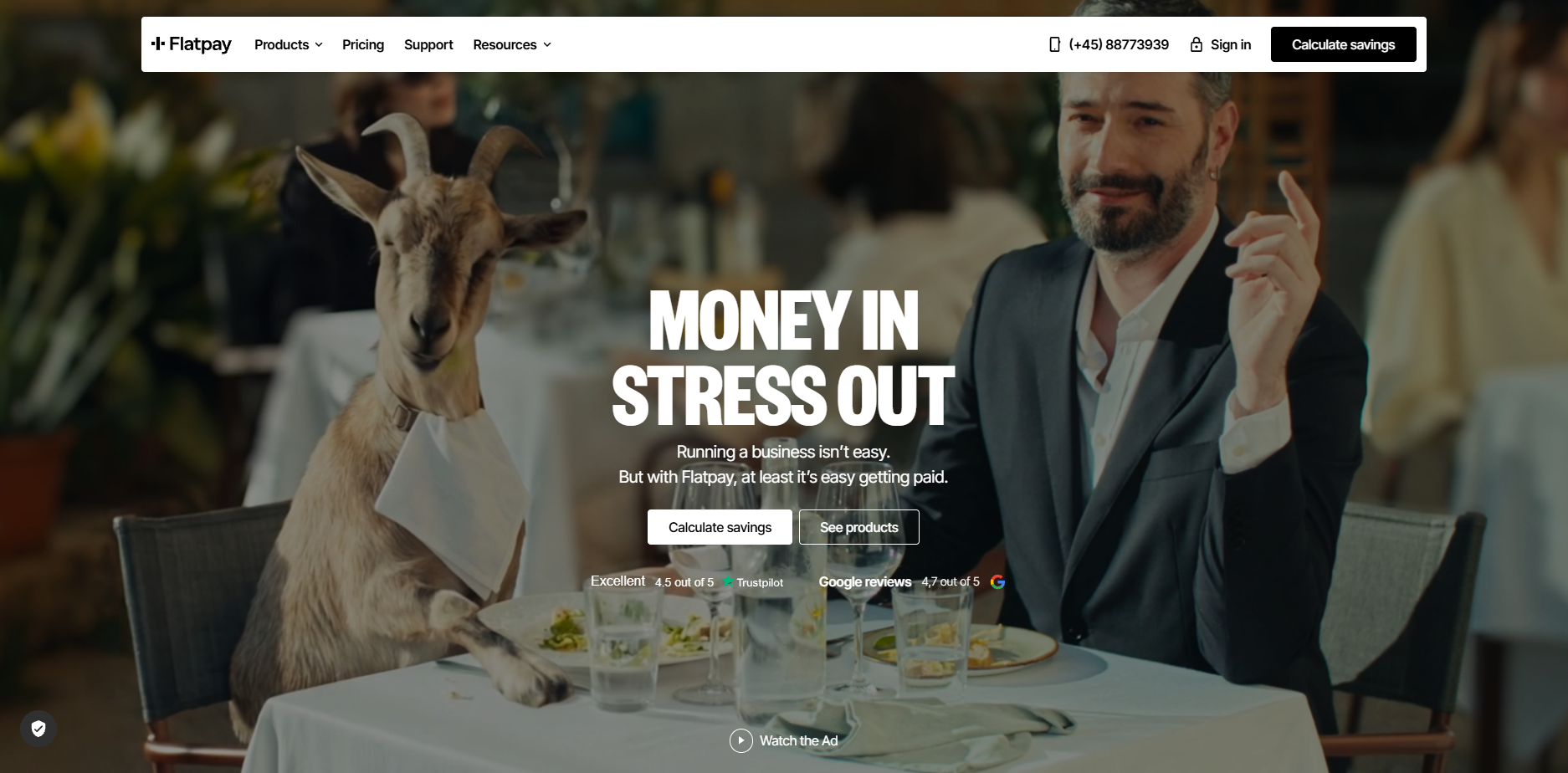
This is the result from the first prompt:
Prompt 2: The Conversion Path Coherence Audit
# Conversion Path Coherence Audit
## Context
These pages form a sequence that visitors move through.
The biggest conversion leaks often live between pages, not on them.
## Your task
Evaluate all screenshots as a connected journey:
1. Message consistency — Do promises made on one page carry through to the next, or do they shift?
2. CTA consistency — Is the call-to-action language stable across pages, or does it change confusingly?
3. Orientation — Are there pages where a visitor might feel lost or unsure what to do next?
4. Distractions — What elements pull visitors away from the conversion goal (unrelated links, social buttons, irrelevant navigation)?
## Output format
Score each transition between pages:
| Transition | Coherence (1-10) | Key issue |
|-----------|:---:|-----------|
| Page 1 to Page 2 | | |
| Page 2 to Page 3 | | |
| (continue as needed) | | |
Overall path score: X/10
What this reveals: Messaging fragmentation is the most common path-level problem, and it's also the least visible to the people who built the site. The homepage says "Get a free consultation." The service page says "Contact us for pricing." The contact page says "Send us a message." Three different implied offers. Three moments of micro-doubt. Each transition chips away at the visitor's confidence that they're in the right place. The path should feel like one continuous conversation.
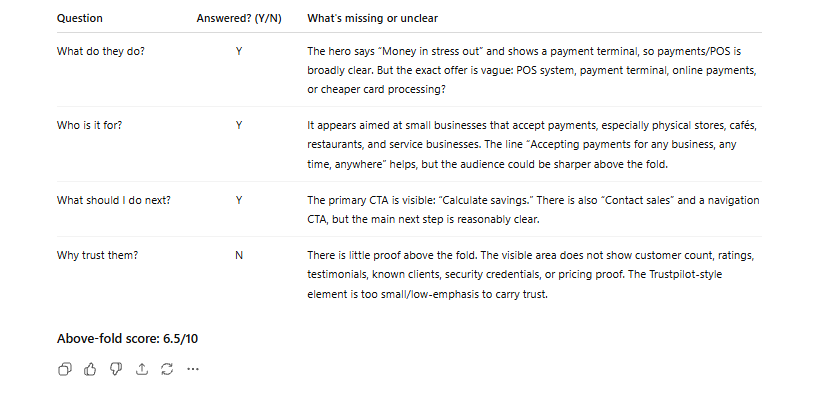
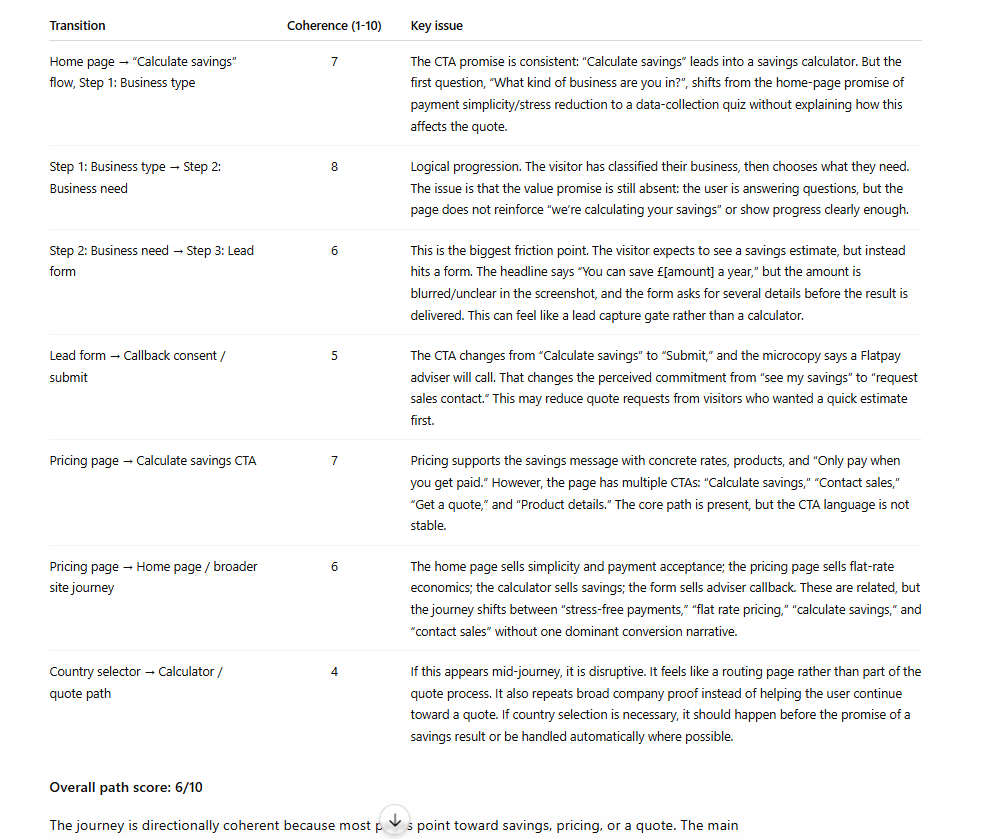
Flatpay uses a multi-step CTA journey for "calculate savings" or "get a quote", which most serves as a teaser as well as pre-qualifier for leads and Flatpay.
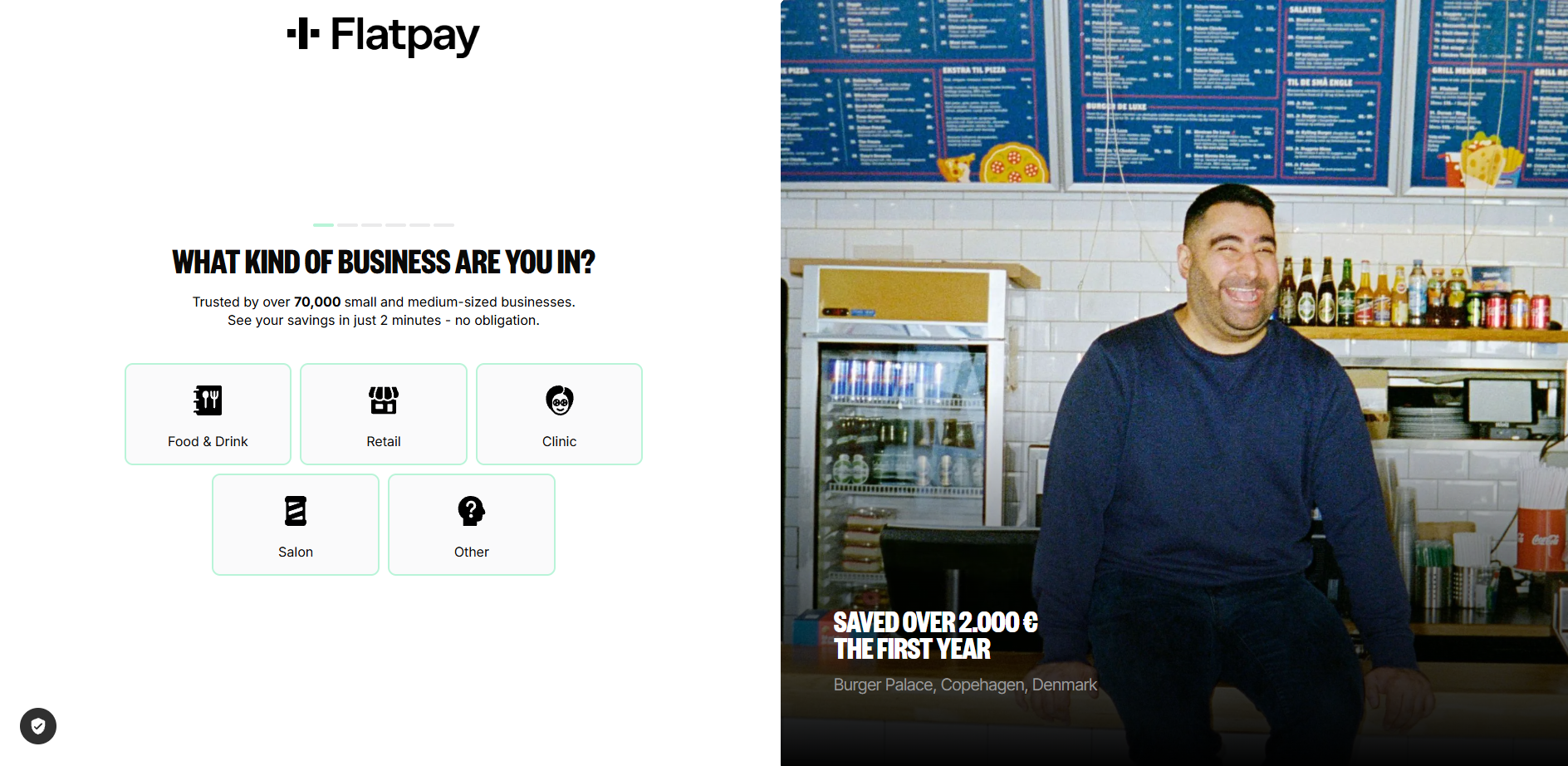
Flatpay results from prompt 2:
Prompt 3: The Trust Signal Inventory
# Trust Signal Inventory
## Your task
Across all pages, catalogue every trust signal present:
customer logos, testimonials, reviews, case studies, certifications, team photos, years in business, guarantees, privacy assurances, awards, association memberships.
Then evaluate:
1. Which pages have strong trust signals?
2. Which pages have weak or no trust signals?
3. Is there a trust gap specifically on the conversion page (contact or pricing page)?
4. What trust signals would you add, and where?
## Output format
| Page | Trust signals present | Trust signals missing | Gap severity |
|------|----------------------|----------------------|:---:|
| Homepage | | | |
| Service page | | | |
| Contact page | | | |
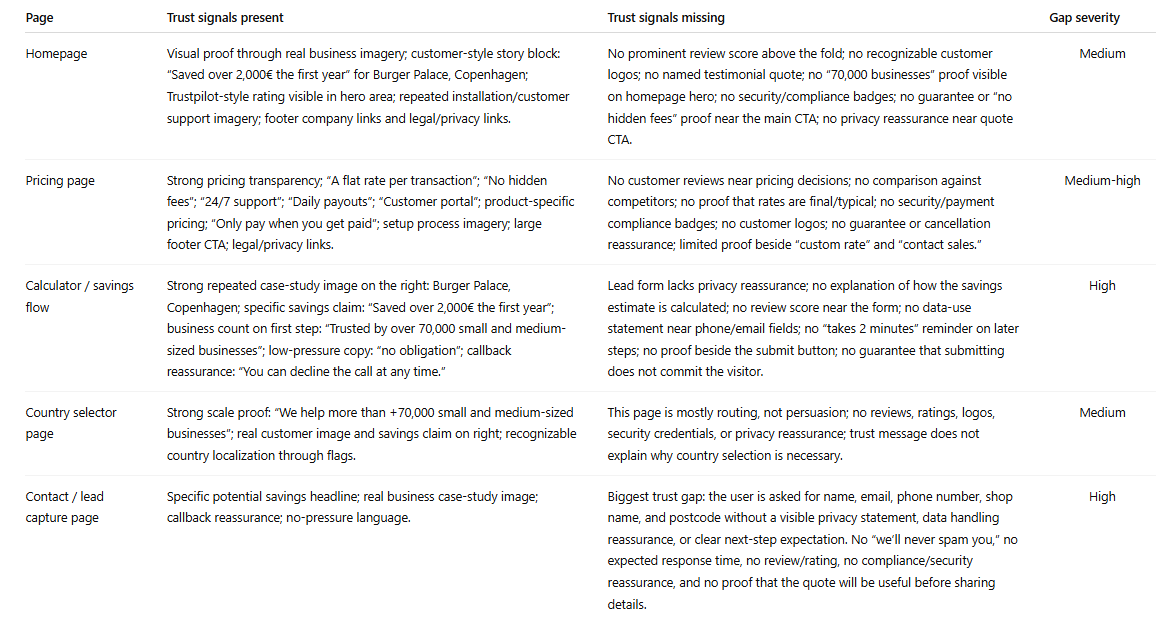
What this reveals: Trust signals cluster on homepages, where they're least needed, and disappear on contact pages, where they matter most. The moment a visitor is about to hand over their phone number is precisely when they need reassurance. They're asking: will someone actually reply to this? Have you done this for businesses like mine? Our chat data shows the most common questions visitors ask right before converting are trust questions: "How quickly will someone respond?" "Do you work with companies in my industry?" A single line on the contact page, "We typically respond within two hours," does more conversion work than most hero sections. Adding it takes five minutes.
Flatpay results from prompt 3:
Prompt 4: The Dead Form Diagnosis
# Lead Capture Form Diagnosis
## Context
This is your final conversion point. A motivated visitor is about to become a lead, or quietly close the tab.
## Your task
Evaluate the contact or lead form as a slightly hesitant potential customer who is ready to enquire:
1. Field count: How many fields? Which feel unnecessary for a first interaction?
2. Expectation setting: Does the page explain what happens after submission? Who responds? How soon?
3. Alternatives: Is there any option besides this form (phone, chat, booking link, WhatsApp)?
4. Urgency: Is there a reason to submit now, or could I come back to it later with no consequence?
5. Friction score: Rate 1 (effortless) to 10 (not worth the effort).
## Output format
| Criteria | Rating | Specific issue |
|----------|:---:|----------------|
| Field necessity | /10 | |
| Expectation clarity | /10 | |
| Alternative channels | /10 | |
| Urgency/motivation | /10 | |
| Overall friction | /10 | |
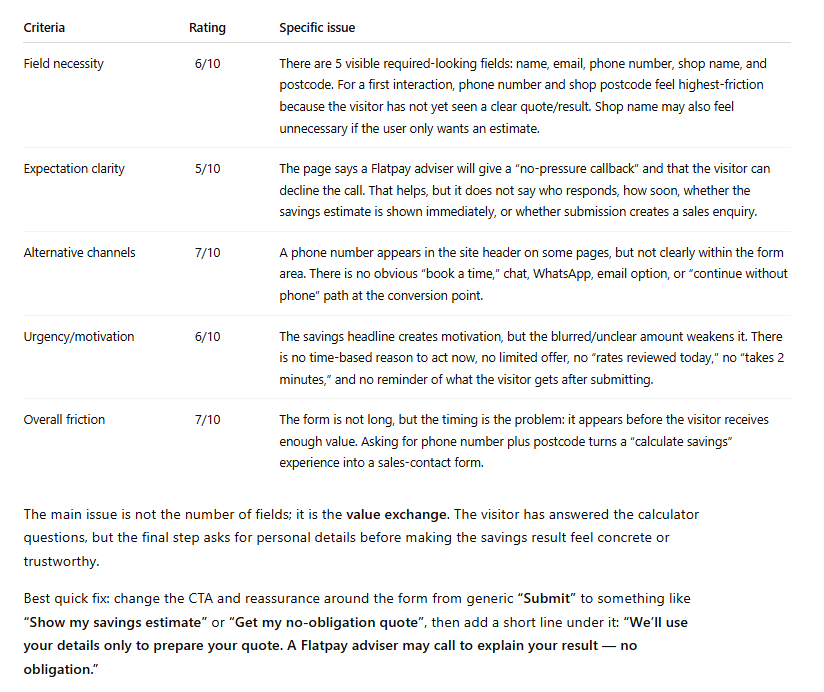
What this reveals: Forms are where conversions go to die, and the problem usually isn't the fields themselves. It's the silence around them. No indication of what happens after you submit. No alternative for the person who has a quick question but isn't ready to commit to a form submission. No urgency. Just a form floating on a page, asking for information and offering nothing in return. Our data shows that between 35 and 50 percent of chat conversations start because a visitor saw the form and decided they wanted to talk to a person instead. The form didn't convert them. A conversation did.
Flatpay Results:
Prompt 5: The AI Search Visitor Test
# AI Search Visitor Experience Audit
## Context
A growing share of visitors now arrive from AI search tools (ChatGPT, Perplexity, Google AI Overviews, Claude). These visitors have been in a conversational research flow: asking questions, refining needs, receiving personalised guidance. They land here mid-dialogue, having just been told this website looks like a good match for their needs.
## Your task
Evaluate these pages as an AI-referred visitor who was just told: "[Company] looks like a good option for your needs."
1. Conversation continuity. Can this visitor continue their dialogue, or does the experience break from conversation to static content? What engagement options exist?
2. Information redundancy. How much of this repeats what the AI tool likely already told them? What is genuinely new here?
3. Specificity gap. The visitor has a refined need. Does the site address specific use cases, or only general claims?
4. Next-step friction How many clicks stand between landing here and having a real conversation about their specific situation?
## Output format
| Criteria | Score (1-10) | Key finding |
|----------|:---:|-------------|
| Conversation continuity | | |
| Information redundancy | | |
| Specificity gap | | |
| Next-step friction | | |
Verdict: Is this website ready for the AI search era?
Single most impactful change:
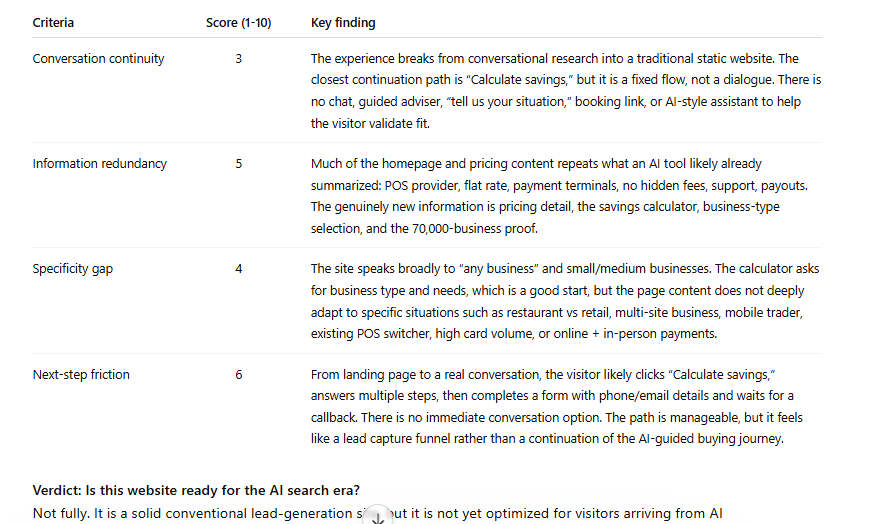
What this reveals: An AI-referred visitor has been in an active dialogue. They arrive expecting to continue it. Instead they hit a static page and a form. It's like being mid-conversation with someone, then being walked to a colleague's office where that colleague hands you a clipboard. The AI will almost always point to real-time conversational engagement as the single most impactful change.
Results from Flatpay analysis:
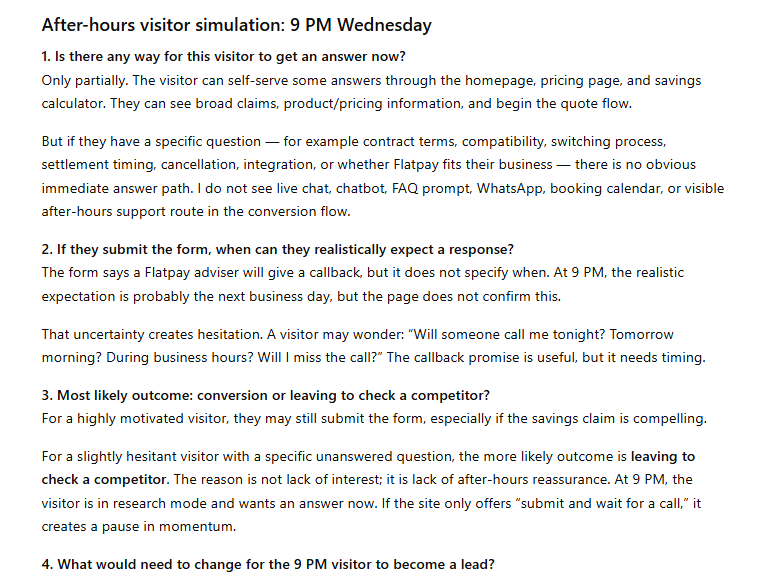
Prompt 6: The After-Hours Visitor Test
# After-Hours Visitor Simulation
## Scenario
It is 9 PM on a Wednesday. A potential customer lands on this website from a search. They're interested but have a specific question about the service.
## Your task
1. Is there any way for this visitor to get an answer now?
2. If they submit the form, when can they realistically expect a response?
3. What is the most likely outcome: conversion, or leaing to check a competitor?
4. What would need to change for the 9 PM visitor to become a lead?
What this reveals: Between 35 and 50 percent of high-intent traffic arrives outside business hours. The visitor at 9 PM with an urgent question, a pest control problem, an insurance query, a question about a dental procedure, is often your most motivated visitor. They're ready to act. Your website offers them a form that won't be read until tomorrow morning. By then, they've found a competitor who responded immediately. The after-hours visitor rarely shows up in your analytics as a lost lead. They show up as a lead that was never there.
Prompt 7: The Competitor Comparison
# Competitive Conversion Comparison
## Context
I'm now uploading screenshots from a competitor's website.
## Your task
Compare their conversion path to mine across four dimensions:
1. Engagement methods — Do they offer anything we don't? (chat, callback, WhatsApp, instant quote, booking tool)
2. Trust signals — Stronger, weaker, or different in type?
3. Path simplicity — Fewer or more steps to conversion?
4. If you were a potential customer comparing both, which makes it easier to take the next step? Why?
## Output format
| Dimension | My site | Competitor | Advantage |
|-----------|---------|------------|-----------|
| Engagement options | | | |
| Trust signals | | | |
| Path simplicity | | | |
| Overall ease | | | |
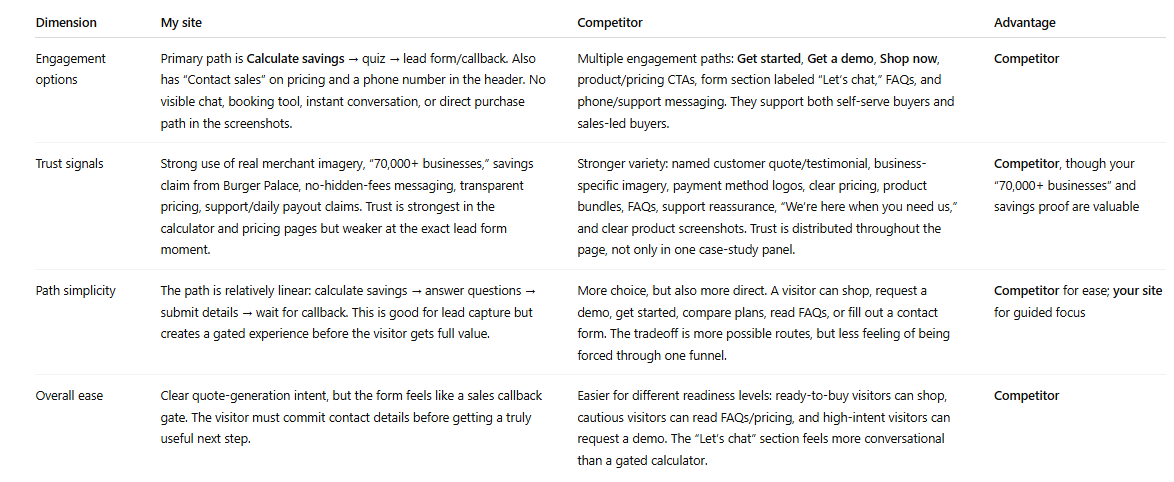
What this reveals: This is the prompt that makes abstract findings feel urgent. When the AI tells you "your competitor has live chat and a 60-second quote promise, you have a contact form," the gap stops being theory. It's a specific competitive disadvantage, described in plain language, sitting in a table. Running this against one or two competitors takes ten minutes. The output is more persuasive than any conversion audit report, because it shows exactly what a visitor experiences when they compare options, and most of the time, they are comparing options.
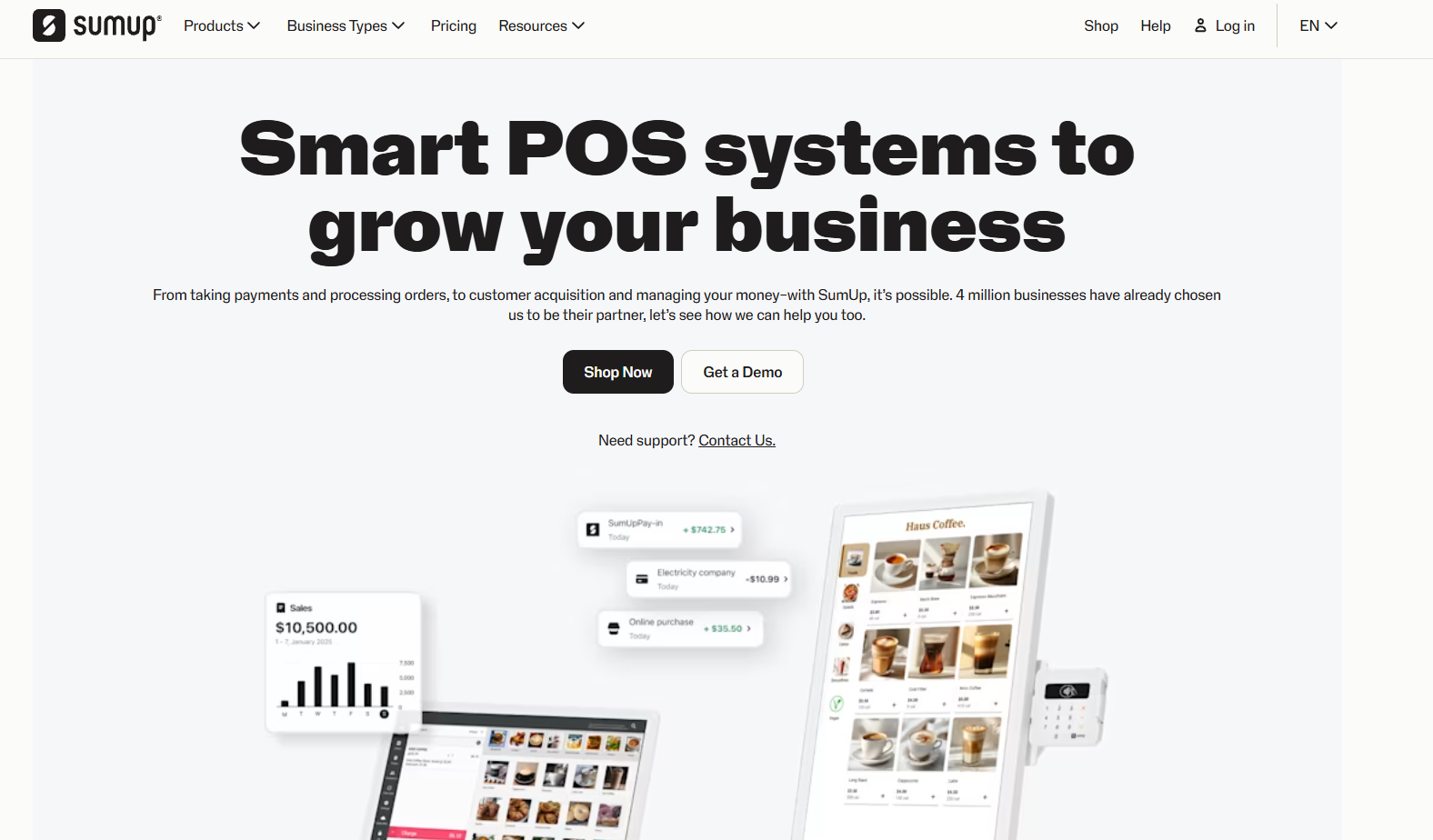
For this competitor comparison we used SumUp.
Response from ChatGPT on this prompt for comparison:
Prompt 8: The Priority Fix List
# Prioritised Conversion Fix List
## Your task
Based on everything analysed across all pages, give me the 5 most impactful changes to increase leads from this website.
For each recommendation:
1. The specific change
2. Which leak it fixes
3. Difficulty (easy / medium / hard)
4. Potential impact (low / medium / high)
## Output format
| Priority | Change | Leak fixed | Difficulty | Impact |
|:---:|-------|-----------|:---:|:---:|
| 1 | | | | |
| 2 | | | | |
| 3 | | | | |
| 4 | | | | |
| 5 | | | | |
Put highest-impact, lowest-difficulty changes first.
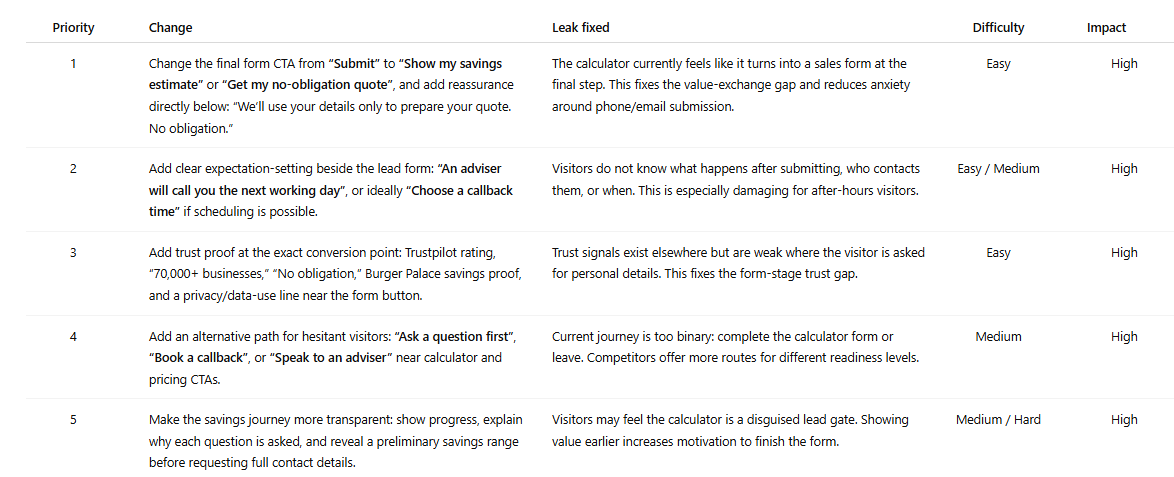
What this reveals: This is the prompt that turns the audit into a to-do list.
Flatpay priority fix list:
What to Do With Your Results
Most audits produce one of three finding patterns. Here's how to act on each.
Messaging and CTA inconsistencies. These are quick wins. Align the headline, the button text, and the implied offer across every page in the path so the visitor feels like they're moving through one coherent conversation. This costs nothing and can be done in an afternoon. It's also the change most businesses deprioritise because it doesn't feel significant enough. It is.
Trust gaps on conversion pages. Add one or two trust signals directly to your contact page this week. A response-time commitment. A relevant testimonial. A count of businesses you've helped. Visitors about to submit a form need reassurance at that precise moment. Putting it on the homepage instead is like putting the "safe to drink" sign on the bottle rather than the glass.
No real-time engagement option. This is the structural finding that shows up in almost every audit and sits at the top of almost every priority list. You have a few honest options:
Managing chat yourself during business hours works for some businesses and isn't sustainable for most. An AI chatbot handles FAQ deflection and support reasonably well. It struggles with the nuanced, pre-purchase questions that are actually standing between a visitor and a conversion. It fails at custom lead qualification questions and collecting customer lead information.
Managed live chat with human agents available around the clock, including evenings and weekends, is what Weply provides. It's the approach behind more than 250,000 qualified leads generated across our customer base in 2025. If the after-hours prompt produced an uncomfortable answer, it's worth a look.
Read our guide to the best chat solutions for business in 2026 here or dive deep on why a chat solution is needed to match visitor expectations coming from AI search.
What This Process Replaces
The standard alternative is hiring a CRO agency. Budget: EUR 3,000 to 8,000. Timeline: four to six weeks. Deliverable: a PDF. The report is usually good. The process is slow, expensive, and produces findings that are already weeks old when they reach you. The process in this guide takes 30 minutes and produces an action plan from your own pages, in your own conversation thread, reviewable immediately. Run it quarterly. Run it after every redesign. Run it whenever traffic goes up and leads don't.
Try Weply for free for 7 days. Get qualifed leads, customer support and insights into the conversations that your webiste visitors have.
10 Best Chat Solutions for Customer Support and Lead Generation in 2026
The right chat solution can turn your website traffic into paying customers and lift your customer support from reactive to proactive, or strengthen your lead generation and help grow your business. In the age of AI search having a chat solutions has become even more important. In this guide, we've reviewed the 10 best chat solutions available in 2026, including Weply, Intercom Fin, and Zendesk AI. We've looked at features, pricing, reviewsite ratings, and customer cases, so you don't have to. Here are our three top picks:

Looking for the best chat solution for your business?
Customers expect answers now. 63% of consumers prefer live chat over email or phone, and 46% of all leads are generated outside of normal business hours. With an ever-growing selection of solutions and increasing demands around GDPR compliance, data residency, and 24/7 availability, choosing the right chat solution has never been more important.
The right solution helps you:
- Convert anonymous visitors into named and qualified leads.
- Give customers immediate help, 24/7.
- Free up tiem for your team for other, more high-value interactions.
- Comply with GDPR and data handling requirements within the EU.
- Integrate with your existing CRM, helpdesk or e-com platform.
Why trust Weply?
We built Weply because we saw how businesses across Europe were losing potential customers on their websites, either because they had no chat at all, it was only availbale during operating hours, or because they put an AI support chat in front of high intent traffic and think it can convert it to qualified leads. Our platform combines trained chat consultants with AI and we generated over 250,000 qualified leads for more than 2,400 customers in 2025. We know this market inside out, from SMBs to enterprise. That gives us a unique position to evaluate which chat solutions actually deliver on the European and US markets. Finding the right solution is always about understanding your own needs first.
Here's how some of our customers rate us:
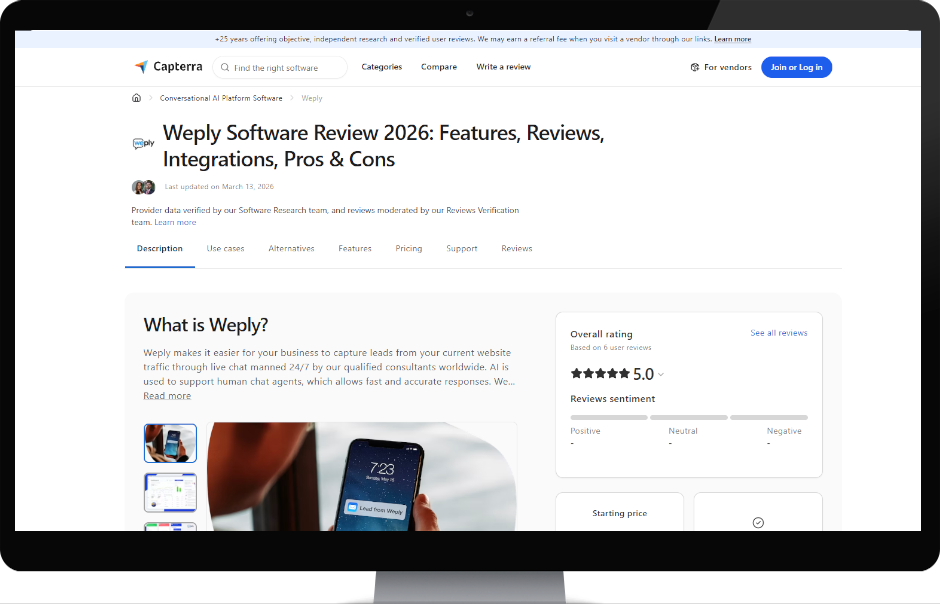
Now, let's take a look at the 10 best chat solutions for 2026.
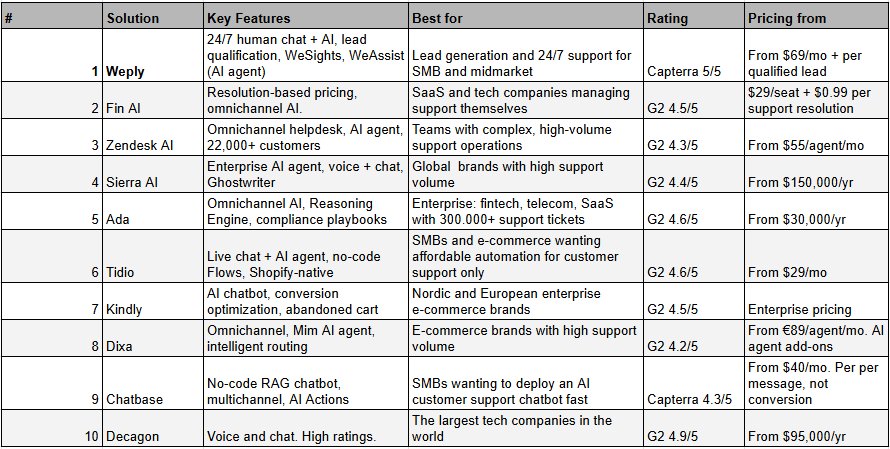
Now let's dive into each solution.
1. Weply

Weply is a Nordic 24/7 live chat solution that combines trained human chat consultants, lead conversion experts, with AI technology to generate and pre-qualify leads directly on your website. Founded in 2013 and headquartered in Copenhagen, Denmark, Weply has generated over 250,000 qualified leads for more than 2,400 customers in 2025, making it the largest Nordic operator in hybrid human-AI chat. Weply recently launched WeAssist, a support AI agent that chat consultants can activate for incoming support queries. What sets Weply apart from pure AI solutions is that your customers always interact with a real human being, backed by AI. That means meaningfully higher conversion rates and fewer missed interactions compared to fully automated chatbots. All support responses are also quality-checked by a human in real time, minimising the risk of AI hallucinations and ensuring answers are delivered with human empathy and nuance.
Key Features
- 24/7 Human Live Chat + AI (WeAssist): Trained chat consultants are available around the clock, complemented by WeAssist AI for standard support queries. You never miss a relevant customer interaction.
- Sales-qualified leads delivered to your inbox: Weply pre-qualifies visitors based on your criteria and delivers warm leads, with name, phone number, and relevant context, directly to your CRM or inbox.
- AI Co-pilot for internal chat agents: some customer run internal customer support agents using Weply outside normal opening hours or if overloaded, and those agents have access to AI WeAsssist co-pilot.
- WeSights our analytics platform: Gives you insight into chat volume, chat context, campaign data, and conversion patterns, so you can continuously optimise your digital marketing, web, and lead strategy.
- Dedicated Customer Success Manager: Every customer gets a dedicated CSM who helps with setup, optimisation, and ongoing strategy.
- GDPR-compliant and EU-hosted: Data is processed in accordance with GDPR, with servers in the EU and full compliance with the ISO and EU AI Act.
Pricing
Pricing consists of a small monthly subscription starting from $69/mo, covering up to 100 monthly support chats with the WeAssist AI agent included. Beyond that, you pay only for success, a fixed price per qualified lead Weply generates, based on your unique lead qualification criteria. Weply offers a fully free 7-day trial, where all generated leads and answered support queries are free.
Pros
- Human touch for your potential and existing customers 24/7, 365 days a year. Customers always talk to a real person, not just a bot.
- Experts in lead conversion. If you're already spending money and time driving potential customers to your website, Weply is the only specialist. Typically converts minimum 50–80% more chat visitors into qualified leads than AI chatbots.
- WeAssist is included in the subscription price, meaning you get an AI support chatbot verified in real time by humans. At a significantly lower cost than the alternatives.
- Plug-and-play setup with CRM integrations, live quickly.
- Dedicated Customer Success Manager always included.
- GDPR, AI Act, ISO. Verified with over 2,400 paying customers across the Nordics and Europe.
- You get AI where AI is strong (support, but verified by humans) and humans where they're best (qualified lead generation).
- Free 7-day trial, no credit card required, no commitment.
Cons
- WeSights, the unique chat analytics tool, is an add-on.
- Available as chat only, not yet on voice, email, or social channels.
- Not ideal for public institutions where all traffic is support-related, or for chat behind a login wall as inside a SaaS support tool.
Rating
Capterra: 5/5. Trustpilot 4.4/5. Businesses consistently highlight that Weply delivers significantly more leads and better lead quality than AI chatbots, alongside 24/7 availability, easy setup, and a very high level of customer service.
2. Intercom Fin
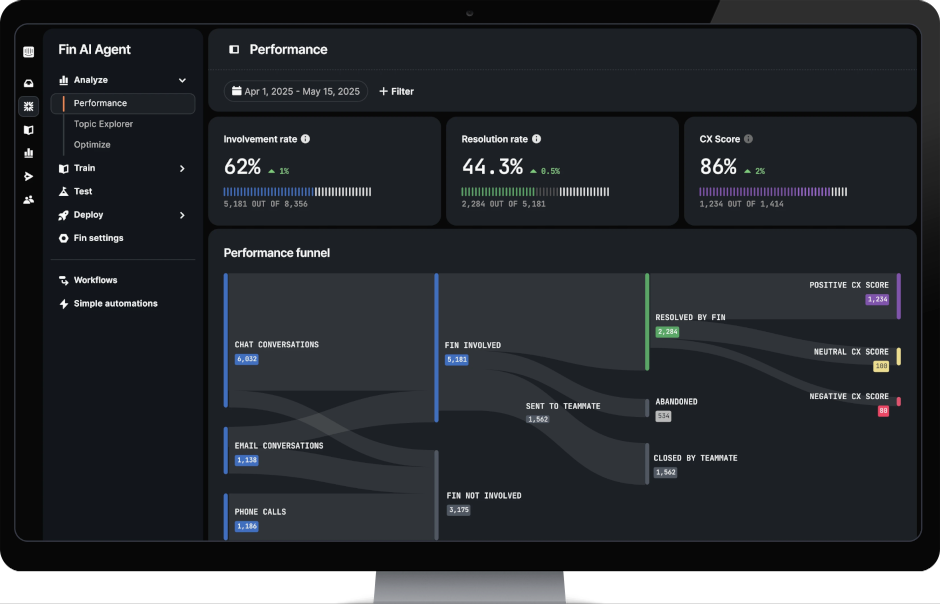
Intercom Fin is Intercom's AI agent, launched in 2023 and now one of the most widely deployed AI support platforms globally. Fin states it resolves an average of 60% of all queries automatically and supports all major channels: email, live chat, WhatsApp, Messenger, SMS, and voice.
Key Features
- Outcome-based AI agent: Fin receives queries, responds using your knowledge base, and escalates to your support team when needed.
- Omnichannel out-of-the-box: Fin works across email, live chat, WhatsApp, Messenger, SMS, and voice from a single platform.
- Fin Copilot (agent assist): AI assistant for human agents in the inbox, generates reply suggestions, summarises case history, and retrieves knowledge in real time. $35/user/mo add-on.
- AI-driven simulations and performance insights: Test Fin's performance against historical tickets before going live, and receive ongoing improvement recommendations.
- Integrations: 450+ integrations including Shopify, Salesforce, Zendesk, and HubSpot.
Pricing
- Fin AI Agent: $0.99 per resolution (min. 50 resolutions/mo = $49.50). Copilot is $35/user/mo as an add-on.
- Example: 1,000 Fin resolutions/mo = $990 on top of seat costs. For 10 agents on the Advanced plan ($85/seat), the monthly total is approximately $1,840.
Pros
- Outcome-based model is fair: you pay only for success.
- Works standalone alongside Zendesk, Intercom and Salesforce.
- Strong for SaaS and B2B support teams that manage their own helpdesk.
Cons
- Pricing scales aggressively at high volumes: 1,000 resolutions/mo = $990 in AI costs alone.
- Requires internal setup and optimisation. No dedicated CSM on lower plans.
- Not suited for active lead generation, only customer support.
- Fin Copilot is a paid add-on.
- Some G2 reviewers report that what Intercom counts as a "resolution" doesn't always match real-world outcomes.
Rating
G2: 4.5/5. Users praise the modern interface and automation rate. Most criticism: pricing scales unpredictably, and advanced features require expensive plans.
3. Zendesk AI
Zendesk is still the world's most widely used customer service platform, with 22,000+ support teams globally and a well-established enterprise presence. Zendesk's AI capabilities including AI agents (chatbots), Copilot for human agents, and intelligent triage, are layered on top of its core omnichannel helpdesk and have been significantly expanded since 2024. Zendesk is used by teams ranging from fast-growing SaaS companies to large enterprise organisations across every industry. Zendesk's core strength is organisational scale: it handles email, live chat, voice, WhatsApp, Instagram, Facebook Messenger, X, and web forms in a single agent workspace, and routes tickets intelligently across large agent pools.
Key Features
- AI agents and intelligent triage: Built-in AI agents handle common queries using your help centre content and can take basic actions.
- Omnichannel unified workspace: Email, live chat, phone, WhatsApp, social media, and web forms in a single agent view. Routing ensures tickets reach the right agent based on skills, language, and current load.
- Zendesk AI Copilot: Agent-side AI that suggests replies, surfaces relevant knowledge articles, and summarises long ticket threads in real time.
- Knowledge base and help centre: AI-powered content suggestions for help centre articles, and a self-service portal that deflects tickets before they reach your support team.
- Analytics and reporting: Pre-built dashboards and, on higher tiers, Explore for custom reports tracking response time, resolution rate, CSAT, and agent performance.
Pricing
- Suite Team: $55/agent/mo (annual). Basic multichannel ticketing, help centre, AI agents with limited resolutions.
- Suite Growth: $89/agent/mo (annual). Adds SLAs, multiple ticket forms, multilingual support, light agents.
- Suite Professional: $115/agent/mo (annual). Skills-based routing, community forums, HIPAA compliance, custom analytics.
- Suite Enterprise: From $169/agent/mo (annual, negotiated). Custom agent roles, sandbox, advanced data protection.
- Advanced AI add-on: ~$50/agent/mo extra. Required for Copilot, advanced triage, and generative AI features.
- AI Agent resolutions: $1.50 per automated resolution (committed volume) or $2.00 pay-as-you-go.
For a 20-agent team on Suite Professional with Advanced AI, total annual cost approaches $40,000 before implementation.
Pros
- The most established customer support platform globally. Deep integration ecosystem and proven enterprise track record.
- Strong at scale: skills-based routing, SLAs, and omnichannel work well for 15+ agent teams.
Cons
- Advanced AI features require a separate $50/agent/mo add-on.
- Own support quality criticised consistently on G2: slow response times and link-heavy replies.
- Some G2 reviewers describe being oversold during the buying process, real-world AI performance fell short of what was promised.
- Per-agent pricing model means costs scale directly with headcount, with no outcome-based option on core plans. Expensive option.
Rating
G2: 4.3/5 (6,800+ reviews). Satisfaction correlates strongly with team size: large, multi-channel support teams tend to find the cost justified; smaller teams often feel they're paying for features they don't use.
4. Sierra.ai
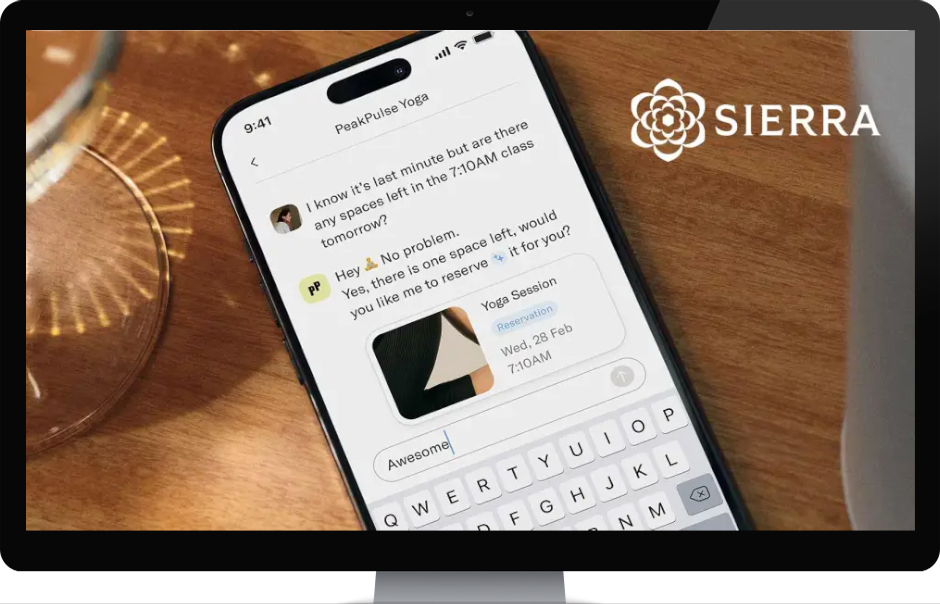
Sierra.ai is an American enterprise AI company founded in 2023 by Bret Taylor (former co-CEO of Salesforce and current chairman of OpenAI's board) and Clay Bavor. Sierra has raised $950 million to date and is one of the most discussed AI companies globally. Sierra's customers include Sonos, SiriusXM, Weight Watchers, ADT, and Casper. The platform is built for large consumer brands with high inbound support volume across chat and voice.
Key Features
- Empathetic AI agents: Sierra's agents are designed to mirror your brand's voice and tone precisely, handling complex interactions like returns, subscription changes, and account management autonomously.
- Agent Studio + Agent SDK: No-code workflow builder for CX teams (Agent Studio) and a developer-focused SDK for custom integrations.
- Ghostwriter: Automatically generates production-ready AI agents from SOPs, call transcripts, audio recordings, and whiteboard photos. Also runs an automatic improvement loop based on live interactions.
- Multi-model "Constellation" architecture: Uses multiple AI models in parallel for accuracy-checking, reducing hallucination, but can introduce latency (700ms+) in voice environments.
- Voice + chat across channels: Sierra's agents support web chat, mobile apps, and voice.
Pricing
Sierra publishes no pricing and has no pricing page. All contracts are enterprise agreements. Third-party estimates:
- Annual contracts from $150,000+.
- Implementation and onboarding fees: $50,000–$200,000.
- Outcome-based model: payment per successful resolution (rate confidential, but with minimum commitment volumes).
Pros
- One of the world's leading chat and voice agents for support.
- Ghostwriter significantly reduces time-to-deployment.
- Documented results at global consumer brands.
Cons
- Pricing makes it exclusive to the largest enterprises. SMBs and mid-market are entirely excluded.
- Long and technically complex implementation.
- Support only. No real lead generation capability.
Rating
G2: 4.4/5. Users praise the intuitive interface and empathetic AI interactions. Most common criticism: high price with unclear ROI, steep learning curve during onboarding.
5. Ada
Ada is an enterprise AI customer service platform founded in Toronto in 2016 by Mike Murchison and David Hariri. Ada has raised $200M+ and serves 350+ enterprise customers including Monday.com, Pinterest, Verizon, and YETI. The platform is built for high-volume, omnichannel AI deflection in industries including financial services, e-commerce, telecommunications, and SaaS. Ada's 2026 platform centres on its "Reasoning AI" which are agents that understand intent, follow compliance-sensitive playbooks, and execute multi-step workflows across chat, email, voice, SMS, and WhatsApp from a single platform.
Key Features
- Reasoning AI engine: Ada's agents understand customer intent and follow structured playbooks, including compliance-sensitive flows for regulated industries, rather than simple script logic. Claims to resolve 80%+ of inquiries automatically.
- Omnichannel coverage: Chat, email, voice, SMS, WhatsApp, and social messaging managed from a single platform. Handoff integrations with Zendesk, Salesforce, Freshworks, Genesys, Dixa, Gorgias, and more.
- Coaching and feedback loops: Platform managers can provide precise, surgical guidance to the AI agent through a coaching interface, and verify outcomes through test scenarios before going live.
- SOP-based playbooks: Ada can follow complex, multi-step workflows, including triggering refunds, extensions, or system updates, based on standard operating procedures. Well-suited to regulated industries.
- Enterprise security: SOC 2 Type II, HIPAA, GDPR, and PCI compliant. Zero Data Retention option with all LLM providers.
Pricing
Ada does not publish pricing. Estimates from third-party sources:
- Starting from ~$30,000/year.
- Pricing model: typically $1–$3.50 per AI resolution, based on resolved conversations.
Pros
- Strong omnichannel coverage across 10+ channels from a single platform.
- Enterprise-grade compliance: SOC 2, HIPAA, GDPR, PCI. Suitable for regulated industries.
- Coaching interface gives platform managers strong control over AI behaviour.
Cons
- Implementation timeline is measured in months.
- Only for large global enterprises.
- Pricing scales aggressively at high volume.
Rating
G2: 4.6/5. Platform administrators rate Ada highly for ease of use and coaching capability. Negative sentiment on Trustpilot: 1.8/5.
6. Tidio + Lyro
Tidio is a live chat and AI support platform primarily serving small businesses and e-commerce stores. Founded in Poland in 2013 and used by 300,000+ businesses globally, Tidio combines live chat, ticketing, a no-code chatbot builder and Lyro, its conversational AI agent, in a single platform. Tidio is particularly popular with Shopify merchants and SMBs that want to start with live chat and gradually layer in automation without switching tools.
Key Features
- Lyro AI agent: Conversational AI that answers common customer questions based on your support content. Handles handoff to human agents when needed.
- No-code Flows builder: Drag-and-drop chatbot builder for creating automated conversation paths: product recommendations, lead capture, FAQ automation, and more .
- Live chat with live typing preview: Agents can see what customers are typing before they hit send, allowing faster, more prepared responses.
- Multichannel inbox: Manages website chat, email, Instagram, Messenger, and WhatsApp in a single unified inbox.
Pricing
- Starter: From $29/mo (annual). Includes live chat, ticketing, basic automation.
- Growth: From $59/mo (annual). Includes Lyro AI conversations and advanced Flows.
- Advanced: $749/mo (annual). Higher conversation limits, custom branding, advanced analytics.
- Lyro AI add-on: Can be purchased separately from $39/mo for additional AI conversation quotas.
Pros
- Among the most affordable live chat + AI combinations on the market for SMBs.
- Conversation-based pricing is more predictable than per-seat models for smaller teams.
- Very fast to set up. Live in minutes. Strong Shopify native integration.
Cons
- Data processing: primarily EU-based, but some data is also transferred to the US.
- Not well-suited for complex enterprise workflows, SLA management, or large multi-team operations.
- Very limited lead generation capability. Can only be used for customer support.
Rating
G2: 4.6/5. Users consistently highlight ease of setup and Shopify integration. Most criticism relates to some agreesive prices increases.
7. Kindly
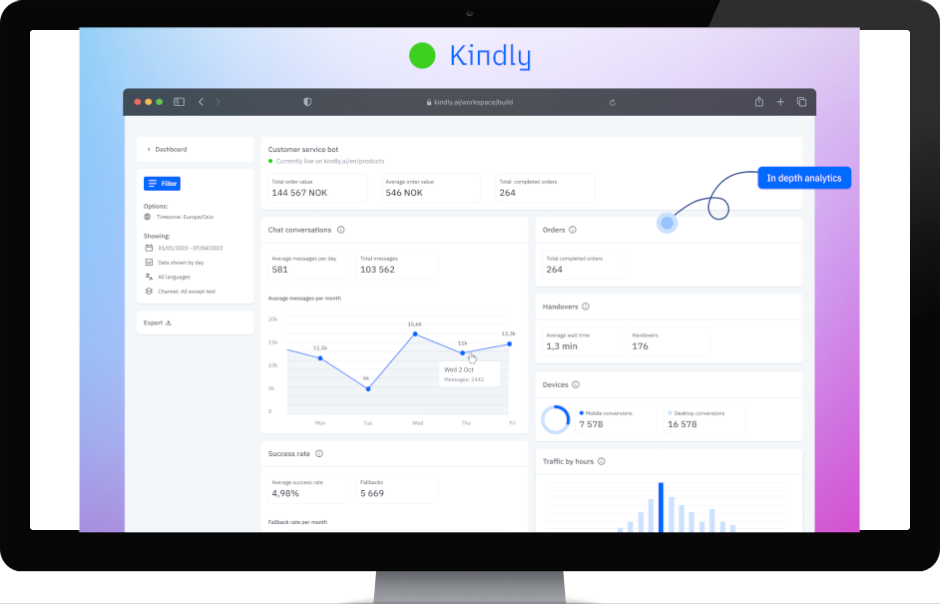
Kindly is a Nordic AI chatbot platform founded in Oslo in 2016 and one of Europe's leading conversational AI providers for enterprise e-commerce and customer service.
Key Features
- Generative AI chatbot with multilingual training: Train the chatbot in one language and it understands queries in 100+ languages automatically. Nordic language expertise is a core competency.
- Conversion optimisation and abandoned cart: Kindly's platform can increase conversion rates by up to 12% and automates abandoned cart messages.
- Visual product carousel in chatbot: Enables product search and displays products directly within the chat interface based on selections made in the chatbot.
- Simple customisation without coding: No code required to match the chatbot to your brand identity, tone, and layout.
- Support automation: Automates up to 80% of customer inquiries according to themselves.
Pricing
Kindly does not publish pricing. All agreements are reached via direct contact. Enterprise prices.
Pros
- Deep Nordic and European market presence with proven language expertise.
- Unique combination of AI chatbot, conversion optimisation, and support automation in one platform.
- Strong customer references: Elkjøp, Norwegian Air, Kahoot, Lindex, Hertz.
- E-commerce focused
Cons
- No public pricing. Expensive and only for enterprises.
- Primary focus on e-commerce. Not tailored for public sector or regulated industries.
- Only for customer support. Not suited for active lead generation.
Rating
G2: 4.9/5. Users highlight easy implementation, Nordic language expertise, and high automation rates.
8. Dixa
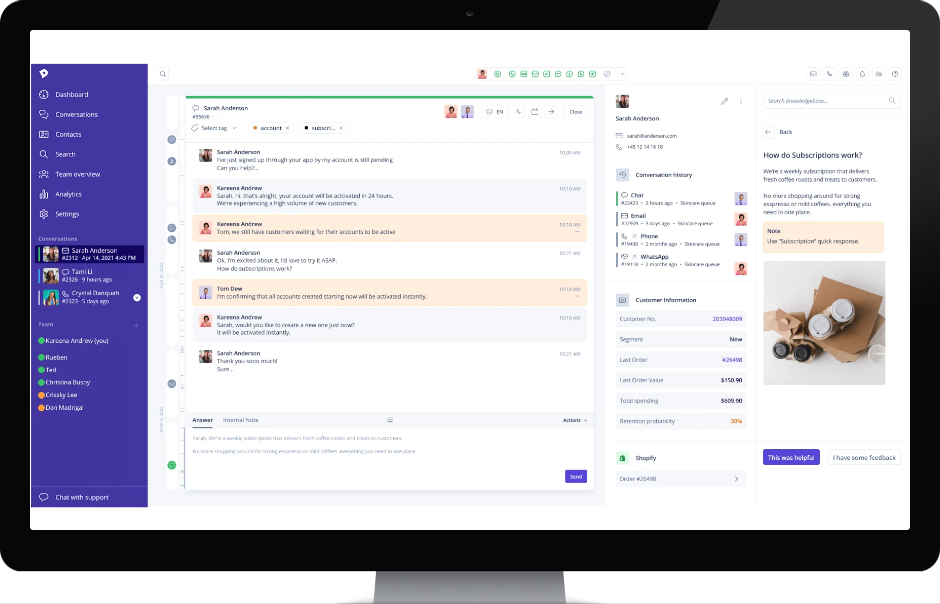
Dixa is a Danish-founded customer experience platform aimed at e-commerce brands that want to consolidate all customer communication in one system. Dixa is used by 850–1,000+ brands across 42 countries, including Rapha, Hobbii, Mejuri, and Miinto. In 2025, Dixa launched Mim, an agentic AI agent.
Key Features
- Mim AI Agent: Dixa's AI agent handles end-to-end customer interactions, including order lookup in Shopify and Magento, refunds, and self-service, with intelligent escalation to interrnal human agents.
- E-commerce focused: Built exclusively for e-commerce companies, with features and integrations tailored to these specific workflows.
- Omnichannel native: Phone, email, live chat, WhatsApp, Instagram, Facebook Messenger, and SMS in a single Team Hub.
- Intelligent routing and Flow Builder: Drag-and-drop routing engine that assigns interactions to the right agent based on skills, language, and workload.
- Shopify + Magento + WooCommerce integrations: Deep e-commerce integrations mean agents see order history directly within the conversation window.
Pricing
- Growth: From €89/agent/mo. All channels included.
- Ultimate: From €139/agent/mo. Adds various AI features.
- Prime: From €179/agent/mo. Enterprise functionality including SSO.
- Mim AI agent is an additional cost on all plans.
Pros
- All channels included as standard.
- Danish-founded with strong Nordic support and understanding of European data requirements.
- Mim AI Agent is one of the market's most mature agentic AI solutions for e-commerce.
Cons
- Built specifically for e-commerce brands. Limited or no relevance for other verticals.
- Mim AI agent access costs extra on top of the base subscription.
- AI copilot is also an add-on.
Rating
G2: 4.2/5. Users praise the user-friendly interface and customer support, but criticise long contracts and minimum seat requirements.
9. Chatbase
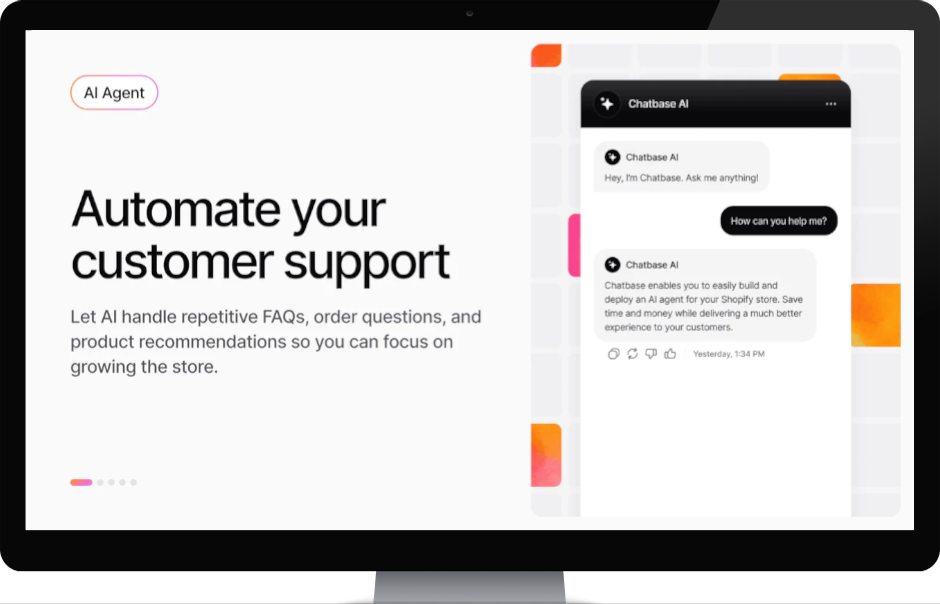
Chatbase is a no-code AI chatbot builder used by over 10,000 businesses globally. Chatbase lets you train an AI chatbot on your website, PDF documents, Notion pages, and internal knowledge sources, and deploy it on websites, Shopify, email, WhatsApp, Instagram, Facebook, and Slack. It is designed for SMBs and teams that want AI support without programming or developer resources.
Key Features
- RAG-based knowledge training: Upload PDFs, link to URLs, or Notion pages. Chatbase automatically builds a knowledge foundation and uses it to answer queries accurately with source references.
- Multichannel deployment: Deploy your chatbot on your website with a script tag, or connect to Shopify, WhatsApp, Instagram, Facebook Messenger, and Slack via native integrations.
- AI Actions: The chatbot can take real actions via API as booking meetings in Calendly, updating subscriptions in Stripe, and so on.
- Flexible AI model selection: Choose between economy LLM models (GPT-4o Mini, Claude Haiku) and premium models (Claude Sonnet) depending on quality and cost requirements.
Pricing
- Prices start from $40/mo. You pay additional credits when your usage exceeds the amount included in your plan.
- Note: Chatbase uses "messages" rather than "chat conversations" as its consumption metric. A single conversation can contain many messages, which can be difficult to control and therefore forecast costs. In theory one single chat can eat your entire budget.
Pros
- Fastest time-to-live of any solution in this guide.
- Multichannel deployment without any coding.
- Flexible model selection (GPT-4o, Claude Haiku/Sonnet/Opus).
Cons
- The free plan deletes the chatbot after 14 days of inactivity. Unreliable for production use.
- Limited workflow logic. Not suited for complex escalation flows or multi-step automation.
- Output quality depends heavily on which AI models you choose. The best models can make the solution expensive very quickly.
- Priced per message, not per conversation. Many add-ons may be required.
- Good for customer support. Not in the same league as Weply for active lead generation.
- Data is processed in the US. Not EU compliant for most EU-based companies.
Rating
Capterra 4.3/5. Users praise easy setup and quick deployment. Most common criticism: pricing climbs quickly on higher plans and workflow capabilities are limited compared to alternatives.
10. Decagon
Decagon is an American enterprise AI customer service platform founded in 2023. Decagon has raised $481M across five rounds, reaching a $4.5B valuation in January 2026, and was named to the Forbes AI 50 list. Its customer list includes 100+ enterprise customers to date. Decagon's core concept is that AI agents should work like employees, not tools.
Key Features
- Agent Operating Procedures (AOPs): Define agent workflows in natural language. A non-technical support manager can write instructions like "If a customer asks for a refund over $100, verify their purchase date and escalate to billing", and the AI follows that logic precisely, with full audit trails.
- Decagon Voice 2.0: Inbound and outbound voice with sub-second latency, customisable tone and speed, interruption handling, and branded caller IDs.
- Cross-channel memory: If a customer starts in chat and later calls, the voice agent already knows what was discussed. No information repeated, no disconnected experiences across channels.
- Continuous self-learning: Decagon agents learn from new tickets and human replies, updating their own knowledge without manual retraining.
- Enterprise security and version control: SOC 2 compliant, data residency options, strict guardrails for sensitive operations (identity verification, refunds).
Pricing
- Esitamted annual platform fee: ~$50,000/year, regardless of usage volume.
- Per-conversation fee: ~$0.99/conversation on top of the platform fee.
- Effective starting cost: ~$95,000/year total. Median enterprise spend is estimated at ~$400,000/year at scale.
- No public pricing page. All contracts are enterprise agreements with custom volume terms.
Pros
- Voice 2.0 with sub-second latency and outbound capabilities is a genuine differentiator vs Sierra and Ada.
- AOPs make complex workflow logic accessible to non-technical teams without sacrificing precision.
- Very strong customer references for SaaS and tech enterprises globally.
Cons
- Pricing makes it inaccessible for all but the largest tech enterprises.
- Deployment typically takes mulitple weeks.
- Support only. No lead generation capability.
Rating
Choosing the right chat solution for your business
The best chat solution depends on your company's size, industry, and primary purpose, whether that's lead generation, customer support, or both.
- Do you need lead generation, because some of the traffic you drive to your website is genuinely purchase-ready? Then Weply is the only solution on this list that specialises in it, offering 24/7 human-led lead qualification backed by AI.
- Are you a SaaS or tech company running your own helpdesk? Intercom Fin is a strong choice, with its outcome-based pricing and solid resolution rates.
- Is your business an international enterprise with high support volume? Sierra.ai or Decagon are the natural candidates.
- Are you an e-commerce brand wanting quick, affordable AI support? Tidio + Lyro is the best entry-level option.
- Most visitors to a live chat prefer talking to a human. If you want to satisfy both potential and existing customers on that dimension, Weply is the only solution offering a hybrid between real human experts and a controlled AI agent, for both lead generation and support.
Whatever you choose, the most important thing is to start. Try Weply free for 7 days, no credit card, no commitment, and see what it means for your conversion rate and customer support this week.
FAQ: Chat Solutions for Support and Lead Generation
What is the best chat solution for lead generation?
Weply is the only chat solution in this guide specifically built for lead generation. The platform combines trained human chat consultants with AI agents and is available 24/7, including outside business hours, where 46% of all leads arise. With 2,400+ customers and 250,000+ leads generated in 2025, it's the most documented solution for active lead generation in Europe.
How much does a chat solution cost for a business in 2026?
Pricing varies significantly depending on solution type. Solutions are typically priced as a combination of a subscription and an outcome-based fee (per qualified lead or per resolved conversation). Enterprise platforms like Sierra.ai and Ada start from $30,000–$150,000+/year. SMB solutions like Weply start from $69/mo + per lead, while Tidio starts from $29/mo and Chatbase from $40/mo.
What's the difference between an AI chatbot and a live chat solution?
An AI chatbot answers questions automatically based on pre-programmed rules or AI training from your content. A live chat solution connects visitors to real team members in real time. Hybrid solutions like Weply combine both: AI handles standard queries with human experts in the loop and as the sender of every message, while human consultants take over complex conversations and real lead qualification and lead capture. The human layer ensures empathy, nuance, and accuracy in every response, as well as outperform AI on lead generation by 2x.
Which chat solution is best for e-commerce brands?
For e-commerce, Dixa and Kindly are strong choices depending on scale and geography. Dixa is built exclusively for e-commerce with all channels included as standard and a mature AI agent (Mim). Kindly offers deep European language expertise and strong conversion optimisation tools, with proven results at Elkjøp across the Nordics. For e-commerce companies selling high-value products, where lead qualification matters as much as support, Weply is commonly used as a complement.
Are AI chatbots GDPR-compliant?
Most professional chat solutions are GDPR-compliant, but data residency varies. Weply, Dixa, and Kindly store data on EU servers and are built with European data requirements in mind. Intercom, Zendesk, Chatbase, and Tidio are also GDPR-compliant, but may process data in the US under standard contractual clauses unless EU hosting is specifically selected on enterprise plans. Ada and Sierra offer EU hosting on enterprise agreements.
Can a chat solution replace my customer service team?
No, and it shouldn't. The best chat solutions free your team from repetitive, low-value queries so they can focus on complex cases and relationship-building. The hybrid model , AI for volume, humans for value, consistently produces the highest customer satisfaction scores. Weply's approach takes this further: humans remain in the loop on every AI-assisted support response, ensuring quality and empathy at every touchpoint.
8 Bästa Chattlösningar för Kundsupport och Leadgenerering i Sverige 2026
Sammanfattning
Rätt chattlösning kan förvandla din webbplatstrafik till betalande kunder och lyfta din kundsupport från reaktiv till proaktiv, eller stärka din leadgenerering och bidra till att växa ditt företag. I den här guiden har vi gått igenom de 9 bästa chattlösningarna på den svenska marknaden 2026, inklusive Weply, Kundo och Kindly. Vi har tittat på funktioner, priser, G2-betyg och kundcase, så att du slipper göra det. Här är våra tre toppval:

Letar du efter den bästa chattlösningen för den svenska marknaden?
Svenska konsumenter förväntar sig svar nu. 63 % föredrar livechatt framför e-post eller telefon, och 46 % av alla leads genereras utanför normal kontorstid. Med ett allt större utbud av lösningar och ökande krav på GDPR-efterlevnad, svenska språkkunskaper och lokal förankring är valet av rätt chattlösning viktigare än någonsin.
Rätt lösning hjälper dig att:
- Konvertera anonyma besökare till namngivna, kvalificerade leads.
- Ge kunderna omedelbar hjälp — även kl. 23 på kvällen.
- Frigöra dina medarbetare för komplexa supportärenden.
- Uppfylla GDPR med datahantering inom EU.
- Integrera med befintligt CRM, e-handelsplattform och helpdesk.
Varför lita på Weply?
Vi byggde Weply för att vi såg hur svenska och nordiska företag förlorade potentiella kunder på sina webbplatser, antingen för att de saknade chatt helt och hållet, eller under de timmar då ingen var tillgänglig. Vår plattform kombinerar utbildade chattonsulenter med AI och genererade under 2025 över 250.000 kvalificerade leads till mer än 2400 nordiska och internationella kunder. Vi känner den här marknaden utan och innan, från SME:er till enterprise-bolag. Det ger oss ett unikt utgångspunkt för att bedöma vilka chattlösningar som faktiskt levererar kvalitet på den svenska marknaden. Att hitta rätt lösning handlar alltid om att förstå era egna behov och önskemål.
Så här betygsätter några av våra kunder oss:
Leder oss nu ta en titt på de 8 bästa chattlösningarna för den svenska marknaden.

Nu dyker vi ner i varje lösning.
1. Weply
Weply är en nordisk 24/7 livechatt-lösning som kombinerar utbildade mänskliga chattkonsulenter, leadkonverteringsexperter, med unik AI-teknologi för att generera och förkvalificera leads direkt på din webbplats. Företaget grundades 2013 och har sitt säte i Köpenhamn. Med mer än 2400 kunder och 250.000+ genererade leads under 2025 är Weply den största nordiska aktören inom hybrid human-AI-chatt. Nyligen lanserade Weply WeAssist, en support-AI-agent som chattkonsulenter kan aktivera vid supportärenden.
Det som skiljer Weply från rena AI-lösningar är att dina kunder alltid möts av en riktig människa, backed up av AI. Det innebär väsentligt högre konverteringsgrader och färre missade ärenden jämfört med helautomatiserade chatbotar. Dessutom kvalitetsgranskas alla supportsvar av en människa i realtid, vilket minimerar risken för hallucineringar och säkerställer att svaren levereras med mänsklig empati och nyans.
Nyckelfunktioner
- 24/7 mänsklig livechatt + AI (WeAssist): Utbildade chattkonsulenter är tillgängliga dygnet runt, kompletterade av WeAssist AI för att hantera standardärenden. Du missar aldrig ett relevant kundärende.
- Säljkvalificerade leads direkt i inkorgen: Weply förkvalificerar besökare utifrån dina kriterier och skickar varma leads, med namn, telefonnummer och relevant kontext, direkt till ditt CRM eller din inkorg.
- WeSights — analysplattform: Ger dig inblick i chattvolym, chattkontext, kampanjdata och konverteringsmönster, så att du kan optimera din digitala marknadsförings-, webb- och leadstrategi löpande.
- Dedikerad Customer Success Manager: Alla kunder får en fast CSM som hjälper till med uppsättning, optimering och löpande rådgivning.
- GDPR-kompatibel, ISO-certifierad och nordisk förankring: Data hanteras i enlighet med GDPR, och företaget är registrerat i Danmark med verksamhet i hela Norden.
Priser
Priset består av ett litet månadsabonnemang som börjar från 599 SEK och täcker upp till 100 månatliga supportchattar, där AI-agenten WeAssist ingår. Utöver det betalar du bara per framgång, en fastpris per kvalificerat lead som Weply genererar, baserat på varje företags unika leadkvalifikationskrav. Weply erbjuder en helt gratis provperiod på 7 dagar, där alla leads som genereras och supportärenden som besvaras är kostnadsfria för dig.
Fördelar
- Mänsklig touch till dina potentiella och befintliga kunder 24/7, 365 dagar om året. Kunder pratar alltid med en riktig person, inte en AI-bot.
- Experter på leadkonvertering. Om ni redan lägger pengar och tid på att driva potentiella kunder till er webbplats och vill växa, är Weply den enda specialisten. Normalt konverterar Weply upp till 50–80 % fler chattbesökare till kvalificerade leads än AI-chatbotar.
- WeAssist ingår i abonnemangspriset, vilket innebär att du får en AI-support-chatbot styrd och verifierad i realtid av människor, till ett mycket lägre pris än alternativen.
- Plug-and-play-uppsättning, integrationer till CRM, live på kort tid.
- Dedikerad Customer Success Manager alltid inkluderad, hjälper företag att nå bästa resultat.
- Nordisk förankring, GDPR, AI Act, ISO. Verifierat med över 2400 betalande kunder.
- Du får AI där AI är stark (supporten, men verifierad av människor) och människor där vi är bäst (leadgenerering).
- Prisvärt. Abonnemang från 599 kr och du betalar sedan bara per kvalificerat lead.
- Gratis provperiod i 7 dagar helt utan bindning.
Nackdelar
- WeSights, det unika chatt-analysverktyget, är ett tillval.
- Tillgänglig enbart som chatt. Inte voice, e-post eller sociala kanaler.
- Inte idealisk för offentliga institutioner där all trafik är supportrelaterad, eller om du vill ha chatt bakom inloggning som support i ett SaaS-verktyg.
Betyg
Capterra: 5/5. Trustpilot SE 4.2/5: Företag lyfter konsekvent fram att Weply levererar markant fler leads och med bättre leadkvalitet än AI-chatbotar. De nämner även 24/7-tillgängligheten, enkel uppsättning och väldigt hög servicenivå.
2. Kundo
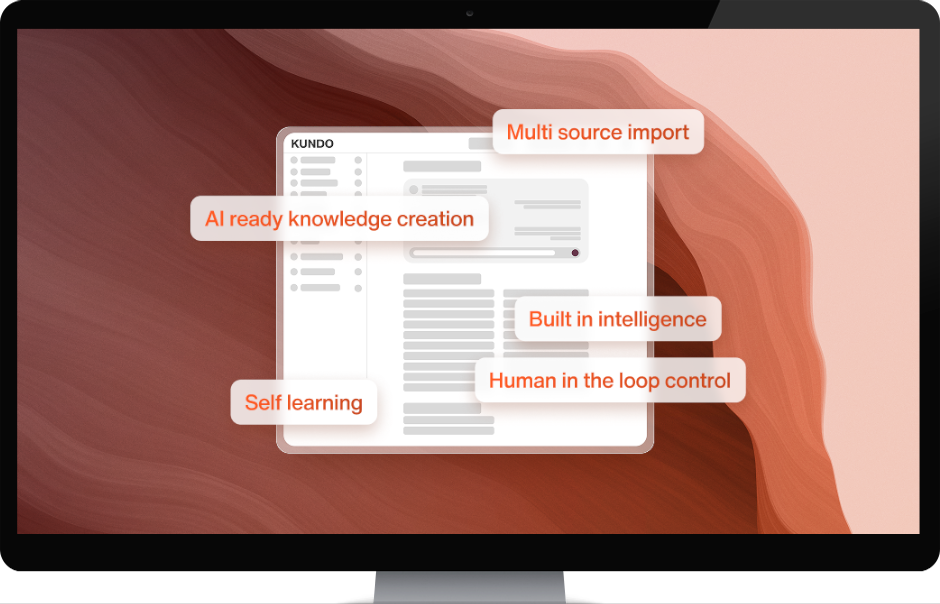
Kundo är en ledande svenska kundserviceplattformen, grundad i Sverige och idag använd av 500+ organisationer inklusive Plantagen, Tradera, Toyota Financial Services, och Sveriges Radio. Kundo positionerar sig som en "AI-first Service Experience Platform" och kombinerar självlärande AI-agenter med automatiserad kunskapshantering och ärendehantering i alla kanaler.
Nyckelfunktioner
- AI Ticketing: Genererar svarsutkast, sammanfattar ärendehistorik och översätter språk med AI. Agenter blir blixtsnabba och konsekventa oavsett vem som hanterar ärendet.
- Knowledge Agent: Samlar in, förfinar och uppdaterar all er kunskap utan manuellt underhåll. Levererar tillförlitliga svar i alla kanaler och tränar bättre AI-modeller automatiskt.
- AI Chat: Kundos AI Chat lär sig kontinuerligt och levererar tillförlitliga svar utan manuellt underhåll. Integreras med er kunskap, ton och varumärke för en serviceupplevelse dygnet runt.
- Mail, CSAT och Forum: Samlar alla kanaler, e-post, chatt, formulär och forum, i en och samma plattform, med full ärendeöversikt och strukturerad hantering.
Priser
Kundo publicerar inga priser.
Fördelar
- 500+ kunder på den svenska marknaden, enterprises.
- Självlärande AI eliminerar behovet av manuellt kunskapsunderhåll.
- Nordisk förståelse och GDPR-kompatibel datahantering.
Nackdelar
- Inga publika priser. Kräver direktkontakt för offert.
- Primärt för kundsupport och självservice, inte för aktiv leadgenerering.
- Inte idealisk för företag som söker en enkel plug-and-play-lösning utan onboarding.
Betyg
3. ImBox
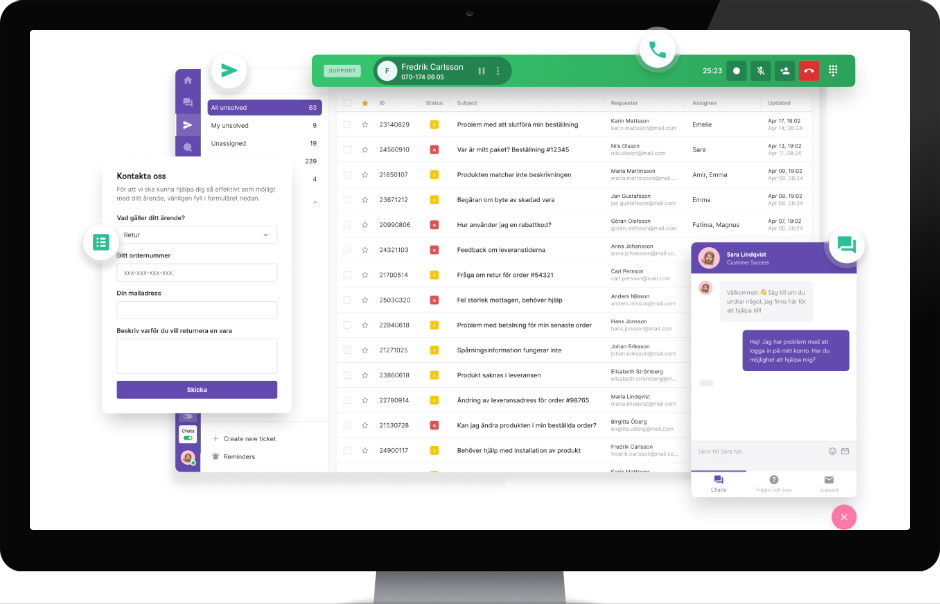
ImBox är en svensk plattform för kundkommunikation grundad 2013 i Göteborg). ImBox är byggt helt in-house i Sverige och positionerar sig som ett allt-i-ett-verktyg för direkt kundkommunikation: livechatt, AI-chatbot, ärendehantering, FAQ, formulär, hjälpcenter och telefoni. I en och samma plattform med ett enda inlogg.
ImBox riktar sig till svenska företag och organisationer som vill konsolidera sin kundkommunikation.
Nyckelfunktioner
- Livechatt med besökarövervakning: Chatten följer besökaren genom hela webbplatsen och gör det enkelt att fånga upp frågor var de än befinner sig.
- Generativ AI-chatbot: ImBox AI-chatbot drivs av generativ AI och automatiserar kundservice.
- Ärendehantering (ticketing) och e-post: Strukturerar och samlar alla inkommande ärenden och e-postmeddelanden i en plattform med full översikt, prioritering och spårning.
- Telefoni (Softphone) och omnichannel: Möjliggör att hantera alla kunddialoger, chatt, e-post, formulär och telefon, kopplat till samma verktyg. Ingen separat hårdvara behövs.
- ImBox Analytics: Statistikverktyg specifikt designat för att analysera varje konversation, person och ärende.
Priser
ImBox publicerar inga priser på sin webbplats. Kontakta ImBox för en personlig demo och offert anpassad till era behov.
Fördelar
- Helsvenskt bolag, lokal förståelse, GDPR och EU-datahantering.
- Allt-i-ett-plattform: chatt, AI-chatbot, telefoni, ärendehantering och FAQ i ett verktyg med ett inlogg.
- Snabb implementation, chatbot live på minuter med koppling till webbplats, produktkatalog eller FAQ.
Nackdelar
- Inga publika priser. Kräver direktkontakt för offert.
- Begränsad internationell synlighet utanför den nordiska marknaden.
- Inte specialiserad på aktiv leadgenerering.
Betyg
Inga recensioner.
4. Boost.ai
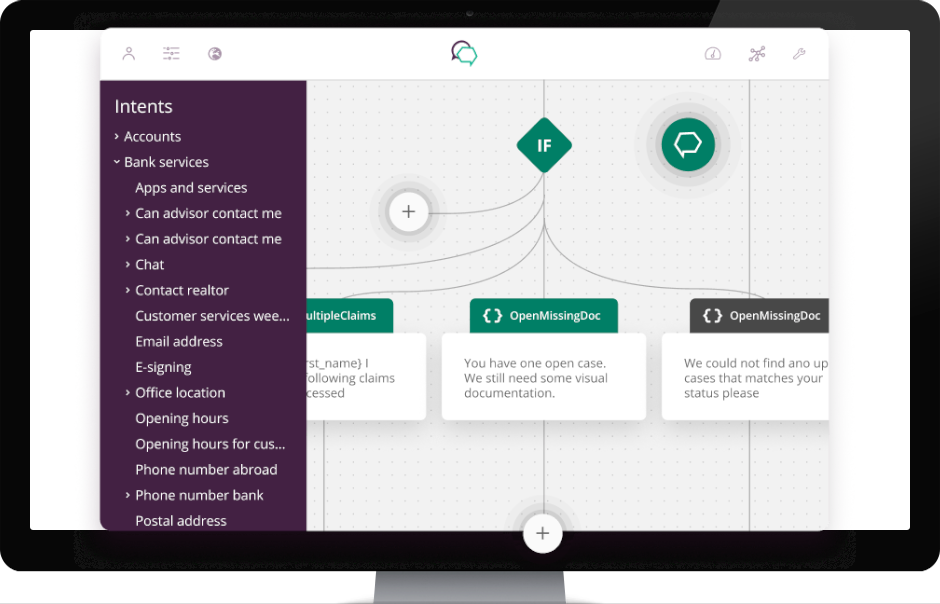
Boost.ai är en norsk enterprise-AI-plattformoch är Gartner Magic Quadrant Leader 2025 for Conversational AI Platforms. Med 650+ driftsättningar, 600 live virtuella agenter och över 150 miljoner automatiserade konversationer globalt är Boost.ai en av de mest beprövade AI-plattformarna för reglerade branscher i Skandinavien. I Sverige och Norden används Boost.ai primärt av finanssektorn och energibolag: Nordea, DNB, SpareBank 1 och Telenor är nordiska referenskunder.
Nyckelfunktioner
- No-code conversation builder: Icke-tekniska team kan bygga och underhålla komplexa konversationsmodeller med dra-och-släpp, ingen kodning krävs. Intentionshierarkin stödjer tusentals intentionsvarianter.
- Hybrid NLU + LLM-arkitektur: Boost.ai kombinerar traditionell NLU-noggrannhet med generativ AI:s flexibilitet. Företag kan styra exakt när LLM-genererade svar används, avgörande för compliance i reglerade branscher.
- Självlärande AI med full kontroll: Plattformen föreslår automatiskt nya intentioner och träningsdata baserat på faktiska konversationer, men kräver mänskligt godkännande innan implementering. Ingen black box.
- Omnichannel och Agent Assist: Stöder chatt, voice och sociala kanaler. Agent Assist ger mänskliga medarbetare realtidsförslag och kontextöversikt under livekommunikation.
- Enterprise-säkerhet och compliance: GDPR- och SOC2-kompatibel.
Priser
Boost.ai är enterprise-only och publicerar inga priser. SelectHub och SoftwareFinder uppskattar startpriset till $50 000/år, men faktiska avtal beror på komplexitet och volym.
Fördelar
- Gartner Magic Quadrant Leader 2025. Starkaste validerade enterprise-AI-plattformen i Skandinavien.
- Utmärkt i reglerade branscher för enterprise (bank, försäkring, energi, offentlig sektor).
- Hybrid NLU+LLM ger företag kontroll och flexibilitet i ett.
Nackdelar
- Priset utesluter SME och midmarket. Boost.ai är inte realistiskt under $50 000/år.
- Kräver dedikerade implementeringsresurser och teknisk onboarding, ofta med ytterligare konsultkostnader.
- Rapportering och analytics har begränsade anpassningsmöjligheter enligt G2-recensenter.
Betyg
G2: 4.7/5. Användare berömmer det intuitiva gränssnittet, flödesbyggarens kraft och den responsiva supporten. Mest kritik gäller begränsade rapporteringsmöjligheter och komplexitet vid avancerade uppsättningar.
5. Dixa
Dixa är en danskgrundad customer experience-plattform inriktad på e-handelsvarumärken som vill samla all kundkommunikation i ett system. Dixa används av 850–1 000+ varumärken i 42 länder, inklusive Rapha, Hobbii, Mejuri och Miinto. 2025 lanserades Mim, en agentisk AI-agent.
Dixa är fundamentalt annorlunda än de flesta konkurrenter: de fokuserar på en vertikal, och alla kanaler, telefon, e-post, livechatt, WhatsApp, Instagram, Facebook Messenger och SMS, ingår i alla planer som standard, utan extra tillägg.
Nyckelfunktioner
- Mim AI Agent: Dixas AI-agent hanterar end-to-end-kundinteraktioner, inklusive ordersökning i Shopify och Magento, återbetalningar och självservice.
- E-handelsfokuserat: Lösningen är byggd exklusivt för e-handelsföretag och funktionerna stödjer dessa specifika behov.
- Omnichannel native: Telefon, e-post, livechatt, WhatsApp, Instagram, Facebook Messenger och SMS i ett Team Hub.
- Intelligent routing och Flow Builder: Dra-och-släpp-routingmotor som fördelar ärenden till rätt agent baserat på kompetens, språk och belastning. Minskar väntetid och felrouting markant.
- Shopify + Magento + WooCommerce-integrationer: Djupa e-handelsintegrationer innebär att agenter ser orderhistorik direkt i konversationsfönstret.
Priser
- Growth från €89/agent/mån: Inkluderar alla kanaler.
- Ultimate från €139/agent/mån: Lägger till diverse AI-funktioner.
- Prime från €179/agent/mån: Enterprise-funktionalitet inklusive SSO.
- Mim AI-agent är ett tillval utöver ovanstående.
Fördelar
- Alla kanaler inkluderade som standard.
- Danskgrundad med stark lokal support och nordisk förståelse.
- Mim AI Agent är en av marknadens mest mogna agentiska AI-lösningar för e-handel.
Nackdelar
- Byggd specifikt för e-handelsvarumärken.
- Tillgång till Mim AI-agent kostar extra.
- AI-copilot är ett tillval.
Betyg
G2: 4.2/5. Användare berömmer det användarvänliga gränssnittet och kundsupporten, men kritiserar långa avtal och minimikrav på antal agenter.
6. Intercom Fin
Intercom Fin är Intercoms AI-agent. Lanserad 2023 och nu en av de mest utbredda AI-supportplattformarna globalt. Stödjer alla större kanaler: e-post, livechatt, WhatsApp, Messenger, SMS och voice.
Nyckelfunktioner
- Outcome-baserad AI-agent: Fin tar emot ärenden, svarar med tillgång till en kunskapsbas och kan eskalera till dina egna supportmedarbetare när det behövs. Du betalar vid framgångsrik resolution.
- Omnichannel out-of-the-box: Fin fungerar över e-post, livechatt, WhatsApp, Messenger, SMS och voice från en plattform. Kan också användas standalone med Zendesk, Salesforce och HubSpot.
- Fin Copilot (agent-assist): AI-assistent för mänskliga agenter i inkorgen som genererar svarsförslag, sammanfattar bakgrund och hämtar kunskap i realtid.
- Integrationsmöjligheter: 450+ integrationer inklusive Shopify, Salesforce, Zendesk och HubSpot.
Priser
- Fin AI Agent: $0,99 per resolution (min. 50 resolutions/mån = $49,50). Copilot är $35/användare/månad som tillägg.
- Exempel: 1 000 Fin-resolutions/mån = $990 utöver platskostnaderna.
Fördelar
- Outcome-baserad modell är rättvis: du betalar bara vid framgång.
- Fungerar standalone med Intercom, Zendesk och Salesforce. Behöver inte byta helpdesk.
Nackdelar
- Priset skalerar aggressivt vid många supportkonversationer: 1 000 resolutions/mån = $990 bara i AI-kostnader.
- Kräver intern uppsättning och optimering. Ingen dedikerad CSM på lägre planer.
- Inte bra för kvalificerad leadgenerering, enbart support.
Betyg
G2: 4.5/5. Användare berömmer det moderna gränssnittet och automatiseringsgraden. Mest kritik: priset skalerar oförutsägbart och avancerade funktioner kräver dyra planer.
7. Chatbase
Chatbase är en no-code AI-chatbot-byggare använd av över 10 000 företag globalt. Chatbase gör det möjligt att träna en AI-chatbot på din webbplats, PDF-dokument, Notion-sidor och interna kunskapskällor.
Nyckelfunktioner
- RAG-baserad kunskapsträning: Ladda upp PDF:er, länka till webbadresser eller Notion-sidor. Chatbase bygger automatiskt ett kunskapsunderlag och använder det för att besvara kundärenden korrekt med källhänvisningar.
- Multikanal-driftsättning: Driftsätt din chatbot på webbplatsen med ett script-tag, eller anslut den till Shopify, WhatsApp, Instagram, Facebook Messenger och Slack via native integrationer.
- AI Actions: Chatboten kan utföra verkliga åtgärder via API: boka möten i Calendly, uppdatera abonnemang i Stripe, skapa ärenden i Zendesk eller hämta orderdata från Salesforce.
- Valbar AI-modell: Välj mellan economy-LLM-modeller (GPT-4o Mini, Claude Haiku) och premiummodeller (Claude Sonnet).
Priser
- Priser börjar från $40/mån. Du betalar ytterligare credits när ditt förbruk överstiger det som ingår i ditt paket.
- Observera att Chatbase använder "messages", inte "chattkonversationer", som förbrukningsparameter. En chattkonversation kan naturligtvis innehålla många meddelanden, vilket kan vara svårt att kontrollera.
Fördelar
- Snabbast time-to-live av alla lösningar i den här guiden.
- Multikanal-driftsättning utan kodning.
- Flexibelt modellval (GPT-4o, Claude Haiku/Sonnet/Opus).
Nackdelar
- Gratisplanen tar bort chatboten efter 14 dagars inaktivitet. Opålitligt för produktionsbruk.
- Begränsad workflow-logik, inte lämplig för komplexa eskaleringsflöden.
- Outputkvaliteten beror på vilka modeller du väljer. De bästa modellerna kan snabbt göra lösningen dyr.
- Prissatt per meddelande, inte per chattkonversation. Många tillägg kan behövas.
- Bra för kundsupport. Inte i nivå med Weply för leadgenerering.
- Data i USA.
Betyg
Capterra 4.3/5. Användare berömmer enkel uppsättning och snabb driftsättning. Vanligaste kritiken: priset stiger snabbt på högre planer och workflow-möjligheterna är begränsade jämfört med konkurrenterna.
8. Sierra.ai
Sierra.ai är ett amerikanskt enterprise-AI-bolag grundat 2023 av Bret Taylor (tidigare co-CEO på Salesforce och nuvarande styrelseordförande för OpenAI) och Clay Bavor. Sierra har nyligen rest $950 miljoner och är ett av de mest omtalade AI-bolagen globalt.
Sierras kunder inkluderar Sonos, SiriusXM, Weight Watchers, ADT och Casper. Plattformen är byggd för stora konsumentvarumärken med hög inkommande supportvolym över chatt och voice.
Nyckelfunktioner
- Empatiska AI-agenter: Sierras AI-agenter är designade för att spegla ditt varumärkes röst och ton exakt, och hantera komplexa interaktioner som returer, prenumerationsändringar och kontoadministration autonomt.
- Agent Studio + Agent SDK: No-code workflow-byggare för CX-team (Agent Studio) och en developer-orienterad SDK för anpassade integrationer.
- Ghostwriter: Automatisk generering av produktionsklara AI-agenter från SOPs, samtalsutskrifter, ljudinspelningar och whiteboard-foton. Kör också en automatisk förbättringscykel baserat på live-interaktioner.
- Multi-model "Constellation"-arkitektur: Sierra använder flera AI-modeller parallellt för noggrannhetskontroll, reducerar hallucinering markant, men kan introducera latens i voice-miljöer.
- Voice + chatt i alla kanaler: Sierras agenter stöder webbchatt, mobilappar och voice.
Priser
Sierra publicerar inga priser och har ingen prissida. Alla avtal är enterprise-kontrakt. Tredjeparter uppskattar:
- Årsavtal från $150 000+.
- Implementerings- och onboardingavgifter: $50 000–$200 000.
- Outcome-baserad modell: betalning per framgångsrik resolution.
Fördelar
- En av världens ledande chatt- och voice-agenter för support.
- Ghostwriter-teknologin är banbrytande och minskar implementeringstiden dramatiskt.
- Dokumenterade resultat hos globala konsumentvarumärken.
Nackdelar
- Prisnivån gör det exklusivt för de allra största enterprise-bolagen. SME och midmarket är helt uteslutna.
- Lång och tekniskt komplex implementering.
- Uteslutande för support.
Betyg
G2: 4.4/5. Användare berömmer det intuitiva gränssnittet och de empatiska AI-interaktionerna. Vanligaste kritiken: högt pris med oklar ROI, brant inlärningskurva under onboarding.
Välj den bästa chattlösningen för ditt företag
Den bästa chattlösningen beror på ditt företags storlek, bransch och primära syfte: antingen leadgenerering, kundsupport eller båda.
- Behöver du leadgenerering, för att en del av den trafik du driver till din webbplats är köpintresserad? Då är Weply den enda lösningen på listan som erbjuder det out-of-the-box och som är expert på det området.
- Är du ett etablerat svenskt företag med hög supportvolym? Då bör du titta närmre på Kundo. Marknadsledande i Sverige med självlärande AI och starka nordiska referenser.
- Är du ett e-handelsvarumärke i Norden? Dixa är ett starkt val med djup nordisk expertis.
- Söker du en allt-i-ett-lösning byggd i Sverige? ImBox samlar chatt, AI-chatbot, ärendehantering och telefoni i ett verktyg med ett inlogg.
- Är ditt företag ett internationellt enterprise med behov av kundsupport? Då är Sierra.ai eller Boost.ai de självklara valen. Särskilt Sierra vid omnichannel-approach.
- Vill ditt företag ha en lösning som täcker både support och leadgenerering? Då är Weply ett starkt val.
- De flesta besökare i en chatt föredrar att prata med en människa. Om ni som företag vill tillfredsställa era potentiella och befintliga kunder i det avseendet, är Weply de enda som erbjuder en hybridlösning mellan riktiga människor (chatt- och leadgenereringsexperter) och kontrollerad användning av AI-agenter.
Oavsett vad du väljer är det viktigaste att komma igång. Prova Weply gratis i 7 dagar, inget kreditkort, ingen bindning, och se vad det innebär för din konverteringsgrad och kundsupport redan den här veckan.
Starta din gratis Weply-provperiod →
Vanliga frågor om chattlösningar i Sverige
Vad är den bästa chattlösningen för leadgenerering i Sverige?
Weply är den bästa chattlösningen för leadgenerering på den svenska marknaden. Plattformen kombinerar utbildade mänskliga chattkonsulenter med AI-agenter och är tillgänglig 24/7, även utanför kontorstid, där 46 % av alla leads uppstår. Med 2500+ kunder och 250.000+ genererade leads under 2025 är Weply den mest dokumenterade lösningen för aktiv leadgenerering i Norden.
Vad kostar en chattlösning för ett svenskt företag?
Priset varierar mycket beroende på lösningstyp. Lösningarna är oftast prissatta med en kombination av ett abonnemang och ett framgångsbaserat pris (per kvalificerat lead eller per konversation). Enterprise-plattformar som Boost.ai och Sierra.ai startar typiskt vid $50 000–$150 000/år. De flesta SME-lösningar erbjuder en gratis provperiod. Abonnemangspriserna för Weply och Chatbase ligger från 599 SEK respektive $40/mån.
Vad är skillnaden mellan en AI-chatbot och en livechatt-lösning?
En AI-chatbot besvarar frågor automatiskt baserat på förinställda svar eller AI-träning från din webbplats. En livechatt-lösning kopplar besökare till riktiga medarbetare i realtid. Hybridlösningar som Weply kombinerar båda: AI hanterar standardärenden med experter in-the-loop och som avsändare på varje meddelande, medan mänskliga konsulenter tar över komplexa konversationer och leadkvalificering. Chattexperterna säkerställer empati, nyanser och mänsklighet i samtalen.
Vilken chattlösning är bäst för svenska e-handelsbolag?
Dixa är det starkaste valen för nordiska e-handelsbolag. Dixa är inriktad på e-handel med alla kanaler inkluderade och den agentiska AI-agenten Mim. För e-handelsbolag som säljer högvärdiga produkter (cyklar, HiFi, möbler), där leadkvalificering är lika viktigt som support, används Weply ofta.
Är AI-chatbotar GDPR-kompatibla i Sverige?
De flesta professionella chattlösningar är GDPR-kompatibla, men det skiljer sig åt var data behandlas. Lösningar som Weply, Kundo och ImBox lagrar data på EU-servrar och uppfyller svensk GDPR-praxis. Internationella plattformar som Intercom och Chatbase är också GDPR-kompatibla, men data kan behandlas utanför EU.
Lead response time: Det verkliga priset för att svara för långsamt
Vad som händer minut för minut
Enligt en undersökning från Optifai 2026 tar det i genomsnitt 47 timmar för ett B2B-företag att svara på ett nytt lead. Problemet är att fönstret där köparen fortfarande aktivt jämför leverantörer ofta stängs redan efter fem minuter. Det är inte bara en liten operativ ineffektivitet. Det är ett av de största, men minst uppmätta, läckagen i europeisk inbound leadgenerering. Och det blir bara större i takt med att köparnas förväntningar på snabb respons ökar. När en potentiell kund kontaktar dig är timingen avgörande. De första minuterna är då intentionen är som högst, konkurrenterna ännu inte nödvändigtvis har tagit chansen och samtalet fortfarande är öppet.
Lead response time betyder helt enkelt den tid som går från att ett lead kontaktar ditt företag tills ni svarar med en verklig och meningsfull kontakt, till exempel ett samtal, ett chattmeddelande, ett mejl eller ett bokat möte.
Vad händer vid olika tidsintervall?
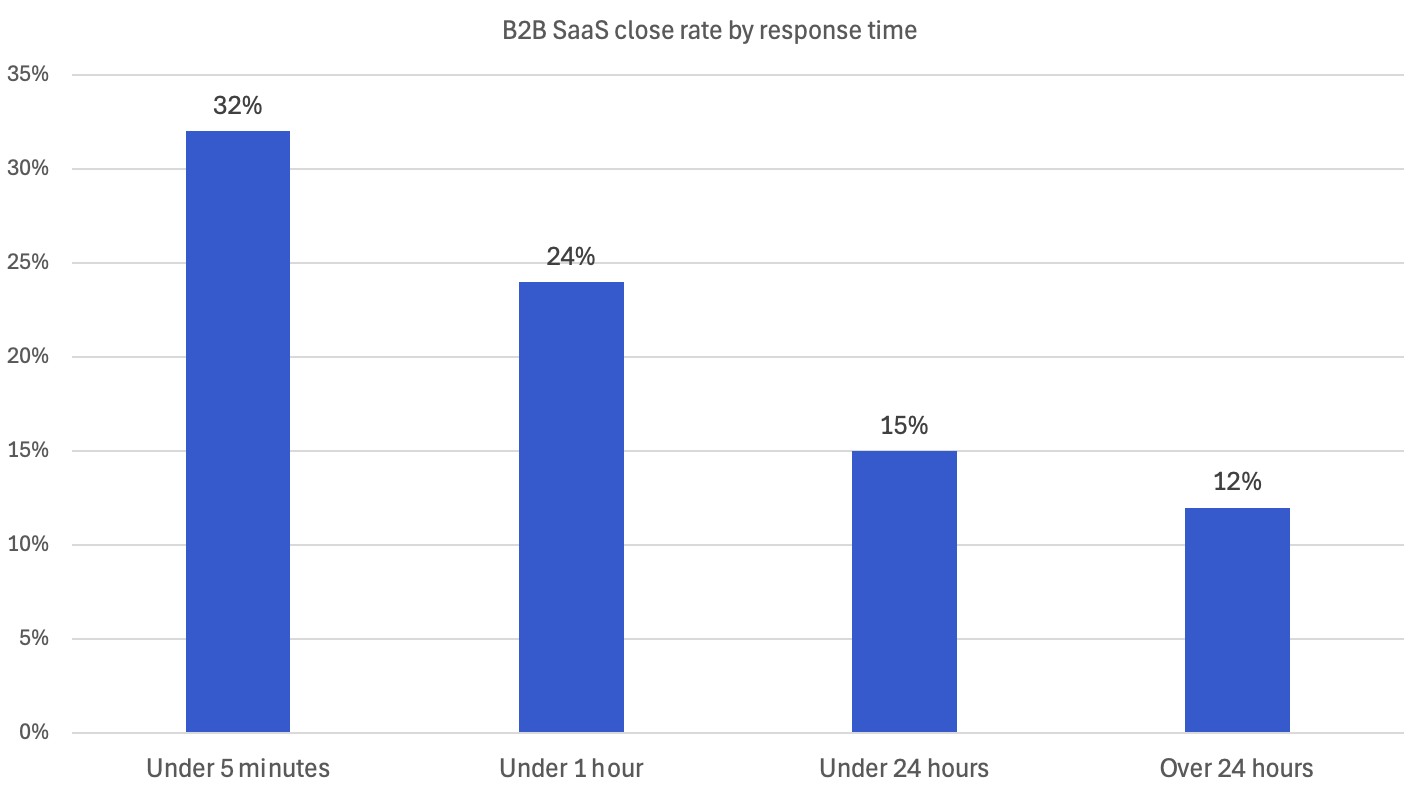
Kurvan för förlorat leadvärde är dokumenterad i flera källor: den ursprungliga Oldroyd/MIT-studien, publicerad i Harvard Business Review, Velocifys senare data, Optifais benchmark från 2026 och nyare branschstudier som Hennessey Digitals analys från 2025. Siffrorna varierar från bransch till bransch, men kurvans form är densamma: close rates faller snabbt.
Efter 1 minut
Leadet är fortfarande varmt. Besökaren har sannolikt fortfarande din sida öppen, och ofta även konkurrenternas. Velocifys data, refererad av LeadAngel, visar betydligt högre konvertering vid respons inom en minut jämfört med bara några minuters försening. Här kan chatt med en riktig människa hjälpa ditt företag att sticka ut från konkurrenterna.
Efter 5 minuter
Det här är den mest kända benchmarken. Optifai visar en close rate på 32% för leads som kontaktas inom fem minuter. Det är 2,6 gånger högre än för leads som först kontaktas efter 24 timmar. Den ursprungliga HBR-studien visade dessutom att företag har betydligt större chans att överhuvudtaget få kontakt med leadet efter fem minuter än efter 30 minuter.
Efter 10 minuter
Engagemanget faller snabbt. Strolids analys av 2,3 miljoner leads inom bilindustrin visade att köparengagemanget minskar betydligt mellan fem och tio minuter. I praktiken innebär det att varje extra minuts väntan under de första minuterna kostar faktisk pipeline.
Efter 30 minuter
Vid det här laget är du inte längre först in i samtalet. Enligt HBR är sannolikheten att konvertera leadet betydligt lägre än vid respons inom fem minuter.
Efter 1 timme
Du kan fortfarande vinna leadet, men du är i defensiven. HBR:s slutsats gäller fortfarande: företag som kontaktar leads inom en timme presterar betydligt bättre än företag som väntar längre.
Efter 24 timmar
Leadet är ofta i praktiken förlorat. Optifai visar att close rates faller till omkring 12% efter 24 timmar. Samtidigt visar Kixies genomgång av lead response-data att många företag först svarar efter flera dagar. Om de överhuvudtaget svarar.
Varför blir problemet med svarstid på leads värre?
Man skulle kunna tro att CRM-system, marketing automation och AI-assisterad försäljning hade löst problemet. Det har de inte. Den genomsnittliga svarstiden är fortfarande alldeles för hög, och flera trender drar åt fel håll.
För det första har köparnas förväntningar förändrats. Enligt Zendesk förväntar sig en stor andel yngre köpare snabb eller omedelbar respons från företag de kontaktar. Tillgänglighet 24/7 har blivit avgörande.
För det andra sker fler förfrågningar utanför ordinarie öppettider. Mobila användare, AI-hänvisad trafik och research på kvällar och helger innebär att fler leads uppstår när de flesta säljteam inte är online.
För det tredje kontaktar köpare sällan bara en leverantör. De begär ofta in flera offerter samtidigt. I det ögonblicket handlar konkurrensen inte längre bara om produkt, pris eller varumärke, utan om vem som svarar först.
Glappet utanför öppettider
Den största förlusten sker ofta när ingen tittar.
Kvällar, nätter och helger utgör en stor del av veckan. Ändå är många företag bara riggade för att reagera under kontorstid. Det betyder att en kund som fyller i ett formulär tisdag kl. 21.14 i praktiken först blir kontaktad onsdag morgon. Då kan tre konkurrenter redan ha svarat. Housecall Pro/Apten pekar på att en betydande andel jobb inom home services bokas utanför ordinarie öppettider. Neil Patel refererar också data som visar att en stor andel live chat-leads kommer efter normal arbetstid. GreetNow lyfter fram att företag med 24/7-respons konverterar betydligt bättre än företag som bara täcker 9–17.
Den viktiga frågan är därför inte om ditt företag har öppet på kvällen. Frågan är om dina konkurrenters responssystem har det. En lösning som Weply fungerar dygnet runt och fångar alla relevanta leads på din webbplats.
Branscher reagerar olika på långsam lead response time
Alla branscher påverkas av långsam lead response time, men inte i samma takt.
Försäkring
Försäkringsleads skickas ofta från vissa källor till flera leverantörer samtidigt. Här handlar det om att komma först in i samtalet med det inkommande leadet. iOvox och SalesWings lyfter båda fram hur kritisk snabb respons är inom försäkringsbranschen.
Automotive
I bilbranschen är datan särskilt tydlig. Strolid visar ett kraftigt fall i engagemang efter bara några minuter, även om många bilhandlare fortfarande reagerar för långsamt.
Hantverkare
När en potentiell kund har ett akut problem, till exempel ett stopp i avloppet, skadedjur eller en läckande hängränna, kontaktar kunden ofta flera leverantörer. Den som svarar först vinner ofta jobbet.
Advokater
Juridiska inkommande leads har oftast utrymme för en något längre övervägandeprocess än till exempel skadedjursbekämpning eller VVS. Men enligt Hennessey Digital mäts fönstret fortfarande i minuter och timmar, inte dagar.
B2B SaaS
Beslutsprocessen är längre, men responsen betyder fortfarande mycket. Revenue.io framhåller att B2B-köpare i hög grad bedömer leverantörer utifrån hur snabbt och relevant de följer upp.
Vad kostar det i praktiken?
En lead decay-graf flyttar sällan budgetar. Konkreta siffror gör det.
Föreställ dig en svensk försäkringsförmedlare med 200 inbound leads i månaden från webbplatsen. Om företaget svarar efter 45 minuter under arbetstid och först nästa morgon på kvällsleads, förlorar det en betydande del av den potentiella konverteringen. Om close rate vid respons inom fem minuter ligger omkring 32%, medan respons efter längre tid ligger betydligt lägre, kan skillnaden snabbt bli många förlorade försäkringar varje månad.
Detsamma gäller ett skadedjursföretag med 50 inbound leads i månaden. Om nästan hälften kommer utanför öppettider och företaget först svarar nästa dag, är en stor del av omsättningen redan på väg till konkurrenten.
Vad kan du göra?
Gratis. Går att börja med direkt
Börja med att ta fram timestamps på alla formulär, chattar och samtalsförfrågningar från de senaste 30 eller 90 dagarna. Fördela dem efter timme och veckodag. Ta reda på hur stor andel som kommer utanför era öppettider. Sätt därefter upp en riktig auto-acknowledgement på alla webbformulär. Inte ett generiskt “tack för din förfrågan”, utan ett tydligt meddelande som bekräftar mottagandet, sätter förväntningar och erbjuder en snabbare kanal vid brådskande ärenden.
Måttlig investering
Implementera live-chatt med mänskliga agenter under arbetstid. Data från bland annat Intercom pekar på att chattinteraktioner kan öka konverteringen, särskilt när leadet får svar snabbt. Utanför öppettider kan en kvalificerad chattlösning säkra namn, kontaktuppgifter, behov, urgency och förväntningsavstämning, så att leadet inte bara ligger passivt i en inbox.
Full täckning
Den starkaste lösningen är 24/7-bemannad chatt med AI-stöd. Inte en AI-bot som står ensam, utan ett människostyrt samtalslager där konverteringsexperter kan engagera, kvalificera och hålla kvar leads dygnet runt. Det är den typ av lösning som Weply erbjuder europeiska företag: mänsklig leadkvalificering understödd av teknik, så att företag inte betalar för trafik med köpintention utan att vara närvarande när kunden faktiskt tar kontakt.
FAQ
Vad är en bra lead response time?
Under fem minuter för kvalificerade inbound leads med aktiv intention, till exempel chattleads, offertförfrågningar, demobokningar och kontaktformulär. De bästa teamen siktar hela vägen ner mot under 60 sekunder.
Förbättrar live-chatt verkligen svarstiden?
Ja. Live-chatt tar bort det asynkrona glappet mellan formulärinskick och mänsklig uppföljning. När chatten är bemannad på rätt sätt kan leadet både engageras och kvalificeras direkt, samtidigt som förväntningarna kring fortsatt respons kan sättas.
Är femminutersregeln för svarstid på leads baserad på verklig data?
Ja, men med förbehåll. Den ursprungliga forskningen kommer från Dr. James Oldroyds studie, som senare omnämndes i Harvard Business Review. Senare benchmarks från bland annat Optifai och Hennessey Digital stödjer riktningen, även om de exakta multiplikatorerna varierar beroende på bransch och kanal.
Vad händer om vi inte är tillgängliga utanför ordinarie öppettider?
Då är frågan vem som svarar kunden medan ni har stängt. Det är sällan nödvändigt att bemanna ett helt säljteam hela natten, men någon form av kvalificering i realtid och förväntningsavstämning kan ofta löna sig. Det bästa sättet är att låta konverteringsexperter som Weply bemanna en chattfunktion 24/7, 365 dagar om året, så att ni säkrar att relevant webbtrafik konverteras till kvalificerade leads.
Betyder svarstid mest i B2C eller B2B?
Svarstid betyder mycket i båda, men på olika sätt. B2C har ofta snabbare beslutsprocesser och högre decay-hastighet. B2B kan ha något längre tolerans, men förlusten per missat lead är ofta större eftersom värdet på ett lead normalt är betydligt högre.
Slutsats
Två säljteam kan ha samma leads, samma produkt och samma pris, men ändå få helt olika resultat enbart på grund av svarstid. De företag som vinner är de som mäter sin egen inbound-data, förstår hur stor andel av deras leads som kommer utanför öppettider, räknar på förlusten vid långsam svarstid och väljer den täckning som siffrorna kan motivera. Siffrorna har varit tydliga i flera år. Frågan är om du agerar på dem innan konkurrenterna gör det.