

AI search is changing your website traffic.
Here's what we know
How ChatGPT, Claude, and AI assistants are shifting how to attract traffic, who the visitors are and how to convert them.
![How to Get Your Brand Into Google AI Overviews [2026 update]](https://cdn.prod.website-files.com/687998866aa498f98160dbb6/69a6d966299d1892b3fc1f8c_Blog_post_header_AI_Overviews.png)
How to Get Your Brand Into Google AI Overviews [2026 update]
Google AI Overviews now appear in roughly 50% of all US search queries. But here is what that number actually means for your brand: users who encounter an AI Overview click on a traditional search result in just 8% of visits, compared to 15% without one, according to Pew Research. The Overview doesn't just take the top slot. It fundamentally changes whether anyone scrolls down at all.
For the brands cited inside an AI Overview, the effect runs in the opposite direction: 35% more organic clicks and 91% more paid clicks compared to brands that appear in the same results but aren't included in the Overview. The gap between cited and not-cited is large and growing.
The strategic frame to carry into everything that follows: today's SERPs are more about awareness than traffic. If you don't appear in an AI Overview on a relevant query, you don't get seen. It's binary. The goal is no longer just to rank. It's to be the source Google's AI reaches for.
Understand Which Queries Actually Trigger AI Overviews
Before optimising anything, you should know where the opportunity sits, because AIOs do not appear uniformly.
Ahrefs' analysis of 146 million SERPs found that AI Overviews trigger on 21% of all keywords overall. But the rates vary sharply by query type. Question-based queries trigger AIOs 57.9% of the time, compared to just 15.5% for non-question queries. More usefully, the type of question matters:
- "Why" / reason queries: 59.8% trigger rate (the highest of any category)
- "Yes/no" / bool queries: 57.4%
- Definition queries: 47.3%
- 7+ word queries: 46.4%, compared to 9.5% for single-word searches
Meanwhile, 99.9% of AI Overview keywords are informational in intent. Transactional and navigational queries barely register.
The practical implication is specific: if you want to appear in AI Overviews, build content around "why" and "how" questions, definition queries, and long-tail informational searches of 7+ words. Not broad short-tail keywords. Think "why does customer churn increase after the free trial ends" rather than "customer retention."
Industries with the highest AIO saturation include Science (43.6% trigger rate), Health (43%), and B2B Tech (AIOs present on 70% of SERPs). E-commerce and local search see far lower rates, 7–16%, meaning your sector context shapes how aggressively to prioritise this.
Your Featured Snippet Performance Already Tells You Where You Stand
Here is the most practical shortcut in this entire guide: if you already rank for Featured Snippets or People Also Ask boxes, you are already well-positioned for AI Overviews. The underlying logic is identical.
Featured Snippets and AIOs both reward the same content characteristics; structured, direct, scannable, answer-first writing. If Google has already selected your content as the best concise answer to a query, that is a strong signal that the same content will be drawn on when Google assembles an AI Overview for a related query.
Check your Google Search Console data for Featured Snippet appearances. These pages are your highest-priority targets for AIO optimisation as they are already halfway there.
Traditional Rankings Are Still the Entry Ticket
There is a misconception that AI Overviews operate independently of traditional rankings. They don't. Ahrefs' analysis of 1.9 million AI Overview citations found that 76% of cited URLs also rank in Google's top 10, with the median position for the top-cited URL being position 2.
This makes sense given how AI Overviews work: they use retrieval-augmented generation (RAG), pulling from Google's own search index. If Google doesn't surface your content in traditional search, AI Overviews won't either.
Google's own guidance on this is unambiguous: there are no special tricks for AI Overviews. The same signals that drive organic rankings like page speed, mobile optimisation, crawlability, quality content, authoritative links, are the foundation of AIO eligibility. If Googlebot can't access and index your content reliably, you are disqualified before any AI evaluation begins.
Run the fundamentals rigorously: verify pages are indexable via Google Search Console's URL Inspection tool, check that no AIO-relevant pages are accidentally blocked in robots.txt, resolve any redirect chains, and keep Core Web Vitals healthy. This is the floor. But many brands are losing AIO visibility simply because the floor hasn't been properly laid.
AI Scans. It Doesn't Read.
This is the mental model that makes all the formatting advice make sense. When Google's AI evaluates your content, it is not reading it the way a person would in terms of building context, following an argument, appreciating nuance. It is scanning for extractable answers. It is looking for the clearest, most self-contained response to a specific query.
That means anything that buries your point sunch as long flowing paragraphs, elaborate sentence constructions, ideas spread across multiple sections actively works against you. Content that performs in AI Overviews is ruthlessly direct.
What AI struggles to cite:
- Long, multi-clause sentences
- Key points buried in paragraph three of a six-paragraph section
- Unformatted text blocks with no visual hierarchy
- Sections that "build toward" an answer rather than leading with it
What AI reliably extracts:
- Short paragraphs: maximum 3–4 sentences, one idea per paragraph
- Bullet lists for any enumerated point
- Tables for comparisons
- Headers that describe exactly what follows. "How to reduce churn in the first 30 days" beats "Strategic considerations around retention"
A useful self-test: paste two versions of a page into ChatGPT or Claude and ask "Which of these would you use as a source for a Google AI Overview?" The simpler, more structured version wins every time. Use this as a cheap, zero-cost sanity check before publishing or refreshing any content.
Lead Every Page With a Direct Answer
The most effective structural change you can make is placing a direct, 40–60 word answer to the page's primary question immediately under the opening H2 heading. Before context, background, or caveats.
Think of it as writing the AI Overview response you want Google to use, then building the rest of your article to support it. This "answer capsule" mirrors the structure AI Overviews use to synthesise information, and research consistently shows that Google's AI draws heavily from the first ~100 words of a page.
Name the relevant entity (your brand, product, topic, or framework) clearly in that opening section. AI systems ground their answers in entities; recognisable, named things, so the more clearly your content identifies what it's about at the top, the more reliably it gets matched to the right queries.
Use the Formats Google's AI Prefers
SE Ranking's analysis of 141,507 AI Overviews found that 78% of responses use list-based formatting, with unordered lists appearing in 61% of AIOs. Structured, scannable content is not just reader-friendly. It is what the system demonstrably reaches for.
FAQ structure: Question-format H2 or H3 headings with direct, concise answers beneath them. This mirrors exactly how AIO content is assembled. Every pillar page and guide should include an FAQ section targeting the specific questions your audience asks. Add FAQPage schema markup to these sections. Pages with schema markup are 60% more likely to be featured in AI Overviews compared to equivalent unstructured content.
Numbered step-by-step guides: Sequential instructions are easy for AI to extract and present as a structured response. "How to" content built around numbered steps is one of the most consistently cited formats.
Comparison tables: AIOs frequently frame comparative answers. Pre-building these as clean tables with concise, single-idea cells makes your content easy to draw from when a user asks a decision-oriented question.
HowTo schema: Alongside FAQPage, HowTo structured data sends a direct machine-readable signal that your content is formatted for extraction.
Build E-E-A-T Signals That AI Can Verify
Google's AI evaluates not just what your content says, but whether the source can be trusted to say it. E-E-A-T (Experience, Expertise, Authoritativeness, Trustworthiness) shapes AIO source selection just as it shapes organic rankings, but with a specific emphasis on verifiability.
Name your authors and give them credentials. A byline with a brief bio and verifiable professional background signals expertise that anonymous content cannot. Link author profiles to their LinkedIn or professional site.
Publish original data. AI systems preferentially cite sources that contain information unavailable elsewhere. A proprietary survey result, an internal benchmark, or a case study with specific quantified outcomes gives AI a unique, anchor-worthy fact. Original data is one of the strongest predictors of AIO citation.
Cite outward to authoritative sources. Linking to government sites, peer-reviewed research, and established institutions within your content signals that your page belongs to a reliable information ecosystem. Use these deliberately but not mechanically.
Apply a higher standard to YMYL content. Health, finance, legal, and safety queries trigger AIOs at surprisingly high rates. Google applies stricter E-E-A-T scrutiny here, which makes these high-opportunity categories for well-credentialled, thoroughly sourced content.
Keep Content Fresh. Especially Pages Already Ranking
Seer Interactive's research found that 85% of AI Overview citations came from content published within the last two years, with 44% from 2025 alone. Recency is a meaningful signal, particularly for topics where information changes: pricing, tool comparisons, best practices, regulatory guidance.
This is not an argument for publishing constantly. It is an argument for being strategic about which existing pages to refresh. Prioritise:
- Pages already ranking in positions 1–10 that aren't yet appearing in AIOs
- Pages sitting just outside the top 10 on page 2. Google already considers them relevant; a targeted refresh can push them into AIO range
- Content where your product details, pricing, or competitive positioning has shifted
When refreshing, update the publication date only if the content has meaningfully changed. Add new data, revise outdated comparisons, check that all cited statistics still link to live sources. Cosmetic updates do not trigger freshness signals.
Earn Citations Beyond Your Own Domain
Your own site is one source. Google's AI cites multiple. The two dominant external sources in AI Overviews are Reddit (21% of all AIO citations) and YouTube (18.8%), according to DemandSage. Quora is the most commonly cited website in Google's AI Overviews overall, per Semrush's study.
These platforms are cited heavily because they contain authentic, first-hand, experience-based content. The kind that complements editorial content on brand sites. For brands, this reinforces the broader LLM seeding logic covered in our previous guide: genuine participation in Reddit communities, YouTube content with descriptive titles and accurate captions, detailed Quora answers, and active profiles on review platforms like G2 and Trustpilot all feed the pool Google's AI draws from.
One important note: optimising for AIO citations from external platforms requires the same content discipline as your own site. A Reddit comment written in dense paragraph prose will not be extracted. A well-structured Quora answer with clear subheadings and specific, factual responses will be. Learn how to empower your LLM seeding strategy in this guide from Weply.
How to Track Whether You're Appearing in AI Overviews
One critical expectation to set first: AI Overviews are non-deterministic. They change with every refresh, and so do the URLs they cite. Don't treat AIO visibility as a stable ranking. Treat it as a probability you are either increasing or decreasing through the quality and structure of your content.
Manual testing remains the most direct method. Search your 30–50 most important queries in Google (use incognito to reduce personalisation). Record whether an AIO appears, whether your brand is cited, and where in the response it features. Do this monthly and track the trends.
GSC (Google Search Console) pattern analysis. Rising impressions alongside flat or declining clicks on specific queries is a reliable proxy for AIO presence. The Overview is absorbing visibility while traditional results receive fewer clicks.
SEO platform tracking. Semrush, Ahrefs, and SE Ranking all now include AIO presence tracking in their SERP feature reports, showing which target keywords are triggering AIOs and whether your domain is being cited. So do several of the AI visibility tracking tools on the market.
The metric that matters most is not whether an AIO appears on your target queries. It is whether you are cited in it. Being cited correlates with 35% more organic clicks on that query. Not being cited, on a query where an AIO appears, means significantly less.
Summary
Google has stated clearly that there are no special tricks for AI Overviews. The brands appearing most consistently have invested in structured, expert-driven, regularly refreshed content that directly answers the questions their audience is asking. Presented in formats that a scanning AI can extract without ambiguity. That is the entire strategy.
If this is the second piece you've read in this series, you'll notice the overlap with LLM seeding is intentional: the same content discipline that earns citations in ChatGPT and Perplexity is the discipline that earns citations in Google AI Overviews. The platforms differ. The principles don't.
Frequently Asked Questions
Do I need a high domain authority to appear in Google AI Overviews? Not exclusively. While 76% of AIO-cited URLs rank in Google's top 10, domain authority alone is not the determining factor. Content structure, directness, and E-E-A-T signals matter independently. Smaller or newer sites can earn AIO citations on specific long-tail, question-based queries where their content is more structured and directly answers the query than that of larger competitors. The best starting point regardless of domain size is the same: identify the informational questions your audience is asking, write structured and answer-first content around them, and fix any crawlability issues that might prevent Google from accessing your pages.
Can I stop my content from appearing in Google AI Overviews? Yes. Adding a nosnippet meta tag to a page instructs Google not to use its content in any snippet, including AI Overviews. A more targeted option is the max-snippet tag, which limits how many characters Google can extract. Bear in mind these directives also affect Featured Snippets and standard meta descriptions, so using them on commercially important pages may reduce overall visibility. Most publishers pursuing AI search visibility will want the opposite, making their content as extractable as possible.
How long does it take to start appearing in AI Overviews after optimising? There is no fixed timeline, and because AI Overviews are non-deterministic, meaning it is changing with every search refresh, it is not accurate to think of it as "appearing" at a set date the way traditional rankings work. In practice, pages that already rank in the top 10 and that undergo meaningful structural improvements (cleaner formatting, answer-first structure, FAQ schema) can see AIO citations relatively quickly, sometimes within a few weeks of Googlebot recrawling the updated content. Pages that are not yet ranking in the top 10 should focus on improving organic rankings first, since AIO eligibility is closely tied to traditional search performance.
My business is e-commerce or local. Should I prioritise AI Overviews?With caution. AI Overviews appear on only 7–16% of e-commerce and local search queries, compared to 57–70% for informational and B2B tech queries. That does not mean ignoring AIOs entirely, but it does mean the effort-to-reward ratio is lower than for content-heavy or informational sites. The highest-value play for e-commerce and local brands is building informational content adjacent to their products, like buying guides, "how to choose," and comparison content, which targets the informational query types that do trigger AIOs, rather than optimising product or category pages where AIOs rarely appear.
How is optimising for AI Overviews different from optimising for Featured Snippets? In practice, it is barely different at all, which is the most useful thing to understand. Both surfaces reward the same content characteristics: a clear, concise answer near the top of the page, structured formatting, question-mirroring headings, and schema markup. If you already have Featured Snippet rankings in Google Search Console, those pages are your fastest path to AI Overview citations. Start there rather than treating AIO optimisation as an entirely separate workstream.
What does "non-deterministic" mean for how I should measure AIO performance? It means AI Overviews are genuinely unstable in ways traditional rankings are not. The same query can produce different cited sources on consecutive refreshes, meaning your brand may appear in the morning and not in the afternoon. This is not a tracking failure; it is how the system works. The practical implication is that you should not measure AIO performance by whether you appear on any single test. Instead, run the same set of 20–30 representative queries monthly, track your citation rate over time as a percentage, and look for trends rather than snapshots. Treat AIO visibility as a probability distribution you are shifting. Not a ranking position you are holding.
Will AI Overviews eventually replace traditional search results entirely? Google's public signals suggest more AI integration, not less. But replacement of the traditional SERP is not the stated direction. Google frames AI Overviews as a complement to organic results, not a substitute. What is changing is the attention economy of the results page: AIOs capture the first and most significant interaction, while traditional results receive less initial engagement. The strategic response, which is being cited inside the Overview rather than relying on traditional clicks, is more durable than trying to predict how Google's UI will evolve. Optimising for AIO citation also strengthens the same content signals that support organic rankings, so the work is not at risk if Google's approach shifts.
Read Weply's full guide to Answer Engine Optimization.
![LLM Seeding: The Complete Guide to Getting Your Brand Cited in AI Search Results [2026]](https://cdn.prod.website-files.com/687998866aa498f98160dbb6/6a8630ea63f85f3d690eeaab_llm-seeding-guide.png)
LLM Seeding: The Complete Guide to Getting Your Brand Cited in AI Search Results [2026]
AI-referred visitors convert at up to 18%. Roughly 4–10x higher than organic search. Yet AI citations still account for less than 2% of total web traffic. The brands who master LLM seeding now are locking in compounding authority before the channel saturates. This guide tells you exactly how.
Your competitor just appeared in a ChatGPT answer. You didn't. That's not a coincidence, and it's not luck. It's the result of a deliberate strategy called LLM seeding: the practice of engineering your brand's presence across the web so that large language models cite you when users ask the questions that matter to your business. LLM seeding is a specific part of your overall Answer Engine Optimization strategy.
The stakes are shifting fast. LLMs cite only 2–7 domains per response, compared to Google's 10 blue links + more behind. The competition for those slots is intensifying, and once a model establishes a trusted source, it tends to reinforce that choice across related prompts. This is winner-takes-most dynamics baked into the model's parameters. If you're not in those answers today, you're training users to associate your category with someone else's brand.
This guide covers everything: how AI models actually decide what to cite, the strategies that consistently earn mentions, the platforms that carry the most weight, and how to measure whether any of it is working.
What Is LLM Seeding?
LLM seeding, a part of the overall Answer Engine Optimization (AEO) strategy, is the practice of strategically distributing accurate, authoritative, and machine-readable content across the web so that AI models like ChatGPT, Claude, Perplexity, and Google's AI Overviews incorporate your brand into their generated responses.
The term breaks down simply:
- LLM (Large Language Model): The AI technology behind conversational tools like ChatGPT, Claude, Perplexity, and Gemini
- Seeding: Planting your brand information in the soil where AI grows its answers: training data, trusted web sources, authoritative platforms
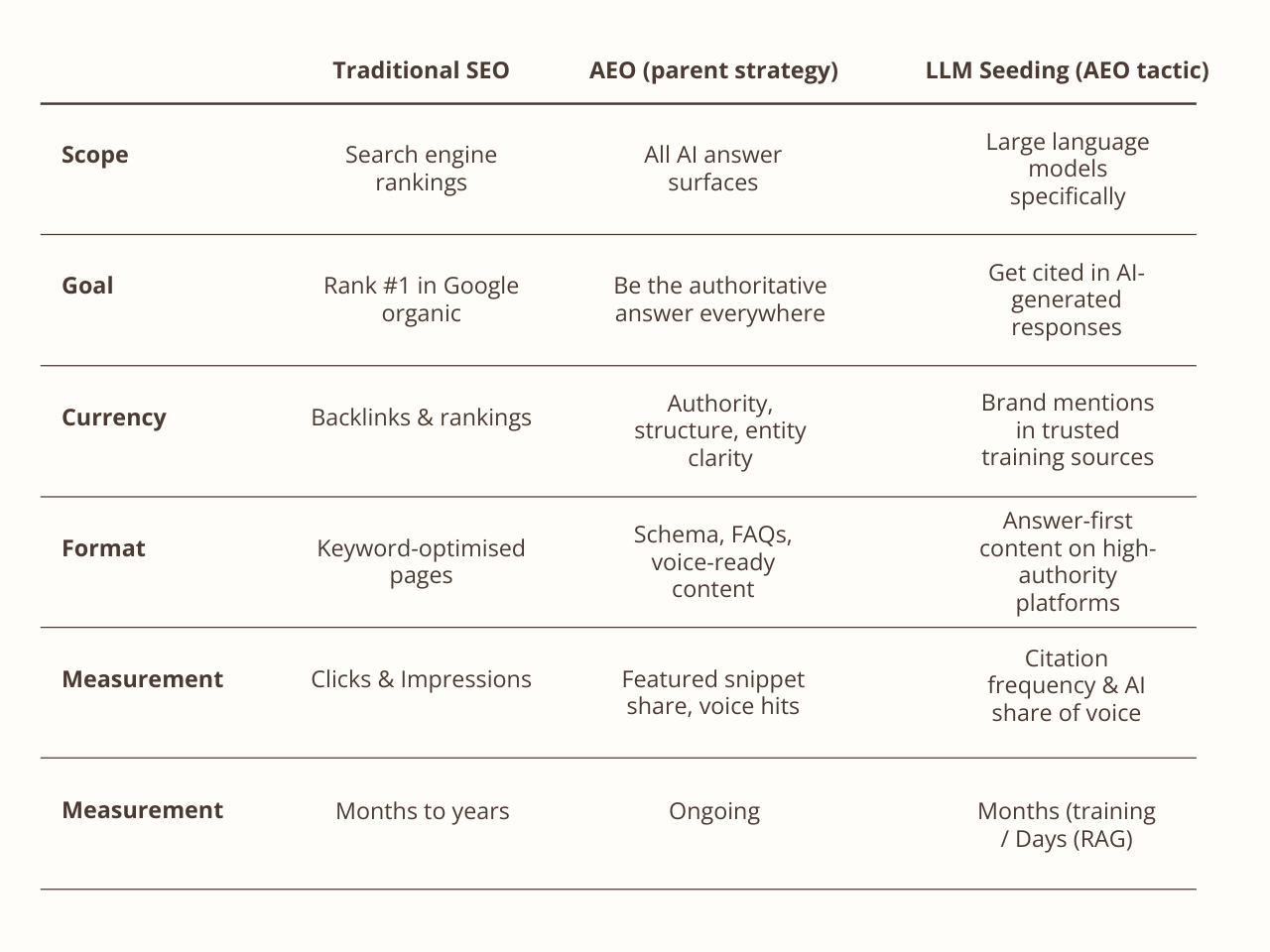
Traditional SEO asks: How do I rank on page one? LLM seeding asks: How do I become the source an AI trusts enough to quote? These are meaningfully different questions with meaningfully different answers. The table below captures the core distinction:
How AI Models Actually Discover and Cite Your Brand
Understanding why AI cites certain brands requires understanding the two fundamentally different ways LLMs access information.
Parametric Knowledge (Training Data)
This is everything the model "baked in" during training. A vast crawl of the web, books, Wikipedia, Reddit, and countless other sources. Approximately 22% of major AI training data comes from Wikipedia alone. This knowledge is static, fixed at training cutoff, and accessed in milliseconds without any external call. Entities mentioned frequently across authoritative sources during training develop stronger neural "representations", making them far more likely to surface in responses. Around 60% of ChatGPT queries are answered purely from this parametric memory, with no live web lookup triggered at all.
What this means for you: If your brand, product, or expertise isn't woven across multiple authoritative sources before a model's training cutoff, you are effectively invisible to the majority of queries that model will ever answer.
Retrieved Knowledge (RAG — Retrieval-Augmented Generation)
The other 40% of the time, modern AI systems actively retrieve real-time information. The user's query gets converted into vector embeddings, relevant documents are retrieved and re-ranked, and the model synthesizes a response from those sources. This is how tools like Perplexity, Google AI Overviews, and ChatGPT Search operate when they browse the web in real time.
What this means for you: For real-time retrieval, recency, crawlability, structured data, and domain authority matter enormously. A well-structured page on a trusted domain published last month can outperform a buried 3-year-old article, even from a bigger brand.
The Three Signals That Drive AI Citation
Across both pathways, three factors consistently separate cited brands from invisible ones:
Consistency. Your brand information appears with the same accurate details across multiple trusted sources. Contradictory or sparse information trains models to be uncertain, and uncertain models hedge by not citing.
Structure. Content uses clear headings, defined terms, FAQ formats, schema markup, and lists that AI can parse without ambiguity. Research shows that 44.2% of all LLM citations come from the first 30% of an article, the intro. Lead with answers.
Authority. Third-party mentions, reviews, Wikipedia presence, and citations from established publications signal credibility. Brand search volume, not backlinks, is the strongest predictor of AI citations, with a 0.334 correlation, higher than the 0.255 correlation between referring domains and organic rankings.
Why the Numbers Demand Your Attention Now
The urgency around LLM seeding isn't hype. The data tells a specific, compelling story.
The traffic is small but explosive. AI referral traffic currently represents less than 2% of total web traffic. But AI-sourced traffic grew 527% year-over-year between January and May 2025. According to Semrush, AI search traffic is projected to surpass traditional search by the end of 2027. If you include AI Overviews the web traffic number is much higher. It is also likely that the number of overall searches has increased significantly. A lot of searches are done on LLMs and never result in a click-through.
The quality is extraordinary. Research analyzing 1,200+ publisher sites found that LLM-referred visitors converted to sign-ups at 1.66%, compared to just 0.15% from traditional search. A separate study found AI-driven visitors convert at 4.4x the rate of organic search visitors. Why? Because when an LLM cites you, the user has already been through a competitive filter. The AI has compared you to alternatives, found you credible, and presented you as the answer. They arrive pre-educated and pre-qualified.
The zero-click reality. 60% of searches now end without any click. Even when users never visit your site, being named in an AI response builds brand familiarity and drives direct searches later. The correlation between AI chatbot mentions and brand search volume is 0.334, higher than the link-to-ranking correlation that SEO has relied on for two decades.
The playing field is levelling. Almost 90% of ChatGPT citations come from pages ranking in position 21 or lower in Google, meaning AI doesn't reward the same sites that dominate traditional search. A well-structured article on page 4 of Google can outperform a competitor's top-ranked page if it provides better, more structured answers.
The competitive window is open, but closing. Only 16% of brands systematically measure AI search performance as of late 2025. The majority of your competitors are optimizing blindly, or not at all.
The LLM Seeding Strategy Framework
Step 1: Map Your Prompts Before You Write a Word
Before producing any content, you need to understand how your customers are querying AI tools. Not how they're querying Google. AI queries are conversational, contextual, and specific: "What's the best GDPR-compliant payroll system for a 50-person European startup?" is an AI query. "payroll software Europe" is a Google query. It is important to mirror the conversational nature once they land on your webpage which its why it is vital to enable chat on your website to continue that conversational context.
Build a prompt map: list every question a potential customer might ask an AI assistant at each stage of their buying journey: awareness, consideration, decision, and post-purchase. Think in user intent, not just keywords. The goal is to understand which conversations your brand needs to be a natural part of. For a practical approach, manually query ChatGPT, Le Chat (Mistral), Perplexity, and Claude with industry questions and study the patterns in who gets cited and how.
Step 2: Publish Authoritative, Answer-First Content
The single most important content principle for LLM seeding: lead with the answer, then explain it. AI models heavily favor content where the main claim appears in the first paragraph. After that, support it with specifics: statistics, comparisons, named examples, and expert perspective.
A key tactic here is semantic chunking. Semantic chunking is organizing your content into short, clearly labelled sections that each focus on a single idea or answer. Chunked content with natural-language headers is far easier for AI to parse, extract, and cite. Use a consistent layout for each section; repeatable structure signals credibility and makes your content predictable enough for AI to rely on.
Structure every piece with:
- A direct answer to the primary question in the opening paragraph
- Clear H2/H3 headings that mirror how a user might phrase the question
- Short, semantically self-contained sections (semantic chunking)
- Specific, verifiable facts (dates, percentages, company names, study sources)
- A TL;DR or key takeaway summary. Models consistently lift these
- FAQs that match the conversational phrasing of real AI prompts
Avoid vague, hedge-heavy language. AI models treat your content like a very literal reader. "Industry-leading solutions that transform business outcomes" provides nothing extractable. "The tool reduces customer response time by 40% in under 30 days, based on data from 200 deployments" does.
Step 3: Build a Web of Consistent Third-Party Mentions
Your own website is one voice. AI builds confidence from a chorus. The goal is consistent, accurate brand information spread across many trusted, independent sources.
PR and media outreach: A single mention on a respected industry publication carries more citation weight than a dozen posts on your own blog. Brands in the top 25% for web mentions get 10x more AI visibility than others. Pursue contributor articles, expert quotes, and product features in trade media. Tools like HARO (now Connectively) or Featured.com can help you find journalist requests to contribute to.
Wikipedia: Given that roughly 22% of major AI training data comes from Wikipedia, a neutral, well-sourced Wikipedia presence is one of the highest-leverage moves available to established brands. Follow Wikipedia's editorial standards rigorously. Any appearance of promotional content will result in deletion and may hurt your brand's perceived credibility with AI systems.
Structured reviews: Reviews on G2, Capterra, Trustpilot, and Google Business Profile create user-generated content that AI retrieves for commercial queries. Specificity matters enormously here. A review that says "Reduced our support ticket volume by 35% in the first quarter" is citation-worthy. "Great product, highly recommend" is noise. Prompt your best customers with specific questions: "What problem did this solve, and what measurable result did you see?"
Step 4: Maintain Semantic Consistency Across All Channels
This step is frequently overlooked but critically important. AI models build associations between brands and topics based on patterns in data. If your messaging is broad, shifting, or inconsistent across channels, like different positioning on your blog versus your LinkedIn versus your press releases, those patterns become weak or contradictory, and the semantic link between your brand and your core topic suffers.
Pick your three to five most important thematic associations. The topics you most want to own in AI responses. And reinforce them consistently everywhere: on your site, in your contributed articles, in community posts, in PR quotes, and in your social content. The more consistently you appear in the same contexts with the same framing, the stronger and more reliable your brand's entity representation becomes in training data.
Step 5: Claim and Optimize Your Knowledge Graph Presence
AI models have a concept of "entity". A distinct, recognizable thing in the world. Strong brands have strong entity representations: consistent name, consistent attributes, consistent associations across dozens of sources. Weak entities are ambiguous, contradictory, or sparsely represented.
To strengthen your brand's entity:
- Ensure your Google Business Profile is complete, accurate, and regularly updated
- Maintain consistent NAP (Name, Address, Phone) information across all platforms
- Use structured data markup to formally define your brand's attributes
- Build connections between your content and established entities (industry terms, recognized tools, named frameworks) so AI can contextualize your brand within its existing knowledge graph
Step 6: Publish Proprietary Data and Original Research
One of the most powerful LLM seeding tactics is owning a unique data point that no one else can replicate. When an LLM discovers a unique fact, it returns to that source repeatedly because no alternative source can satisfy the same query.
Conduct mini-surveys, analyze your own customer data, or commission third-party research. Present findings with proper attribution: date, methodology, sample size. This signals to AI that the data is verifiable and citable, the two things it needs before including a claim in a response.
The Best Platforms for LLM Seeding
Not all content channels reach AI models equally. Prioritize based on the two pathways (training data vs. real-time retrieval):
High-authority publishing platforms (LinkedIn, Medium, Substack): Frequently crawled, high domain authority, and indexed quickly. LinkedIn articles are tied to real professional profiles, which gives them a credibility signal LLMs respond to. Medium's minimalist, semantic structure is highly LLM-readable. Substack suits thought leadership and newsletter-style content. Its emphasis on editorial voice and topical depth adds authority signals.
Industry publications and earned media: Niche authority sites carry disproportionate weight when AI is looking for expert sources in a specific vertical. A mention on a respected industry blog outperforms broad general-interest coverage for targeted queries. Getting featured in "best of" roundups; newsletters, blog posts, curated lists, is particularly high-leverage because these formats are among the most frequently cited by LLMs.
Review and comparison platforms (G2, Capterra, Trustpilot): Heavily cited when users ask AI for tool recommendations. These platforms are trusted by default because they aggregate third-party user experiences rather than brand-produced content. Prioritize detailed, specific reviews from real customers.
Reddit and Quora: According to Semrush, Reddit is cited more than any other single source in LLM responses. Quora is the most commonly cited website in Google's AI Overviews. Both reward specific, expert-driven, helpfully formatted contributions. Not promotional content.
YouTube: YouTube citations in LLM responses have been increasing noticeably throughout 2025, as AI systems improve at extracting value from transcripts, captions, and descriptions. Optimize video titles, descriptions, and captions with the same principles applied to written content.
GitHub Discussions: For technical brands, GitHub community discussions are a powerful and underused seeding channel. Participating in relevant threads, answering questions, and contributing fixes builds credibility that AI picks up on for developer-focused queries.
Editorial microsites: A standalone, editorially-structured microsite, built around your industry, not just your product, can carry more citation credibility than a branded company page. IKEA's Life at Home research site is a good example: it publishes original data on homelife and happiness that connects to its brand without being a product catalogue. Structure it like an independent publication, include author bios, cite your sources, and make your editorial policies visible.
Your own site (with technical AEO): The foundation. Even if AI doesn't always cite your domain directly, a well-structured, authoritative site strengthens your brand's entity representation and is frequently retrieved via RAG.
Content Formats That Earn Citations
The format of content matters as much as the substance. Some structures are simply easier for AI to extract, paraphrase, and cite.
"Best of" lists with transparent methodology are among the highest-performing formats for LLM citation. But they need to go beyond a simple ranked list. Explain how you selected the items. Your testing process, your criteria, your scoring methodology. LLMs prioritize content that shows transparent, well-reasoned decision-making. Give each item a targeted "best for" label that mirrors real query language ("best for freelancers on a budget," "best for enterprise teams"), because AI quotes these phrases directly when matching responses to specific user contexts. Use a consistent layout for each entry: name, summary, key features, pros and cons, pricing.
First-person product reviews with measurable outcomes are citation-worthy because they include the three things AI trusts most: real testing, repeatable methodology, and specific quotable conclusions. Include how many items you tested, who did the testing, when it was conducted, and what criteria you used. Write short, declarative sentences that balance positives and negatives; "It's the best choice for teams under 20 people, but lacks the advanced reporting features enterprise users need" is vastly more extractable than a paragraph of flowing prose.
FAQ-format content mirrors the exact structure of AI queries. The question-and-answer format is essentially pre-formatted for extraction. Every key page on your site should include an FAQ section targeting the specific questions users ask AI tools. WordPress plugins like RankMath and Yoast can automatically add FAQPage structured data to these sections, improving parse rates further.
Comparison tables are consistently pulled into decision-oriented queries. Go beyond feature comparisons. Include use-case verdicts ("best for X"), clear tradeoffs, and citation-ready phrasing that tells AI exactly which option is right for which user type.
Numbered lists and step-by-step guides are easy for models to parse and cite as sequential reasoning. A "How to..." guide with numbered steps is more citation-friendly than flowing prose covering the same topic.
Opinion-led pieces with clear takeaways earn citations when they stake out a genuine, well-supported position. A contrarian industry opinion or a data-backed prediction, especially from a named, credential author, gives AI something distinctive to reference. Structure it with defined sections and explicit summary takeaways so the core argument is easy to extract.
Named expert opinions and E-E-A-T signals add credibility that AI recognizes. Include identified authors with bios, direct quotes from named professionals, and attributions to specific research. Content with transparent authorship (Experience, Expertise, Authoritativeness, Trustworthiness) consistently outranks shallow material in AI responses.
Case studies with specific outcomes. The more specific, the more citation-worthy. Quantified results ("reduced response time from 4 hours to 22 minutes") give AI extractable, verifiable facts it can include with confidence.
Tools, templates, and frameworks attract citations because they solve specific problems that users reference repeatedly. When Perplexity is asked "how do I check keyword rankings for free?" it recommends specific tools by name. Give your resource a descriptive title that matches how users search, include an intro that explains who it's for and how to use it, and add FAQs or use-case examples so AI understands its context and value.
How to Track AI Brand Visibility
Measuring LLM seeding success requires a different toolkit than traditional SEO analytics. The channel is newer, and the signals are less standardized, but the measurement landscape is developing quickly.
The GSC Signal: Rising Impressions, Falling Clicks
One of the clearest early indicators of LLM influence is a specific pattern in Google Search Console: impressions increasing while clicks decrease. This happens because users see your brand named in an AI response, make a mental note, and then search for you directly days or weeks later, bypassing the organic click entirely. The result is declining organic click-through rates paired with stable or growing branded searches and direct traffic.
To spot it: open Google Search Console and compare impressions versus clicks over the past 3–6 months. Then cross-reference with Google Analytics. If direct traffic is growing while organic clicks are declining, LLMs are likely influencing awareness. This is a positive signal, not a problem.
Manual Prompt Testing (Free)
The most direct method: regularly ask AI tools the questions your customers ask and observe whether your brand appears in responses. Use a private or incognito browser to avoid personalization skewing results. Test across ChatGPT, Perplexity, Claude, and Google AI Overviews. The same brand can see citation rates range from under 1% on one platform to over 27% on another, making multi-platform testing essential.
Build a prompt bank of 20–30 representative queries at different funnel stages. Run each monthly and document: which tool was used, the exact prompt, whether your brand appeared, where in the response it featured, the sentiment and framing, and which competitors were cited alongside you. This data becomes your baseline for tracking improvement over time.
AI Monitoring Tools
Otterly.ai (https://otterly.ai). Tracks AI-generated citations and brand mentions across ChatGPT, Perplexity, and other tools
Profound AI (https://www.tryprofound.com). Enterprise-grade platform; tracks LLM search volume, citation frequency, and bot traffic analytics
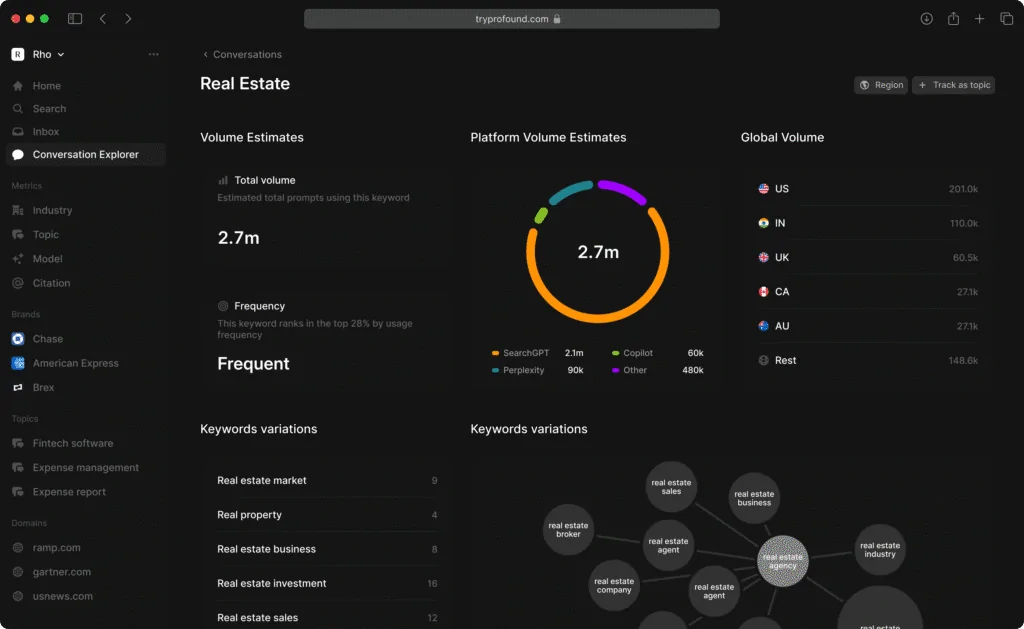
Semrush AI Visibility Toolkit (https://www.semrush.com/ai-seo/). Add-on to existing plans: Tracks brand performance, share of voice, and sentiment across ChatGPT, Perplexity, and Google AI Mode; includes competitor benchmarking
PromptMonitor (https://www.promptmonitor.ai). Monitors brand mentions across major LLM platforms
Analytics Configuration
Configure your web analytics to properly capture AI referral traffic. Many platforms currently misattribute LLM traffic as "direct",meaning your data likely underestimates AI-driven visits significantly. Add custom channel groupings that capture traffic from ChatGPT, Perplexity, Copilot, and Gemini referral domains. Track this traffic separately and compare its conversion rate against organic and direct channels.
The Five Metrics That Matter
Beyond rankings, focus on these GEO-specific KPIs:
- Citation Frequency: How often your brand appears in AI responses for target prompts
- Brand Visibility Score: Percentage of target prompts where you receive a mention
- AI Share of Voice: Your citations as a proportion of total citations in your category
- Sentiment Score: How the AI frames your brand (positive, neutral, negative)
- LLM Conversion Rate: Revenue or lead outcomes attributed to AI-referred traffic
Common Pitfalls and Realistic Expectations
Timelines are longer than SEO. Content optimized for training data may take several months to influence a model's parametric knowledge. Real-time retrieval tools like Perplexity show results faster. Plan for a 3–6 month horizon before expecting consistent citation changes for training-based models. LLM seeding resembles brand-building and thought leadership more than performance marketing — it compounds slowly, then accelerates.
You influence, not control. AI responses are probabilistic. There's less than a 1-in-100 chance that ChatGPT will produce the same list of brands in any two responses to identical prompts. You can dramatically increase the likelihood of being cited; you cannot guarantee it. There is no "optimization knob" to turn.
Transparency in training data is limited. It's not always clear which sources a given model weights most highly. LLM seeding must be based on strategic assumptions; that credibility, consistency, topical depth, and authoritative third-party mentions increase citation probability, rather than precise reverse engineering of an opaque process.
Attribution is genuinely hard. Zero-click AI mentions build brand awareness without generating measurable website traffic. This is real value. But it won't show up cleanly in your analytics. Proxy metrics like branded search volume increases, direct traffic growth, and the quality of sales-qualified leads from AI-referred sessions help close the attribution gap.
Manipulation backfires. Publishing fabricated reviews, seeding false statistics, or attempting to game AI outputs with deceptive content tends to backfire as models improve at detecting manipulation. The sustainable strategy; accurate, helpful, well-structured information across authoritative sources, also happens to be the ethical one.
Turning AI Citations into Revenue
Being cited by AI is worth nothing if the experience ends there. The high-converting nature of AI-referred traffic comes precisely because those visitors arrive pre-qualified. But you still need to capture them when they land. This is where a conversational revenue layer solution like Weply, experts in lead conversions, is essential.
Across 13 months of data, LLM referrals delivered an approximate 18% conversion rate. Higher than any other traffic channel including paid search, SEO, and direct. But this traffic is also growing from a small base, meaning you can dramatically improve revenue outcomes through relatively small increases in citation frequency.
The practical implication: when AI-referred visitors land on your site, they are more likely than any other cohort to be evaluating a purchase or seriously considering your solution. Ensure landing pages reflect the context they arrived from. If AI mentions you in the context of a specific use case, your landing page should speak to that use case immediately. Use contextual CTAs , chat and avoid treating them like cold traffic who need extensive education about your category.
AI-generated awareness delivers high-intent visitors; real-time chat captures their intent before it dissipates.
FAQs About LLM Seeding
How long does LLM seeding take to show results? For training-data-based models like ChatGPT and Claude, expect 3–6 months before content influences citations consistently. Real-time retrieval tools like Perplexity can respond to new content within days. Start with Perplexity to see faster feedback loops while building long-term foundations for training-based visibility.
Is LLM seeding the same as SEO or the same as AEO? Neither, though they're related. LLM seeding is a specific tactic that sits within AEO (Answer Engine Optimization), which is itself a broader discipline than traditional SEO. SEO optimizes for clicks and rankings in search engines. AEO optimizes for citations and authority across all answer surfaces; voice search, featured snippets, knowledge panels, and AI tools. LLM seeding is AEO's most forward-looking workstream: it focuses specifically on influencing what large language models know and recall about your brand, through deliberate content placement in the sources AI learns from. Almost 90% of ChatGPT citations come from pages ranking position 21 or lower in Google, which illustrates why LLM seeding requires its own logic, separate from, though complementary to, traditional SEO.
Does LLM seeding work the same way across ChatGPT, Claude, and Perplexity? No, and this distinction matters. ChatGPT and Claude rely more heavily on parametric (training) knowledge and are harder to influence in real time. Perplexity is primarily a RAG-based engine that retrieves fresh content during every query, making it more responsive to recent, well-structured content. Google AI Overviews blend both pathways. A diversified strategy including consistent web presence plus structured, crawlable content increases citation probability across all platforms.
Can small businesses compete with large brands for AI citations? Yes, particularly in niche verticals. Consistency matters more than budget. A small business that publishes specific, well-structured answers to underserved questions, earns genuine customer reviews, and participates authentically in community forums can outperform a larger competitor that publishes generic content. Identify the specific, long-tail prompts your customers ask AI, and own those thoroughly rather than competing on broad, high-volume queries.
How do I correct inaccurate information an AI tool is spreading about my brand? Publish accurate, well-sourced content across authoritative platforms to establish the correct narrative. The more consistently credible sources reflect accurate information, the faster AI systems update. For critical corrections, prioritize Wikipedia (if applicable), major review platforms, and earned media coverage. These carry the most weight in both training data and real-time retrieval.
Is LLM seeding ethical? Yes, when it focuses on making truthful, helpful brand information accessible. The goal is ensuring AI can find and verify accurate information about your brand, not deceiving users or gaming AI with false claims. Creating genuinely useful content, earning authentic reviews, and building real third-party credibility are the tactics that work, and they happen to be entirely ethical.
The AEO Funnel: Why AI Search Sends Fewer Visitors but Higher Intent
TL;DR:
AI search isn't killing your traffic. It's compressing your funnel. The research, comparison, and consideration stages of the buying journey now happen inside AI conversations before a visitor ever reaches your site. What arrives is for many brands often slightly fewer visitors, but with dramatically higher intent. AI-referred traffic converts at 14.2% versus 2.8% for traditional organic search. This article introduces a new measurement framework called AEO Traffic Quality (ATQ) with five metrics that actually capture what that's worth: time to conversion, pages per visit, source-segmented conversion rate, demo request rate, and chat interaction rate. The strategic implication is simple: static websites are designed for browsers. AI search is sending you buyers. Most companies aren't set up to tell the difference.
Picture a marketer on a Monday morning. GA4 is open. Organic traffic is slightly down. Nothing catastrophic, but enough to notice. Enough to send a Slack message. "Is AI search killing our traffic?"
Here's the thing. That question is based on a false premise, and the false premise is doing real strategic damage. A recent large-scale study by Graphite and Similarweb, analysing over 40,000 of the largest sites in the US, found that organic search traffic is down around 2.5% year-over-year. Not 25%. Not 50%. The apocalyptic numbers circulating in marketing circles turn out to be driven by surveys, small biased samples, and a healthy dose of frequency illusion. The cognitive bias that makes things you've recently noticed seem everywhere.
So SEO isn't dead. Traffic isn't collapsing. But something is changing. And it's more interesting than a traffic decline. The volume is roughly stable. The visitor profile isn't.
That same marketer staring at their GA4 dashboard hasn't noticed what's buried in the data: AI-referred visitors convert at an average of 14.2%, compared to 2.8% for traditional organic search. That's not a rounding difference. That's a structural one. Not in how many people are arriving, but in who they are and why they clicked. The traffic panic is based on bad data. The real story is better. And almost nobody is measuring it properly.
The Funnel Didn't Disappear. It Moved.
To get what AI search is actually doing, you need to hold two funnels in your head at the same time.
The traditional search funnel:
Search → Click → Browse → Compare → Consider → Convert
A visitor arrives knowing they have a problem, but not much else. They don't know the solution, don't know the provider, maybe don't know the budget. Your website has to do all of it: educate them, build credibility, introduce the product, handle objections, and nudge them toward a decision across multiple sessions over days or weeks.
The funnel is long because the website owns the journey.
The AI search funnel:
Ask → AI Conversation → Recommendation → Click (for validation) → Convert
Now something's different. That visitor had a conversation. With ChatGPT, Perplexity, Gemini or in AI Overviews in Google. One of the dozens of AI tools now woven into how people research and decide. The AI asked them questions. It compared options. It absorbed their constraints like budget, timeline, specific requirements, and gave them a recommendation. Your brand came out of that conversation as a credible answer to their specific problem.
The research stage happened inside the AI. So did comparison. So did consideration. What arrives at your website isn't the start of a buying journey. It's the end of one.
This is the reframe everything else hangs on: AI search doesn't compress the conversion rate. It compresses the funnel. The visitor who clicks through has already done what your website was designed to make them do. They don't need educating. They don't need nurturing. They need one thing: confirmation that the AI got it right.
The Data That Proves It
Three independent bodies of evidence. All pointing in the same direction. The volume story is calmer than the headlines suggest.
The Graphite/Similarweb study found that AI Overviews only appears on roughly 30% of queries, not the 50% figure that's been widely reported. And when it does appear, it's mostly on informational keywords. Commercial and transactional queries, the ones that actually drive revenue, are largely unaffected. Google itself stated in August 2025 that total organic click volume to websites has been "relatively stable year-over-year." Traffic to Google actually grew 1.4% in Q4 2025 versus Q4 2024.
So yes, when an AI Overview is present, click-through rates do fall from 15% to 8%. That's a real reduction. But it happens on fewer queries than assumed, and on the queries where commercial intent matters least. The panic overstates the volume problem by a significant margin.
The conversion gap is not subtle. Where things get genuinely interesting is what happens to the visitors who do come through.
That 14.2% conversion rate for AI-referred visitors holds across platforms. Claude-referred visitors at around 16.8%, ChatGPT at 14.2%, Perplexity at 12.4%. Different tools, different audiences, different use cases. Same structural pattern. Every AI referral source converts at dramatically higher rates than organic search's 2.8%.
So here's the arithmetic that most marketing teams haven't done yet: if overall volume is roughly flat but a growing slice of that traffic converts at five times the rate, the value per session is rising even as the panic about declining sessions continues. The headline number is misleading. The unit economics are improving.
And then there's the Microsoft Clarity data, which is hard to argue with. Analysing over 1,200 publisher and news websites, Microsoft found that Copilot-referred visitors converted at 17 times the rate of direct traffic and 15 times the rate of standard search traffic. Not 17% better. Seventeen times the rate. And Adobe's analysis of AI referral sessions found a 23% lower bounce rate, 12% more page views, and 41% longer time on site compared to other sources.
These visitors aren't bouncing and leaving. They're reading. They're exploring. They already care when they arrive. The downstream story compounds it further. AI-sourced customers generate more referrals and cancel less often than customers acquired through other channels. Funnel compression doesn't just produce faster conversions. In many cases, it produces better ones.
Introducing AEO Traffic Quality
Here's the problem. Every standard analytics metric your team reviews was designed for the traditional funnel. A visitor who arrives early, needs time, and should be nudged gradually toward a decision. Session duration. Pages per visit. Assisted conversions. Multi-touch attribution models. These benchmarks were built for a different visitor. Apply them to AI-referred traffic and you'll misread your best sessions as your weakest ones.
What's needed is a different measurement lens. Call it AEO Traffic Quality (ATQ). 5 intent-centric metrics that replace volume-centric thinking when you're evaluating the visitors AI search is sending.
1. Time to Conversion
AI-referred visitors don't come back next week. 73% of them convert within their first session. Not first visit, first session. If your attribution model is built around 7-day or 30-day windows and multi-touch journeys, you're likely underreporting the value of AI-referred traffic simply because the conversion happens too fast for your model to catch it properly. Shorten the window. Look for same-session conversions specifically.
2. Pages Per Visit (Lower Is Normal and Good)
An AI-referred visitor who views two pages and books a demo is not a low-quality session. They came to confirm one thing, confirmed it, and acted. That's the funnel doing exactly what it should, just in a compressed form. Measuring pages per visit without segmenting by traffic source is one of the most common ways teams accidentally misread their most valuable visitors as their least engaged.
3. Conversion Rate, Segmented by Source
Never aggregate AI-referred traffic into your overall conversion rate. A blog reader and a Perplexity-referred visitor arriving at your pricing page are not the same visitor. They shouldn't share a benchmark. Build separate segments in GA4 for each AI platform, and track conversion rates independently. The variance between sources will tell you which platforms are sending the most commercially qualified traffic for your specific product.
4. Demo Requests and Direct Sales Inquiries
AI-referred traffic concentrates on bottom-funnel pages like pricing, case studies, comparison content. These visitors are the most likely on your site to reach a high-intent CTA. Demo requests, quote requests, consultation bookings. These should be your primary ATQ indicators. If these numbers are rising while session volume is flat, that's the funnel compression working correctly. Don't let aggregate traffic trends bury the signal.
5. Chat Interaction Rate
This one's specific to the AEO era. An AI-referred visitor who opens a live chat is not a support ticket. They're one conversation away from a decision. Tracking chat engagement rate separately for AI-referred traffic is the most direct leading indicator of conversion you have. A real-time read on whether your site is continuing the dialogue these visitors already started, or breaking it. Get those insights and the chat conversion expert team to handle it 24/7 with Weply.
The instinct when traffic looks flat or slightly down is to optimise for volume. More content, more links, more reach. In the AEO era, that instinct is often backwards. The better question is: are you converting the visitors already arriving at the rate their intent deserves? For most teams, the answer is no. Not because the visitors aren't there, but because the measurement isn't catching them.
How AI Visitors Actually Behave on Your Website
The behavioural gap between an AI-referred visitor and a traditional organic visitor is large enough that it effectively requires different on-site infrastructure to convert. Understanding why means understanding what these visitors are actually doing when they land.
They arrive at the end of the journey, not the beginning.
They've researched. Compared. Had their specific constraints like budget, use case, and scale, absorbed by an AI that then gave them a personalised recommendation. They arrive carrying context your website cannot see and your analytics cannot capture. They're not looking for an introduction to your product. They're looking for confirmation that the recommendation was right.
Gartner's research found that 83% of the B2B buying journey now happens before a buyer speaks to a salesperson. Forrester found that nearly 90% of B2B buyers now use generative AI tools during the purchase journey. What's arriving at your website isn't the top of the funnel. It's whatever remains after the funnel has already done most of its work elsewhere.
They skim for proof, not explanation.
Not hero banners. Not origin stories. They scan for the signals that close decisions. Case studies from their industry, pricing clarity, specific feature confirmation, social proof from peers in situations similar to theirs. This is why AI-referred traffic lands disproportionately on pricing pages and case study pages. These are the pages that answer the one or two remaining questions standing between a provisional decision and a final one.
They're fast. And they don't give second chances.
Companies that respond to a lead within five minutes are 21 times more likely to qualify them than companies that wait 30 minutes. This research is a decade old, but it applies to AI-referred visitors with even more force. A high-intent visitor who arrived after a thorough AI conversation, found no live chat support, submitted a contact form on a Thursday evening, and received a reply Monday morning , hasn't waited. The same AI that recommended you also recommended two alternatives. They're already in a conversation with one of them.
This is the evidence behind what we argued in The Website You Built Wasn't Designed for the Visitor AI Search Is Sending You. That article named the problem. These are the mechanics that explain it.
Static Sites Are Built for Browsers. AI Visitors Come to Finish a Decision.
Traditional website architecture is built on a browsing assumption: visitors arrive early, need information, and should be moved gradually toward a commitment across multiple sessions. Every page is a step in a sequence. Every CTA is an invitation to go a little deeper. The whole structure assumes a visitor who needs to be won over.
The AI-referred visitor doesn't fit that model. At all. They've already been through something like your funnel — inside the AI conversation that recommended you. They don't need the sequence. They need the answer. And they need it in a format that matches the conversational experience that just earned their trust. Here's what the mismatch looks like in practice:
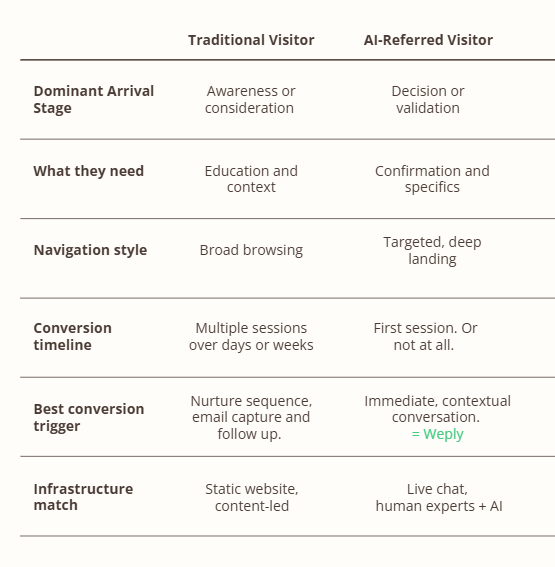
This is why conversation beats navigation for AI-referred traffic. Not as a philosophy. As a practical response to how these visitors actually behave. They arrived in dialogue mode. The AI that referred them created an expectation of responsiveness, of personalisation, of back-and-forth. A static landing page breaks that expectation the moment they land. A contact form asking them to wait 24–48 hours for a reply doesn't just fail to meet their intent. It directly contradicts the experience that brought them to your site in the first place. What these visitors need is a continuation of the conversation. Not a brochure.
The Measurement Mandate: You Can't Optimise What You Don't Measure
Only 16% of brands currently track AI search performance in any systematic way. Which means 84% of companies are making decisions about their website, their conversion infrastructure, and their content investment without the data that would tell them where their highest-value visitors are coming from, or what's happening when those visitors arrive.
Three changes close most of that gap.
A. Segment your analytics by AI referral source. In GA4, create dedicated segments for chatgpt.com, perplexity.ai, claude.ai, and gemini.google.com. Not as a single "AI traffic" bucket. Separate segments. These platforms send different audiences with different intent profiles. Mixing them into aggregate organic or referral traffic makes them invisible, which means their exceptional conversion rates get averaged away by lower-intent sources.
B. Build an ATQ dashboard and review it separately. The five AEO Traffic Quality metrics: time-to-conversion, pages-per-visit by AI source, conversion rate by platform, demo/inquiry rates, and chat engagement rate, should live in a standalone reporting view. Reviewed weekly. Alongside, not inside, your overall traffic report. The goal is a clean, consistent read on what AI-referred traffic is actually worth, without having it diluted by site-wide benchmarks built for a different visitor.
C. Audit your highest-intent pages for the AI-visitor experience. Pricing pages. Comparison pages. Case studies. For each one, ask a single question: if someone arrived here having already provisionally decided to buy, what is the one remaining question standing between them and a yes, and is there a fast, human way to answer it? If the answer is a contact form and a two-day wait or an AI support chatbot, you already know what to fix.
The Funnel Didn't Shrink. It Sharpened.
Back to that marketer on Monday morning. Traffic is roughly flat, maybe down slightly. The GA4 line is uninspiring. The instinct is to panic, or at least to treat the situation as a volume problem requiring a volume solution. But the Graphite data resets the premise. Overall search traffic is down only 2.5%. AI Overviews appears on 30% of queries and concentrates on informational, not commercial, intent. The traffic apocalypse isn't happening.
What is happening is a quiet but significant shift in visitor composition. A growing proportion of the people arriving at your site came through an AI conversation. They arrive later in their decision process, with higher intent, and with conversion rates that dwarf anything traditional organic search ever produced. The funnel hasn't collapsed. It's compressed. And what comes out the other end is more valuable, not less.
The question was never whether AI search kills traffic. It's whether your measurement, your on-site experience, and your conversion infrastructure are built for the visitor who survived the compression. Fewer browsers. More buyers. Most websites were designed for the ones who no longer show up.
This article is part of Weply's ongoing series on Answer Engine Optimisation. Read the earlier pieces: How to Get Your Brand Into Google AI Overviews, LLM Seeding: The Complete Guide to Getting Your Brand Cited in AI Search Results, and The Website You Built Wasn't Designed for the Visitor AI Search Is Sending You.
Frequently Asked Questions
What is AEO Traffic Quality and how do I measure it? AEO Traffic Quality (ATQ) is a set of five intent-centric metrics designed to capture the value of AI-referred visitors rather than their volume. The five are: time-to-conversion, pages per visit (segmented by source), conversion rate by AI platform, demo and direct inquiry rates, and chat interaction rate. To measure it, create dedicated GA4 segments for each AI referral source like grok.com, chatgpt.com, perplexity.ai, claude.ai, gemini.google.com, and track conversion behaviour independently for each, with a shortened attribution window to capture same-session conversions that multi-touch models tend to miss.
Why is my conversion rate higher but my traffic lower since AI Overviews launched? This is funnel compression in action and it's the expected pattern, not a contradiction. AI Overviews and AI search tools are absorbing the early research and comparison stages of the buying journey. Visitors who click through have already been through a version of your funnel inside the AI conversation. They arrive later in their decision process, with more specific intent, and convert at significantly higher rates. It's worth noting, too, that recent large-scale research suggests the traffic decline may be smaller than commonly reported. Around 2.5% overall, not the 25%+ figures that have circulated.
Should I optimise for traffic volume or conversion rate in the AEO era? Conversion rate, specifically for AI-referred visitors as a distinct segment. Optimising for volume in a period when AI search is delivering higher-intent sessions at stable overall volume risks chasing the wrong metric. The more valuable question is whether you're converting the AI-referred visitors already arriving at the rate their intent warrants. For most sites, the infrastructure gap is larger than the traffic gap.
How do I track visitors from ChatGPT and Perplexity in Google Analytics? In GA4, go to Explore and create segments using the Referral source condition. Add chatgpt.com, perplexity.ai, claude.ai, and gemini.google.com as separate filters preferbly, or group them into a single "AI Referral" segment. Bear in mind that some AI-referred visitors arrive as direct traffic if the referral header is stripped. UTM parameters on any links you control can supplement referral tracking. Cross-reference with an AI visibility platform for a fuller picture.
What does "funnel compression" mean in AI search, practically? It means the research, comparison, and consideration stages of the buying journey are now happening inside AI conversations, before the visitor ever reaches your website. By the time someone clicks through from an AI recommendation, they've already been through a version of your awareness and consideration funnel. What the website receives is the final stage: validation and decision. In practice: fewer sessions, shorter visits, higher conversion rates, and a requirement for immediate contextual engagement rather than long-form nurturing.
Does AI-referred traffic convert better than paid search? In many cases, yes. In particular for high-consideration purchases. Paid search achieves high intent through targeting criteria set at the campaign level. AI-referred visitors arrive having already moved through an equivalent qualification process inside the AI conversation, carrying a specific recommendation and residual trust from that exchange. The most meaningful comparison isn't channel-level aggregate rates. It's the intent level of an AI-referred visitor at the moment they land versus a paid visitor at the equivalent decision stage. And on that basis, AI referral tends to win.
Answer Engine Optimization: The Complete 2026 Guide
What Is Answer Engine Optimization?
Answer Engine Optimization (AEO) is the practice of making your brand, content, and digital presence visible to LLM's that synthesize answers. AI models like ChatGPT, Perplexity, Google AI Overviews, Claude and Grok, rather than returning a ranked list of links for users to click through as we are used to from traditionel search engines like Google and Bing.
Traditional search engines rank pages. Answer engines synthesize responses. That is the meaningful distinction. When someone asks ChatGPT "what's the best project management tool for a remote engineering team," they don't receive ten blue links. They receive a paragraph, a comparison table, or a numbered list that pulls from dozens of sources and presents a consolidated answer. Your job is to be one of those sources and be mentioned in the answer.
Getting there requires a strategy built on two distinct pillars. Most AEO guides conflate them. This one separates them. Because confusing them leads to wasted effort.
The Framework That Explains Everything: Seen vs. Trusted
Most AEO advice fails because it treats citation as a single problem. It isn't. There are two separate reasons a brand does or doesn't appear in AI answers.

Seen: Built Offsite
Seen means AI models have encountered your brand across enough sources such as Reddit threads, YouTube content, Wikipedia mentions, review platforms, press coverage, and 3rd party listicles that your brand is part of their underlying model of the world. This is a function of training data. When someone asks ChatGPT about the best transcription tool and your product appears repeatedly across its training corpus, it mentions you even without a live web search. You can't inject yourself directly into training data, but you can generate the offsite mentions that feed it over time.
Trusted: Built Onsite
Trusted means that when AI systems perform live web retrieval to ground their answers, which they now do for most queries on Claude, Grok, ChatGPT, Perplexity, and Google AI Overviews as examples, your pages are structured, authoritative, and clear enough to be cited. This is where content structure, schema markup, page speed, and domain authority directly matter.
Why the Distinction Matters
Most brands get one or the other. A well-known brand with poor content structure might be Seen but not Trusted. Mentioned in passing, but never cited as a source link. A brand with excellent content on a weak domain might be Trusted occasionally but never Seen. Cited when AI happens to retrieve the right page, but never proactively mentioned.
The brands that win AI visibility consistently invest in both pillars simultaneously. Understanding which pillar is your bottleneck changes your entire strategy:
- Startup with great content, no brand presence? → Reddit, YouTube, earned media, and review platforms first.
- Established brand already mentioned in AI responses? → Structured content and schema that give AI something citable and specific to extract.
The Honest State of AEO in 2026
Before tactics, you deserve an accurate account of what practitioners running actual experiments have found. Most AEO content tells you what to do. This section also tells you what to stop doing, which is rarer and considerably more useful.
What Has Been Overhyped
The "AEO is completely different from SEO" narrative. The fundamentals of good content such as authority, depth, clarity, and demonstrated expertise, remain the core inputs to both traditional search and AI citation. Roughly 12% of citations overlap between ChatGPT answers and Google's top 10 results (Ahrefs, 2025). For Google AI Overviews, that overlap jumps to 76%. Good SEO still feeds AI visibility. It is just not sufficient on its own for platforms like ChatGPT and Perplexity. Ethan Smith, CEO of Graphite and one of the few practitioners applying controlled experiments to AEO, stated plainly in early 2026: "Saying that AEO and SEO are totally different, that's an exaggeration. There are differences, but the magnitude of the differences was overhyped." (Ahrefs Podcast, February 2026)
LLMs.txt files as an AEO growth tactic. In late 2024, the SEO community excited itself about LLMs.txt, a file format intended to help AI crawlers understand your site. Malte Landwehr, CPO at Peec AI, was direct at the Peec AI 2026 AEO Webinar: it was "overhyped, not as a tool to feed information to coding agents or document how your API works, but as the secret SEO, GEO, AEO growth hack." If you are building developer tools and want AI coding assistants to understand your API, LLMs.txt has value. For marketers trying to drive ChatGPT citations, it is a distraction.
Markdown copies of your content. Creating a markdown version of every article was widely promoted as an AEO tactic in 2025. Landwehr's analysis found it creates duplicate content without measurable benefit and may hurt traditional SEO performance, which then negatively impacts AI visibility through web search grounding. (Peec AI AEO Webinar, 2026)
Mass-scaled AI-generated content. Lily Ray, VP of SEO Strategy at Amsive and one of the most data-driven voices in search, has seen many brands attempt to pump out hundreds of AI-generated articles to build topical authority quickly. Her assessment, shared at BrightonSEO 2025: "This strategy almost always crashes and burns." Ethan Smith agreed in the same period: "I never saw mass-scaled AI content working well for very long, outside of really quick spikes." AI systems are increasingly effective at identifying content with no genuine expertise behind it.
What Is Working Better Than Expected
Self-referential category listicles. Brands that publish "Best [Category] Tools" lists and include themselves, as part of a genuine comparison, are seeing disproportionate AI citation benefits. Lily Ray noted: "I was really surprised to see how well these work, even on Google." (BrightonSEO, 2025) If you cover your category comprehensively and include yourself alongside competitors with honest commentary, AI models treat this as authoritative category content. It won't work indefinitely, but it works now and the tactic is legitimate if the content is genuine.
Reciprocal mentions. Ethan Smith identified a pattern he calls "reciprocal mentions", roughly analogous to early-era reciprocal backlinks (Graphite.io, 2026). If Zoom's help center mentions your integration and your documentation mentions Zoom, AI models interpret this mutual acknowledgment as a validated relationship. The implication for partnership marketing: when you build a real integration or partnership, ensure it is documented explicitly on both sites.

Help center content in a subdirectory. Smith calls this "the most underutilized opportunity in AEO." Every "Does your product do X?" question flowing into ChatGPT can be answered by a well-structured help center page. Most companies have those pages. They are just on the wrong subdomain and not cross-linked to anything that matters. (Graphite.io, 2026)
What to Watch For
Lily Ray has predicted that AI platforms will begin issuing manual actions, like penalties for obvious manipulation, during 2026, similar to Google's Panda and Penguin updates that dismantled entire SEO business models. Ethan Smith believes the worst offenders are addressed first while subtler tactics continue working. The practical implication: build your AEO strategy on genuine expertise and authentic brand presence. Manipulative shortcuts carry increasing platform risk.
The Numbers That Should Change Your Strategy
The following statistics come from 2025–2026 research across millions of AI responses and website sessions. Each one has a direct implication for how you should allocate resources.
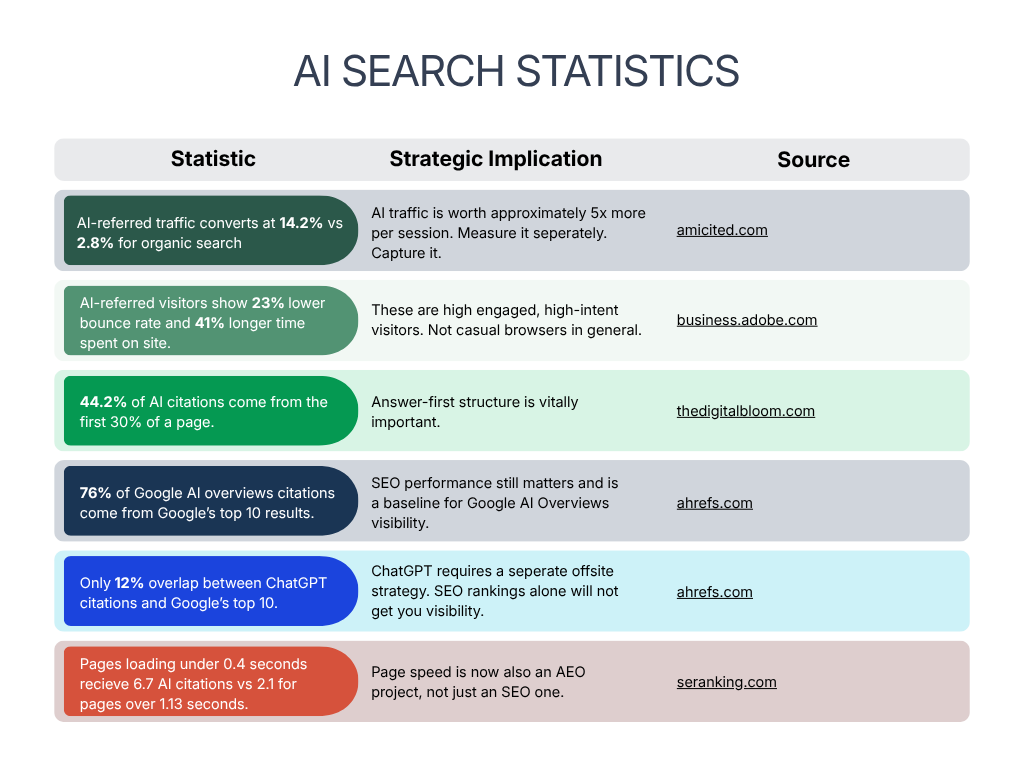
Two additional data points that reshape how you think about AEO measurement:
- Only 12% overlap between ChatGPT citations and Google's top 10 results means ChatGPT is doing something genuinely different from Google. Google AI Overviews has 76% overlap, making it the most accessible entry point for brands already ranking well in search.
- Only 13.7% of citations overlap between Google AI Overviews and Google AI Mode. They are not the same product and do not share the same citation sources. Treating them as equivalent leaves material visibility on the table.
How AI Decides What to Cite
Understanding the mechanism behind citations helps you make better optimization decisions. There are three distinct pathways through which AI systems surface and cite content.
Training Data Citation
The model references your brand from its pre-training corpus, information absorbed before the model's knowledge cutoff. This is the Seen pillar. It is influenced by the total volume of mentions across the web: Reddit posts, YouTube content, review site entries, press coverage, forum discussions. You cannot inject yourself directly into training data, but you can generate the offsite mentions that feed it over time.
Retrieval-Augmented Generation (RAG)
Most modern AI answers from ChatGPT, Perplexity, and Google AI Overviews involve some form of real-time web retrieval. The model performs a live search and pulls from current pages to ground its answer. This is the Trusted pillar. Content structure, schema markup, page speed, and domain authority directly influence whether you get cited. RAG is the most actionable citation pathway for marketers because you can improve it immediately.
Entity Recognition
AI models identify your brand as an entity with specific attributes: category associations, use cases, user types, geographic coverage, integration partners. Building rich entity coverage through structured data, consistent brand information across the web, Wikipedia entries, and authoritative third-party descriptions helps AI models represent you accurately whenever you are surfaced. This is the bridge between Seen and Trusted: an AI model that recognizes you as a well-defined entity is more likely to cite you precisely.
The Five Channels That Drive AI Citations
Here is the channel-by-channel breakdown of where AI citations actually come from, and the specific playbook for each.
Channel 1: Reddit (~40% of AI Citations)
Reddit's dominance in AI citations reflects the same mechanism that made it valuable in Google: its community moderation and voting system acts as a quality filter that algorithms struggle to replicate. When Reddit users collectively upvote a genuinely helpful answer, AI interprets that social validation as an authority signal. Most B2B marketers avoid Reddit. That gap is a competitive opportunity.
The playbook (from Ethan Smith, Graphite): Create one real account. Disclose who you are and where you work. Give genuinely helpful answers to questions in your category. Not promotional responses, not links to your blog, just answers. Five high-quality comments in the right subreddits can meaningfully shift your brand's AI visibility. No automation. No fake accounts.
Where to focus: Find subreddits where your buyers ask questions. Automotive → r/whatcarshouldibuy, r/askcarsales, r/cars. Travel → r/solotravel, r/travel, r/travelhacks. B2B SaaS → r/sales, r/marketing, r/entrepreneur. Search each for your category's most common questions and contribute authentically.
What to avoid: Promotional posts masquerading as advice, link-dropping without context, and anything that reads like marketing copy. Reddit readers are exceptional at detecting inauthenticity. Getting flagged as a shill is worse for your AI visibility than not participating at all.
For the complete LLM seeding strategy across all offsite channels, see our dedicated guide: LLM Seeding: The Complete Guide to Getting Your Brand Cited in AI Search Results.
Channel 2: YouTube
YouTube consistently ranks among the top cited domains in Perplexity and ChatGPT. AI systems extract information from video transcripts, and Google's ownership of YouTube gives it preferential indexing. More importantly, the AEO opportunity in video is radically under-exploited.
While brands fight over high-volume text content, YouTube videos for specific B2B queries represent wide-open territory. Nobody makes videos about "AI-powered payment processing APIs" or "HIPAA-compliant meeting transcription for healthcare teams". Which is exactly why you should. The long tail of AEO is 4× bigger than traditional SEO, and almost all of it is uncontested in video format.
The playbook: Identify your top 20 long-tail AEO query clusters. For each, produce a focused 5–10 minute video that directly answers the question. Include a complete, human-edited transcript as a description or companion article. The combination of video (as a citation source) and transcript (as crawlable text) gives AI multiple surfaces to pull from.
Channel 3: Review Platforms
Brands with profiles on Trustpilot, G2, and Capterra are 3× more likely to be cited by ChatGPT than brands without, according to SE Ranking's November 2025 research. This is not about star ratings. It is about the existence of an authoritative, third-party record of your brand. AI models use these records as entity validation.
The playbook: Claim every relevant review platform profile. Ensure your description, category tags, and feature lists are accurate and detailed. This is structured data that AI reads. Build a systematic review generation process: post-purchase emails, in-app prompts, and customer success touchpoints should all request reviews on the platforms most relevant to your category. Review language itself gets cited. Specific, detailed reviews describing use cases become part of your citation footprint.
Channel 4: Your Help Center
Every customer question that flows into an LLM is a citation opportunity. If you have a well-structured page that directly answers it. Most companies have those pages. They are just on a subdomain (help.yourcompany.com) that weakens both their SEO authority and their AI citation potential.
The playbook:
- Move your help center from help.yourcompany.com to yourcompany.com/help. Subdirectory preserves domain authority.
- Audit your top 100 support tickets and customer questions from the past year.
- Ensure every question has its own dedicated page with a direct answer in the first paragraph.
- Cross-link help center content to relevant product pages and vice versa.
- Apply HowTo and FAQPage schema markup to relevant pages.
- Treat help center content with the same editorial quality as your main blog.
The return on this investment is compounding: better AI citation, lower support ticket volume, and improved SEO for navigational queries. Ethan Smith of Graphite calls it the most underutilized opportunity in AEO, and the data supports that view. (Graphite.io, 2026)
Channel 5: Earned Media and Brand Mentions
PR coverage in authoritative publications creates the proof layer; third-party records of your brand's existence, category membership, and credibility. AI models rely on these records when constructing answers about brands they were not explicitly trained to know.
Prioritise publications that consistently rank in your category. For B2B tech: TechCrunch, VentureBeat, Forbes Tech, Harvard Business Review. A single genuine feature in an authoritative publication can shift your citation rates more than a year of blog posts.
The reciprocal mentions opportunity: When you build real integrations and partnerships, ensure they are documented on both companies' sites. AI models interpret bilateral acknowledgment as a validated relationship, with real implications for recommendation queries. This is a partnership marketing tactic with a direct AEO payoff. (Ethan Smith, Graphite, 2026)

Onsite Content Optimization: What Actually Works in AI Search
Getting the offsite channels right builds your Seen pillar. The following onsite practices build the Trusted pillar, ensuring that when AI systems perform live retrieval, your content is structured to be found, parsed, and cited.
Rule 1: Lead With the Answer. Always.
The single most important structural rule in AEO: 44.2% of citations come from the first 30% of a page's text. If your most important claim is buried after an extended preamble, AI is statistically unlikely to find it. Every section should open with a direct, one-to-two sentence answer to the question posed by the heading. Context, nuance, and expansion come after.
Rule 2: Use Question-Based Headers
AI systems parse heading structures to understand what question each section answers. Format H2 and H3 headings as the questions your users actually ask, not the topics you want to cover.
- "Schema Markup" → topic heading (weak)
- "How Does Schema Markup Help AI Understand My Content?" → question heading (strong)
Rule 3: The 30–60 Word Definition Block
For any key term or concept, write a definition block of 30–60 words directly beneath the heading. This is the format most consistently extracted by AI as a featured answer. Make it self-contained. It should make complete sense without surrounding context. Think of it as writing the AI Overview response you want Google to use, then building the rest of the section to support it.
Content Types by Query Intent
Different stages of the buying journey generate different types of AI queries, and each requires a different content format to win citations.
Awareness-stage queries ("What is X?", "How does X work?") are best served by definition-led pillar content: long-form guides with clear H2 structure, definition blocks, FAQ sections, and HowTo schema. These are the queries where AI Overviews appears most frequently and where informational citations are won.
Consideration-stage queries ("X vs Y", "Best tools for Z") are best served by genuine comparison content. Include yourself alongside competitors with honest, specific commentary. AI models treat comprehensive, balanced category content as authoritative. Self-referential listicles like "Best [Category] Tools" lists that include your own product are currently one of the highest-performing AEO formats, according to Lily Ray at BrightonSEO 2025.
Decision-stage queries ("Does X integrate with Y?", "What is X's pricing?", "How long does X take to set up?") are best served by help center content and product detail pages with specific, direct answers. These are the queries that the AI has often already answered by the time a user clicks through to your site. The visitor who lands on your pricing page after a ChatGPT conversation is not browsing. They are validating a near-final decision. Your content should reflect that. For a full analysis of how these visitors behave and what infrastructure converts them, see Why AI Search Sends Fewer Visitors but Higher Intent.
Long-tail conversational queries ("I'm a solo founder at an EU-regulated startup. What is the minimum viable compliance stack?") are best served by content that mirrors the conversational specificity of the question. These queries exist in AI tools at high volume but have almost no traditional search equivalent, meaning that the competitive bar is exceptionally low. See the Long Tail section below for the full opportunity.
Schema Markup: The Non-Negotiable Technical Foundation
Schema markup is structured code that tells AI systems what your content is, not just what it says. These are the schema types with the most direct AEO impact:
- FAQPage: Add to any page with a Q&A section. Highest-impact schema type for AEO. Structures question-answer pairs that AI can extract cleanly.
- HowTo: Add to step-by-step process content. Marks up each step individually.
- Article: Include author, publication date, and modification date. AI systems weight freshness, and schema-marked dates give explicit freshness signals.
- Organization: Establishes entity data such as name, description, URLs, social profiles. Entity building at the technical level.
- Product / Review: For SaaS, services and e-commerce in particular, marks up your offering with structured pricing, feature, and rating data.
Implementation does not require a developer for most use cases. Google's Structured Data Markup Helper generates the code. Plugins like Yoast and Rank Math handle the basics automatically. Pages with schema markup are 60% more likely to be featured in AI Overviews compared to equivalent unstructured content.
For the full technical guide to appearing in Google AI Overviews specifically, see How to Get Your Brand Into Google AI Overviews (2026 Update).
The Long Tail: Where the Real AEO Opportunity Lives
The AEO long tail is four times bigger than traditional SEO. Users ask ChatGPT questions averaging 25+ words versus 6 in Google.
Most AEO guides focus on head terms like "best CRM software." These are contested. The real opportunity is in queries that don't exist in traditional search, because they are too specific for keyword-based tools to surface:
- "Which project management tools integrate with Notion and have a free tier for teams under 10 people?"
- "What electric car currently available for under 350,000 DKK has the best private leasing deal?"
- "I'm a solo founder at an EU-regulated startup. What's the minimum viable compliance stack I actually need?"
These are asked thousands of times per day in AI tools, and almost nobody is optimising for them.
How to find long-tail AEO queries:
- Pull your competitors' paid search keywords. These reveal what buyers pay to answer, which means AI is being asked them too.
- Query AI tools as your ideal customer persona and record the follow-up questions that arise naturally.
- Mine your support tickets. Customers articulate their real questions to support teams.
- Use AnswerThePublic and AlsoAsked, then extend each answer to address the more specific follow-ups an LLM user would ask next.
How to create content for them: Build a dedicated page for each significant long-tail query cluster. Answer the primary question in the first paragraph. Then answer the three to five most likely follow-up questions in subsequent sections. This mirrors how an AI conversation unfolds and positions your page as the source for the full arc of the query.
Page Speed: The AEO Signal Most Marketers Ignore
Pages with a First Contentful Paint under 0.4 seconds average 6.7 AI citations. Pages loading slower than 1.13 seconds average 2.1 citations, which is a 3× gap for a purely technical factor (SE Ranking). AI crawlers deprioritise slow-loading content during retrieval, just as search crawlers do. Core Web Vitals improvements are no longer only an SEO project. They are also an AEO project.
Keep Content Fresh. AI Actively Penalises Staleness
When Ahrefs analysed AI Overview content changes, they found that content refreshes triggered new citations within weeks of competitor content being updated. Your most-cited pages should be on a regular update schedule. Not reviewed annually, but actively monitored for outdated statistics, superseded claims, and sections that new developments have complicated.
Quarterly content audits on your top 20 pages are the minimum viable cadence. When refreshing, update the publication date only if the content has meaningfully changed. Add new data, revise outdated comparisons, check that all cited statistics still link to live sources. Cosmetic updates do not trigger freshness signals.
Platform-by-Platform Optimization Guide
Different AI platforms have meaningfully different citation behaviours. Treating them as equivalent wastes effort. Here is what the data shows about each major platform.
Critical distinction: Google AI Overviews and Google AI Mode share only 13.7% of their citations. They are not the same product. Optimizing for one while assuming you've covered both leaves significant visibility on the table.
ChatGPT: The Highest-Priority Platform
ChatGPT's citation sources are dominated by Reddit, a platform many B2B marketers avoid, followed by Wikipedia, major review aggregators, and authoritative publications. The low 12% overlap with Google's top 10 means your Google rankings are a weak predictor of ChatGPT visibility. A dedicated offsite strategy is required.
Research from Growth Memo in Fenruaryb 2026 found that ChatGPT favours content using definite language (not hedged or vague), content containing question marks, and content with high entity density and simple sentence structures. After its October 2025 algorithm update, ChatGPT now shows 3–4 brand mentions per answer on average, down from 6–7. Competition for each mention has intensified.
Google AI Overviews: The SEO Continuity Play
AI Overviews is the most accessible entry point for brands with existing Google rankings. The 76% overlap with top 10 results means your current SEO investment has significant residual value here. The optimization levers are familiar: E-E-A-T signals, structured data, freshness, author credibility with demonstrable subject-matter expertise.
Importantly, AI Overviews appears on approximately 30% of queries, not the 50% that has been widely reported, and concentrates heavily on informational intent. Commercial and transactional queries, the ones that drive revenue, are largely unaffected. (Graphite) If you are only going to optimise for one AI platform, and you already rank well in Google, start here.
For the complete technical guide to Google AI Overviews optimisation, see How to Get Your Brand Into Google AI Overviews (2026 Update).
Perplexity: The Researcher's Platform
Perplexity's audience skews toward researchers and professionals who value source transparency and want to verify information quickly. Content with explicit methodology, original data, and clear sourcing performs best. Perplexity has the strongest overlap with traditional search rankings of any major AI platform (28% with Google's top 10), making it the most accessible for brands with moderate to good SEO authority.
How to Measure AEO Success
Traditional marketing metrics as keyword rankings, organic traffic numbers, and click-through rates capture SEO performance. They do not adequately capture AEO. Here is the measurement framework that reflects how AI citation actually works.
Tier 1: Visibility Metrics
These measure your raw presence in AI answers.
Share of Voice (SOV): Of all AI answers in your category, what percentage include your brand versus competitors? This is the AEO equivalent of search market share and the primary metric for competitive benchmarking. Tracked via Profound, Peec AI, Otterly, or other AI visibility tracking tools.
Visibility Score: Establish a prompt library of 50–100 queries your ideal customer would plausibly ask. Test them weekly across platforms. Track change over time.
Sentiment and Prominence: When you are mentioned, is the framing positive, neutral, or negative? Are you the first brand mentioned in the answer, or buried at the end? Position within the answer carries conversion weight.
Citation page performance: Which specific pages are being cited? If AI is pulling from an outdated case study or a page with inaccurate pricing, you need to know before your sales team finds out the hard way.
Tier 2: Attribution Metrics
These track what happens after AI sends users to your site.
Referral traffic by AI source: Set up custom channel groups in GA4 for perplexity.ai, chatgpt.com, claude.ai, and gemini.google.com. Monitor weekly. The channel is growing fast enough that monthly reviews miss meaningful changes.
AEO Traffic Quality (ATQ): Standard analytics metrics like pages per visit, session duration, and multi-touch attribution were built for a visitor who arrives early in the research process and needs time. They systematically misread AI-referred visitors, who arrive at the decision stage and convert fast. The ATQ framework, which is five intent-centric metrics specifically calibrated for AI-referred traffic, is covered in full in Why AI Search Sends Fewer Visitors but Higher Intent. The five metrics are: time to conversion, pages per visit (segmented by source), conversion rate by AI platform, demo and direct inquiry rates, and chat interaction rate.
Entry page distribution: Which pages do AI-referred visitors land on? Compare against your citation monitoring tool. Anomalies between the two data sources are worth investigating.
Tier 3: Business Impact
These connect AEO to the revenue conversation your CFO actually cares about.
Conversion rate from AI-referred traffic: Set the benchmark at 14.2% (the documented average). If you are below it, investigate whether your landing pages are structured for high-intent visitors, ncluding whether a live chat solution staffed with lead generation experts is available on your key pages. If you are above the threshold, focus resources on expanding volume.
Lead quality scoring: Track AI-referred lead quality scores, sales cycle lengths, and lifetime values separately from other organic or paid sources. The data will make your internal case for AEO investment.
Revenue attribution: Build a separate attribution model for AI traffic. Don't allow it to get absorbed into undifferentiated "organic." It has meaningfully different conversion behaviour and deserves its own reporting line.
The Cadence Reality
Monthly citation drift across major AI platforms runs at 40–60%. AEO requires weekly monitoring. A 30-minute weekly review of visibility scores, AI referral traffic, and any significant citation changes is sufficient. The goal is to catch drops early, identify the cause whether it is competitor content, a platform update, or a freshness issue on a key page, and respond before a week of lost visibility becomes a month.
How to Convert AI Visibility Into Revenue
Visibility is the beginning, not the end. Here is how to ensure that when an AI tool sends someone to your site, the experience matches the intent they have built up through conversation.
Understand what AI-referred visitors expect. These users have already had a conversation. They asked a question, received an answer mentioning your brand, and clicked through. They are not at the beginning of their research journey. They are at the end. Looking to validate a decision they have effectively already made. Your landing pages should reflect this. Lead with specifics, proof points, and use cases, not with category-level brand positioning. For the full analysis of AI-referred visitor behaviour and the infrastructure that converts them, see The Website You Built Wasn't Designed for the Visitor AI Search Is Sending You.
.png)
Ensure 24/7 response capability. AI search happens outside business hours. A user asking ChatGPT at 10pm on a Sunday about your product and clicking through is not going to fill out a contact form and wait until Monday morning. Live chat, staffed by lead generation experts and backed by a capable AI assistant with clear handoff protocols, captures the high-intent windows that traditional lead capture or an AI support chatbot misses entirely.
Build follow-up content for the questions AI answers. When AI cites your page, the user has received an answer. The next page they visit should answer the logical next question in their buyer journey. Map the post-citation content experience as deliberately as you map the post-click landing page in paid search.
Track AI-sourced leads through the full funnel. The insight that AI traffic converts at 5× the rate of Google organic is only useful if you measure it. Create a UTM convention for AI-referred traffic, tag it in your CRM, and follow it to closed revenue. This is the data that funds next year's AEO investment.
Getting Started: The AEO Priority Stack
If you are building an AEO programme from scratch, this is the sequence that delivers the fastest compound returns. Each step builds on the last.
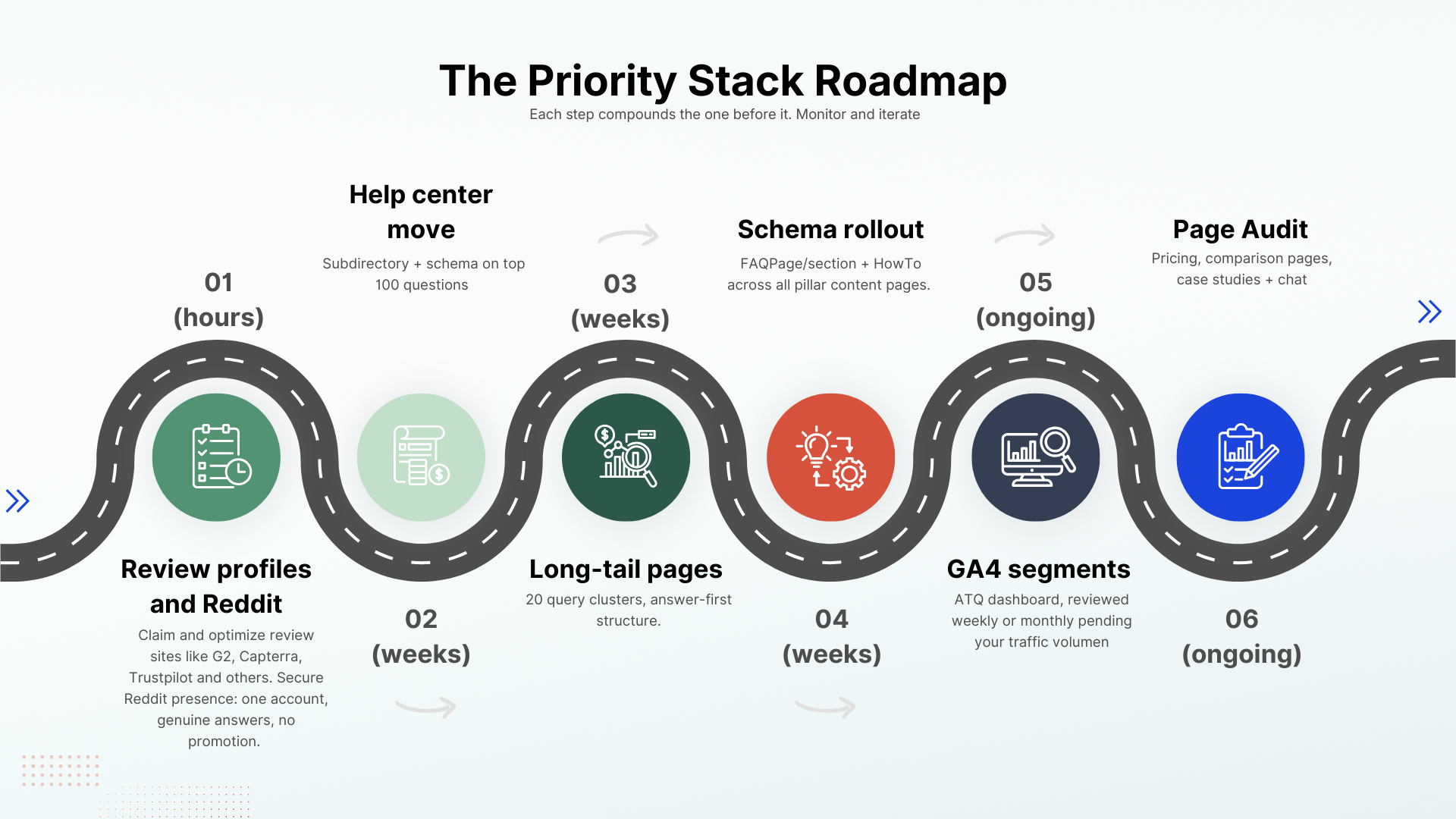
Step 1. Claim and optimise every review platform profile. Start here because it is zero-cost, takes hours not weeks, and has an immediate impact on entity recognition across every major AI platform. Trustpilot, G2, Capterra, and any category-specific review site relevant to your vertical. Ensure that descriptions, feature lists, and category tags are accurate, detailed, and consistent with how you describe yourself on your own site. Consistency across sources is one of the three core signals AI uses to decide citation confidence.
Step 2. Move your help center to a subdirectory and schema-mark your top 100 questions. This is the highest-ROI technical move available to most companies. yourcompany.com/help outperforms help.yourcompany.com for both SEO authority and AI citation probability. Audit your top support tickets and customer questions. Give each question its own dedicated page. Apply FAQPage and HowTo schema. Cross-link to relevant product pages. This step alone can produce measurable citation gains within weeks of recrawl.
Step 3. Start one genuine Reddit presence. One account. Full disclosure of who you are. Five high-quality, genuinely helpful answers per week in the subreddits where your buyers ask questions. No links. No promotion. Just answers. This is the highest-leverage, lowest-cost offsite move available, and the one most companies skip because it feels off-brand or uncomfortable for them. It isn't.
Step 4. Build dedicated pages for your 20 most important long-tail query clusters. Use the methods described in the Long Tail section: pull competitor PPC keywords, query AI tools as your customer persona, mine support tickets. For each cluster, build one page that answers the primary question in the first paragraph and the three to five most likely follow-up questions in subsequent sections. These pages target queries that have almost no competition in traditional search and very little in AI search.
Step 5. Implement FAQPage and HowTo schema across all pillar content. If steps 2–4 are done, your help center is already schema-marked. Now extend that to your main blog and pillar content. Every long-form guide should have an FAQ section with FAQPage schema. Every how-to article should have HowTo schema. This is a one-time implementation that compounds indefinitely.
Step 6. Set up GA4 AI referral segments and a weekly ATQ review. Create dedicated GA4 segments for chatgpt.com, perplexity.ai, claude.ai, gemini.google.com, and grok.com. Build the five-metric ATQ dashboard described in Why AI Search Sends Fewer Visitors but Higher Intent. Review it weekly. Your goal is early detection of changes, not a comprehensive audit. Without this step, everything else you do is invisible in your data.
Step 7. Audit your highest-intent pages for the AI-visitor experience. Pricing pages, comparison pages, and case study pages are where AI-referred visitors land. For each one: does the page answer the one remaining question a near-decided visitor would have? Is there a live conversation capability available? Not an AI support bot, but a human expert who can convert intent into a decision? If either answer is no, the traffic you've worked to earn is leaving without converting. Fix the bottom of the funnel before doubling down on the top. Get help from Weply to convert the precious traffic into qualified leads.
AEO Trends Shaping the Next 18 Months
Multimodal AI search. AI systems are increasingly processing images, audio, and video alongside text. Optimise all content formats: images need descriptive alt text written for AI extraction, not just accessibility compliance. Videos need complete, searchable transcripts. Podcasts should have dedicated transcript pages. Brands that invest in multimodal optimisation now will have a compounding advantage as multimodal citation becomes more prevalent.
Personalized AI answers. AI models are beginning to tailor answers based on user history, stated preferences, and context. This will make topical authority. Being recognised as the authoritative voice in a specific domain is more valuable than ever. Comprehensive coverage of a well-defined topic area will outperform scattered content across multiple categories.
AI agents with purchasing authority. The next evolution beyond AI search is AI agents that don't just recommend a product but book the demo, sign up for the trial, or initiate the purchase. Being cited in agent responses will require even stronger entity data, machine-readable pricing and feature information, and API-accessible product catalogue data. Start building this infrastructure now. It will likely be a competitive moat within 24 months.
Industry-specific AI platforms. Vertical AI tools are proliferating for law, medicine, finance, engineering, and dozens of professional fields. If your market is specialised, identify which vertical AI tools your buyers use and optimise for those platforms specifically. Their citation patterns differ significantly from general-purpose tools.
Measurement infrastructure is maturing. In 2024, AEO measurement was mostly manual and anecdotal. In 2026, Profound, Peec AI, AthenaHQ, and emerging competitors provide systematic tracking across platforms. Brands without systematic measurement are increasingly flying blind in a category where their competitors are not. Most likely it is enough for you to just implement the cheapest option unless you are an enterprise investing heavily in AEO efforts.
Frequently Asked Questions
Is AEO the same as GEO (Generative Engine Optimization)? The terms are largely interchangeable and describe the same discipline: optimising for AI-generated answers. Some practitioners use GEO specifically for generative AI tools. For practical purposes, treat them as synonyms. What matters is the strategy, not the label.
If I rank #1 on Google, will ChatGPT cite me? Not reliably. Only 12% of citations overlap between ChatGPT answers and Google's top 10 results. High Google rankings help significantly with Google AI Overviews (76% overlap) but are a weak predictor of ChatGPT or Perplexity citation. You need a dedicated AEO strategy for non-Google AI platforms, and that strategy looks substantially different from SEO.
Should I optimise for ChatGPT or Google AI Overviews first? Depends on your existing position. If you already rank well in Google, prioritise AI Overviews. The overlap is high and the incremental effort is low. If you are a newer brand without strong Google rankings, ChatGPT and Perplexity offer a more level playing field, and the Reddit and content strategy outlined in this guide is likely your fastest path to visibility.
How often does AI change which sources it cites? Frequently. AI Overview content changes for the same query at high rates month to month. Monthly citation drift is 40–60% across major platforms. AEO requires ongoing monitoring, not one-time optimisation. A page cited last month may not be cited this month. This is why weekly measurement cadence is not optional.
Does AEO work for small teams? Yes, and this is one of AEO's genuine democratising qualities versus traditional SEO. Traditional SEO requires many months or years of domain authority accumulation. A new brand mentioned in a Reddit thread today can appear in ChatGPT tomorrow. Ethan Smith of Graphite notes that early-stage startups can win at AEO immediately, if they invest in the right channels. The playing field is flatter than it has ever been in search history. (Graphite.io, 2026)
What is the single highest-ROI AEO action a small team can take this quarter? Move your help center to a subdirectory and ensure every common customer question has a dedicated, schema-marked page. This requires no external budget, creates direct competitive advantage for your specific category queries, and compounds over time. It is the most consistently underexploited AEO opportunity for brands that already have a product and customers.
Is Reddit really important for B2B brands? Yes. The instinct to avoid Reddit because it feels off-brand for B2B is understandable, and increasingly costly. Reddit's share of AI citations applies across all categories. Subreddits like r/sales, r/marketing, and dozens of category-specific communities are where buyers document their real experiences. Authentic participation in these conversations is one of the highest-leverage, lowest-cost AEO investments available.
Will AEO hurt my traditional SEO rankings? No. The content practices that improve AEO like direct answers, clear structure, schema markup, fresh content, demonstrated expertise are a strict subset of what improves traditional SEO. There is no AEO tactic that trades off against SEO performance. In most cases, AEO optimisation improves both simultaneously. The "AEO vs. SEO" framing is misleading. They share the same foundation.
When will manipulative AEO tactics stop working? In stages, based on expert consensus: the most obvious manipulations get addressed first. More subtle tactics like self-referential listicles, reciprocal mentions, review generation will likely continue working longer. Build your AEO strategy on genuine expertise and authentic brand presence so that when platform crackdowns come, your visibility is earned rather than manufactured.
Final Word
AEO is not a project with a completion date. It is a continuous practice of earning the right to be the source that AI trusts.
The brands that build that trust systematically across both onsite content and offsite presence, across all platforms simultaneously, measured weekly rather than quarterly, with a conversational solution on the page ready to capture the traffic when it arrives, are the ones that will own the fastest-growing acquisition channel in marketing over the next three years.
The playbook is here. The question is whether you start now, or spend the next 18 months watching competitors establish the positions you could have taken.
This guide is part of Weply's ongoing series on Answer Engine Optimisation. Read the other pieces in the series: