Wat is Answer Engine Optimization?
Answer Engine Optimization (AEO) draait om het zichtbaar maken van je merk, content en online aanwezigheid in de antwoorden van AI-tools. Denk aan ChatGPT, Perplexity, Google AI Overviews, Claude en Grok. Deze systemen combineren informatie tot een antwoord, waar traditionele zoekmachines zoals Google en Bing vooral een gerangschikte lijst met links tonen. Dat verschil bepaalt je aanpak. Als iemand ChatGPT vraagt ‘Wat is de beste projectmanagementtool voor een developmentteam dat op afstand werkt?’, krijgt diegene een uitgewerkt antwoord. Bijvoorbeeld een toelichting, vergelijkingstabel of genummerde lijst, samengesteld uit meerdere bronnen. Je wilt dat jouw content een van die bronnen is en dat je merk in het antwoord wordt genoemd.
Daarvoor heb je een strategie nodig die op twee pijlers rust. Veel AEO-gidsen halen die door elkaar. In deze gids behandelen we ze afzonderlijk, zodat je weet waar je inspanningen het meeste opleveren.
Twee pijlers voor AI-zichtbaarheid: bekend en betrouwbaar
Veel AEO-advies behandelt het verkrijgen van bronvermeldingen als één vraagstuk. Maar er spelen twee verschillende zaken: kent de AI je merk, en beschouwt het je content als een betrouwbare bron? Beide bepalen of en hoe je in AI-antwoorden verschijnt.

Bekend: opgebouwd buiten je eigen website
Bekend betekent dat AI-modellen je merk op voldoende plekken zijn tegengekomen: in Reddit-discussies, YouTube-video’s, Wikipedia-vermeldingen, reviews, media-aandacht en vergelijkingsartikelen van derden. Daardoor maakt je merk deel uit van de kennis die het model tijdens de training heeft opgebouwd. Als iemand ChatGPT vraagt naar de beste transcriptietool en jouw product regelmatig in de trainingsdata voorkomt, kan het je noemen zonder eerst op het web te zoeken. Je kunt je merk niet rechtstreeks aan die trainingsdata toevoegen. Wel kun je zorgen voor relevante vermeldingen op externe platforms die op termijn in nieuwe trainingsdata terecht kunnen komen.
Betrouwbaar: opgebouwd op je eigen website
Betrouwbaar betekent dat je pagina’s duidelijk, goed gestructureerd en gezaghebbend genoeg zijn om als bron te worden gebruikt wanneer AI-systemen actuele informatie op het web ophalen. Dat gebeurt onder meer bij Claude, Grok, ChatGPT, Perplexity en Google AI Overviews. Hier spelen de opbouw van je content, schema markup, laadsnelheid en de autoriteit van je domein een rol. Ze helpen systemen je informatie te vinden, te begrijpen en te gebruiken in een antwoord.
Waarom dit onderscheid belangrijk is
Veel merken zijn sterker in de ene pijler dan in de andere. Een bekend merk met slecht gestructureerde content kan regelmatig worden genoemd, terwijl de eigen website nauwelijks als bron wordt aangehaald. Een kleiner merk met uitstekende content kan juist af en toe een bronvermelding krijgen wanneer AI de juiste pagina vindt, maar nog weinig spontaan worden aanbevolen.
Merken die structureel zichtbaar willen zijn in AI-antwoorden, investeren in beide pijlers. Welke pijler achterblijft, bepaalt waar je begint:
- Een startup met sterke content, maar weinig naamsbekendheid? Geef prioriteit aan Reddit, YouTube, media-aandacht en relevante reviewplatforms.
- Een gevestigd merk dat al in AI-antwoorden wordt genoemd? Zorg voor gestructureerde content en schema markup, zodat AI concrete informatie uit je pagina’s kan halen en je als bron kan vermelden.
AEO in 2026: wat werkt en wat wordt overschat?
Voordat je met de tactieken aan de slag gaat, is het goed om te kijken naar de bevindingen van specialisten die AEO daadwerkelijk testen. Waar veel gidsen vooral nieuwe taken toevoegen aan je lijst, helpt dit overzicht je ook bepalen waar je geen tijd meer aan hoeft te besteden.
Wat wordt overschat?
Het idee dat AEO totaal anders is dan SEO. Autoriteit, diepgang, helderheid en aantoonbare expertise blijven belangrijk voor zowel traditionele zoekresultaten als bronvermeldingen in AI-antwoorden. Ongeveer 12% van de bronnen in ChatGPT-antwoorden overlapt met de top 10 van Google (Ahrefs, 2025). Bij Google AI Overviews is dat 76%. Goede SEO draagt dus nog steeds bij aan AI-zichtbaarheid. Voor platforms als ChatGPT en Perplexity heb je daarnaast een bredere aanpak nodig. Ethan Smith, CEO van Graphite en een van de specialisten die gecontroleerde AEO-experimenten uitvoeren, verwoordde het begin 2026 zo: ‘Zeggen dat AEO en SEO totaal verschillend zijn, is overdreven. Er zijn verschillen, maar de omvang daarvan is overschat.’ (Ahrefs Podcast, februari 2026)
LLMs.txt als groeistrategie voor AEO. Eind 2024 ontstond veel enthousiasme over LLMs.txt: een bestandsformaat dat AI-systemen zou helpen je website te begrijpen. Tijdens het Peec AI AEO-webinar van 2026 maakte Malte Landwehr, CPO bij Peec AI, een duidelijk onderscheid. Volgens hem was het vooral overschat als geheime groeitruc voor SEO, GEO en AEO, terwijl het wel nuttig kan zijn om informatie aan coding agents te geven of de werking van een API te documenteren. Ontwikkel je tools voor developers en wil je AI-codeassistenten helpen je API te begrijpen? Dan kan LLMs.txt waarde hebben. Voor marketeers die meer bronvermeldingen in ChatGPT willen, is het volgens die analyse geen prioriteit.
Markdown-versies van je content. In 2025 werd het maken van een Markdown-versie van elk artikel veelvuldig aangeprezen als AEO-tactiek. Volgens Landwehrs analyse levert dat dubbele content op zonder meetbaar voordeel. Het kan bovendien je traditionele SEO schaden, wat weer gevolgen heeft voor de AI-zichtbaarheid die via webzoekopdrachten tot stand komt. (Peec AI AEO Webinar, 2026)
AI-content op grote schaal publiceren. Lily Ray, VP of SEO Strategy bij Amsive, zag veel merken honderden AI-artikelen publiceren om snel autoriteit binnen een onderwerp op te bouwen. Haar oordeel tijdens BrightonSEO 2025: ‘Deze strategie loopt bijna altijd uit op een mislukking.’ Ethan Smith kwam tot een vergelijkbare conclusie: ‘Ik heb grootschalige AI-content nooit lang goed zien werken, afgezien van heel korte pieken.’ AI-systemen worden steeds beter in het herkennen van content waar geen echte expertise achter zit.
Wat werkt beter dan verwacht?
Vergelijkingslijsten waarin je ook je eigen product opneemt. Merken die artikelen publiceren zoals ‘De beste tools voor [categorie]’ en daarin hun eigen product meenemen in een inhoudelijke vergelijking, zien opvallend goede resultaten in AI-antwoorden. Lily Ray zei hierover: ‘Ik was echt verrast hoe goed deze werken, zelfs in Google.’ (BrightonSEO, 2025)
Behandel je de categorie grondig en bespreek je zowel je eigen aanbod als dat van concurrenten eerlijk en concreet? Dan kunnen AI-modellen je artikel als een gezaghebbende bron over die categorie gebruiken. Of deze aanpak even effectief blijft, is onzeker. De inhoud moet in ieder geval een oprechte vergelijking bieden.
Wederzijdse vermeldingen. Ethan Smith signaleerde een patroon dat hij ‘reciprocal mentions’ noemt: wederzijdse vermeldingen die enigszins doen denken aan de wederzijdse backlinks uit de beginjaren van SEO (Graphite.io, 2026).
Als het helpcentrum van Zoom jouw integratie beschrijft en jouw documentatie Zoom noemt, kunnen AI-modellen die wederzijdse bevestiging gebruiken om de relatie tussen beide partijen te herkennen. Voor partnershipmarketing betekent dit: zorg dat een echte integratie of samenwerking duidelijk op beide websites wordt beschreven.

Helpcentrumcontent in een submap. Smith noemt dit ‘de meest onderbenutte kans binnen AEO’. Elke vraag aan ChatGPT in de trant van ‘Kan jullie product X?’ kan worden beantwoord met een goed gestructureerde pagina in je helpcentrum. Veel bedrijven hebben die pagina’s al. Ze staan alleen op een los subdomein en zijn nauwelijks verbonden met relevante productpagina’s via interne links. (Graphite.io, 2026)
Wat je in de gaten moet houden
Lily Ray voorspelde dat AI-platforms in 2026 handmatige maatregelen tegen duidelijke manipulatie zouden gaan nemen. Ze vergelijkt dat met Googles Panda- en Penguin-updates, die destijds hele SEO-verdienmodellen onderuit haalden. Ethan Smith verwacht dat de meest zichtbare overtredingen eerst worden aangepakt, terwijl subtielere tactieken langer blijven werken. Voor je strategie betekent dit: investeer in aantoonbare expertise en een geloofwaardige aanwezigheid van je merk. Manipulatieve trucs maken je zichtbaarheid steeds kwetsbaarder voor ingrepen van platforms.
De cijfers die richting geven aan je strategie
De volgende cijfers komen uit onderzoek uit 2025 en 2026 naar miljoenen AI-antwoorden en websitesessies. Elk cijfer helpt je bepalen waar je tijd, budget en mensen het beste kunt inzetten.
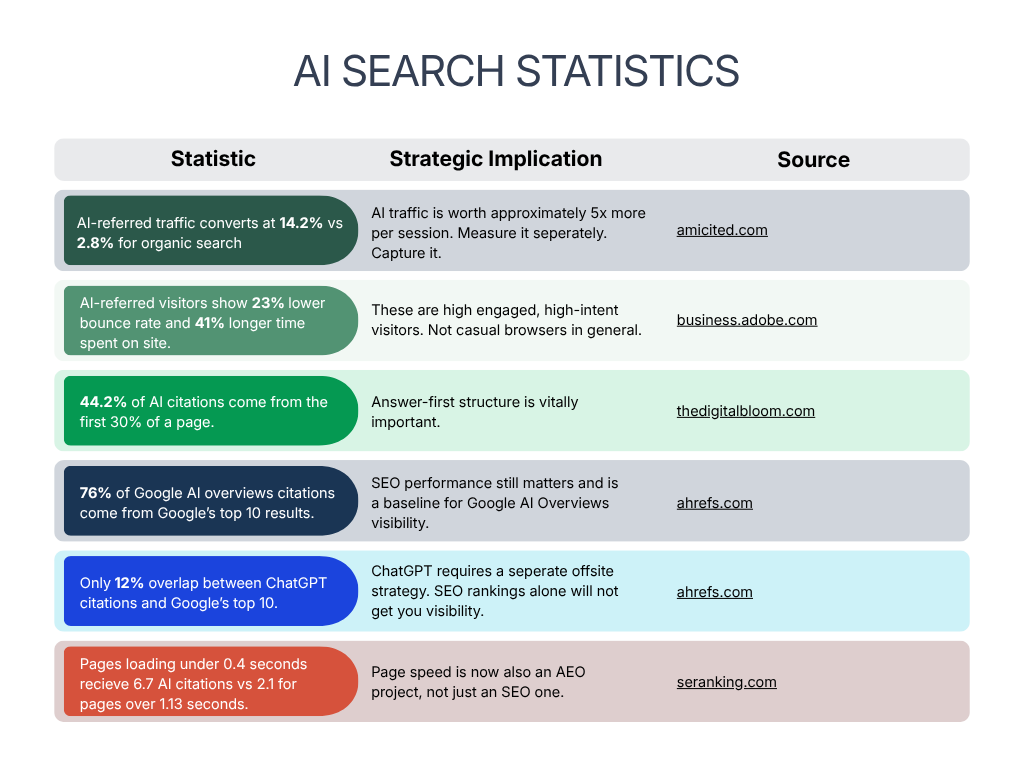
Nog twee cijfers die belangrijk zijn voor de manier waarop je AEO meet:
- De bronnen in ChatGPT-antwoorden overlappen voor slechts 12% met de top 10 van Google. Je Google-posities vertellen dus maar een deel van het verhaal over je zichtbaarheid in ChatGPT. Bij Google AI Overviews is die overlap 76%. Dat maakt AI Overviews een logische eerste stap voor merken die al goed scoren in Google.
- Google AI Overviews en Google AI Mode hebben slechts 13,7% van hun bronvermeldingen gemeen. Het zijn verschillende producten die andere bronnen gebruiken. Meet je ze als één kanaal, dan mis je belangrijke verschillen en kansen.
Hoe bepaalt AI welke bronnen het gebruikt?
Als je begrijpt hoe AI informatie vindt en verwerkt, kun je gerichter optimaliseren. Er zijn drie manieren waarop je merk en content in AI-antwoorden terechtkomen.
Vermeldingen vanuit trainingsdata
Het model noemt je merk op basis van informatie die het tijdens de training heeft opgenomen, vóór de kennisgrens van het model. Dit hoort bij de pijler bekend. Vermeldingen op het web spelen daarbij een rol: Reddit-berichten, YouTube-content, reviews, media-aandacht en forumdiscussies. Je kunt je merk niet rechtstreeks aan de trainingsdata toevoegen. Wel kun je zorgen voor relevante vermeldingen op externe platforms die op termijn in nieuwe trainingsdata terecht kunnen komen.
Retrieval-Augmented Generation (RAG)
Veel AI-antwoorden van ChatGPT, Perplexity en Google AI Overviews maken gebruik van actuele informatie uit het web. Het systeem zoekt relevante pagina’s op en gebruikt die om het antwoord te onderbouwen. Dit hoort bij de pijler betrouwbaar. De structuur van je content, schema markup, laadsnelheid en domeinautoriteit kunnen bijdragen aan de kans dat je als bron wordt gebruikt. Voor marketeers is dit de meest direct beïnvloedbare route: je kunt je pagina’s vandaag al verbeteren.
Entiteitsherkenning
AI-modellen herkennen je merk als een entiteit: een organisatie met specifieke kenmerken. Denk aan je productcategorie, toepassingen, doelgroepen, werkgebied en integratiepartners. Structured data, consistente bedrijfsinformatie, relevante Wikipedia-vermeldingen en betrouwbare beschrijvingen door derden helpen AI je merk correct te plaatsen. Dit verbindt de pijlers bekend en betrouwbaar: hoe duidelijker het systeem begrijpt wie je bent en wat je aanbiedt, hoe gerichter het je kan noemen en als bron kan gebruiken.
Vijf kanalen die bijdragen aan bronvermeldingen in AI
Waar halen AI-systemen hun informatie vandaan? Hieronder lees je welke kanalen belangrijk zijn en hoe je ze gericht inzet.
Kanaal 1: Reddit — circa 40% van de AI-bronvermeldingen
De sterke positie van Reddit heeft te maken met de manier waarop de community informatie beoordeelt. Moderatie en stemmen vormen samen een kwaliteitsfilter. Antwoorden die gebruikers behulpzaam vinden, krijgen meer zichtbaarheid. AI-systemen kunnen die waardering meenemen als signaal van betrouwbaarheid. Veel B2B-marketeers laten Reddit links liggen. Juist daardoor kan er ruimte zijn om binnen jouw categorie een waardevolle bijdrage te leveren.
De aanpak (volgens Ethan Smith van Graphite): Maak één echt account aan en wees duidelijk over wie je bent en waar je werkt. Beantwoord vragen binnen je vakgebied met concrete, bruikbare informatie. Vijf goede reacties in relevante subreddits kunnen al bijdragen aan je AI-zichtbaarheid. Laat automatisering, nepaccounts en verkooppraatjes achterwege.
Waar begin je? Zoek de subreddits waar je potentiële klanten vragen stellen. Voor automotive zijn dat bijvoorbeeld r/whatcarshouldibuy, r/askcarsales en r/cars. Voor reizen: r/solotravel, r/travel en r/travelhacks. Voor B2B SaaS: r/sales, r/marketing en r/entrepreneur. Zoek naar veelgestelde vragen binnen je categorie en draag bij vanuit je eigen expertise.
Wat vermijd je? Reclame vermomd als advies, losse links zonder uitleg en reacties die duidelijk als marketingtekst zijn geschreven. Reddit-gebruikers herkennen verborgen promotie snel. Dat kan je reputatie meer schaden dan helemaal niet deelnemen.
Wil je de volledige aanpak voor LLM seeding op externe kanalen? Lees onze gids: LLM seeding: de complete gids om je merk als bron te laten vermelden in AI-zoekresultaten.
Kanaal 2: YouTube
YouTube behoort regelmatig tot de meest gebruikte brondomeinen in Perplexity en ChatGPT. AI-systemen kunnen informatie halen uit videotranscripties. Bovendien is YouTube nauw verbonden met het zoekecosysteem van Google. Vooral bij specifieke B2B-vragen liggen nog veel kansen. Terwijl merken concurreren om populaire onderwerpen in geschreven content, is het videoaanbod voor specialistische vragen vaak beperkt. Denk aan ‘API’s voor betalingsverwerking met AI’ of ‘HIPAA-conforme transcriptie van vergaderingen voor zorgteams’. Volgens de aangehaalde onderzoeken is de long tail van AEO vier keer zo groot als die van traditionele SEO. Voor veel van die specifieke vragen is er nog weinig videoaanbod.
De aanpak: Kies je twintig belangrijkste clusters van specifieke AEO-vragen. Maak voor elk cluster een gerichte video van vijf tot tien minuten die de hoofdvraag direct beantwoordt. Voeg een volledige, door een mens gecontroleerde transcriptie toe in de beschrijving of in een bijbehorend artikel. Zo bied je zowel de video als doorzoekbare tekst aan als informatiebron.
Kanaal 3: Reviewplatforms
Merken met profielen op Trustpilot, G2 en Capterra hebben volgens onderzoek van SE Ranking uit november 2025 drie keer zoveel kans om door ChatGPT als bron te worden vermeld als merken zonder profiel. Daarbij gaat het ook om het bestaan van een onafhankelijke registratie van je bedrijf. AI-systemen kunnen zulke profielen gebruiken om te herkennen wie je bent en wat je aanbiedt.
De aanpak: Claim je bedrijfsprofiel op de reviewplatforms die relevant zijn voor jouw markt. Zorg voor een nauwkeurige beschrijving, passende categorieën en duidelijke informatie over je functies en diensten. Maak het vragen om reviews onderdeel van je klantproces, bijvoorbeeld via e-mails na aankoop, meldingen in je product of contactmomenten met customer success. Vraag klanten om hun echte ervaring te beschrijven. Gedetailleerde reviews over een specifieke toepassing geven AI meer bruikbare informatie dan een algemene beoordeling.
Kanaal 4: Je helpcentrum
Elke klantvraag aan een AI-tool biedt een kans om als bron te worden gebruikt, mits je een duidelijke pagina hebt die die vraag beantwoordt. Veel bedrijven beschikken al over zulke content, maar hebben die op een los subdomein staan, zoals help.jouwbedrijf.nl, met weinig verbindingen naar de rest van de website.
De aanpak:
- Breng je helpcentrum waar passend onder in een submap, bijvoorbeeld jouwbedrijf.nl/help, zodat het onderdeel is van dezelfde websitestructuur.
- Analyseer de honderd belangrijkste supportvragen en klantvragen van het afgelopen jaar.
- Geef elke vraag een eigen pagina met een direct antwoord in de eerste alinea.
- Leg relevante interne links tussen helpcentrumartikelen en productpagina’s.
- Voeg HowTo- en FAQPage-schema markup toe waar die bij de inhoud passen.
- Hanteer dezelfde redactionele kwaliteit als voor je belangrijkste blogartikelen.
Die investering kan op meerdere vlakken rendement opleveren: meer bronvermeldingen in AI, minder terugkerende supportvragen en betere vindbaarheid bij zoekopdrachten over je product. Ethan Smith van Graphite noemt het de meest onderbenutte kans binnen AEO. (Graphite.io, 2026)
Kanaal 5: Media-aandacht en merkvermeldingen
Media-aandacht vormt een onderbouwing van je merk: onafhankelijke bronnen bevestigen dat je bedrijf bestaat, in welke categorie het actief is en waarom het geloofwaardig is. AI-modellen gebruiken die informatie wanneer ze antwoorden samenstellen over merken die ze niet uit hun trainingsdata kennen. Geef prioriteit aan publicaties die goed zichtbaar zijn binnen jouw categorie. Voor B2B-tech kun je denken aan TechCrunch, VentureBeat, Forbes Tech en Harvard Business Review. Eén inhoudelijk artikel in een gezaghebbende publicatie kan meer invloed hebben op hoe vaak AI je als bron vermeldt dan een jaar aan blogartikelen op je eigen website.
De kans van wederzijdse vermeldingen: Ontwikkel je een integratie of ga je een samenwerking aan? Zorg dan dat die op de websites van beide bedrijven wordt beschreven. AI-modellen kunnen die wederzijdse bevestiging gebruiken om de relatie te herkennen en mee te nemen in aanbevelingen. Zo kan partnershipmarketing rechtstreeks bijdragen aan je AEO-resultaten. (Ethan Smith, Graphite, 2026)

Content op je eigen website optimaliseren: wat werkt voor AI-zoekverkeer?
Met je aanwezigheid op externe kanalen bouw je aan de pijler bekend. De onderstaande verbeteringen op je eigen website versterken de pijler betrouwbaar. Ze helpen AI-systemen je content te vinden, te begrijpen en als bron te gebruiken wanneer ze actuele informatie ophalen.
Regel 1: begin met het antwoord
De belangrijkste structurele regel voor AEO: 44,2% van de bronvermeldingen komt uit de eerste 30% van de tekst op een pagina. Staat je belangrijkste antwoord pas na een lange inleiding, dan verklein je de kans dat het wordt opgepikt. Begin elk onderdeel daarom met een direct antwoord van één of twee zinnen op de vraag in de kop. Daarna volgen de context, nuance en toelichting.
Regel 2: formuleer je tussenkoppen als vragen
AI-systemen gebruiken de koppenstructuur om te bepalen welke vraag een onderdeel beantwoordt. Schrijf je H2- en H3-koppen daarom als de vragen die je doelgroep daadwerkelijk stelt.
- ‘Schema markup’ benoemt alleen het onderwerp.
- ‘Hoe helpt schema markup AI mijn content te begrijpen?’ maakt duidelijk welke vraag je beantwoordt.
Regel 3: geef een definitie in 30 tot 60 woorden
Zet bij belangrijke begrippen een korte definitie direct onder de kop. Een blok van 30 tot 60 woorden geeft AI een compact antwoord dat eenvoudig kan worden overgenomen. Zorg dat die definitie op zichzelf begrijpelijk is, zonder de tekst eromheen. Schrijf het antwoord dat je graag in een AI Overview zou terugzien en gebruik de rest van het onderdeel om dat antwoord te onderbouwen.
Stem je content af op de zoekintentie
Elke fase van het aankoopproces leidt tot andere vragen aan AI. Het juiste contentformat helpt je die vragen duidelijk te beantwoorden.
Vragen in de oriëntatiefase, zoals ‘Wat is X?’ en ‘Hoe werkt X?’, vragen om uitgebreide basisgidsen. Begin met een heldere definitie en werk het onderwerp uit met duidelijke H2-koppen, korte uitlegblokken, veelgestelde vragen en waar passend HowTo-schema. Bij dit soort informatieve vragen verschijnen AI Overviews vaak.
Vragen in de vergelijkingsfase, zoals ‘X versus Y’ en ‘De beste tools voor Z’, vragen om inhoudelijke vergelijkingen. Neem je eigen aanbod mee naast dat van concurrenten en bespreek de verschillen eerlijk en concreet. Uitgebreide, evenwichtige content geeft AI bruikbare informatie om opties te vergelijken. Volgens Lily Ray tijdens BrightonSEO 2025 behoren lijsten met de beste tools binnen een categorie, waarin ook het eigen product wordt opgenomen, momenteel tot de goed presterende AEO-formats.
Vragen in de beslisfase, zoals ‘Werkt X samen met Y?’, ‘Wat kost X?’ en ‘Hoelang duurt het om X in te stellen?’, vragen om helpcentrumartikelen en productpagina’s met concrete antwoorden. Vaak heeft AI die vragen al grotendeels beantwoord voordat iemand doorklikt. Een bezoeker die na een ChatGPT-gesprek op je prijspagina belandt, wil bevestigen dat de oplossing past. Je content moet die laatste controle eenvoudig maken. Lees meer over dit gedrag en de aanpak die daarbij past in Waarom AI-zoekverkeer minder bezoekers oplevert, maar met een sterkere koopintentie.
Specifieke vragen in gesprekstaal, zoals ‘Ik ben de enige oprichter van een startup die onder EU-regelgeving valt. Welke tools en processen heb ik minimaal nodig om aan de regels te voldoen?’, vragen om content die net zo gericht is. Dit soort vragen wordt veel aan AI-tools gesteld, terwijl ze nauwelijks terugkomen in traditionele zoekwoorddata. Daardoor kan de concurrentie beperkt zijn. Verderop, in het onderdeel over long-tailvragen, lees je hoe je die kansen vindt.
Schema markup: een technische basis voor begrijpelijke content
Schema markup is gestructureerde code waarmee je aangeeft wat voor informatie op een pagina staat. Het helpt systemen bijvoorbeeld herkennen dat iets een vraag met antwoord, een stappenplan, een artikel of een product is.
Deze schema-types zijn relevant voor je AEO-aanpak:
- FAQPage: Structureert vragen en antwoorden op pagina’s met een FAQ-onderdeel.
- HowTo: Beschrijft de afzonderlijke stappen van een instructie of proces.
- Article: Legt onder meer de auteur, publicatiedatum en wijzigingsdatum vast.
- Organization: Geeft bedrijfsinformatie door, zoals je naam, beschrijving, website en sociale profielen.
- Product / Review: Structureert product- en reviewinformatie, zoals prijzen, kenmerken en beoordelingen. Vooral relevant voor SaaS en e-commerce, en waar passend voor je dienstenaanbod.
Voor de basis heb je vaak geen developer nodig. Google’s Structured Data Markup Helper kan helpen de code te genereren. Plugins zoals Yoast en Rank Math nemen een deel van de implementatie automatisch voor hun rekening.
Volgens de aangehaalde analyse hebben pagina’s met schema markup 60% meer kans om in AI Overviews te verschijnen dan vergelijkbare pagina’s zonder gestructureerde data. Voor de volledige technische aanpak voor Google AI Overviews lees je Zo krijg je jouw merk in Google AI Overviews: de gids voor 2026.
Long-tailvragen: waar de grootste AEO-kansen liggen
De long tail van AEO is vier keer zo groot als die van traditionele SEO. Vragen aan ChatGPT bevatten gemiddeld meer dan 25 woorden, tegenover zes woorden bij zoekopdrachten in Google. Veel AEO-gidsen richten zich op brede zoektermen zoals ‘beste CRM-software’. Daar is de concurrentie groot. Interessante kansen liggen juist bij vragen die zo specifiek zijn dat traditionele zoekwoordtools ze nauwelijks laten zien:
- ‘Welke projectmanagementtools werken met Notion en hebben een gratis abonnement voor teams van minder dan tien mensen?’
- ‘Welke elektrische auto onder de 350.000 Deense kronen heeft op dit moment het beste privateleaseaanbod?’
- ‘Ik ben de enige oprichter van een startup die onder EU-regelgeving valt. Welke tools en processen heb ik minimaal nodig om aan de regels te voldoen?’
Dit soort vragen wordt dagelijks duizenden keren aan AI-tools gesteld, terwijl nog maar weinig bedrijven er gericht content voor maken.
Zo vind je specifieke AEO-vragen:
- Analyseer de zoekwoorden waarop je concurrenten adverteren. Ze laten zien welke vragen commercieel relevant zijn en waarschijnlijk ook aan AI worden gesteld.
- Stel vragen aan AI-tools vanuit de situatie van je ideale klant. Noteer welke vervolgvragen tijdens het gesprek ontstaan.
- Analyseer je supportvragen. Daar verwoorden klanten concreet wat ze willen weten.
- Gebruik AnswerThePublic en AlsoAsked als vertrekpunt. Werk de gevonden vragen vervolgens uit met de specifiekere vervolgvragen die iemand in een AI-gesprek zou stellen.
Zo maak je er content voor: Maak een eigen pagina voor elk belangrijk cluster van samenhangende vragen. Beantwoord de hoofdvraag in de eerste alinea. Werk daarna de drie tot vijf meest waarschijnlijke vervolgvragen uit in afzonderlijke onderdelen. Zo sluit je pagina aan op het verloop van een AI-gesprek en kan die als bron dienen voor meerdere stappen in dat gesprek.
Laadsnelheid: een AEO-factor die veel marketeers over het hoofd zien
Pagina’s met een First Contentful Paint onder 0,4 seconden krijgen gemiddeld 6,7 AI-bronvermeldingen. Bij pagina’s boven 1,13 seconden is dat gemiddeld 2,1: een verschil van ruim een factor drie (SE Ranking). Die samenhang maakt laadsnelheid een relevant aandachtspunt voor je AEO-aanpak. Zorg dat belangrijke content snel beschikbaar is en dat crawlers je pagina’s goed kunnen verwerken. Verbeteringen aan je Core Web Vitals ondersteunen daarmee zowel de gebruikerservaring als je bredere zoekstrategie.
Houd je content actueel
Uit Ahrefs’ analyse van veranderingen in AI Overviews bleek dat vernieuwde content binnen enkele weken nieuwe bronvermeldingen kon opleveren. Plan daarom regelmatige controles voor de pagina’s die het vaakst als bron worden gebruikt. Let op verouderde cijfers, achterhaalde uitspraken en onderwerpen waarbij nieuwe ontwikkelingen om extra uitleg vragen. Controleer je twintig belangrijkste pagina’s minimaal elk kwartaal. Voeg nieuwe gegevens toe, werk vergelijkingen bij en controleer of de links naar je bronnen nog werken. Pas de publicatie- of wijzigingsdatum alleen aan wanneer de inhoud daadwerkelijk is vernieuwd. Alleen een nieuwe datum maakt je content niet actueler.
Optimaliseren per AI-platform
AI-platforms verschillen in de bronnen die ze gebruiken. Stem je aanpak daarom af op de platforms waarop je zichtbaar wilt zijn.
Een belangrijk onderscheid: Google AI Overviews en Google AI Mode hebben slechts 13,7% van hun bronvermeldingen gemeen. Resultaten in het ene product zeggen dus weinig over je dekking in het andere. Meet en optimaliseer ze afzonderlijk.
ChatGPT: geef externe zichtbaarheid prioriteit
Reddit speelt een grote rol in de bronnen die ChatGPT gebruikt, gevolgd door Wikipedia, grote reviewplatforms en gezaghebbende publicaties. Veel B2B-marketeers zijn op Reddit nauwelijks actief. De overlap van slechts 12% met Googles top 10 laat bovendien zien dat je Google-posities maar beperkt voorspellen hoe zichtbaar je in ChatGPT bent. Een gerichte strategie voor vermeldingen buiten je eigen website is daarom belangrijk.
Onderzoek van Growth Memo uit februari 2026 laat zien dat ChatGPT vaker content gebruikt met duidelijke, stellige formuleringen, vragen en eenvoudige zinsstructuren. Ook content waarin relevante merken, producten, personen en begrippen expliciet worden genoemd, komt vaker terug. Na de update van oktober 2025 noemt ChatGPT gemiddeld drie tot vier merken per antwoord, tegenover zes tot zeven daarvoor. Daarmee is de concurrentie om elke vermelding toegenomen.
Google AI Overviews: bouw voort op je SEO
Voor merken die al goed scoren in Google zijn AI Overviews een toegankelijk vertrekpunt. De overlap van 76% met de top 10 betekent dat je bestaande SEO-investering hier waarde houdt. De aandachtspunten zijn vertrouwd: aantoonbare expertise, betrouwbare auteurs, gestructureerde data en actuele content. Volgens het aangehaalde onderzoek verschijnen AI Overviews bij ongeveer 30% van de zoekopdrachten, tegenover de 50% die vaak wordt genoemd. Ze komen vooral voor bij informatieve vragen. Commerciële zoekopdrachten en zoekopdrachten die direct op een aankoop zijn gericht, worden veel minder geraakt. (Graphite). Wil je met één AI-platform beginnen en heb je al sterke Google-posities? Dan zijn AI Overviews een logische keuze.
Lees voor de volledige technische aanpak Zo krijg je jouw merk in Google AI Overviews: de gids voor 2026.
Perplexity: duidelijke bronnen en onderbouwing
Perplexity trekt veel onderzoekers en professionals die informatie snel willen controleren. Content met een duidelijke onderzoeksmethode, originele gegevens en transparante bronverwijzingen sluit goed aan op die behoefte. Van de hier vergeleken zelfstandige AI-platforms heeft Perplexity de grootste overlap met Googles top 10: 28%. Daardoor kan het een toegankelijk kanaal zijn voor merken die al een redelijke tot sterke SEO-positie hebben.
Hoe meet je AEO-resultaten?
Zoekwoordposities, organisch verkeer en klikpercentages laten zien hoe je SEO presteert. Voor AEO heb je aanvullende metingen nodig: hoe vaak verschijnt je merk in AI-antwoorden, wat doen bezoekers vervolgens op je website en wat levert dat op?
Niveau 1: zichtbaarheid
Deze cijfers laten zien hoe aanwezig je merk is in AI-antwoorden.
Share of Voice (SOV): Hoe vaak wordt jouw merk genoemd in antwoorden binnen je categorie, vergeleken met concurrenten? Dit is een belangrijke maatstaf om je concurrentiepositie te volgen. Je kunt die meten met Profound, Peec AI, Otterly of andere tools voor AI-zichtbaarheid.
Zichtbaarheidsscore: Stel een vaste lijst samen van 50 tot 100 vragen die je ideale klant aan AI zou kunnen stellen. Test die wekelijks op verschillende platforms en volg hoe vaak je merk in de antwoorden verschijnt.
Sentiment en positie in het antwoord: Wordt je merk positief, neutraal of negatief beschreven? Ben je de eerste aanbieder die wordt genoemd, of sta je helemaal onderaan? Zowel de formulering als de plek in het antwoord kan beïnvloeden of iemand verder kijkt.
Pagina’s die als bron worden gebruikt: Welke pagina’s haalt AI aan? Als het systeem verwijst naar een verouderde klantcase of onjuiste prijzen, wil je dat weten voordat het tot verwarring leidt in een verkoopgesprek.
Niveau 2: attributie
Deze metingen laten zien wat er gebeurt nadat iemand vanuit een AI-platform op je website terechtkomt.
Verkeer per AI-bron: Maak aangepaste kanaalgroepen in GA4 voor onder meer perplexity.ai, chatgpt.com, claude.ai en gemini.google.com. Bekijk de resultaten wekelijks, zodat je veranderingen tijdig opmerkt.
AEO Traffic Quality (ATQ): Cijfers zoals pagina’s per bezoek en sessieduur worden vaak beoordeeld vanuit een lang oriëntatieproces. Een bezoeker die via AI binnenkomt, kan juist snel de benodigde bevestiging vinden en direct een aanvraag doen. Een kort bezoek hoeft dan geen lage betrokkenheid te betekenen. Het ATQ-framework helpt je de kwaliteit van dit verkeer te beoordelen met vijf meetpunten: tijd tot conversie, pagina’s per bezoek uitgesplitst naar bron, conversiepercentage per AI-platform, demo- en directe aanvragen, en het percentage bezoekers dat een chatgesprek begint. De volledige aanpak lees je in Waarom AI-zoekverkeer minder bezoekers oplevert, maar met een sterkere koopintentie.
Landingspagina’s: Op welke pagina’s komen bezoekers uit AI-platforms binnen? Vergelijk dit met de pagina’s die je monitoringtool als bronnen registreert. Verschillen tussen beide kunnen aanleiding zijn om verder te onderzoeken.
Niveau 3: bedrijfsresultaat
Deze cijfers verbinden AEO met leads, klanten en omzet.
Conversiepercentage van AI-verkeer: Gebruik het genoemde gemiddelde van 14,2% als referentiepunt en beoordeel het naast je eigen markt, conversiedoelen en verkeersvolume. Blijft je conversie achter? Onderzoek dan of je landingspagina’s aansluiten op bezoekers met concrete koopvragen en of zij snel hulp kunnen krijgen van medewerkers die gespecialiseerd zijn in leadgenerering. Presteert het verkeer goed, dan kun je gericht werken aan meer bereik.
Leadkwaliteit: Volg de kwaliteit van leads uit AI-platforms, de lengte van hun verkooptraject en hun klantwaarde afzonderlijk van andere organische en betaalde bronnen. Zo kun je onderbouwen wat verdere investeringen in AEO opleveren.
Omzetattributie: Rapporteer AI-verkeer afzonderlijk, zodat de resultaten zichtbaar blijven binnen je kanaalanalyse. Volg leads waar mogelijk door tot de uiteindelijke omzet.
Wekelijks meten en bijsturen
De bronnen die grote AI-platforms gebruiken, kunnen van maand tot maand sterk veranderen. De genoemde maandelijkse verschuiving ligt tussen de 40 en 60%. Plan daarom een wekelijkse controle van ongeveer 30 minuten. Bekijk je zichtbaarheidsscores, verkeer uit AI-platforms en opvallende veranderingen in bronvermeldingen. Zo kun je dalingen vroeg signaleren en onderzoeken of ze samenhangen met nieuwe content van concurrenten, een platformupdate of verouderde informatie op je eigen website.
Hoe zet je AI-zichtbaarheid om in omzet?
Wanneer een AI-tool iemand naar je website stuurt, moet de ervaring aansluiten op de vragen en verwachtingen die tijdens het gesprek zijn ontstaan.
Begrijp wat deze bezoekers verwachten. Ze hebben al vragen gesteld, een antwoord gekregen waarin je merk werd genoemd en vervolgens doorgeklikt. Vaak zijn ze al ver in hun keuzeproces en zoeken ze vooral bevestiging. Laat je landingspagina’s daarop aansluiten. Geef concrete informatie, relevante toepassingen en bewijs dat je oplossing past bij hun situatie. Voor een uitgebreide analyse van dit gedrag en de aanpak die daarbij hoort, lees je Je website is niet gebouwd voor de bezoekers die AI je stuurt.
.png)
Zorg dat bezoekers dag en nacht antwoord kunnen krijgen. AI-zoekgedrag houdt zich niet aan kantooruren. Iemand die op zondagavond om 22.00 uur via ChatGPT jouw product ontdekt en doorklikt, wil op dat moment verder. Met bemand livechat kun je die interesse direct opvangen. Experts in leadgenerering, ondersteund door AI en duidelijke afspraken over het overdragen van gesprekken, helpen bezoekers de volgende stap te zetten wanneer hun koopintentie sterk is.
Maak content die de volgende vraag beantwoordt. Wanneer AI je pagina als bron gebruikt, heeft de bezoeker al een antwoord gekregen. De volgende pagina moet aansluiten op wat diegene daarna wil weten. Breng die vervolgstappen net zo zorgvuldig in kaart als de landingspagina’s achter je zoekadvertenties.
Volg leads uit AI-platforms tot aan de omzet. De genoemde vijf keer hogere conversie ten opzichte van organisch Google-verkeer krijgt pas waarde als je die in je eigen resultaten kunt terugzien. Gebruik vaste UTM-afspraken voor links die je zelf beheert, registreer de AI-bron waar mogelijk in je CRM en volg de lead tot een afgeronde verkoop. Daarmee onderbouw je het AEO-budget voor volgend jaar.
Aan de slag: welke AEO-acties pak je eerst op?
Begin je vanaf nul met AEO? De onderstaande volgorde helpt je een basis op te bouwen waarop elke volgende stap voortbouwt. Zo versterken je inspanningen elkaar en groeit het rendement in de loop van de tijd.
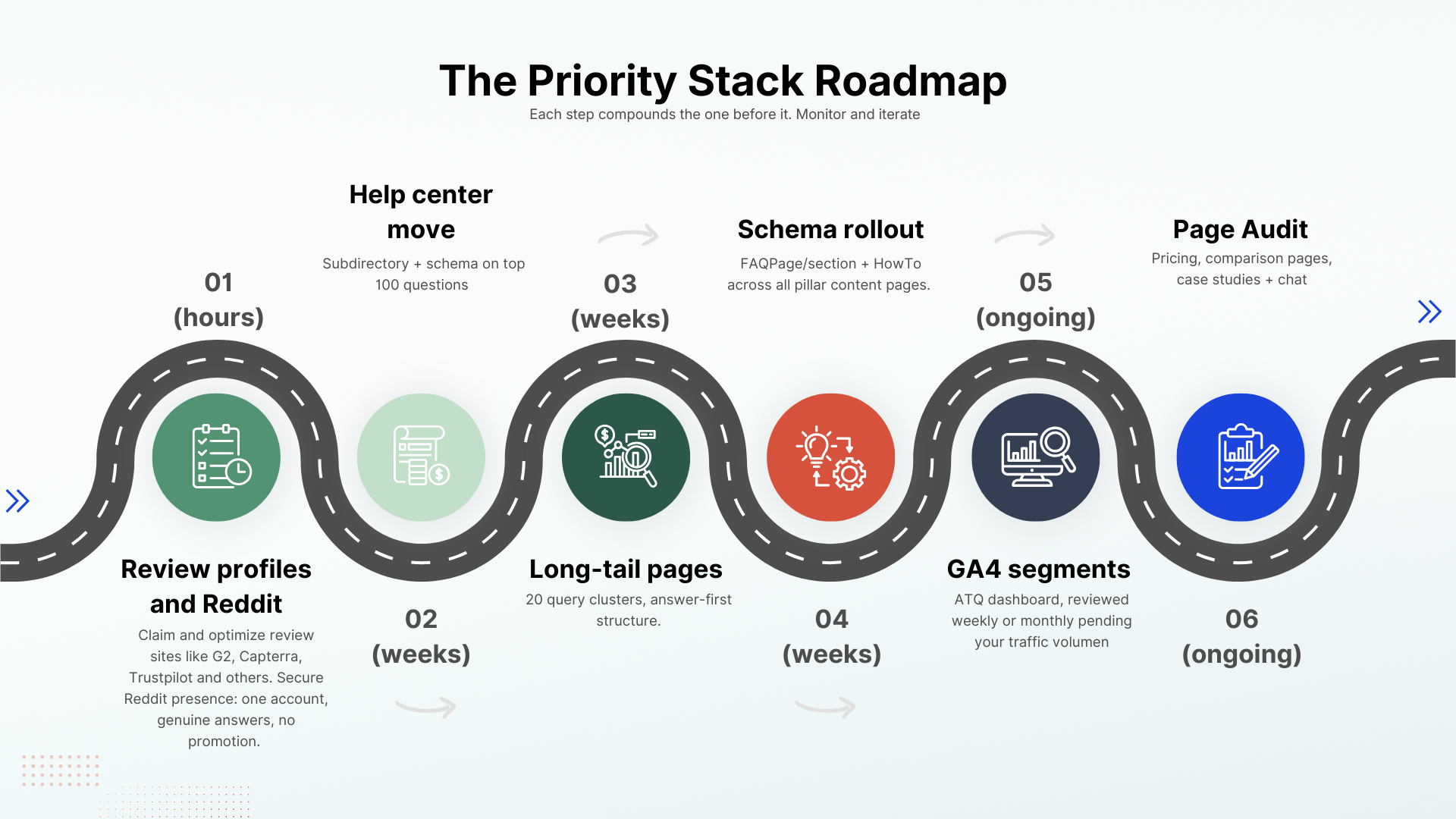
Stap 1. Claim en optimaliseer je profielen op relevante reviewplatforms. Begin met Trustpilot, G2, Capterra en reviewplatforms die belangrijk zijn binnen jouw branche. Een basisprofiel aanmaken kost meestal weinig tijd en helpt je bedrijfsinformatie op meerdere plekken beschikbaar te maken. Zorg dat beschrijvingen, functies en categorieën nauwkeurig zijn en overeenkomen met de informatie op je eigen website. Consistente informatie helpt AI-systemen je merk te herkennen en correct te beschrijven.
Stap 2. Breng je helpcentrum onder in een submap en structureer je honderd belangrijkste klantvragen. Een helpcentrum op jouwbedrijf.nl/help maakt het eenvoudiger om de content te verbinden met de rest van je website. Analyseer je belangrijkste supportvragen en geef elke relevante vraag een eigen pagina, met een direct antwoord in de eerste alinea. Voeg waar passend FAQPage- en HowTo-schema toe en leg interne links naar relevante productpagina’s. Na een nieuwe crawl kunnen zulke verbeteringen binnen enkele weken zichtbaar worden in bronvermeldingen.
Stap 3. Bouw een oprechte aanwezigheid op Reddit op. Gebruik één account en wees open over wie je bent en waar je werkt. Geef wekelijks vijf inhoudelijke, bruikbare antwoorden in de subreddits waar je doelgroep vragen stelt. Richt je op helpen, zonder promotie of links naar je eigen content. Veel bedrijven slaan dit kanaal over omdat het niet bij hun gebruikelijke marketingaanpak past. Juist daar kan ruimte liggen om met je expertise bij te dragen.
Stap 4. Maak pagina’s voor je twintig belangrijkste clusters van specifieke vragen. Gebruik de aanpak uit het onderdeel over long-tailvragen: analyseer betaalde zoekwoorden van concurrenten, voer AI-gesprekken vanuit de situatie van je ideale klant en onderzoek supportvragen. Maak per cluster een pagina die de hoofdvraag direct beantwoordt en daarna drie tot vijf logische vervolgvragen behandelt. Daarmee richt je je op concrete behoeften waarvoor vaak nog weinig goede content beschikbaar is.
Stap 5. Voeg passende schema markup toe aan je belangrijkste gidsen. Breid de aanpak uit je helpcentrum uit naar je blog en uitgebreide basisartikelen. Structureer veelgestelde vragen met FAQPage-schema en stappenplannen met HowTo-schema waar dat aansluit op de inhoud. Neem dit op in je publicatieproces, zodat nieuwe en bijgewerkte content dezelfde structuur krijgt.
Stap 6. Maak GA4-segmenten voor AI-verkeer en bekijk je ATQ-cijfers wekelijks. Maak afzonderlijke segmenten voor chatgpt.com, perplexity.ai, claude.ai, gemini.google.com en grok.com. Bouw het dashboard met de vijf ATQ-meetpunten uit Waarom AI-zoekverkeer minder bezoekers oplevert, maar met een sterkere koopintentie. Bekijk het wekelijks om veranderingen vroeg te herkennen en het resultaat van je inspanningen te volgen.
Stap 7. Controleer of je belangrijkste conversiepagina’s aansluiten op bezoekers uit AI-platforms. Begin met prijs-, vergelijkings- en klantcasepagina’s. Beantwoordt de pagina de laatste vraag van iemand die bijna klaar is om te beslissen? Kan die bezoeker direct spreken met een medewerker die de situatie begrijpt en helpt bij de volgende stap?
Ontbreekt een van beide, dan laat je mogelijk waardevolle aanvragen liggen. Verbeter eerst de opvang van het verkeer dat je al hebt. Weply helpt je die interesse om te zetten in gekwalificeerde leads.
AEO-trends voor de komende achttien maanden
AI verwerkt steeds meer soorten content. Naast tekst gebruiken AI-systemen ook beelden, audio en video. Zorg voor beschrijvende alt-teksten die de inhoud van afbeeldingen duidelijk weergeven. Voeg volledige, doorzoekbare transcripties toe aan video’s en geef podcasts een eigen transcriptiepagina. Zo maak je je informatie toegankelijk in meerdere formats.
AI-antwoorden worden persoonlijker. AI-tools stemmen antwoorden steeds vaker af op eerdere gesprekken, voorkeuren en de situatie van de gebruiker. Daardoor wordt herkenbare expertise binnen een duidelijk onderwerp belangrijker. Een samenhangend aanbod van diepgaande content helpt je merk een duidelijke positie op te bouwen.
AI-agents gaan ook acties uitvoeren. De volgende stap is dat AI een demo boekt, een proefaccount aanmaakt of een aankoop start. Daarvoor moeten productinformatie, prijzen en functies duidelijk en machineleesbaar beschikbaar zijn. Voor sommige bedrijven wordt ook toegang tot catalogusgegevens via een API relevant. Begin met het op orde brengen van die basis.
Branchespecifieke AI-platforms groeien. Voor onder meer juridische dienstverlening, zorg, financiën en techniek ontstaan steeds meer gespecialiseerde AI-tools. Onderzoek welke tools jouw klanten gebruiken en welke bronnen die platforms raadplegen. Hun bronselectie kan sterk verschillen van die van algemene AI-assistenten.
AEO wordt beter meetbaar. Waar metingen in 2024 vaak handmatig gebeurden, bieden platforms als Profound, Peec AI en AthenaHQ inmiddels systematische monitoring. Kies een tool die past bij je belangrijkste platforms, vragen en budget. Voor veel teams is een betaalbare basisoplossing voldoende om te beginnen. Grotere organisaties met uitgebreide AEO-programma’s hebben mogelijk meer diepgang en rapportagemogelijkheden nodig.
Veelgestelde vragen
Is AEO hetzelfde als GEO (Generative Engine Optimization)?
De termen worden grotendeels door elkaar gebruikt en beschrijven dezelfde discipline: optimaliseren voor AI-antwoorden. Sommige specialisten gebruiken GEO specifiek voor generatieve AI-tools. In de praktijk kun je ze als synoniemen behandelen. Je aanpak is belangrijker dan het label.
Als ik op nummer één sta in Google, noemt ChatGPT mij dan ook als bron?
Dat is geen garantie. De bronnen in ChatGPT-antwoorden overlappen voor slechts 12% met Googles top 10. Hoge Google-posities helpen aanzienlijk bij Google AI Overviews, waar de overlap 76% is, maar voorspellen veel minder goed je zichtbaarheid in ChatGPT of Perplexity. Voor AI-platforms buiten Google heb je daarom een gerichte AEO-aanpak nodig die verder gaat dan je gebruikelijke SEO-strategie.
Moet ik eerst optimaliseren voor ChatGPT of Google AI Overviews?
Dat hangt af van je uitgangspositie. Scoor je al goed in Google? Begin dan met AI Overviews. De overlap is groot en je kunt voortbouwen op je bestaande SEO-investering. Voor een nieuw merk zonder sterke Google-posities kunnen ChatGPT en Perplexity meer kansen bieden. De aanpak voor Reddit en content uit deze gids is dan een logisch vertrekpunt.
Hoe vaak verandert AI de bronnen die het gebruikt?
Regelmatig. Ook voor dezelfde vraag kunnen de bronnen in AI Overviews van maand tot maand sterk verschillen. Bij grote AI-platforms verandert maandelijks 40 tot 60% van de bronvermeldingen. Daarom vraagt AEO om doorlopende monitoring. Een pagina die vorige maand werd aangehaald, kan deze maand ontbreken. Plan dus een wekelijkse meting.
Werkt AEO ook voor kleine teams?
Ja. Kleine teams kunnen met specifieke expertise en de juiste kanalen relatief snel zichtbaar worden. Bij traditionele SEO kan het maanden of jaren duren om domeinautoriteit op te bouwen. Een nieuw merk dat vandaag in een relevante Reddit-discussie wordt genoemd, kan al snel in een ChatGPT-antwoord verschijnen. Ethan Smith van Graphite benadrukt dat ook jonge startups kansen hebben binnen AEO, als ze in de juiste kanalen investeren. (Graphite.io, 2026)
Welke AEO-actie levert een klein team dit kwartaal het meeste op?
Breng je helpcentrum onder in een submap en geef elke veelgestelde klantvraag een eigen, goed gestructureerde pagina met passende schema markup. Daarmee maak je bestaande productkennis beter vindbaar en bruikbaar voor AI. Voor bedrijven die al een product en klanten hebben, is dit een van de meest onderbenutte AEO-kansen. De waarde groeit naarmate je meer relevante vragen beantwoordt.
Is Reddit echt belangrijk voor B2B-merken?
Ja. Reddit overslaan omdat het niet bij je merk lijkt te passen, kan betekenen dat je waardevolle gesprekken mist. In subreddits zoals r/sales, r/marketing en gespecialiseerde communities delen kopers hun ervaringen en stellen ze concrete vragen. Door daar open en behulpzaam aan bij te dragen, bouw je tegen relatief lage kosten aan je zichtbaarheid en geloofwaardigheid.
Kan AEO mijn traditionele SEO-posities schaden?
De belangrijkste contentverbeteringen voor AEO ondersteunen ook SEO: directe antwoorden, een duidelijke structuur, passende schema markup, actuele informatie en aantoonbare expertise. In de meeste gevallen versterken die verbeteringen beide. SEO en AEO hebben dezelfde inhoudelijke basis, al verschillen de platforms en de manier waarop ze informatie presenteren.
Wanneer stoppen manipulatieve AEO-tactieken met werken?
Experts verwachten dat dit stapsgewijs gebeurt. Duidelijke manipulatie wordt waarschijnlijk als eerste aangepakt. Subtielere tactieken, zoals vergelijkingslijsten waarin het eigen product staat, wederzijdse vermeldingen en het actief verzamelen van reviews, kunnen langer effectief blijven. Bouw je strategie daarom op echte expertise, eerlijke vergelijkingen, authentieke reviews en aantoonbare relaties. Zo blijft je zichtbaarheid geloofwaardig wanneer platforms hun aanpak aanscherpen.
Blijf bouwen aan vertrouwen
AEO vraagt om een blijvende investering in de kwaliteit en betrouwbaarheid van je merk als informatiebron.
Merken die daar systematisch aan werken, versterken zowel hun eigen content als hun aanwezigheid op externe platforms. Ze meten wekelijks, leren van verschillen tussen AI-tools en zorgen dat bezoekers op hun website direct verder kunnen met hun vragen. Zo zetten ze AI-zichtbaarheid om in concrete commerciële kansen.
Je hebt de aanpak nu in handen. Begin vandaag, zodat je de komende achttien maanden zelf een positie opbouwt in plaats van te zien hoe concurrenten die innemen.
![Zo krijg je jouw merk in Google AI Overviews [update 2026]](https://cdn.prod.website-files.com/687998866aa498f98160dbb6/69a6d966299d1892b3fc1f8c_Blog_post_header_AI_Overviews.png)
![LLM seeding: de complete gids om je merk als bron te laten vermelden in AI-zoekresultaten [2026]](https://cdn.prod.website-files.com/687998866aa498f98160dbb6/6a8630ea63f85f3d690eeaab_llm-seeding-guide.png)