Strategy, data and guidance on driving the right traffic, converting it, and making the most of every lead. From a team doing it every day across 2500+ BtB and BtC companies.
October 5, 2026
|
9
min
How to Find Your Website's Lead Conversion Leaks with ChatGPT [including 8 prompts to use]
The Problem Most Businesses Never Audit
Traffic goes up. Leads stay flat. You've tried new headlines, changed the button colour, maybe swapped the hero image. Nothing moves the needle. Here's what usually isn't happening: a proper audit of the full path a visitor takes from landing on your homepage to becoming a lead.
The average website converts 2 to 3 percent of its visitors. The top performers convert 8 to 15 percent. The gap between those two numbers is often not better traffic or smarter ads. It's fewer leaks in the conversion path. A leak is any point where a motivated visitor quietly exits without taking the action you need them to take.
Leaks hide in obvious places: a form with no clear next step, a contact page stripped of any reason to trust you, a service page that doesn't match what the homepage promised. They also hide in less obvious ones: a visitor arriving at 9 PM with a genuine need and nowhere to turn, or a buyer who just came from an AI search tool mid-conversation and landed on a static brochure page with a contact form at the bottom and a phonenumber in the menu bar.
Most businesses have never audited for these problems systematically. They've looked at individual pages. They haven't looked at the path. This guide changes that. Eight prompts, one conversation thread with an AI, your own screenshots.
Why Listen to Us?
Weply has in 2025 alone generated over 250,000 qualified leads on behalf of 2,400+ customers across the Nordics and Europe. We've been doing this since 2013, across industries ranging from dental chains to insurance companies to fast-growing scaleups, to telco enterprises and so on.
We know what breaks conversion paths because we watch them break in real time.
Our chat consultants, backed by AI, handle the questions visitors can't get answered on a website. They capture the leads that forms lose. Across our customer base, adding managed chat produces an average 12% lift in lead conversion, and one in three chat conversations becomes a qualified lead. That data is the foundation for everything you're about to audit.
Why Use AI for This, and What You'll Need
A conversion specialist can audit your website for between EUR 3,000 and 8,000. They'll spend four to six weeks on it and deliver a PDF. The audit will be thorough, and for complex e-commerce operations, it's probably worth every cent. For most service businesses, you can surface minimum 80% of the same findings in 30 minutes using an AI. Here's why it works: AI evaluates your pages the way a first-time visitor does, without the curse of knowledge. You've looked at your homepage so many times you no longer see it. AI reads it cold. It also audits paths as sequences, which means it catches the friction that lives between pages, not just on them.
One honest caveat: this works well for service and product businesses with a clear conversion path. If you're running a complex multi-product e-commerce operation, a full specialist audit will find things this process won't. For everyone else, 30 minutes is enough to find what's bleeding leads.
What you'll need:
ChatGPT Plus, Team, or Claude Pro (the free tier works, with limitations on image uploads)
A browser
A full-page screenshot tool (GoFullPage for Chrome, Firefox's built-in screenshot function, or use mulitple screenshot directly from Claude)
30 minutes
Optional: GA4 access for one advanced prompt
Before You Start: Four Preparation Steps
Step 1: Map your conversion path. For most businesses this is Homepage, Service/Product Page, Pricing Page, Contact Page. If you're unsure which pages matter most, open GA4, go to Explore, and check the path exploration report. Three to five pages is enough to work with. Step 2: Take full-page screenshots of each page in sequence. Full-page, not just the top fold. You need the AI to see the whole page. Step 3: Screenshot your lead form and your confirmation page. The confirmation page matters because it tells you, and the AI, what promise you make to someone after they submit. Step 4: Open a new conversation in ChatGPT or Claude, upload all screenshots together, and add this context: You are a senior conversion rate optimisation specialist with experience auditing business websites. These are screenshots of my website pages in the order a visitor would see them. My business is [type of business]. My goal is to generate [desired action: enquiries / consultations / quote requests]. I'll be asking you to audit specific aspects of these pages.
Set this context once at the start. Every prompt that follows builds on it.
The Prompt Library
Eight prompts. Run them in sequence in the same conversation thread. Each builds on what came before.
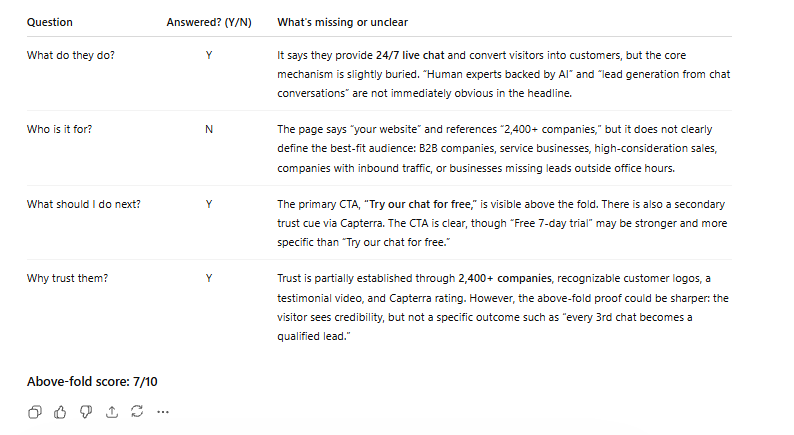
Prompt 1: The First-Impression Test (copy this exact prompt) # First-Impression Audit ## Context Visitors decide within 5 to 10 seconds whether to stay or leave. This audit evaluates what's communicated before any scrolling. ## Your task Look at the first screenshot only (homepage or landing page). Based exclusively on what's visible above the fold, answer:
1. Clarity — What does this company do? 2. Audience — Who is it for? 3. Action — What should I do next? 4. Trust — Why should I believe them?
## Output format | Question | Answered? (Y/N) | What's missing or unclear | |----------|:---:|---------------------------| | What do they do? | | | | Who is it for? | | | | What should I do next? | | | | Why trust them? | | | Above-fold score: X/10
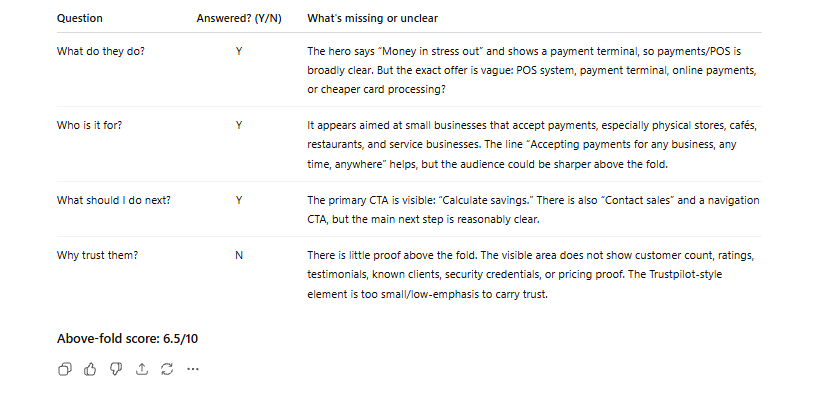
What this reveals: The failure we see most often across service websites is in row three of that table: "What should I do next?" Businesses build strong hero sections explaining what they do, then offer no visible next step. No CTA above the fold. No invitation to start a conversation. The visitor who wants to engage has to scroll, navigate, and figure the path out alone. Every step of effort they have to put in is a point where you can lose them. The good news is this is the quickest fix in the whole audit. A clear, visible CTA above the fold costs nothing to add and almost always moves conversion numbers.
Example from running the prompt on Weply's homepage
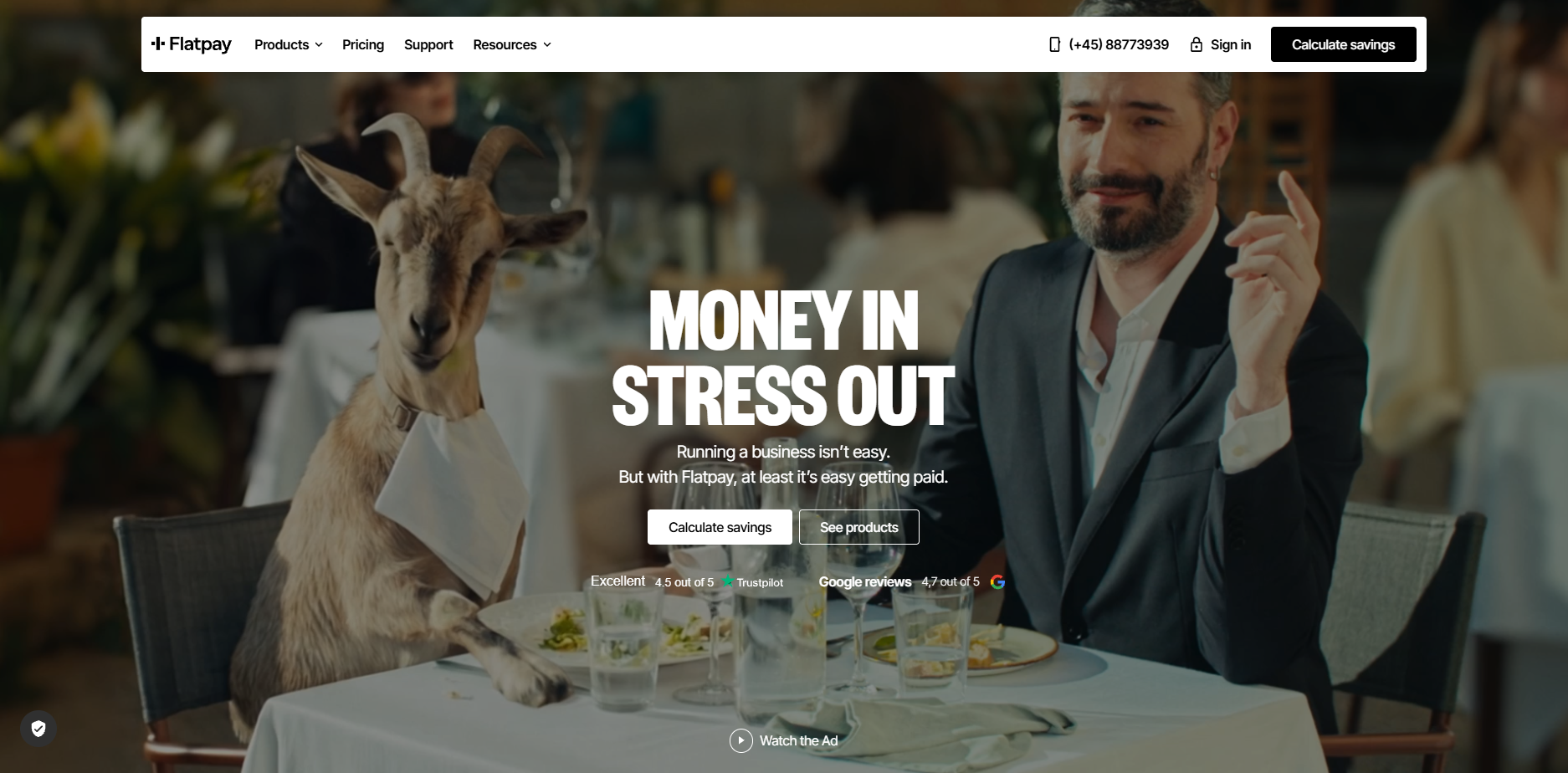
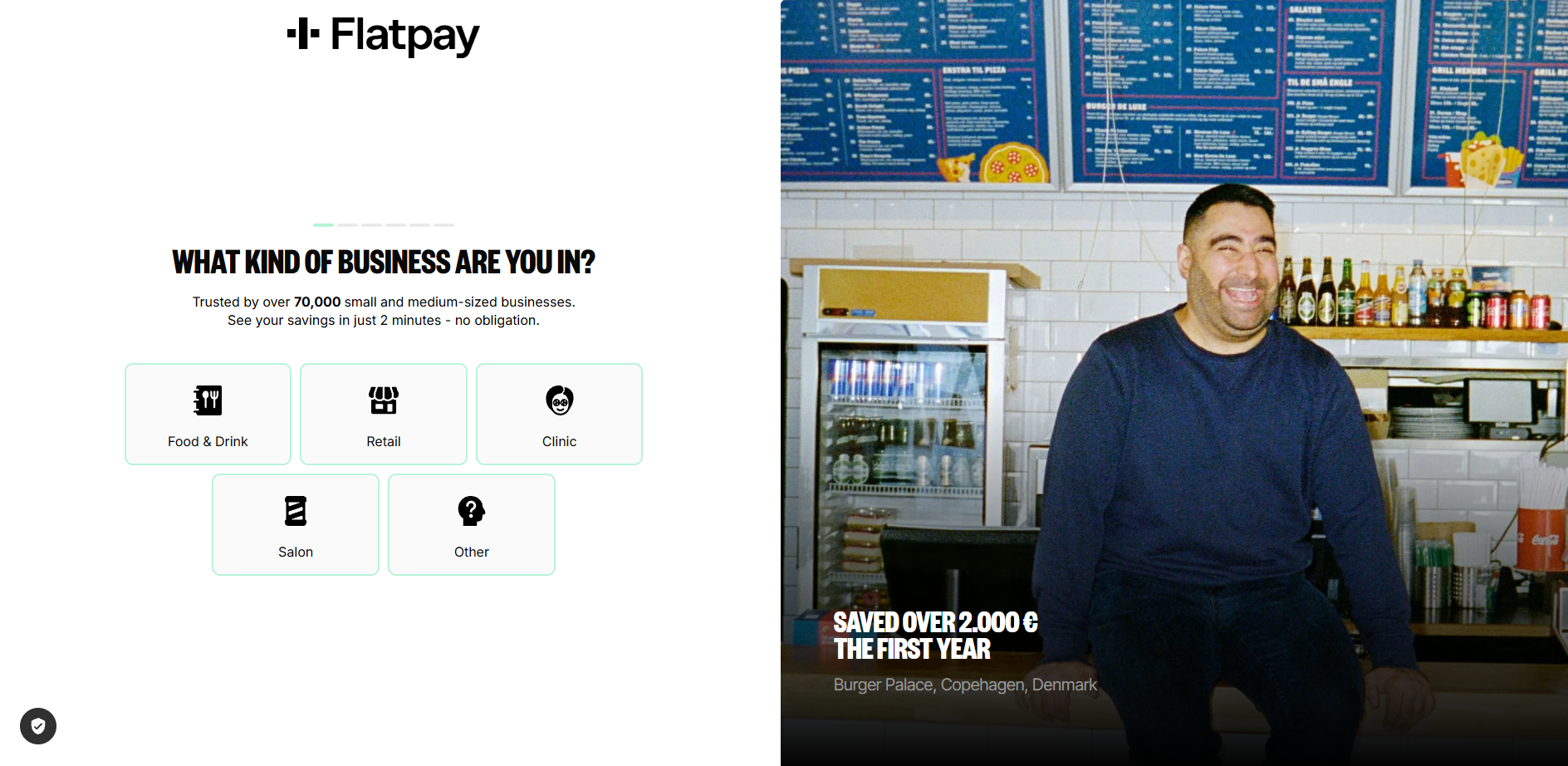
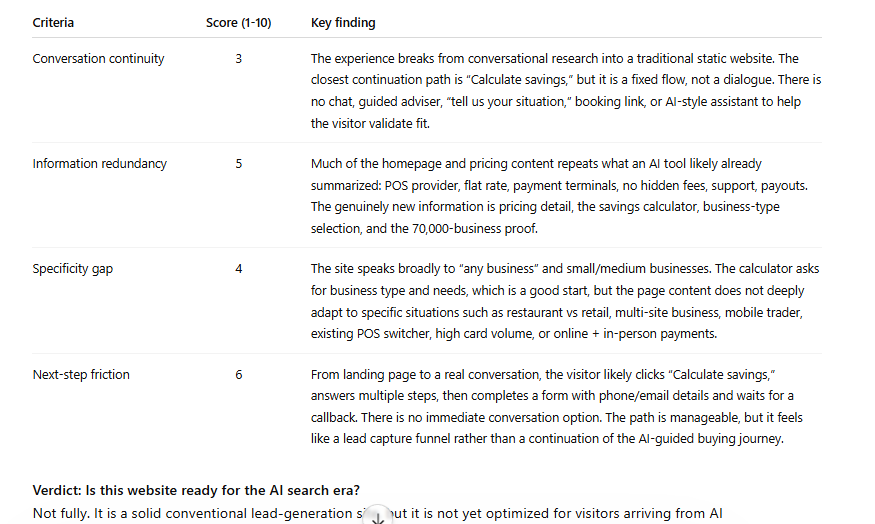
Now what we did was to run the full series of prompts on one of the most succesful current scaleups in Europe and one of the best at digital marketing, Flatpay.
This is the result from the first prompt:
Prompt 2: The Conversion Path Coherence Audit # Conversion Path Coherence Audit ## Context These pages form a sequence that visitors move through. The biggest conversion leaks often live between pages, not on them. ## Your task Evaluate all screenshots as a connected journey:
1. Message consistency — Do promises made on one page carry through to the next, or do they shift? 2. CTA consistency — Is the call-to-action language stable across pages, or does it change confusingly? 3. Orientation — Are there pages where a visitor might feel lost or unsure what to do next? 4. Distractions — What elements pull visitors away from the conversion goal (unrelated links, social buttons, irrelevant navigation)?
## Output format Score each transition between pages: | Transition | Coherence (1-10) | Key issue | |-----------|:---:|-----------| | Page 1 to Page 2 | | | | Page 2 to Page 3 | | | | (continue as needed) | | |
Overall path score: X/10
What this reveals: Messaging fragmentation is the most common path-level problem, and it's also the least visible to the people who built the site. The homepage says "Get a free consultation." The service page says "Contact us for pricing." The contact page says "Send us a message." Three different implied offers. Three moments of micro-doubt. Each transition chips away at the visitor's confidence that they're in the right place. The path should feel like one continuous conversation.
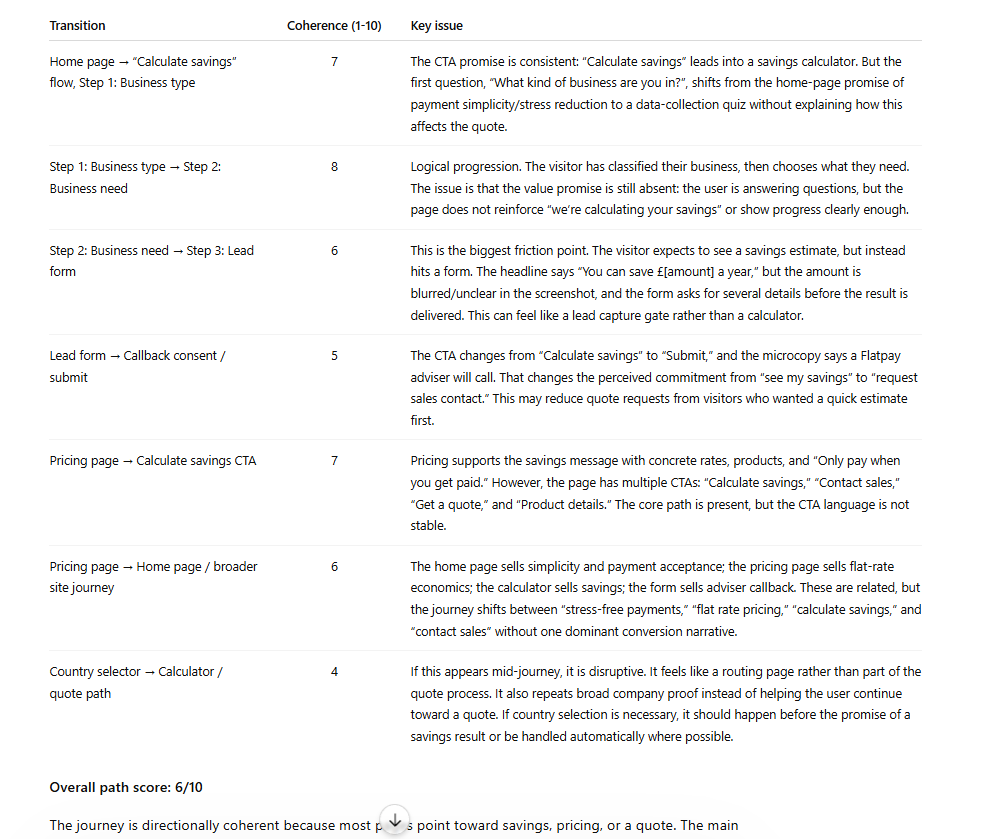
Flatpay uses a multi-step CTA journey for "calculate savings" or "get a quote", which most serves as a teaser as well as pre-qualifier for leads and Flatpay.
Flatpay results from prompt 2:
Prompt 3: The Trust Signal Inventory # Trust Signal Inventory ## Your task Across all pages, catalogue every trust signal present: customer logos, testimonials, reviews, case studies, certifications, team photos, years in business, guarantees, privacy assurances, awards, association memberships. Then evaluate:
1. Which pages have strong trust signals? 2. Which pages have weak or no trust signals? 3. Is there a trust gap specifically on the conversion page (contact or pricing page)? 4. What trust signals would you add, and where?
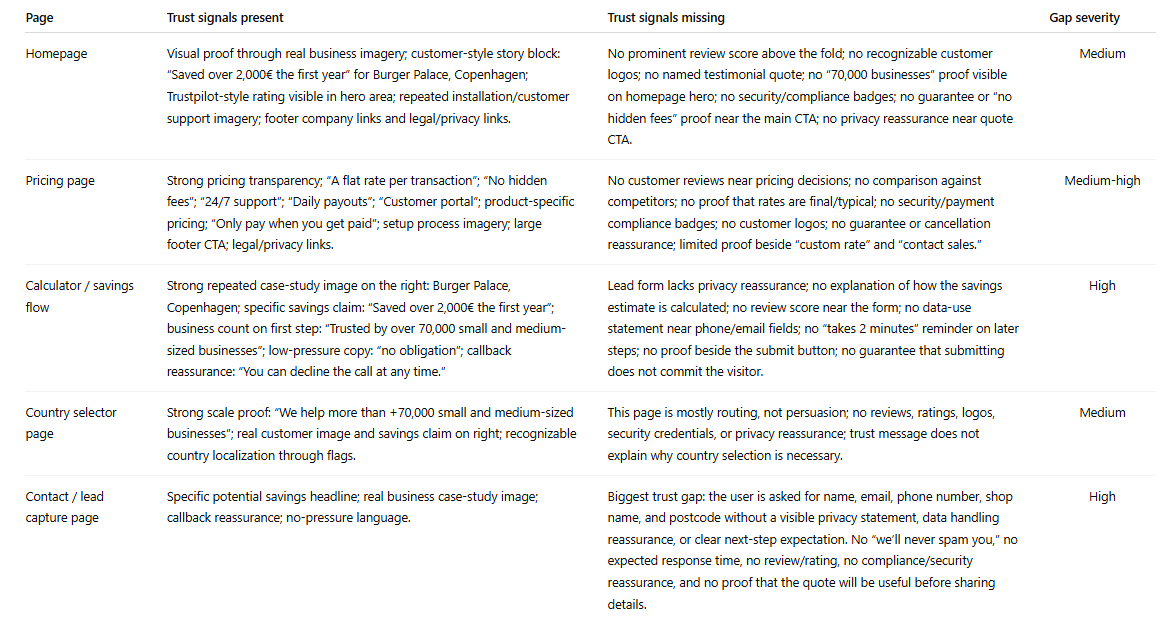
What this reveals: Trust signals cluster on homepages, where they're least needed, and disappear on contact pages, where they matter most. The moment a visitor is about to hand over their phone number is precisely when they need reassurance. They're asking: will someone actually reply to this? Have you done this for businesses like mine? Our chat data shows the most common questions visitors ask right before converting are trust questions: "How quickly will someone respond?" "Do you work with companies in my industry?" A single line on the contact page, "We typically respond within two hours," does more conversion work than most hero sections. Adding it takes five minutes. Flatpay results from prompt 3:
Prompt 4: The Dead Form Diagnosis # Lead Capture Form Diagnosis ## Context This is your final conversion point. A motivated visitor is about to become a lead, or quietly close the tab. ## Your task Evaluate the contact or lead form as a slightly hesitant potential customer who is ready to enquire:
1. Field count: How many fields? Which feel unnecessary for a first interaction? 2. Expectation setting: Does the page explain what happens after submission? Who responds? How soon? 3. Alternatives: Is there any option besides this form (phone, chat, booking link, WhatsApp)? 4. Urgency: Is there a reason to submit now, or could I come back to it later with no consequence? 5. Friction score: Rate 1 (effortless) to 10 (not worth the effort).
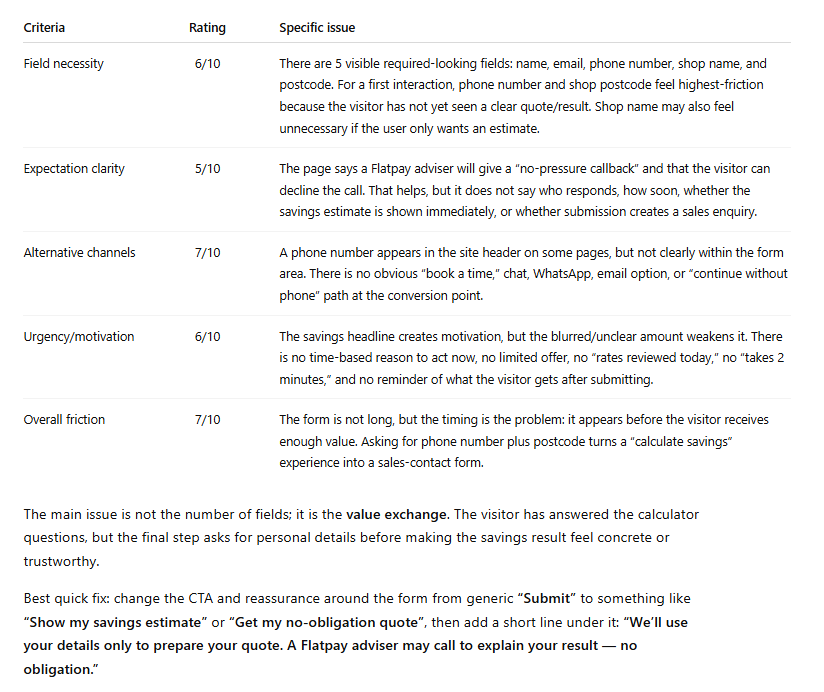
What this reveals: Forms are where conversions go to die, and the problem usually isn't the fields themselves. It's the silence around them. No indication of what happens after you submit. No alternative for the person who has a quick question but isn't ready to commit to a form submission. No urgency. Just a form floating on a page, asking for information and offering nothing in return. Our data shows that between 35 and 50 percent of chat conversations start because a visitor saw the form and decided they wanted to talk to a person instead. The form didn't convert them. A conversation did. Flatpay Results:
Prompt 5: The AI Search Visitor Test # AI Search Visitor Experience Audit ## Context A growing share of visitors now arrive from AI search tools (ChatGPT, Perplexity, Google AI Overviews, Claude). These visitors have been in a conversational research flow: asking questions, refining needs, receiving personalised guidance. They land here mid-dialogue, having just been told this website looks like a good match for their needs. ## Your task Evaluate these pages as an AI-referred visitor who was just told: "[Company] looks like a good option for your needs."
1. Conversation continuity. Can this visitor continue their dialogue, or does the experience break from conversation to static content? What engagement options exist? 2. Information redundancy. How much of this repeats what the AI tool likely already told them? What is genuinely new here? 3. Specificity gap. The visitor has a refined need. Does the site address specific use cases, or only general claims? 4. Next-step friction How many clicks stand between landing here and having a real conversation about their specific situation?
## Output format | Criteria | Score (1-10) | Key finding | |----------|:---:|-------------| | Conversation continuity | | | | Information redundancy | | | | Specificity gap | | | | Next-step friction | | | Verdict: Is this website ready for the AI search era? Single most impactful change:
What this reveals: An AI-referred visitor has been in an active dialogue. They arrive expecting to continue it. Instead they hit a static page and a form. It's like being mid-conversation with someone, then being walked to a colleague's office where that colleague hands you a clipboard. The AI will almost always point to real-time conversational engagement as the single most impactful change. Results from Flatpay analysis:
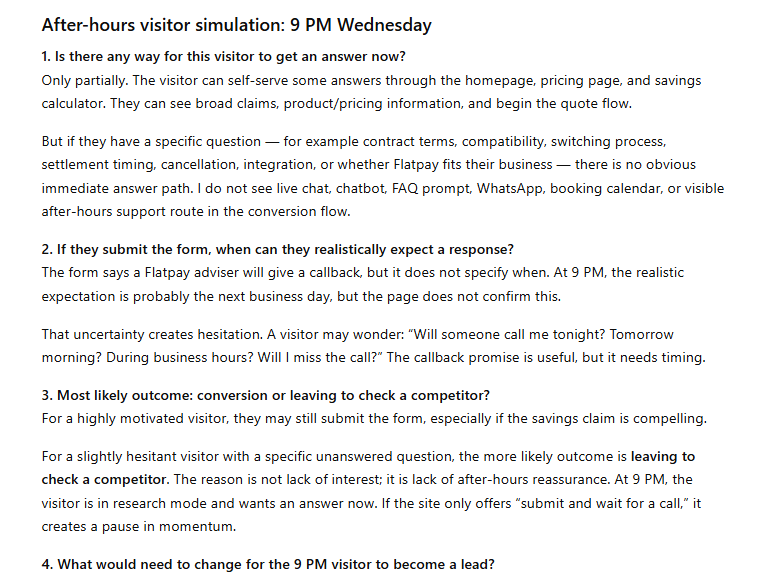
Prompt 6: The After-Hours Visitor Test # After-Hours Visitor Simulation ## Scenario It is 9 PM on a Wednesday. A potential customer lands on this website from a search. They're interested but have a specific question about the service. ## Your task
1. Is there any way for this visitor to get an answer now? 2. If they submit the form, when can they realistically expect a response? 3. What is the most likely outcome: conversion, or leaing to check a competitor? 4. What would need to change for the 9 PM visitor to become a lead?
What this reveals: Between 35 and 50 percent of high-intent traffic arrives outside business hours. The visitor at 9 PM with an urgent question, a pest control problem, an insurance query, a question about a dental procedure, is often your most motivated visitor. They're ready to act. Your website offers them a form that won't be read until tomorrow morning. By then, they've found a competitor who responded immediately. The after-hours visitor rarely shows up in your analytics as a lost lead. They show up as a lead that was never there.
Example from Flatpay conversion analysis. Prompt 6 answer form.
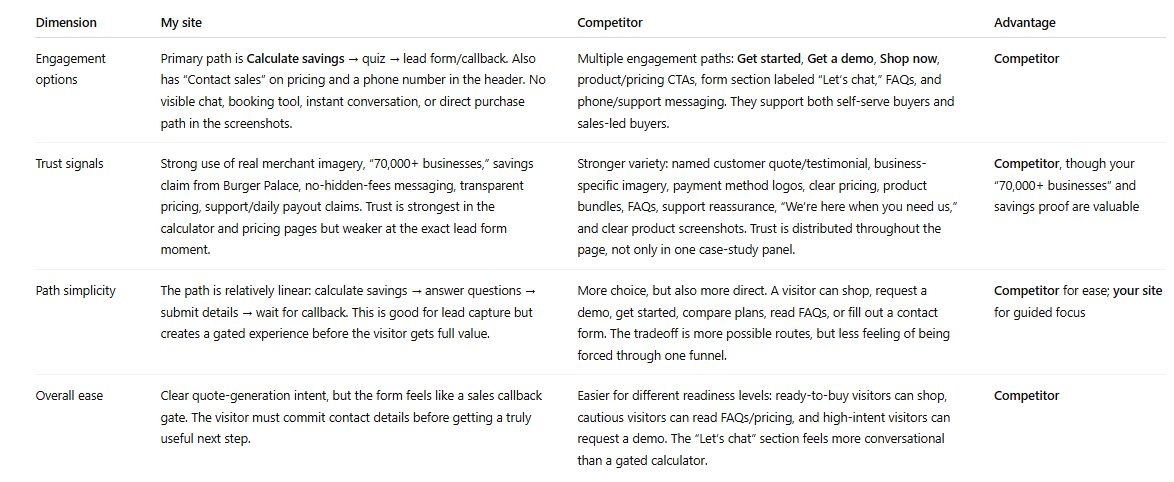
Prompt 7: The Competitor Comparison # Competitive Conversion Comparison ## Context I'm now uploading screenshots from a competitor's website. ## Your task Compare their conversion path to mine across four dimensions:
1. Engagement methods — Do they offer anything we don't? (chat, callback, WhatsApp, instant quote, booking tool) 2. Trust signals — Stronger, weaker, or different in type? 3. Path simplicity — Fewer or more steps to conversion? 4. If you were a potential customer comparing both, which makes it easier to take the next step? Why?
What this reveals: This is the prompt that makes abstract findings feel urgent. When the AI tells you "your competitor has live chat and a 60-second quote promise, you have a contact form," the gap stops being theory. It's a specific competitive disadvantage, described in plain language, sitting in a table. Running this against one or two competitors takes ten minutes. The output is more persuasive than any conversion audit report, because it shows exactly what a visitor experiences when they compare options, and most of the time, they are comparing options.
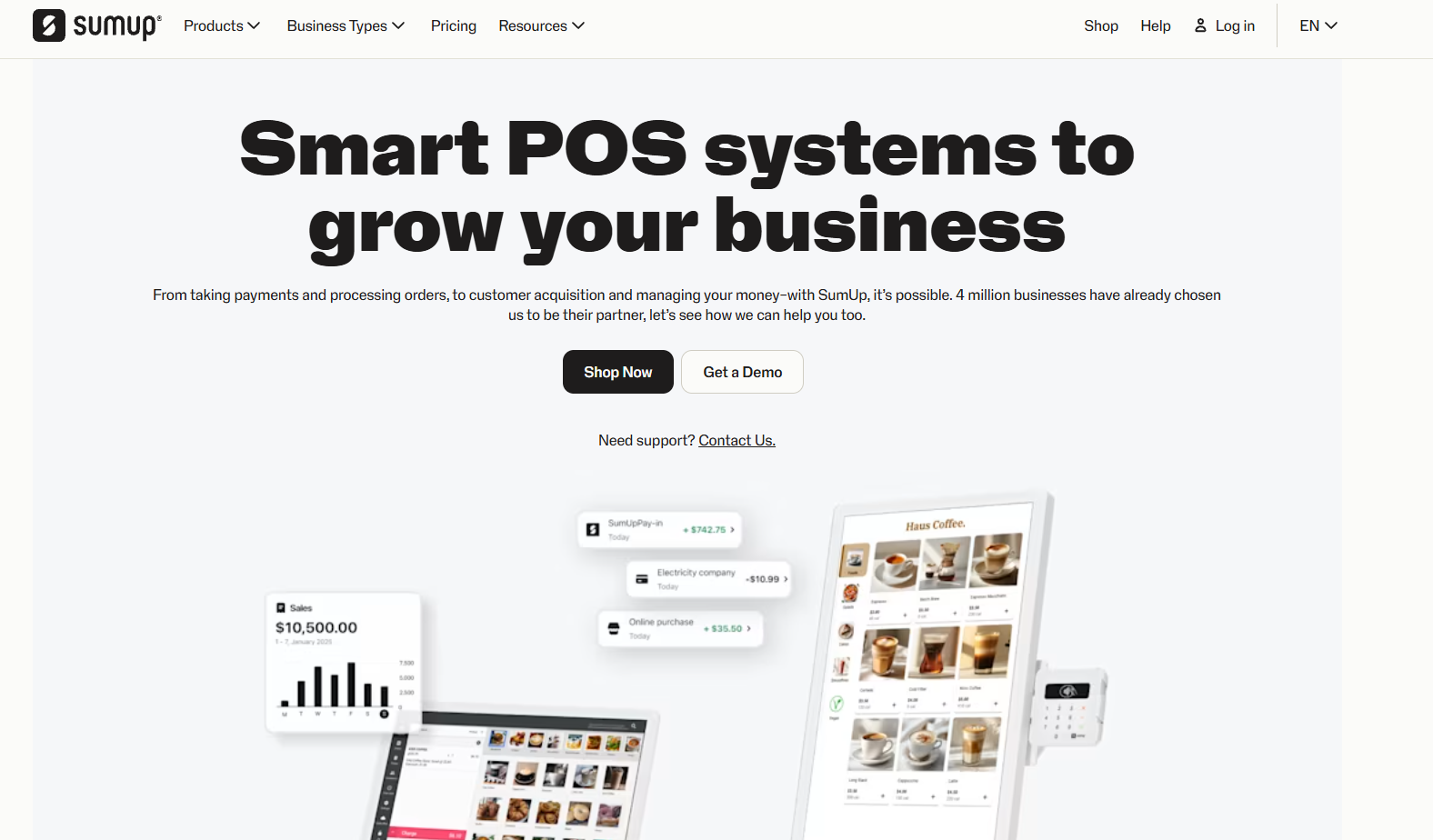
For this competitor comparison we used SumUp.
Response from ChatGPT on this prompt for comparison:
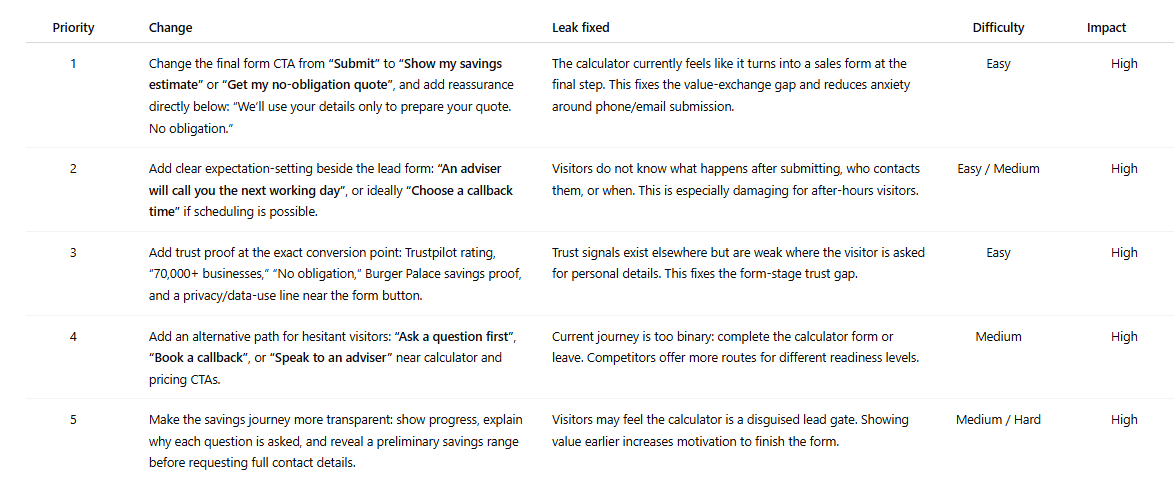
Prompt 8: The Priority Fix List # Prioritised Conversion Fix List ## Your task Based on everything analysed across all pages, give me the 5 most impactful changes to increase leads from this website.
For each recommendation:
1. The specific change 2. Which leak it fixes 3. Difficulty (easy / medium / hard) 4. Potential impact (low / medium / high)
What this reveals: This is the prompt that turns the audit into a to-do list. Flatpay priority fix list:
What to Do With Your Results
Most audits produce one of three finding patterns. Here's how to act on each.
Messaging and CTA inconsistencies. These are quick wins. Align the headline, the button text, and the implied offer across every page in the path so the visitor feels like they're moving through one coherent conversation. This costs nothing and can be done in an afternoon. It's also the change most businesses deprioritise because it doesn't feel significant enough. It is. Trust gaps on conversion pages. Add one or two trust signals directly to your contact page this week. A response-time commitment. A relevant testimonial. A count of businesses you've helped. Visitors about to submit a form need reassurance at that precise moment. Putting it on the homepage instead is like putting the "safe to drink" sign on the bottle rather than the glass. No real-time engagement option. This is the structural finding that shows up in almost every audit and sits at the top of almost every priority list. You have a few honest options: Managing chat yourself during business hours works for some businesses and isn't sustainable for most. An AI chatbot handles FAQ deflection and support reasonably well. It struggles with the nuanced, pre-purchase questions that are actually standing between a visitor and a conversion. It fails at custom lead qualification questions and collecting customer lead information. Managed live chat with human agents available around the clock, including evenings and weekends, is what Weply provides. It's the approach behind more than 250,000 qualified leads generated across our customer base in 2025. If the after-hours prompt produced an uncomfortable answer, it's worth a look.
The standard alternative is hiring a CRO agency. Budget: EUR 3,000 to 8,000. Timeline: four to six weeks. Deliverable: a PDF. The report is usually good. The process is slow, expensive, and produces findings that are already weeks old when they reach you. The process in this guide takes 30 minutes and produces an action plan from your own pages, in your own conversation thread, reviewable immediately. Run it quarterly. Run it after every redesign. Run it whenever traffic goes up and leads don't.
Try Weply for free for 7 days. Get qualifed leads, customer support and insights into the conversations that your webiste visitors have.
Read more
Articles
Blogs
|
October 11, 2026
|
9
min
7 Best Intercom Fin AI Alternatives in 2026
Quick Summary
Intercom's Fin AIis a capable AI support agent, but its $0.99-per-resolution pricing becomes expensive fast, and it only handles support well. This guide covers the 7 best alternatives across the full range, from free SMB tools to enterprise platforms, including one that generates leads instead of just deflecting tickets. Fin AI sounds cheap, but pricing scales extremely fast. Even for SMB's. Which is why "Intercom Fin alternatives" has been one of the fastest-growing support software queries of 2026.
Here are our top three picks:
Why trust us?
We built Weply because we saw how businesses loose potential customers on their webiste, by either having no chat as a communication channel, having a live chat but only manned during opening hours, or chossing an AI chatbot - made and trained for support - not suited for converting high-intent traffic to qualified leads. In 2025 alone, Weply generated over 250.000 qualified leads for 2.400+ customers across the Nordics and Europe. We have operated since 2013 and seen it all. This gives us a clear-eyed view of where Intercom Fin fits, where it doesn't, and which alternatives actually deliver at different budgets and use cases.
What Fin actually costs
The $0.99 number looks reasonable in a sales deck. It stops looking reasonable around month three. Here's the math Intercom doesn't tell: If you have 10 agents on the Advanced plan ($85/seat/month), your baseline Intercom bill is $850 a month before Fin touches a single ticket. Add 1,000 Fin resolutions, not a particularly high volume for a team that size, and you're at $1,840 a month. Push to 3,000 resolutions and you're past $3,800. Add Copilot ($35/agent/month) for the agents who handle what Fin can't, and the number climbs again. None of this is hidden. Intercom publishes it. But the compounding effect surprises a lot of finance teams when the first big invoice lands.
Why teams look for alternatives
1. The billing model punishes success. The more effectively Fin works, the more it costs. For teams with high support volume, per-resolution pricing isn't outcome-based. It's a variable tax on your growth. A team handling 10,000 resolutions a month is paying $10,000 in Fin fees before any other costs. At that scale, per-seat alternatives with flat monthly fees often work out significantly cheaper.
2. Fin is tied to the Intercom ecosystem. Fin works cleanest inside Intercom. You can deploy it as a standalone agent in front of Zendesk or Salesforce, but that adds integration complexity and you still pay the $0.99 per resolution either way. Teams that aren't already committed to Intercom end up buying the AI agent and effectively inheriting pressure to adopt the rest of the platform.
3. Fin handles support. It doesn't generate pipeline. This is the constraint that rarely appears in Fin reviews. Fin deflects tickets. It answers product questions, looks up order status, handles returns. What it doesn't do is convert an undecided website visitor into a lead, qualify sales intent, or push warm prospects into your CRM. If your chat function is supposed to do anything other than reduce support volume, Fin isn't built for it.
Before you choose: one question worth asking
Most alternatives articles give you a ranked list and call it a day. That's not useful, because the right answer depends on what you actually want to change. Do you want to swap the AI layer only, or replace the whole platform? If you want to keep Intercom and just reduce Fin's costs or add capabilities it lacks, your shortlist is different from someone who wants to walk away from Intercom entirely. → Keep Intercom, replace or supplement Fin: Look at Chatbase or Freshdesk's Freddy AI, which can run as a standalone agent in front of your existing helpdesk. HubSpot's Breeze Customer Agent is also worth considering if your CRM is already HubSpot. If you want to do customer support and lead generation while integrating to Intercom, consider Weply. → Replace the whole platform: Look at Zendesk AI. → You want chat to generate revenue, not just sav cost:Weply is the only option in this list built specifically for that outcome. With that framing established, here are the eight alternatives worth evaluating.
1. Weply
Weply is the only tool on this list that isn't primarily a support platform. That distinction matters if you've been thinking of chat as a cost centre when it could be doing more. Every other alternative here deflects tickets, reduces support volume, and helps your team handle more with less. Weply does that too, but it also actively works the other side of the funnel. Trained human chat consultants, available 24/7, qualify leads from website visitors and push them into your CRM with context. The AI layer (WeAssist) handles support queries, and is included in the base subscription. Humans are always in the loop, which eliminates hallucination risk on support conversations and means your leads are pre-qualified by a person, not a bot pattern-matching on keywords. The lead qualification demands are set by you, and thereby custom for each company. The result: Normally 2x more leads. And contrary to AI chatbot, the leads have been qualified to meet your lead crieteria.
Key Features
24/7 human + AI hybrid: Chat consultants run every conversation, with WeAssist handling standard support queries. Customers always interact with a human, which consistently produces higher conversion rates than automated-only chat.
Lead qualification direct to CRM: Weply pre-qualifies visitors against your criteria and delivers named, warm leads, with the contact information you want, to your inbox or CRM.
WeSights analytics: Dashboard covering chat volume, campaign attribution, lead quality, and conversion patterns. Helps connect chat activity to marketing spend.
Dedicated Customer Success Manager: Included on all plans. An actual person responsible for your results.
Pricing
Monthly subscription from $69, covering up to 100 support chats with WeAssist included. Lead fees are charged per qualified lead, based on your defined qualification criteria. 7-day free trial, no credit card required.
Pros
The only alternative here with active lead generation built in. Not a support tool with a lead capture form bolted on.
Human-verified responses mean much less hallucination risk on live support conversations.
Converts 2x more chat visitors into qualified leads than pure AI chatbots, based on internal customer data.
Transparent, predictable pricing with a per-lead model.
Validated by more than 2.400 customers live.
Cons
Chat only. No voice, email, or social channels yet.
WeSights is an add-on, not included by default.
Not the right fit if all your chat traffic is only support-related with no commercial intent.
Rating
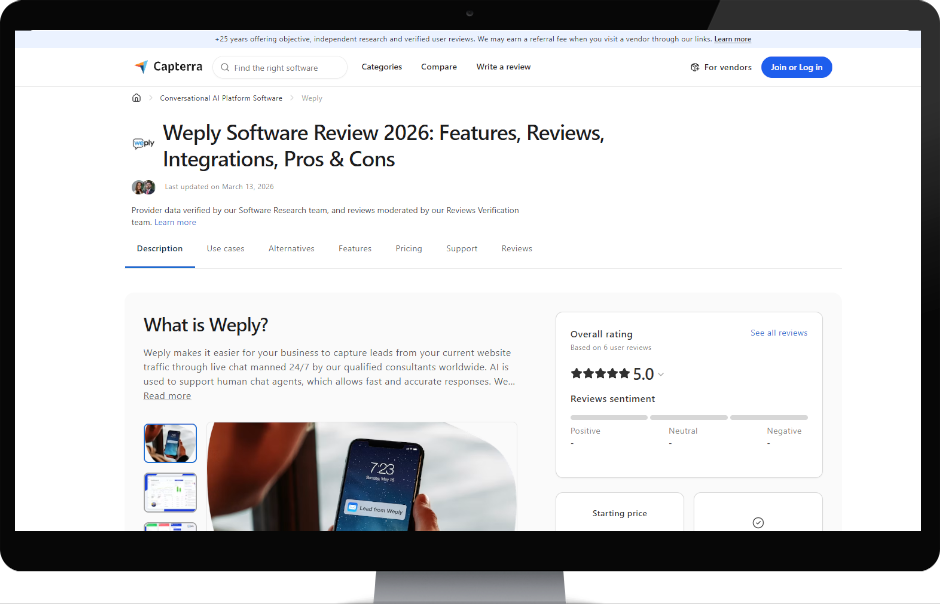
Capterra: 5/5. Customers consistently cite lead quality and volume improvements over their previous AI-only chat setup.
2. Zendesk AI
Zendesk is the default choice for support teams that need a mature, full-featured helpdesk and are willing to pay for it. With 22,000+ customers globally, its routing, SLA management, and omnichannel capabilities are genuinely enterprise-grade once configured. It makes the most sense for teams of 15+ internal support agents where organisational structure and ticket workflow start to matter as much as raw AI performance. The catch with Zendesk's AI story is the pricing structure. The headline per-agent price is real, but it's not the whole story. To get AI features worth comparing against Fin, you need the Advanced AI add-on at roughly $50/agent/month on top of your Suite plan. AI-automated resolutions are billed separately at $1.50 per committed resolution or $2.00 pay-as-you-go. A 20-agent team on Suite Professional with Advanced AI is therefore looking at close to $40,000 a year before implementation.
Key Features
Omnichannel unified workspace: Email, live chat, phone, WhatsApp, social media and web forms in one agent view.
AI Triage and routing: Classifies tickets by intent, language and sentiment before a human sees them. Sends conversations to the right agent tier based on skills and current load.
Zendesk Copilot: Suggests replies, surfaces knowledge articles, and summarises long threads for agents in real time. Available as the ~$50/agent/month add-on.
AI-automated resolutions: The AI agent handles queries it can resolve fully, charged at $1.50–$2.00 per completed resolution.
Reporting via Explore: Customisable dashboards at Professional and above, tracking CSAT, response time, resolution rates, and agent performance.
Pricing
From $55/agent/month. AI resolutions: $1.50-2 per committed resolution.
Pros
The most proven full customer support platform at enterprise scale in the market.
Comprehensive integration ecosystem .
Skills-based routing and SLA management work well for large teams.
Cons
The AI features that actually compete with Fin require the Advanced AI add-on that many teams don't budget for during the buying process.
Zendesk's own support quality is a consistent complaint on G2: slow responses, link-heavy replies.
Per-agent pricing scales directly with headcount with no outcome-based option on core plans.
Rating
G2: 4.3/5 across 6,800+ reviews. Satisfaction correlates strongly with team size. Small teams often find they're paying for features they haven't configured yet.
3. Tidio
Tidio is the clearest SMB alternative to Fin, and probably the fastest to deploy of anything on this list. The platform combines live chat, a no-code chatbot builder, and Lyro, its conversational AI agent, in a single product. It's particularly strong for Shopify merchants and e-commerce teams that want to handle chat, email, and social from one place without committing to an enterprise contract.
Key Features
Lyro AI agent: Answers questions based on your support content, handles hand-off to human agents when needed, and runs 24/7.
Flows builder: No-code drag-and-drop chatbot for creating automated conversation paths.
Multichannel inbox: Website chat, email, Instagram, Messenger, and WhatsApp managed from one view.
Live typing preview: Agents see what the customer is typing before they send it.
Shopify-native: Order lookup, product data, and customer details visible to agents within the chat window.
Pricing
Starter from $29/month. Growth from $59/month. Advanced $749/month. Lyro AI available as a standalone add-on from $39/month for additional conversation quota. Known for heavy price increases to existing customers.
Pros
G2 4.7/5, one of the highest-rated tools in this category.
Conversation-based pricing is more predictable than per-seat for smaller teams.
Live in minutes. Shopify integration is genuinely seamless.
Cons
Data processing happens primarily in the EU, but some data is also transferred to the US.
Best for e-commerce. Only to be used for customer support.
Not suited to complex enterprise workflows, multi-team SLA management, or large agent pools.
Rating
G2: 4.7/5. Users consistently mention ease of setup and the Shopify integration. Most criticism centres on pricing changes.
4. HubSpot Breeze Customer Agent
If your CRM is HubSpot and your support team already lives in Service Hub, HubSpot's Breeze Customer Agent is probably the path of least resistance. It runs inside your existing HubSpot setup, draws on your CRM data and knowledge base without additional integration work, and as of April 2026, moved to outcome-based pricing at $0.50 per resolved conversation. That's half the cost of Fin per resolution. Combined with a reported 65% average resolution rate across 8,000 activated customers, the economics are notably better for teams with high volume.
The important constraint: Breeze Customer Agent requires Service Hub Professional at a minimum, which starts at $90/seat/month. If you're not already on Professional or Enterprise, you're looking at a meaningful plan upgrade as a prerequisite.
Key Features
CRM-grounded AI: The agent draws on your full HubSpot customer data, relationship history, and knowledge base.
Nine channels supported: Chat, email, WhatsApp, Facebook, Instagram, Telegram, LINE, and SMS.
28-day free trial: New as of April 2026 alongside the outcome-based pricing shift.
Outcome-based pricing: $0.50 per resolved conversation.
Pricing
Breeze Customer Agent: $0.50/resolved conversation (60 free/month on Pro, 100 on Enterprise). Requires Service Hub Professional at $90/seat/month or Enterprise at $130/seat/month. Mandatory onboarding service approximately $1,500 on Professional plans.
Pros
Half the per-resolution cost of Intercom Fin.
Best option if your stack is already HubSpot Service Hub. Minimal integration work.
65% average resolution rate with full CRM context.
Most competitive outcome-based customer support pricing of any tool on this list.
Cons
Only practical if you're already in HubSpot and has bought their service hub. Adopting it as a standalone requires committing to HubSpot's ecosystem.
Get expensive with the mandatory purchases of additional Hubspot products.
Mandatory onboarding fee adds to the initial cost.
Rating
G2: 4.4/5. Users value the CRM context and the unified view of customer history. Common criticism: the platform's breadth can create complexity for teams that only want the Hubspot support module.
5. Freshdesk + Freddy AI
Freshdesk is the most commonly cited alternative when teams leave Zendesk on cost grounds, and it handles a lot of the same use cases for less money. The Freddy AI suite, Freshworks' AI product line, is built into Freshdesk's higher plans and works across the Freshworks stack, which includes Freshchat for live chat.
Freshdesk uses a session-based model for its AI agent rather than per-resolution pricing. A session counts any unique user who engages with Freddy, resolved or not.
Key Features
Freddy AI Agent: Handles frontline queries via chat and email. Trained on your Freshdesk knowledge base. Performs actions like order lookups and ticket creation.
Freddy Copilot: Suggests replies, summarises tickets, and drafts knowledge base articles for human agents. Available as an add-on.
Freshchat integration: The live chat product that pairs with Freshdesk for omnichannel support. Add-on.
Skills-based routing and SLA management: Available from higher tiers.
Pricing
Freshdesk Growth: $15/agent/month (email and ticketing). Pro: $49/agent/month (includes Freddy AI agent, 500 sessions/month included). Enterprise: $79/agent/month. Additional Freddy AI sessions: $49/100. Freddy Copilot: ~$29/agent/month add-on.
Pros
Significantly cheaper than Zendesk at comparable tiers, especially for teams primarily managing email.
G2 4.4/5. Well-established with a large user base.
Per-session model is easier to forecast than Fin's per-resolution model for teams with consistent traffic.
Cons
Freddy AI only responds to the first email in a thread. Follow-up messages require human handling.
G2-reported resolution rates from case studies: 23–30%, notably lower than Fin's 60% average or HubSpot's 65%.
Session billing counts engagements, not resolutions. You pay for conversations Freddy doesn't resolve.
Need to use the Freshdesk suite of products to gain real value.
Rating
G2: 4.4/5. The Freshwork platform itself is well-regarded. Freddy AI specifically receives more mixed feedback, with common criticism around setup complexity and the session cost ceiling.
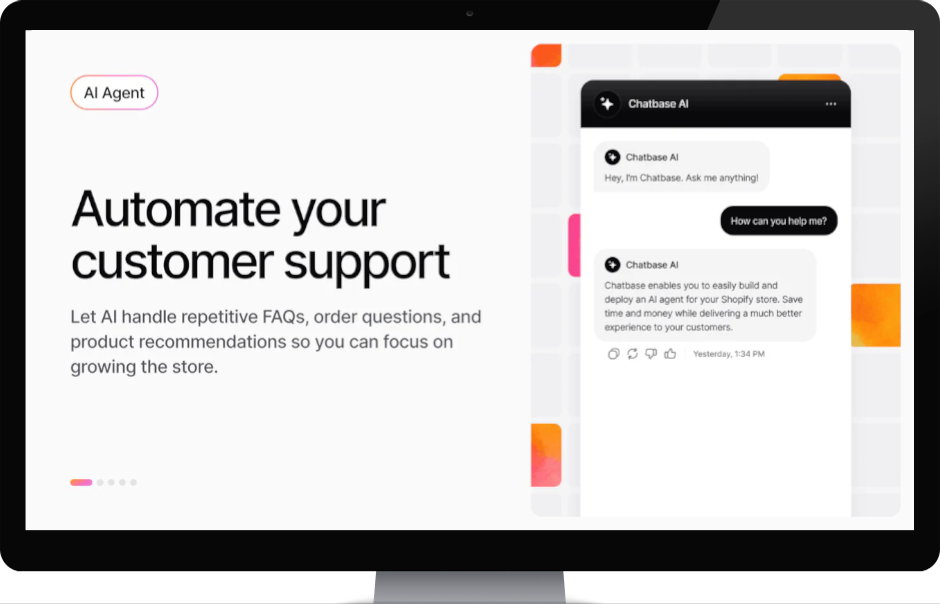
6. Chatbase
Chatbase is the fastest path from zero to a deployed AI chatbot. Upload your documentation, link to your knowledge base or Notion, and you have a functioning AI agent on your website in under an hour. No developer required. Used by 10,000+ businesses. It's worth being clear about what Chatbase is and isn't. It's a no-code chatbot builder, excellent for handling frequently asked questions and reducing inbound support volume for businesses that don't have a helpdesk team or need something running quickly. It's not a replacement for a full support platform, and its workflow automation capabilities are limited compared to Zendesk or Intercom.
One pricing note: Chatbase charges per message, not per conversation. A single back-and-forth exchange can consume multiple credits depending on the AI model you've selected.
Key Features
RAG-based training: Train on URLs, PDFs, Notion pages, or uploaded documents. The chatbot answers from your content and cites sources.
Multichannel deployment: Website widget, Shopify, WhatsApp, Instagram, Facebook Messenger, and Slack via native integrations.
AI Actions: Update Stripe subscriptions, create Zendesk tickets, fetch Salesforce order data. .
Model flexibility: Choose between economy models (GPT-4o Mini, Claude Haiku) and premium models (Claude Sonnet) based on cost and quality needs.
Pricing
From $40/month + credit usage.
Pros
Fastest time-to-live of any tool on this list.
No coding required. Accessible to non-technical teams.
Model selection gives you control over cost vs quality.
Cons
Metered by message, not conversation . Costs can be harder to predict than they look and it can become fast very quick. Credit costs makes it hard to use newer LLM models.
Limited workflow logic. Not suited for complex escalation flows or multi-step automation.
Output quality is directly tied to the quality of your documentation. Poor knowledge base, poor results.
Can only be used for customer support chats. Do not do a good job in lead conversion.
Data processed in the US. Not an option for most European businesses.
Rating
Capterra: 4.3/5. Easy setup and quick deployment are consistently praised. Pricing on higher plans and limited workflow capability are the most common criticisms.
7. Sierra.ai
Sierra.ai is the highest-profile name in enterprise AI customer service right now, founded in 2023 by Bret Taylor (former Salesforce co-CEO, current OpenAI board chair) and Clay Bavor. It's raised $950 million and counts Sonos, SiriusXM, Weight Watchers, and Casper among its customers. The platform handles voice and chat at scale, and its Ghostwriter feature generates production-ready AI agents from existing SOPs and call transcripts, reducing the time from contract to deployment significantly. Sierra is relevant to this list for completeness, not because it's a realistic alternative for most teams reading this article. The effective minimum to work with Sierra is ~$150-200,000 in year one when you factor in platform fees and implementation. If that's your budget range, Sierra is worth a serious evaluation. If it isn't, choose another tool.
Key Features
Empathetic AI agents: Built to mirror brand voice precisely across complex interactions such as returns, subscription management, account changes handled autonomously.
Ghostwriter: Generates deployable AI agents from SOPs, call recordings, and support transcripts. Also runs automated improvement cycles on live interactions.
Decagon Voice 2.0-comparable voice: Sub-second latency on voice interactions, branded caller IDs, interruption handling.
Multi-model architecture: Runs multiple AI models in parallel for accuracy checking, which reduces hallucination but can introduce latency on voice.
Pricing
No public pricing page. Third-party estimates: annual contracts from $150,000+. Implementation and onboarding: $50,000–$200,000. Outcome-based pricing per resolved conversation at undisclosed rates with minimum volume commitments.
Pros
One of the strongest voice + chat combinations in the market.
Ghostwriter materially reduces deployment time compared to traditional enterprise AI implementations.
Proven results at global consumer brands with high support volume.
Cons
Pricing puts it out of reach for any team without a substantial CX budget.
Support only. No lead generation capability.
No self-serve access or free trial.
Rating
G2: 4.4/5. Positive sentiment around empathetic AI quality and deployment support. Most criticism concerns pricing opacity and onboarding complexity.
How to choose
The right choice depends less on feature comparisons and more on what you actually need from chat. Or if you need a complete support platform.
If you need to generate revenue from chat, not just manage support volume then Weply is the only tool here built for that. The others are support platforms or support chats. If you're already deep in HubSpot and want the cheapest per-resolution pricing then Breeze Customer Agent at $0.50/resolution is the most cost-effective AI-only option right now. It require you have bought Hubspot Service Hub as a minimum. If you're a team of 15+ agents needing proper enterprise helpdesk infrastructure you will not go wrong with picking Zendesk, as it is still the most mature platform. If you're SMB and need something affordable and live quickly for customer support only then consider Tidio from $29/month. If you're an enterprise in a regulated industry with complex compliance requirements you should choose Ada or Sierra. If you just need an AI customer support chatbot running on your site within the hour and can live with data hosted in US then Chatbase.
Try Weply free for 7 days, no credit card, no commitment, and see what it adds to your pipeline this week (all qualified leads free of charge)
Can I use Intercom Fin without the rest of Intercom?
Yes. Fin can be deployed as a standalone AI agent in front of Zendesk, Salesforce, HubSpot, or most other helpdesks. You still pay $0.99 per resolution, and the is a minimum commit of $49 per month.
What does Fin AI count as a resolution?
A resolution is a conversation where the customer confirmed their issue was solved, or where they didn't respond after Fin's answer within a set time window (implying the answer was sufficient). The second part, the non-response trigger, is the one teams debate most. A customer who got a partial answer and gave up, or who simply got distracted, can still generate a billable resolution. Fin AI isn't unique in this ambiguity, but it's worth understanding before you project your monthly costs.
What is the cheapest Intercom Fin alternative?
For teams already in HubSpot Service Hub, Breeze Customer Agent at $0.50/resolution is the cheapest outcome-based AI alternative on this list. For teams without an existing platform, Tidio starts at $29/month, Chatbase starts at $40/month with a basic AI chatbot and Weply starts at $69 for a hybrid solution with human chat experts and AI, and doing both customer support and lead egenration.
Is Intercom Fin good?
Fin is a well-built product with a 60% average resolution rate across its customer base and clean integration within the Intercom platform. The criticism it gets is rarely about quality, it's about pricing structure and fit. If your support volume is moderate and you're already committed to Intercom, Fin works fine. The alternatives in this list are for teams where the per-resolution billing is creating budget problems, or where chat needs to do more than deflect support tickets.
Which Fin alternative is best for lead generation?
None of them, with one exception. The tools on this list, Zendesk, Tidio, Freshdesk, Ada, HubSpot, Chatbase, Sierra, are support platforms. They handle incoming queries and reduce ticket volume. Weply is the only alternative that actively generates and qualifies leads from website visitors. If your chat function is supposed to fill pipeline as well as handle support, Weply is the only tool in this category built for that outcome.
Articles
Blogs
|
October 3, 2026
|
9
min
10 Best Chat Solutions for Customer Support and Lead Generation in 2026
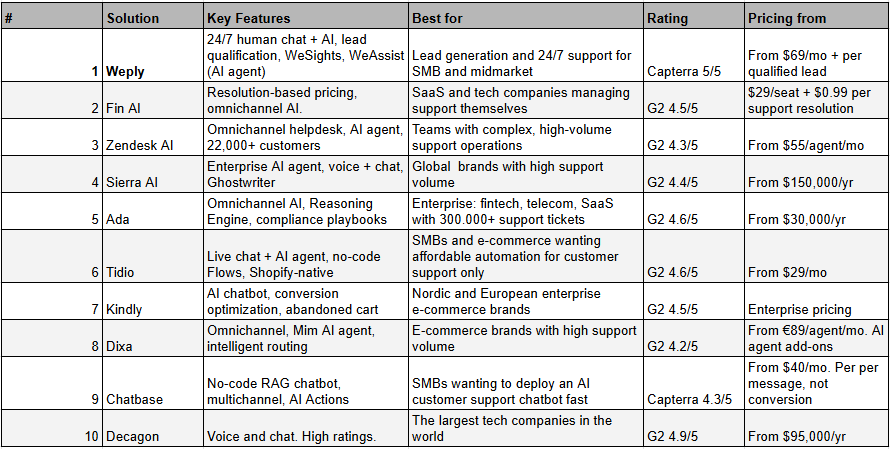
The right chat solution can turn your website traffic into paying customers and lift your customer support from reactive to proactive, or strengthen your lead generation and help grow your business. In the age of AI search having a chat solutions has become even more important. In this guide, we've reviewed the 10 best chat solutions available in 2026, including Weply, Intercom Fin, and Zendesk AI. We've looked at features, pricing, reviewsite ratings, and customer cases, so you don't have to. Here are our three top picks:
Looking for the best chat solution for your business?
Customers expect answers now. 63% of consumers prefer live chat over email or phone, and 46% of all leads are generated outside of normal business hours. With an ever-growing selection of solutions and increasing demands around GDPR compliance, data residency, and 24/7 availability, choosing the right chat solution has never been more important. The right solution helps you:
Convert anonymous visitors into named and qualified leads.
Give customers immediate help, 24/7.
Free up tiem for your team for other, more high-value interactions.
Comply with GDPR and data handling requirements within the EU.
Integrate with your existing CRM, helpdesk or e-com platform.
Why trust Weply?
We built Weply because we saw how businesses across Europe were losing potential customers on their websites, either because they had no chat at all, it was only availbale during operating hours, or because they put an AI support chat in front of high intent traffic and think it can convert it to qualified leads. Our platform combines trained chat consultants with AI and we generated over 250,000 qualified leads for more than 2,400 customers in 2025. We know this market inside out, from SMBs to enterprise. That gives us a unique position to evaluate which chat solutions actually deliver on the European and US markets. Finding the right solution is always about understanding your own needs first. Here's how some of our customers rate us:
Now, let's take a look at the 10 best chat solutions for 2026.
Now let's dive into each solution.
1. Weply
Weply is a Nordic 24/7 live chat solution that combines trained human chat consultants, lead conversion experts, with AI technology to generate and pre-qualify leads directly on your website. Founded in 2013 and headquartered in Copenhagen, Denmark, Weply has generated over 250,000 qualified leads for more than 2,400 customers in 2025, making it the largest Nordic operator in hybrid human-AI chat. Weply recently launched WeAssist, a support AI agent that chat consultants can activate for incoming support queries. What sets Weply apart from pure AI solutions is that your customers always interact with a real human being, backed by AI. That means meaningfully higher conversion rates and fewer missed interactions compared to fully automated chatbots. All support responses are also quality-checked by a human in real time, minimising the risk of AI hallucinations and ensuring answers are delivered with human empathy and nuance.
Key Features
24/7 Human Live Chat + AI (WeAssist): Trained chat consultants are available around the clock, complemented by WeAssist AI for standard support queries. You never miss a relevant customer interaction.
Sales-qualified leads delivered to your inbox or CRM: Weply pre-qualifies visitors based on your criteria and delivers warm leads, with name, phone number, and relevant context, directly to your CRM or inbox.
AI Co-pilot for internal chat agents: some customer run internal customer support agents using Weply outside normal opening hours or if overloaded, and those agents have access to AI WeAsssist co-pilot.
WeSights our analytics platform: Gives you insight into chat volume, chat context, campaign data, and conversion patterns, so you can continuously optimise your digital marketing, web, and lead strategy.
Dedicated Customer Success Manager: Every customer gets a dedicated CSM who helps with setup, optimisation, and ongoing strategy.
GDPR-compliant and EU-hosted: Data is processed in accordance with GDPR, with servers in the EU and full compliance with the ISO and EU AI Act.
Pricing
Pricing consists of a small monthly subscription starting from €53/mo, covering up to 100 monthly support chats with the WeAssist AI agent included. Beyond that, you pay only for success, a fixed price per qualified lead Weply generates, based on your unique lead qualification criteria. Weply offers a fully free 7-day trial, where all generated leads and answered support queries are free.
Pros
Human touch for your potential and existing customers 24/7, 365 days a year. Customers always talk to a real person, not just a bot.
Experts in lead conversion. If you're already spending money and time driving potential customers to your website, Weply is the only specialist. Typically converts minimum 50–80% more chat visitors into qualified leads than AI chatbots.
WeAssist is included in the subscription price, meaning you get an AI support chatbot verified in real time by humans. At a significantly lower cost than the alternatives.
Plug-and-play setup with CRM integrations, live quickly.
GDPR, AI Act, ISO. Verified with over 2,400 paying customers across the Nordics and Europe.
You get AI where AI is strong (support, but verified by humans) and humans where they're best (qualified lead generation).
Free 7-day trial, no credit card required, no commitment.
Cons
WeSights, the unique chat analytics tool, is an add-on.
Available as chat only, not yet on voice, email, or social channels.
Not ideal for public institutions where all traffic is support-related, or for chat behind a login wall as inside a SaaS support tool.
Rating
Capterra: 5/5. Trustpilot 4.4/5. Businesses consistently highlight that Weply delivers significantly more leads and better lead quality than AI chatbots, alongside 24/7 availability, easy setup, and a very high level of customer service.
2. Intercom Fin
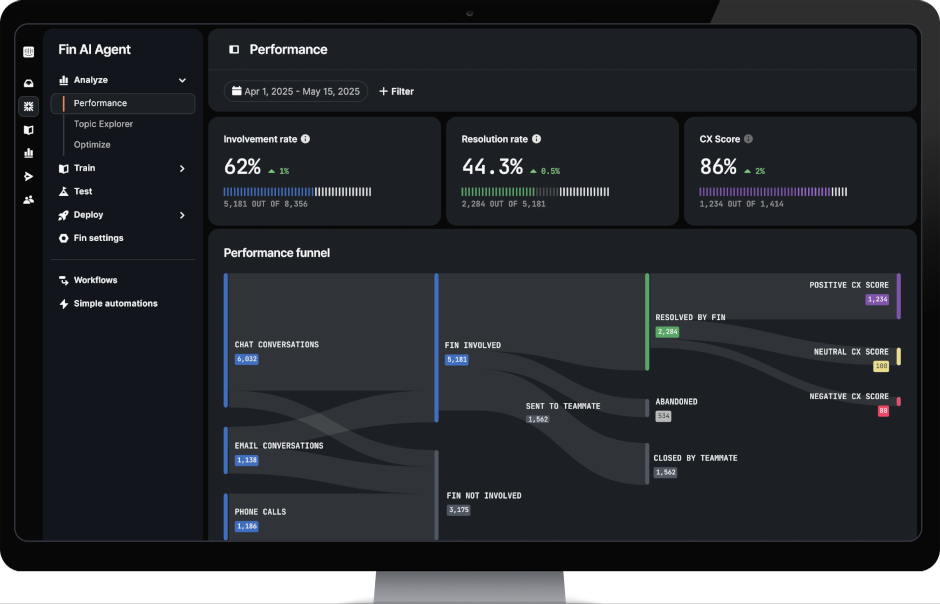
Intercom Fin is Intercom's AI agent, launched in 2023 and now one of the most widely deployed AI support platforms globally. Fin states it resolves an average of 60% of all queries automatically and supports all major channels: email, live chat, WhatsApp, Messenger, SMS, and voice.
Key Features
Outcome-based AI agent: Fin receives queries, responds using your knowledge base, and escalates to your support team when needed.
Omnichannel out-of-the-box: Fin works across email, live chat, WhatsApp, Messenger, SMS, and voice from a single platform.
Fin Copilot (agent assist): AI assistant for human agents in the inbox, generates reply suggestions, summarises case history, and retrieves knowledge in real time. $35/user/mo add-on.
AI-driven simulations and performance insights: Test Fin's performance against historical tickets before going live, and receive ongoing improvement recommendations.
Integrations: 450+ integrations including Shopify, Salesforce, Zendesk, and HubSpot.
Pricing
Fin AI Agent: $0.99 per resolution (min. 50 resolutions/mo = $49.50). Copilot is $35/user/mo as an add-on.
Example: 1,000 Fin resolutions/mo = $990 on top of seat costs. For 10 agents on the Advanced plan ($85/seat), the monthly total is approximately $1,840.
Pros
Outcome-based model is fair: you pay only for success.
Works standalone alongside Zendesk, Intercom and Salesforce.
Strong for SaaS and B2B support teams that manage their own helpdesk.
Cons
Pricing scales aggressively at high volumes: 1,000 resolutions/mo = $990 in AI costs alone.
Requires internal setup and optimisation. No dedicated CSM on lower plans.
Not suited for active lead generation, only customer support.
Fin Copilot is a paid add-on.
Some G2 reviewers report that what Intercom counts as a "resolution" doesn't always match real-world outcomes.
Rating
G2: 4.5/5. Users praise the modern interface and automation rate. Most criticism: pricing scales unpredictably, and advanced features require expensive plans.
3. Zendesk AI
Zendesk is still the world's most widely used customer service platform, with 22,000+ support teams globally and a well-established enterprise presence. Zendesk's AI capabilities including AI agents (chatbots), Copilot for human agents, and intelligent triage, are layered on top of its core omnichannel helpdesk and have been significantly expanded since 2024. Zendesk is used by teams ranging from fast-growing SaaS companies to large enterprise organisations across every industry. Zendesk's core strength is organisational scale: it handles email, live chat, voice, WhatsApp, Instagram, Facebook Messenger, X, and web forms in a single agent workspace, and routes tickets intelligently across large agent pools.
Key Features
AI agents and intelligent triage: Built-in AI agents handle common queries using your help centre content and can take basic actions.
Omnichannel unified workspace: Email, live chat, phone, WhatsApp, social media, and web forms in a single agent view. Routing ensures tickets reach the right agent based on skills, language, and current load.
Zendesk AI Copilot: Agent-side AI that suggests replies, surfaces relevant knowledge articles, and summarises long ticket threads in real time.
Knowledge base and help centre: AI-powered content suggestions for help centre articles, and a self-service portal that deflects tickets before they reach your support team.
Analytics and reporting: Pre-built dashboards and, on higher tiers, Explore for custom reports tracking response time, resolution rate, CSAT, and agent performance.
Pricing
Suite Team: $55/agent/mo (annual). Basic multichannel ticketing, help centre, AI agents with limited resolutions.
Suite Professional: $115/agent/mo (annual). Skills-based routing, community forums, HIPAA compliance, custom analytics.
Suite Enterprise: From $169/agent/mo (annual, negotiated). Custom agent roles, sandbox, advanced data protection.
Advanced AI add-on: ~$50/agent/mo extra. Required for Copilot, advanced triage, and generative AI features.
AI Agent resolutions: $1.50 per automated resolution (committed volume) or $2.00 pay-as-you-go.
For a 20-agent team on Suite Professional with Advanced AI, total annual cost approaches $40,000 before implementation.
Pros
The most established customer support platform globally. Deep integration ecosystem and proven enterprise track record.
Strong at scale: skills-based routing, SLAs, and omnichannel work well for 15+ agent teams.
Cons
Advanced AI features require a separate $50/agent/mo add-on.
Own support quality criticised consistently on G2: slow response times and link-heavy replies.
Some G2 reviewers describe being oversold during the buying process, real-world AI performance fell short of what was promised.
Per-agent pricing model means costs scale directly with headcount, with no outcome-based option on core plans. Expensive option.
Rating
G2: 4.3/5 (6,800+ reviews). Satisfaction correlates strongly with team size: large, multi-channel support teams tend to find the cost justified; smaller teams often feel they're paying for features they don't use.
4. Sierra.ai
Sierra.ai is an American enterprise AI company founded in 2023 by Bret Taylor (former co-CEO of Salesforce and current chairman of OpenAI's board) and Clay Bavor. Sierra has raised $950 million to date and is one of the most discussed AI companies globally. Sierra's customers include Sonos, SiriusXM, Weight Watchers, ADT, and Casper. The platform is built for large consumer brands with high inbound support volume across chat and voice.
Key Features
Empathetic AI agents: Sierra's agents are designed to mirror your brand's voice and tone precisely, handling complex interactions like returns, subscription changes, and account management autonomously.
Agent Studio + Agent SDK: No-code workflow builder for CX teams (Agent Studio) and a developer-focused SDK for custom integrations.
Ghostwriter: Automatically generates production-ready AI agents from SOPs, call transcripts, audio recordings, and whiteboard photos. Also runs an automatic improvement loop based on live interactions.
Multi-model "Constellation" architecture: Uses multiple AI models in parallel for accuracy-checking, reducing hallucination, but can introduce latency (700ms+) in voice environments.
Voice + chat across channels: Sierra's agents support web chat, mobile apps, and voice.
Pricing
Sierra publishes no pricing and has no pricing page. All contracts are enterprise agreements. Third-party estimates:
Annual contracts from $150,000+.
Implementation and onboarding fees: $50,000–$200,000.
Outcome-based model: payment per successful resolution (rate confidential, but with minimum commitment volumes).
Pros
One of the world's leading chat and voice agents for support.
Pricing makes it exclusive to the largest enterprises. SMBs and mid-market are entirely excluded.
Long and technically complex implementation.
Support only. No real lead generation capability.
Rating
G2: 4.4/5. Users praise the intuitive interface and empathetic AI interactions. Most common criticism: high price with unclear ROI, steep learning curve during onboarding.
5. Ada
Ada is an enterprise AI customer service platform founded in Toronto in 2016 by Mike Murchison and David Hariri. Ada has raised $200M+ and serves 350+ enterprise customers including Monday.com, Pinterest, Verizon, and YETI. The platform is built for high-volume, omnichannel AI deflection in industries including financial services, e-commerce, telecommunications, and SaaS. Ada's 2026 platform centres on its "Reasoning AI" which are agents that understand intent, follow compliance-sensitive playbooks, and execute multi-step workflows across chat, email, voice, SMS, and WhatsApp from a single platform.
Key Features
Reasoning AI engine: Ada's agents understand customer intent and follow structured playbooks, including compliance-sensitive flows for regulated industries, rather than simple script logic. Claims to resolve 80%+ of inquiries automatically.
Omnichannel coverage: Chat, email, voice, SMS, WhatsApp, and social messaging managed from a single platform. Handoff integrations with Zendesk, Salesforce, Freshworks, Genesys, Dixa, Gorgias, and more.
Coaching and feedback loops: Platform managers can provide precise, surgical guidance to the AI agent through a coaching interface, and verify outcomes through test scenarios before going live.
SOP-based playbooks: Ada can follow complex, multi-step workflows, including triggering refunds, extensions, or system updates, based on standard operating procedures. Well-suited to regulated industries.
Enterprise security: SOC 2 Type II, HIPAA, GDPR, and PCI compliant. Zero Data Retention option with all LLM providers.
Pricing
Ada does not publish pricing. Estimates from third-party sources:
Starting from ~$30,000/year.
Pricing model: typically $1–$3.50 per AI resolution, based on resolved conversations.
Pros
Strong omnichannel coverage across 10+ channels from a single platform.
Coaching interface gives platform managers strong control over AI behaviour.
Cons
Implementation timeline is measured in months.
Only for large global enterprises.
Pricing scales aggressively at high volume.
Rating
G2: 4.6/5. Platform administrators rate Ada highly for ease of use and coaching capability. Negative sentiment on Trustpilot: 1.8/5.
6. Tidio + Lyro
Tidio is a live chat and AI support platform primarily serving small businesses and e-commerce stores. Founded in Poland in 2013 and used by 300,000+ businesses globally, Tidio combines live chat, ticketing, a no-code chatbot builder and Lyro, its conversational AI agent, in a single platform. Tidio is particularly popular with Shopify merchants and SMBs that want to start with live chat and gradually layer in automation without switching tools.
Key Features
Lyro AI agent: Conversational AI that answers common customer questions based on your support content. Handles handoff to human agents when needed.
No-code Flows builder: Drag-and-drop chatbot builder for creating automated conversation paths: product recommendations, lead capture, FAQ automation, and more .
Live chat with live typing preview: Agents can see what customers are typing before they hit send, allowing faster, more prepared responses.
Multichannel inbox: Manages website chat, email, Instagram, Messenger, and WhatsApp in a single unified inbox.
Pricing
Starter: From $29/mo (annual). Includes live chat, ticketing, basic automation.
Growth: From $59/mo (annual). Includes Lyro AI conversations and advanced Flows.
Lyro AI add-on: Can be purchased separately from $39/mo for additional AI conversation quotas.
Pros
Among the most affordable live chat + AI combinations on the market for SMBs.
Conversation-based pricing is more predictable than per-seat models for smaller teams.
Very fast to set up. Live in minutes. Strong Shopify native integration.
Cons
Data processing: primarily EU-based, but some data is also transferred to the US.
Not well-suited for complex enterprise workflows, SLA management, or large multi-team operations.
Very limited lead generation capability. Can only be used for customer support.
Rating
G2: 4.6/5. Users consistently highlight ease of setup and Shopify integration. Most criticism relates to some agreesive prices increases.
7. Kindly
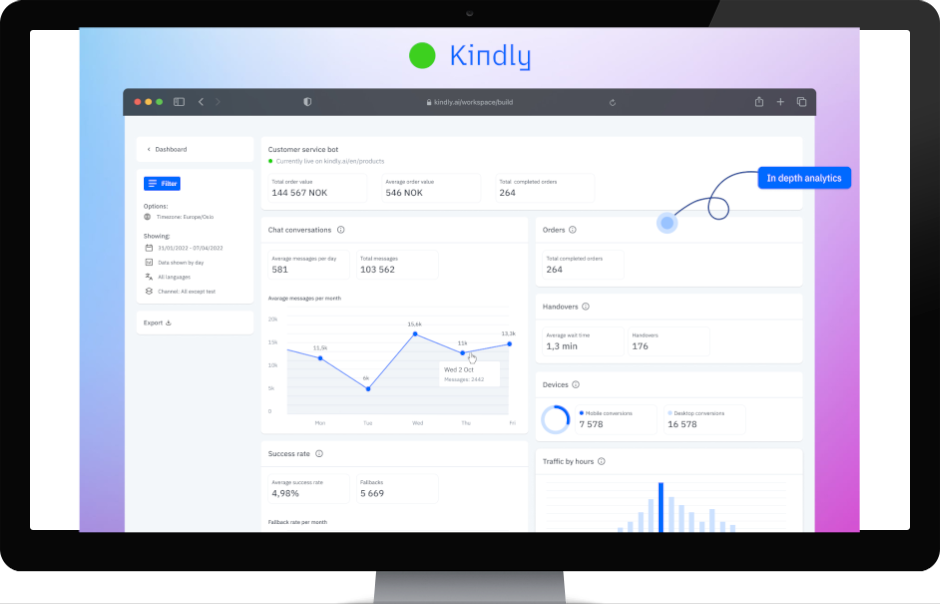
Kindly is a Nordic AI chatbot platform founded in Oslo in 2016 and one of Europe's leading conversational AI providers for enterprise e-commerce and customer service.
Key Features
Generative AI chatbot with multilingual training: Train the chatbot in one language and it understands queries in 100+ languages automatically. Nordic language expertise is a core competency.
Conversion optimisation and abandoned cart: Kindly's platform can increase conversion rates by up to 12% and automates abandoned cart messages.
Visual product carousel in chatbot: Enables product search and displays products directly within the chat interface based on selections made in the chatbot.
Simple customisation without coding: No code required to match the chatbot to your brand identity, tone, and layout.
Support automation: Automates up to 80% of customer inquiries according to themselves.
Pricing
Kindly does not publish pricing. All agreements are reached via direct contact. Enterprise prices.
Pros
Deep Nordic and European market presence with proven language expertise.
Unique combination of AI chatbot, conversion optimisation, and support automation in one platform.
No public pricing. Expensive and only for enterprises.
Primary focus on e-commerce. Not tailored for public sector or regulated industries.
Only for customer support. Not suited for active lead generation.
Rating
G2: 4.9/5. Users highlight easy implementation, Nordic language expertise, and high automation rates.
8. Dixa
Dixa is a Danish-founded customer experience platform aimed at e-commerce brands that want to consolidate all customer communication in one system. Dixa is used by 850–1,000+ brands across 42 countries, including Rapha, Hobbii, Mejuri, and Miinto. In 2025, Dixa launched Mim, an agentic AI agent.
Key Features
Mim AI Agent: Dixa's AI agent handles end-to-end customer interactions, including order lookup in Shopify and Magento, refunds, and self-service, with intelligent escalation to interrnal human agents.
E-commerce focused: Built exclusively for e-commerce companies, with features and integrations tailored to these specific workflows.
Omnichannel native: Phone, email, live chat, WhatsApp, Instagram, Facebook Messenger, and SMS in a single Team Hub.
Intelligent routing and Flow Builder: Drag-and-drop routing engine that assigns interactions to the right agent based on skills, language, and workload.
Shopify + Magento + WooCommerce integrations: Deep e-commerce integrations mean agents see order history directly within the conversation window.
Pricing
Growth: From €89/agent/mo. All channels included.
Ultimate: From €139/agent/mo. Adds various AI features.
Prime: From €179/agent/mo. Enterprise functionality including SSO.
Mim AI agent is an additional cost on all plans.
Pros
All channels included as standard.
Danish-founded with strong Nordic support and understanding of European data requirements.
Mim AI Agent is one of the market's most mature agentic AI solutions for e-commerce.
Cons
Built specifically for e-commerce brands. Limited or no relevance for other verticals.
Mim AI agent access costs extra on top of the base subscription.
AI copilot is also an add-on.
Rating
G2: 4.2/5. Users praise the user-friendly interface and customer support, but criticise long contracts and minimum seat requirements.
9. Chatbase
Chatbase is a no-code AI chatbot builder used by over 10,000 businesses globally. Chatbase lets you train an AI chatbot on your website, PDF documents, Notion pages, and internal knowledge sources, and deploy it on websites, Shopify, email, WhatsApp, Instagram, Facebook, and Slack. It is designed for SMBs and teams that want AI support without programming or developer resources.
Key Features
RAG-based knowledge training: Upload PDFs, link to URLs, or Notion pages. Chatbase automatically builds a knowledge foundation and uses it to answer queries accurately with source references.
Multichannel deployment: Deploy your chatbot on your website with a script tag, or connect to Shopify, WhatsApp, Instagram, Facebook Messenger, and Slack via native integrations.
AI Actions: The chatbot can take real actions via API as booking meetings in Calendly, updating subscriptions in Stripe, and so on.
Flexible AI model selection: Choose between economy LLM models (GPT-4o Mini, Claude Haiku) and premium models (Claude Sonnet) depending on quality and cost requirements.
Pricing
Prices start from $40/mo. You pay additional credits when your usage exceeds the amount included in your plan.
Note: Chatbase uses "messages" rather than "chat conversations" as its consumption metric. A single conversation can contain many messages, which can be difficult to control and therefore forecast costs. In theory one single chat can eat your entire budget.
Pros
Fastest time-to-live of any solution in this guide.
Multichannel deployment without any coding.
Flexible model selection (GPT-4o, Claude Haiku/Sonnet/Opus).
Cons
The free plan deletes the chatbot after 14 days of inactivity. Unreliable for production use.
Limited workflow logic. Not suited for complex escalation flows or multi-step automation.
Output quality depends heavily on which AI models you choose. The best models can make the solution expensive very quickly.
Priced per message, not per conversation. Many add-ons may be required.
Good for customer support. Not in the same league as Weply for active lead generation.
Data is processed in the US. Not EU compliant for most EU-based companies.
Rating
Capterra 4.3/5. Users praise easy setup and quick deployment. Most common criticism: pricing climbs quickly on higher plans and workflow capabilities are limited compared to alternatives.
10. Decagon
Decagon is an American enterprise AI customer service platform founded in 2023. Decagon has raised $481M across five rounds, reaching a $4.5B valuation in January 2026, and was named to the Forbes AI 50 list. Its customer list includes 100+ enterprise customers to date. Decagon's core concept is that AI agents should work like employees, not tools.
Key Features
Agent Operating Procedures (AOPs): Define agent workflows in natural language. A non-technical support manager can write instructions like "If a customer asks for a refund over $100, verify their purchase date and escalate to billing", and the AI follows that logic precisely, with full audit trails.
Decagon Voice 2.0: Inbound and outbound voice with sub-second latency, customisable tone and speed, interruption handling, and branded caller IDs.
Cross-channel memory: If a customer starts in chat and later calls, the voice agent already knows what was discussed. No information repeated, no disconnected experiences across channels.
Continuous self-learning: Decagon agents learn from new tickets and human replies, updating their own knowledge without manual retraining.
Enterprise security and version control: SOC 2 compliant, data residency options, strict guardrails for sensitive operations (identity verification, refunds).
Pricing
Esitamted annual platform fee: ~$50,000/year, regardless of usage volume.
Per-conversation fee: ~$0.99/conversation on top of the platform fee.
Effective starting cost: ~$95,000/year total. Median enterprise spend is estimated at ~$400,000/year at scale.
No public pricing page. All contracts are enterprise agreements with custom volume terms.
Pros
Voice 2.0 with sub-second latency and outbound capabilities is a genuine differentiator vs Sierra and Ada.
AOPs make complex workflow logic accessible to non-technical teams without sacrificing precision.
Very strong customer references for SaaS and tech enterprises globally.
Cons
Pricing makes it inaccessible for all but the largest tech enterprises.
Choosing the right chat solution for your business
The best chat solution depends on your company's size, industry, and primary purpose, whether that's lead generation, customer support, or both.
Do you need lead generation, because some of the traffic you drive to your website is genuinely purchase-ready? Then Weply is the only solution on this list that specialises in it, offering 24/7 human-led lead qualification backed by AI.
Are you a SaaS or tech company running your own helpdesk? Intercom Fin is a strong choice, with its outcome-based pricing and solid resolution rates.
Is your business an international enterprise with high support volume? Sierra.ai or Decagon are the natural candidates.
Are you an e-commerce brand wanting quick, affordable AI support? Tidio + Lyro is the best entry-level option.
Most visitors to a live chat prefer talking to a human. If you want to satisfy both potential and existing customers on that dimension, Weply is the only solution offering a hybrid between real human experts and a controlled AI agent, for both lead generation and support.
Whatever you choose, the most important thing is to start. Try Weply free for 7 days, no credit card, no commitment, and see what it means for your conversion rate and customer support this week.
FAQ: Chat Solutions for Support and Lead Generation
What is the best chat solution for lead generation?
Weply is the only chat solution in this guide specifically built for lead generation. The platform combines trained human chat consultants with AI agents and is available 24/7, including outside business hours, where 46% of all leads arise. With 2,400+ customers and 250,000+ leads generated in 2025, it's the most documented solution for active lead generation in Europe.
How much does a chat solution cost for a business in 2026?
Pricing varies significantly depending on solution type. Solutions are typically priced as a combination of a subscription and an outcome-based fee (per qualified lead or per resolved conversation). Enterprise platforms like Sierra.ai and Ada start from $30,000–$150,000+/year. SMB solutions like Weply start from $69/mo + per lead, while Tidio starts from $29/mo and Chatbase from $40/mo.
What's the difference between an AI chatbot and a live chat solution?
An AI chatbot answers questions automatically based on pre-programmed rules or AI training from your content. A live chat solution connects visitors to real team members in real time. Hybrid solutions like Weply combine both: AI handles standard queries with human experts in the loop and as the sender of every message, while human consultants take over complex conversations and real lead qualification and lead capture. The human layer ensures empathy, nuance, and accuracy in every response, as well as outperform AI on lead generation by 2x.
Which chat solution is best for e-commerce brands?
For e-commerce, Dixa and Kindly are strong choices depending on scale and geography. Dixa is built exclusively for e-commerce with all channels included as standard and a mature AI agent (Mim). Kindly offers deep European language expertise and strong conversion optimisation tools, with proven results at Elkjøp across the Nordics. For e-commerce companies selling high-value products, where lead qualification matters as much as support, Weply is commonly used as a complement.
Are AI chatbots GDPR-compliant?
Most professional chat solutions are GDPR-compliant, but data residency varies. Weply, Dixa, and Kindly store data on EU servers and are built with European data requirements in mind. Intercom, Zendesk, Chatbase, and Tidio are also GDPR-compliant, but may process data in the US under standard contractual clauses unless EU hosting is specifically selected on enterprise plans. Ada and Sierra offer EU hosting on enterprise agreements.
Can a chat solution replace my customer service team?
No, and it shouldn't. The best chat solutions free your team from repetitive, low-value queries so they can focus on complex cases and relationship-building. The hybrid model , AI for volume, humans for value, consistently produces the highest customer satisfaction scores. Weply's approach takes this further: humans remain in the loop on every AI-assisted support response, ensuring quality and empathy at every touchpoint.
Articles
Lead Gen Hub
|
September 28, 2026
|
9
min
The Real Cost of a Slow Lead Response
The Real Cost of a Slow Lead Response: What Happens Minute by Minute
Accoridng to a 2026 study the average B2B company takes 47 hours to respond to a new lead. The window where most buyers are still actively comparing options closes at five minutes. That gap is not a minor inefficiency. It is the single largest unmeasured revenue leak in European inbound lead generation, and it widens every quarter as buyer expectations harden. This article is the minute-by-minute account of what the gap costs you, and what to do about it.
What happens at each interval
The decay curve below is built from four sources: the original Oldroyd/MIT research published in Harvard Business Review 2011, Velocify's follow-up data, Optifai's 2026 benchmark study of 939 B2B SaaS companies, and Hennessey Digital's 2025 study of 1,333 law firm websites. The exact multipliers vary by source and sales motion. The shape of the curve does not.
1 minute. Peak intent. The visitor is still on the page with three competitor tabs open. Velocify's research found a 391% conversion uplift for one-minute responses compared with delays of two minutes or more.
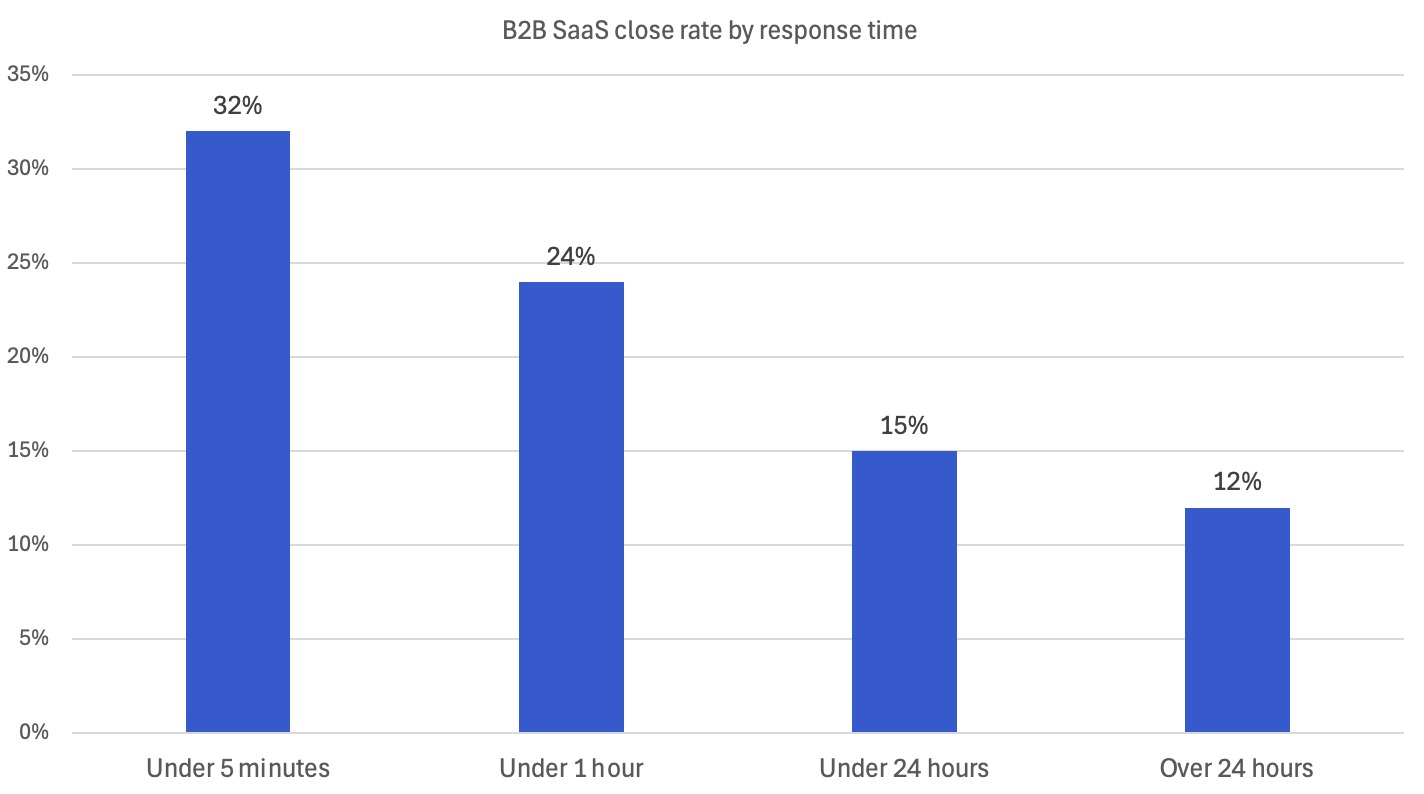
5 minutes. The benchmark every credible study converges on. Optifai's 2026 data, drawn from 939 B2B companies, shows a 32% close rate for leads contacted within 5 minutes, which is 2.6× higher than leads contacted after 24 hours. Looking at contact rates rather than close rates, the original Oldroyd research found firms 100× more likely to reach the lead at 5 minutes than at 30 minutes.
10 minutes. Engagement falls off a cliff. Strolid's analysis of 2.3 million automotive leads found that buyer engagement drops from roughly 80% at 5 minutes to 45% at 10 minutes (Strolid, 2024). Each additional minute of delay in the first five minutes reduces conversion probability by approximately 10%.
30 minutes. You are now 21× less likely to qualify the lead than a competitor who got there in 5. In Strolid's automotive data, just 15% of leads are still in active shopping mode at this point.
1 hour. The original Harvard Business Review finding still holds in the more recent data: firms contacting leads within an hour are 7× more likely to qualify them than those waiting one hour longer, and 60× more likely than those waiting 24+ hours.
4 hours. Most competitors have already had a conversation. The lead may still answer your call. But they are no longer comparing options. They are in a sales process you started too late.
24 hours. Optifai's data shows close rates settle around 12%. Less than half the rate of a 5-minute response. Drift's Lead Response Report found 55% of companies actually take five days or more to respond at all.
48+ hours. Salvage mode. Salesforce data shows that only 27% of leads ever get contacted at all. The remaining 73% are wasted marketing spend, sitting in a CRM that nobody takes action upon.
Why the problem is getting worse, not better
A decade of CRM tools, marketing automation, and AI-assisted sales should have closed the response gap. It hasn't. The B2B average is still 47 hours. Hatch's 2024 analysis of 132,188 home services campaigns found 88% of users take longer than 5 minutes to reply, and the most common response time was a full day.
Three things are pulling the average in the wrong direction.
Buyer expectations have flipped.80% of Millennials expect an immediate response from a company they contact. 64% of Gen Z want the same. The customer base is becoming less tolerant of delay every quarter. The infrastructure most businesses are still running was built for a tolerance window that no longer exists.
Lead volume is shifting outside business hours. AI-referred traffic, mobile inquiries, and after-hours research all push more inquiries into the 5 PM–9 AM window. A homeowner requesting three pest control quotes on a Sunday evening is not the exception. They are the median.
Multi-vendor shopping is the default. A buyer requesting a quote almost never requests just one. Insurance leads from some sources are often sold to between three and eight carriers simultaneously, with the first to respond winning the conversation. 78% of customers buy from the first business that responds. Not the best. Not the cheapest. The first.
The compound effect: rising expectations, more after-hours volume, and simultaneous-vendor shopping have created a window that closes faster than most internal processes can react. A 30-minute response in 2015 was acceptable. In 2026, it could have the same effect on your pipeline as no response at all.
The after-hours gap
This is where most of the leakage happens, and where most businesses haven't looked.
Across Weply's European chat operations, roughly half of all visitor conversations happen outside standard office hours: evenings, nights, and weekends. That is not surprising once you look at the calendar. 5 PM–9 AM weekdays plus weekends is around 64% of the week. What is surprising is how few businesses are set up to respond during that window.
The pattern is consistent across the public data. Housecall Pro found that 41% of home services jobs are booked after hours, when most teams are unavailable to respond. Neil Patel's analysis of LeadChat client data put after-hours leads at 50–60% of total volume. GreetNow's 2026 benchmark report found companies with 24/7 response capability convert at 2.5× the rate of 9-5 operations, and that after-hours leads receiving same-night response have an 85% contact rate, compared with 35% for next-morning response.
Translate the numbers into the buyer's actual experience. Someone fills in your form at 21:14 on a Tuesday. Your CRM stamps it and waits. At 09:00 Wednesday, your team sees it and responds. By then, the buyer has had twelve hours to receive replies from three competitors who do answer at night. The deal isn't lost because your product is worse. It's lost because the conversation happened without you.
The after-hours gap is the single largest unaddressed revenue leak in European inbound lead generation. It is also the easiest to measure. Pull the timestamps on every web form, chat, or call request from the last 90 days. Plot them by hour. The shape you'll see is not 9-5.
Industry response time dynamics are not the same
Not every industry decays at the same rate. The shape of the curve holds across all of them. The slope varies.
Insurance
Insurance leads are often sold to between three and eight carriers simultaneously. The first response wins the conversation. Yet only 37% of insurance reps reply within the first hour, and 24% take more than 24 hours. For an industry where the entire premium structure depends on capturing intent at the point of decision, that is a structural problem. SalesWings's analysis of insurance lead behaviour found that the golden window is the first five minutes, after which connect rates "decay as intent drops and competitors step in".
Automotive
Strolid analysed 2.3 million automotive leads across 847 dealerships between 2022 and 2024. Buyer engagement at five minutes was 80%. At ten, 45%. At thirty, 15%. Yet only 13% of dealership sales teams respond within five minutes to a web form or chat lead. Automotive is one of the clearest cases of an industry where the data is well-known and ignored.
Trades and home services
Hatch's 2024 study of 132,188 home services campaigns found 88% of responses take longer than five minutes; only 3% respond in under a minute. 41% of home services jobs are booked after hours. A homeowner whose drain backs up at 19:00 is contacting three plumbers. The one who answers first wins. This is the vertical where the decay curve is steepest and the after-hours skew is most pronounced.
Legal
Hennessey Digital's 2025 study of 1,333 US law firms found the median response time is 13 minutes, markedly faster than five years ago, but 26% of firms still don't respond at all, and only 25% respond within five minutes. Legal leads are higher-consideration than insurance or trades, but the window is still measured in minutes, not days.
A decay curve and a benchmark spreadsheet don't move budgets. Concrete numbers do. Two illustrative examples, with the maths visible below:
Example A: A Danish insurance brokerage
Inputs. 200 inbound leads per month from the website, hereof 50 pre-qualified by experts in the live chat. Average commission per converted policy: €350. Current response time: 45 minutes during business hours; next-morning for after-hours leads, which represent roughly half of total volume.
What the data says. At a sub-5-minute response, the close rate would land near 32% on the Optifai curve. At a 45-minute response, closer to 24%. That is an 8-percentage-point gap. On 200 leads per month, the brokerage is converting 48 policies instead of an achievable 64.
The maths. 16 lost policies × €350 = €5,600 per month, or €67,200 per year, on the response-time delta alone. That number ignores the 100 after-hours leads receiving no response until the next morning, where GreetNow's contact-rate gap of 85% vs 35% implies a further loss in the range of 30 to 50 policies per year.
Example B: A Dutch pest control company
Inputs. 50 leads per month, average job value €280. Current response: 4 hours during business hours, no response after-hours (roughly 45% of inbound).
What the data says. The 27 after-hours leads receiving no response have an 85% drop in contact rate by next morning. Of the 23 business-hours leads, the 4-hour response is converting roughly half what a 5-minute response would.
The maths. Best-case lost revenue across both buckets sits between €3,000 and €4,500 per month, or roughly €42,000 per year.
The exact numbers will vary by business. The shape of the loss does not.
What to do about it
Three tiers, in increasing investment. Pick the one your data justifies.
Free, this week
Audit your inbound timestamps. Pull every form submission, chat, and call request from the last 30 days. Plot them by hour and day of week. Mark the percentage that arrived outside your team's working hours. Until you have that number, every other decision is guesswork.
Set up an immediate auto-acknowledgement on every web form. A real, useful response within 60 seconds confirming receipt, setting expectations on when a human will reply, and offering an alternative channel like chat for urgent enquiries. This buys you goodwill and time.
Moderate investment
Live chat with human agents during business hours. The data on chat is consistent: one reply in a chat increases conversion probability by 50%, and a second reply doubles it. After-hours, a human agent also does the smart lead qualification; name, contact, intent, urgency, and captures the lead in the conversation rather than letting it sit in an inbox and informs the lead when they can expect to be contacted.
Full coverage
24/7 human-staffed chat with AI support. This is what Weply does for European businesses. Not an AI support bot answering alone. A human-supervised conversational layer with lead conversion experts that handles the conversions 24/7, 365 days a year. Why waste all those marketing initiatives and money in generating traffic with buying intent, when no expert is there to pick it up? Because that is what you do, when you neglect putting conversion experts on your website.
Frequently Asked Questions
What is a good lead response time?Under 5 minutes for any qualified inbound lead with active intent: quote requests, demo bookings, contact form submissions. Top-performing teams hit under 60 seconds. The industry average across B2B is 47 hours, which means even a 1-hour response puts you ahead of the field. The right target for your business depends on the competitive intensity of your vertical.
Is the 5-minute rule actually based on real data?Yes, with caveats. The original research is Dr. James Oldroyd's 2007 study using InsideSales.com data, published in Harvard Business Review in 2011. It analysed 2,241 US companies and roughly 100,000 leads, looking at phone-based outbound responses. The shape of the curve has been replicated in every subsequent study; the precise multipliers vary by motion (chat vs phone vs SMS) and industry. Modern benchmarks like Optifai 2026 and Hennessey 2025 confirm the directional finding.
What if my business doesn't operate after hours? Roughly half of European inbound lead volume arrives outside standard office hours. The question isn't whether your business operates at night. It's whether your competitor's response system does. The economics rarely justify staffing a full sales team after hours, but they almost always justify some form of automated qualification with human handoff and expectation setting in real-time with the high-intent visitor.
How quickly should I respond to after-hours leads? If you can respond same-night, within a few hours, even via outsourced qualification, your contact rate will be roughly 85%, compared with 35% if you wait until the next morning. The cost of a "respond in the morning" policy is roughly half of every after-hours lead lost to a faster competitor.
Does response time matter more for B2C or B2B? Both, differently. B2C buyers have higher decay velocity and shorter consideration cycles. B2B leads have more tolerance for delay measured in minutes, but the deal value is usually higher, so the cost per lost lead is greater. 72% of B2B buyers say a vendor's response time is the most important attribute of a winning vendor.
The bottom line
Two sales teams with identical leads, identical products, and identical prices will produce wildly different revenue results based solely on response speed. The data on this has been consistent for fifteen years and continues to consolidate as buyer expectations harden.
The businesses that win are the ones that first and foremost capture and qualify the leads as the enter the website and that measure the after-hours skew in their own inbound data, calculate the cost of the response delta honestly, and decide what level of coverage the maths supports.
The numbers have been here for a decade. The question is whether you act on them before the competitor next door does.
Thank you! Your submission has been received!
Oops! Something went wrong while submitting the form.
Blogs
|
September 28, 2026
|
9
min
How to Process Customers in MoFu
Customers are aware of your brand but often unaware of how and why.
We've reached the middle of the sales funnel (MoFu), where it's all about information sharing and persuasive messaging.
In this article, we share content tips that will help you lead your customers further down the sales funnel, turning them into paying customers.
Let's get the basics down first
MoFu, is short for The Middle of the Funnel, which refers to the middle section of the sales funnel. While the first stage of the funnel is about creating brand awareness, MoFu focuses on creating engagement.
You can create this by sharing content that moves potential customers from being aware of your brand to considering a purchase of your products or services.
But how does this work in practice?
There are two key factors that you should think about before developing your MoFu strategy.
How do you want customers to experience this phase? Think about what messages are important to highlight. These could include information sharing and offers. You don't have to choose a single starting point. Combine the directions that you think will benefit the ongoing customer journey.
Think about how you can motivate customers to go one step further.
What sparks their motivation and need to complete a purchase?
What will encourage them to take them all the way to the finish line?
Think about whether it's an actual need, or whether it's an emotion-based decision. Point out the main motivations to become a customer of yours in your messaging.
What should I communicate in MoFu?
During MoFu, customers are open to new information and getting to know your brand better. The stage is in many cases data-driven, focusing on problem solving and results.
Compared to the first stage of the customer journey, which is mainly about communicating what you offer, now it's time to tell how and why. It's a great time to show statistics, results and to provide detailed descriptions around your solutions.
We recommend including references, customer cases and personal experiences of your products or services under MoFu. This is to build trust while showing what your offer can generate in practice.
How can your brand facilitate potential customers' challenges? State this in your marketing to increase the possibility of sales.
Strategies during MoFu
Think back to the last time you considered a purchase. You probably read up on the product, searched around for options and scrolled through references. It probably took more than one website visit to convince you to buy from a new brand.
The same goes for the potential customers who are in MoFu. The process can take a long time and require a lot of information before the recipients are convinced.
Therefore, it is important that you have all possible resources available, so you do not lose customers along the way.
Content categories under MoFu
Inform and educate potential leads about your offerings. Help them understand what it means, how it works and what differentiates your products and services from those of your competitors.
Show how your products or services solve their challenges and problems. Before and after pictures, references or customer cases can make the impact clear to potential customers.
Answer the questions potential customers might have and remove potential concerns. For example, implementing a new solution can be perceived as both big and uncertain. Communicate guarantees, support and simplicity, to create confidence in the process.
Work on conviction. You are not selling a product or service, but a solution to a problem. Your offer will make customers' lives better, more fun or easier. Think about the main motivation you should push for in your communication.
Channel choice during MoFu
There are several marketing activities and channels you can work with during the MoFu stage. Webinars, whitepapers and newsletters to name a few.
We have selected three options that capture your potential customers through different strategies and platforms.
Blog
Blogging is not about selling, rather it's about knowledge sharing.
A blog gives you the opportunity to provide your readers with new knowledge and clarify your expertise. Which in turn can generate in need of a solution.
Create a platform that your potential customers can turn to for answers to questions related to your industry.
Do you work as a broker? Then you can inform how styling affects sales prior to a showing.
Do you work in the beauty industry? Then you can share how skin is affected by different climates.
As well as generating value for your potential clients, the blog will help you improve your search engine rankings. This increases your organic visibility and therefore the possibility of capturing more potential customers. Win-win!
Create video content
Although a picture is worth a thousand words, you can triple the message through video content.
Moving content gives you the opportunity to be more informative, evoke emotions and inspire. You can build a story around your product, demonstrate how it works or what it generates.
You can even create video review where selected references talk about their experience and what they think of the product. This builds more trust than a written review, as the recipients get an idea of who the user is and have a chance to relate.
Video footage is useful on social media, on your website, but also very much in advertising.
Interact through social media
Social media is effective when it comes to sharing information and building relationships. Whether it's DMs, comments or questions on stories, we recommend paying attention to your notifications daily. No one feels valued by having to wait days for a response.
We understand the challenge of making time count. And getting to a post can seem like an impossibility at times. But see the channels as an important part of your MoFu strategy.
Social media helps you remind potential customers of your brand. Through a few simple lines and a picture, you can showcase products, news or introduce the team.
They also give you the opportunity to build a deeper relationship with your potential customers through a few quick but well-thought-out messages.
Lacking inspiration?
Look at what your competitors are doing and, most importantly, what your users are writing. Read through the comments and see if you can capture recurring questions and requests. This can give you inspiration both in terms of content but also generate ideas for future product development.
Summary
MoFu is about informing and answering potential customers' questions in a convincing way. Through the right strategy, knowledge sharing and references, you can meet their needs and lead them further through the sales funnel.
Read more
Blogs
|
September 28, 2026
|
9
min
How to increase traffic to your site
Do you find it challenging to generate leads and drive potential customers to your website?
In this guide, we give you concrete tips on which methods you should work on in parallel to gradually increase traffic to your website.
Search Engine Optimization (SEO)
Search Engine Optimisation is a method that helps you to increase your visibility to the search engines and to rank higher in search results.
By creating content with relevant keywords and descriptions, you can become visible to the search engines and rank higher with users.
For example, if you sell beauty products online and know that your customers are searching for specific brands or products such as mascara, lip gloss or sunscreen, it's important that those keywords are included in your website content.
The more authority Google deems you to have, the higher you will rank on those keywords. There are different ways to build authority, link power is one of them.
For example, if you have an entire landing page with products from a particular brand, with links from both internal and external pages, you will have higher authority on that keyword than if you only mentioned the brand in a product text.
Other factors that affect how high your website ranks are how well it works technically. Loading time, mobile-friendliness, URL structure and headings will all affect the page's quality score, which in turn is important for ranking high.
Google Ads includes display and search advertising, which means you pay to appear in search results for a relevant target audience.
This is a good complement to your search engine optimisation, which in many cases requires a lot of resources to produce results.
The advantage of this type of advertising is that you reach relevant and interested recipients, using your chosen keywords for the ad. If you are selling beauty products, you should highlight the keywords that the ad represents, for example, brand name, "mac" and product name, "lipstick".
Your results are measurable down to the smallest detail, so you can track what's working and what's not after the fact and optimise accordingly.
Another advantage of Google Ads is that you only pay for clicks, compared to a newspaper ad where you pay for placement with no guarantee that anyone will visit your website.
Similarly, you can advertise through Microsoft Advertising, formerly known as Bing Ads. Microsoft Advertising is a combination of Big data, Automation and Artificial intelligence.
Microsoft Advertising analyzes behavior based on app interactions and intent data. It helps advertisers reach a relevant audience with their marketing.
As with Google Ads, Microsoft Advertising is a search advertising platform. You only pay per click and the ad appears in search engine results when a user searches for the specific keyword that matches your keywords for the ad.
You also have the opportunity to capture your target audience in their daily social media consumption. When you advertise on Facebook, you have the ability to communicate like a post in the stream.
Again, you only pay for clicks, and have the ability to tailor the targeting to your ideal audience. You can also set different goals for your ads, for example, do you want to increase brand awareness, get more clicks or motivate a purchase?
You can advantageously work on several campaigns and targets in parallel to work on your recipients. On all platforms, you decide the budget and the time period for which the ads will be active.
Whatever ad strategy you choose to apply, try to create as relevant ads as possible. This is done by matching keywords with the content of the ad text and your landing page.
There should be a common thread running through all elements of your communication. Then more searches will lead to clicks and more clicks will lead to more business.
Social Media
Marketing through social media has proven to be a great advantage for both start-ups and established companies, as it is an easily accessible channel that captures users in their everyday lives.
Brands post an average of four posts per week on Instagram and a large number prioritise communicating on multiple media. Social media makes it easy for you to communicate directly to your audience through your posts.
Depending on which channel you are on, there are different features you can use to communicate and engage your audience. Examples include stories (videos/images that are visible for 24 hours) on Instagram, live broadcasts on Facebook or questionnaires on LinkedIn.
You can easily link to your website through posts and in stories.
For optimal impact, encourage recipients to click through to take advantage of an offer, product or collection you highlight in the post.
If you do a good job and manage to build a relevant and engaged following, the ball is rolling. Your social media users can help you and your brand grow by liking, commenting and sharing your content with other users on the channels.
When choosing a channel(s), you should base your choice on the audience you want to attract. If you haven't developed clear personas for your brand, we recommend you start there. Read our article here for tips.
Once you know who you want to reach, you can match them based on their age range, lifestyle, media consumption and how they prefer to receive information.
Do they prefer moving pictures, images, short copy or longer?
The key is to choose the channel according to where your target audience is and create a content plan accordingly with clear CTAs (call to action) included.
Advertise on websites that are in the same industry as you
To increase your chances of being visible to a relevant target audience, advertise on websites that are in a similar industry or segment to you.
For example, if you work as an interior designer, you can reach a relevant audience by being visible on real estate agencies. If you work as a florist, you could place your ads on a website that sells wedding dresses.
The trick is to inspire recipients to visit your site by appearing on pages you can complement with your offer. In this way, the marketing is both genuine and relevant to the recipients.
Read more about how to target your digital ads to relevant websites here.
Guest blogging to increase your link power
Link-building marketing is all about helping your website increase the number of relevant links from external parties.
In short, this is a strategy that will increase your search engine rankings and therefore your visibility. You can make use of this strategy by guest blogging, for example.
Guest blogging is a relationship-building tactic that in turn brings the power of building external link power. Ask to write a guest post on another profile's blog that feels relevant to both their audience and segment.
Create content that represents you and your brand's expertise and knowledge within the segment. Weave in your products in a relevant and genuine way that sparks an interest in recipients to see more and read on.
For example, if you work in the beauty segment and will be guest blogging for a digital fashion magazine, you can highlight your top 5 products and provide tips on how to use them.
You can also review your favourite products and compare them with products from another brand.
Why should people choose your products and not those of your competitors?
If you do a good job, you can expect the majority of readers to be inspired enough to click through to your site - through a simple link.
E-mail marketing
E-mail marketing is an effective method of reaching a relevant target audience with personalised communications. Marketing automation, is a pre-programmed process that guides recipients through different stages of their individual buying journey.
If your recipients have searched for products or services on your website, but have not taken the step to complete a purchase, you can effectively send them reminders of the products they have looked at or recommend new ones in the same category.
Through informative customer data, you can base your marketing on behaviour, activity, purchase history and preferences.
In addition to personalised and accurate communication, email marketing helps you build a deeper relationship with potential and current customers and generate additional sales as they are always up to date with news, offers and promotions on your website.
The methods we mentioned above will help you get a holistic view of your marketing strategy and increase your traffic through multiple channels working in parallel for the same goal.
The methods allow you to capture relevant users who are at different stages of the buying journey, but who share a need and interest in your products/services. We recommend that you monitor the results continuously through Google Analytics, to evaluate each activity because.
Digital marketing is a long-term work, which is both moving and changing, which means that you need to optimize your activities as you go.
In many cases, small adjustments can make a big difference, whether it's SEO or targeting for advertising. The most important thing is to get started, and if all channels are new to you, we recommend taking one step at a time and starting from the top.
Read more
Blogs
|
September 28, 2026
|
9
min
How to create a marketing funnel that leads to sales
In this introductory guide, we'll look at how you can start building and working with your marketing funnel in practice, to create better conditions for your marketing to succeed in the long run.
We'll give you tips on which activities are appropriate at which stage, so that your communications lead customers all the way to sales.
"What is a marketing funnel?"
A marketing funnel is a visualisation of the customer journey, the purpose of which is to map how potential customers are converted into leads and customers through the different stages of the buying journey.
From the initial stages, whose goal is to increase brand awareness and interest among the target audience, to the buying stage where the sales process comes to an end.
Marketing funnels help marketers to define activities for each part of the buying journey in order to strategically process and convert leads into paying customers.
There are several versions of marketing funnels, today we will start from the most common model AIDA.
Each stage will be presented step by step, with hints on which activities can be applied during which phase.
We will give you the tools you need to apply the model in your business marketing strategy.
AIDA step by step
Awareness
Awareness is the first stage of a marketing funnel. It is at this stage that your potential customers are exposed to your brand and content, for example through ads, social media posts, blogs, Google searches or advertising.
Here, your task is to build both interest and trust with the recipients at an early stage, through tailored communication.
Above all, your goal is to increase brand awareness and to provide a clear picture of who you are, what you stand for and what you offer. But, to do this in an attractive way, you first need to know who you want to attract and reach.
So step one is to define your target audience and develop personas. Visualise who or what your typical customers are to create an understanding of how you should communicate with them.
Personas helps to concretise character traits by answering questions such as:
Demographics: age, education, position, capital, location, income and relationship status?
Personal factors: lifestyle, values, interests, ambitions and motivations?
Background factors: work experience, responsibilities, digital use and behaviour?
Define what is important to your target audience, linked to career and lifestyle.
Describe the challenges they face and what motivates them. Include examples of what makes them frustrated. This will give you a clear picture of what to communicate, how to craft your message and what to avoid.
This is also where you'll have a basis for where you should communicate and what channels you should invest in to generate traffic to your website.
Generating traffic to your website can be both organic and paid. Through SEO, social media, articles, etc. you have the opportunity to increase your visibility digitally at no cost.
If you want to reach out more broadly to a specific target audience, you have the option to sponsor your posts on social media and create digital ads through Google to increase the visibility of your communication.
f your target audience is active on social media, this is an obvious channel. If they prefer to consume media while doing other things, podcasts are an optimal medium.
If they prefer to read longer texts, blogs and newsletters are preferable.
If they appreciate longer videos, start a YouTube account.
A mix of media is an effective strategy for many of today's brands, as you have the opportunity to capture all of your personas' preferences.
The key is to communicate through the channels your target audience spends time on.
Once you have a clear picture of your personas, where they are and which channels to drive traffic from, it's time for step two - creating content.
Interest
Once recipients have become aware of your brand, the next step in your marketing funnel is to generate interest. The target audience now has an idea of who you are and what you do, the goal is now to take them one step further.
When you're cultivating your prospects, it's important to always have a clear purpose.
What do you want your recipients to think, feel and do when they engage with your communication?
For example, sign up for a newsletter, click through to your website or contact someone in your business?
Without a clear goal, it becomes a challenge to monitor the activity of the customer journey and analyse the results.
Your communication will now revolve around one to several CTAs (call to actions). You want to lead your recipients further through the buying journey with your communications, whether it's ads, organic posts on social media or with commercials on YouTube.
Encourage recipients to learn more about your services on your website, to click through to a product, or to call you at the touch of a button.
The content of your communication should lead them through the buying journey as simply and clearly as possible, and of course must be interesting enough to make them feel attracted to go to the next step. That's why you need to plant a seed early on in your text, image or video.
For example, if you want to promote a particular product, it is important that it is presented in an attractive way in the ad:
It should be clearly visible, and preferably demonstrated by a user
A top or a piece of jewellery looks better on a person than on a hanger
If you work as a lawyer and offer advice, your service can be demonstrated through a video.
Create a scenario and a classic example of common questions and problems that you solve for your clients. This is where storytelling and evoking emotions is effective.
Demonstrate both an expression of how the client feels when they need help and how they feel afterwards, to clarify the relief after the advice.
Reflect on:
What you are offering
What buttons you can press
How your recipients would prefer to move to move on to the next step
Consideration
At this stage, your target audience has been converted into potential leads and is considered highly receptive to your marketing activities.
For example, your users have clicked through to your website, downloaded a brochure, signed up for a newsletter or contacted you through the chat on your website.
Now you have the opportunity to create a deeper relationship with the users in your lead database and to further customise the communication for each individual lead.
Retargeting
Through retargeting campaigns, you have the opportunity to follow up on an interest in a product, by re-disposing the product in an ad targeted specifically at that recipient.
The aim of retargeting is to remind the customer of the product and to reinforce both the interest and the need.
You also have the option to create automated email campaigns whose content recommends similar products that your recipient has previously shown an interest in. It is at this stage that you create exclusive offers, in the form of discounts, trial periods or free consultations.
Webinars
If your services are extensive and require a lot of information and guidance for a decision, we recommend organising webinars to convince potential leads of your expertise and approach.
This also gives you the opportunity to show who you are, what it's like to work with you and build a more personal relationship with the recipients.
We recommend that you communicate the date and time at least a week before the webinar takes place so that participants can set aside time in their calendars. Evenings or weekends usually yield a larger audience. Read more about how you can work with webinars here.
At the consideration stage, it's all about being as personal and persuasive in your communication as possible, to motivate potential customers to take another step in the buying journey stage.
Intention
To fit into the intent stage, you need potential customers to have demonstrated that they are interested in buying your company's products or services.
If your potential lead has added a product to their shopping cart, started an order for a service, signed up for a free trial, or attended a webinar - they're a hot lead!
As a marketer, you now have a great opportunity to nurture leads with additional arguments as to why your products or services are the ultimate choice for the recipient.
E-mail campaigns
Even at the intent stage, automated email marketing can be a strong player in your communications.
For example, if your customers have added products to your shopping cart but left the website, you have the opportunity to remind them that the products are still there through an email.
This is also where you have the opportunity for additional sales. Recommend similar or complementary products based on what is in the recipient's shopping basket. Then motivate them to see more of your offer with a simple click.
If your potential lead has started a trial of your service, we recommend following up on their experience with an email inviting feedback.
In many cases, feeling involved is highly valued by consumers, so show that you care about their opinion and that they have the opportunity to influence it.
The same goes for webinars, follow up on participants' experience by asking for feedback. Here you can also be more personal and thank them for taking the time and encourage follow-up questions.
This will help your business both to develop and to build a deeper relationship with customers.
Evaluation
In the evaluation stage, potential leads make their final decision: are they convinced enough to complete the buying journey?
In some cases, depending on the industry and business, the salesperson takes over at this stage.
For example, if you work as a lawyer or architect, which involves a larger investment for the client, a more personal contact is likely to be required than for a purchase of, say, a book. Potential customers need to interact on a more personal level to be 100% convinced.
This can also be through live chat, for example, where website visitors can interact personally with the company before making the final purchase online or calling to book an appointment.
Purchase
We are now at the final stage of your marketing funnel, where the customer has made the decision to pursue a purchase and is converted into an active customer.
The sales process ends the moment the transaction takes place, but one purchase should motivate more.
Marketing activities therefore take off again. You should pay as much attention to your existing customers as you do to creating new ones.
If the customer is satisfied with their purchase, your customer service and delivery, they are more likely to return to your company than to seek out a competitor.
So don't forget about your current customers:
Keep sending out automated and personalised emails with offers and recommendations
Recognize them on their birthdays and give them a gift
Organise club days where they get priority for new product releases
The list goes on and on about how you can leverage your existing customers and build loyalty over time.
Wrapping up
We've now gone through the most common model of marketing funnels and examples of which activities are appropriate at which stage.
That said, there is no one right answer to what the structure should look like or in what order the activities should take place.
Depending on the sector, target group and conditions, there are several variants and approaches to work with.
The most important thing is to get started, to dare to try things out and to monitor the results afterwards and optimise your activities from there.
Read more
Blogs
Lead Gen Hub
|
November 2, 2026
|
9
min
How To Convert Leads in BoFu
In the previous article, How to Process Customers in MoFu, we listed strategies, channels and content categories that fit in the middle of the sales funnel.
In this article, we will focus on strategies in the Bottom of the Funnel (BoFu), and how to convert your leads into customers with the right content.
What does BoFu mean?
We've previously reviewed how prospects move from being aware of a problem or need, to paying attention to a solution through a product or service.
In BoFu, Bottom of the Funnel, the lead has decided on an investment - but hasn't decided on the solution. Most likely, they are comparing offers, reading reviews and getting to know the relevant brands better. They are convinced they need a solution, but not which one.
BoFu is the last step in the sales funnel, which means that the leads that are at this stage are hot. It's not a big challenge to convert prospects in ToFu, Top of the Funnel, or Mofu, Middle of the Funnel.
But for the lead to make it all the way to BoFu, there needs to be a strong need or interest in the product/service. This is where the sale is made and it's time to deepen the relationship.
What should I communicate during the BoFu?
At BoFu, it's important to have insights into what really motivates and triggers potential customers to take the step to invest in your offering. Now you need to give them that little extra and meet them along the way.
To gain insight into how to do this, we recommend you reflect on the following questions:
What sets your brand apart from your competitors and how can you communicate this?
Who are your (best) customers today? Going back in history will also tell you how to convert them and who you should focus on.
What needs does your product meet and how can you best present this?
What are your customers' most frequently asked questions? In which place and during which time is it best to answer them?
Once you've taken the time to reflect and answer the questions, the next step is to implement the answers in your marketing.
Strategies during BoFu
We recommend you focus on the following strategies during BoFu:
Free trial periods or product demonstrations
Giving your potential customers the opportunity to feel your product or experience your solution is one of the most effective strategies in BoFu.
Experiencing a product or service boosts decision making.
This could be a month's free trial of a magazine subscription, music service or digital course. Once the recipient has tried your product or service, they will (hopefully) never want to be without it.
Free reviews
Appraisals are a great way to generate value for your potential customers.
For example, you can offer a free review of their SEO ranking. The evidence will give the customer confidence in their decision making. They really need help, and you as a company have demonstrated your expertise in this area.
Product and price brochure
Present your company, products and services through a brand-building brochure.
This will give the customer a clearer picture of what you offer, at what price and benefit. Make sure it answers all potential questions. There is no room here to lose the customer because of a gap in the content in your brochure.
Livechat
Live chats are effective tools for gathering information about the potential leads' buying journey. Analyze what visitors are mainly asking about on your website and what makes them refrain or make a purchase.
Since live chat is the only interactive channel your customers can communicate with on your website, we can promise that significant information can be gleaned from the conversations. Let this information serve as a guide for your future sales strategy.
Let the need dictate
All strategies aim to add value to your potential leads, giving you the chance to deepen your relationship with them. Whether that's in the form of personalized service, free trial periods or informative product leaflets.
Let the need dictate. We know from experience that if you give something, you usually get something in return. If you've done your homework right, you'll get it back in the form of orders and business. And the sales process - it starts a new journey towards more sales.
Read more
Blogs
|
September 28, 2026
|
9
min
How to analyze website traffic
If you have a website, it's important to have some form of analytics in place to track how your website is performing and how visitors are interacting with it.
So, whether you are just starting out with a new website or you are looking to upgrade your current analytics setup, this post will give you some valuable insights and help you make an informed decision.
Google Analytics helps you analyze website traffic
Google Analytics is one of the most common tools for analyzing website traffic.
Analytics gives you answers to where your visitors come from, how they navigate and what pages they are on when they leave your website.
Through Google Analytics you can produce reports focusing on the following:
Audience
Behaviour
Real-time
Acquisition
Conversions
Audience
In Google Analytics, you can find out detailed information about your users: statistics in terms of number of users per month, visit duration and how many pages they visit on average, to give a few examples.
Behaviour
Looking at behaviour in Google Analytics you can see how users navigate on your website, which pages they visit and which Call-To-Actions they follow.
Use the data when you plan to build more pages on your website. Then you'll gain insights into which structure works best for your users.
Acquisition
Here you have the opportunity to see how traffic is moving on your website in real time.
Like target audiences, you can see what pages they visit, where they are geographically and what device they use to visit.
If you drive a lot of traffic to your website, it can be beneficial to break down the information about your visitors in real time from time to time, so as not to miss out on valuable details or patterns.
Conversions
Acquisition gives you insights into which channels are generating the most traffic to your website.
Examples include social media, newsletters and podcasts.
The tool can give you many insights when it comes to optimizing your strategy to increase traffic.
Perhaps you should increase your advertising budget, post more newsletters or spend less resources on social media.
You can adjust your marketing activities according to what generates the most results based on your target audience.
Real-time
Conversions gives you insights into how your website is performing against your set goals.
This could be anything from sales to visitors, or the number of downloads of a whitepaper.
The tool is useful when you want to follow up on a campaign, post or CTA for example. The data can give you indications on how to improve.
Did a particular campaign generate a lot of sales? Then you should probably continue on that track.
Did your last guide not result in as many downloads as you predicted? Then you should revise the headline, the subject line or your CTA to increase the chances of conversion.
This feature is probably the most important, as the data can make a direct difference to the sales of your business.
Simple tracking through Tag Manager
Tag Manager is a complementary tool to Google Analytics that makes it easy for you to track specific goals and optimize as needed.
Tag Manager helps you track relevant activity on your website by configuring tags.
The aim is to easily track activity on your website, without the hassle of coding.
Tracking can be used in different ways, such as tracking the number of downloads of a document, the number of clicks on a CTA and purchases.
Understand website performance in Search Console
Search Console analyses how well your website is performing from an SEO perspective.
Unlike Analytics, which analyses what happens on your website, Search Console analyses how search engines perceive your website.
The tool reacts to different types of changes and alerts you through notifications.
Here are some examples:
The tool reacts to indexing problems
You receive updates on how well your website is performing in the search results
Information about external links
Technical aspects that should be addressed
Analyze organic performance through Google Business Profile
The Google Business Profile tool allows you to define your presence in Google search results and your visibility in Google maps.
Here it is important to update the information that the page displays. For example, if you change your address, phone number or opening hours.
Your information on the website should sync with what you communicate through your Google Business Profile account.
Analyze your users' needs through live chat
Using live chat for traffic analysis can be a useful way to understand the behavior and needs of visitors to your website.
Here are a few ways you can use live chat for traffic analysis:
Track the number of chat sessions initiated: This can give you an idea of the overall level of engagement on your website
Monitor the length of chat sessions: Longer chat sessions may indicate that visitors are seeking more in-depth information or assistance
Analyze the questions asked in chat sessions: This can give you insight into the topics that are of most interest to your visitors and help you identify areas where you may need to provide more information or resources
Monitor chat transcripts for common issues or problems: This can help you identify any problems or challenges that your visitors are facing, and allow you to address them in a timely manner.
Overall, using live chat for traffic analysis can provide valuable insights into the needs and behavior of your website visitors, helping you improve the user experience and drive more traffic to your site.
So, why use these tools?
Analytics tools like those we've mentioned, help you better understand who your visitors are, how they navigate, and where they might go astray.
Whether you're a small business owner, a marketer, or a website owner, having access to this type of data can make a huge difference in your online success.
So if you're not already using an analytic tool for your website, now is the time to start.
Read more
Articles
Resources
|
September 28, 2026
|
9
min
Guide: How to grow your business using SEM
Want to increase brand awareness, reach out to potential customers and drive more traffic to your website?
Then SEM could be the marketing method for you. SEM helps you become visible to your target audience with tailored messages and clear CTAs.
In this guide, we'll look at the difference between SEM and SEO, how SEM works in practice and how you can set realistic goals for your campaigns.
What is SEM?
SEM (Search Engine Marketing) is a strategy to increase the number of visitors to your website. Through paid ads, you drive traffic from the search engines to your platform, without having to rank high organically.
When you create ads in Google Ads, for example, you have the opportunity to be visible at the top of the search results, when users type in keywords related to your business and content.
SEM and SEO can be combined for increased visibility, as you have the opportunity to reach out both organically and through paid marketing.
SEO helps you build long-term trust with the search engines, while SEM helps you gain traffic directly. Think of it as a long-term and a short-term strategy.
While SEM makes an immediate impact in search results, SEO can take longer to build but creates long-term value.
That's why many start-ups choose to focus on SEM first, while building up their site with SEO optimisation afterwards.
The one and only, Google Ads
The most common tool when it comes to search engine marketing is Google Ads, which is Google's advertising platform.
Google Ads allows you to buy advertising space on several different channels, including Google search results, but also, for example, on YouTube, Gmail or other websites participating in the Google AdSense advertising programme.
You, as the marketer, can choose whether to pay for clicks or views, depending on the purpose and objective of the ad.
When you buy ad space in Google search results, you will be competing with other operators who are willing to pay for visibility through similar keywords that you use.
Therefore, in some industries or niches, there may be a lot of competition for ad space, while for other industries there may be very few players advertising.
Compared to SEO, where the goal is to rank in the top five search results, you are competing against all the websites on the internet. Here too, of course, the level of competition will vary.
For some industries, the competition is very high, while in smaller, niche areas, it may be easier to reach the front page.
Now that we've been through the difference between SEM and SEO, let's move on to how SEM works in practice.
How much does SEM cost?
The advantage of applying SEM in your marketing strategy, is that you can get visibility in search results right away.
On the other hand, you need to pay for each visitor you generate through the ads. It is not possible to say an exact price as it is dynamic pricing, but you pay for each click.
A click through Google Ads can cost anything from 50 cents to hundreds of dollars, depending on how many competing operators are bidding on the same keyword.
Of course, you decide what budget you want to spend on each individual ad. In other words, you never have to worry about the money ticking away uncontrollably.
Depending on what you are willing to pay per ad, there will in most cases be a bidding process for the visibility of each relevant recipient. This happens automatically, and is ongoing for the duration of your ad's activity.
So it's not something you have to sit and actively control yourself. However, it is important that you monitor how well your ads are performing over time, so that you can make improvements.
Are your ads not performing?
If your ads are not getting any visibility or clicks, it could be due to several factors. We recommend A/B testing headlines to find out which message has the best impact.
A/B testing involves creating two different versions of ads, or using the same ad against different audiences, then analysing which one performed best and continuing on that track.
A/B testing involves creating two different versions of ads, or using the same ad against different audiences, then analysing which one performed best and continuing on that track.
You can also do this with keywords, images and CTAs (call to action). Dare to test. In many cases, small adjustments can have a big impact on results.
The important thing is that you get a good ROI (Return On Investment). Of course, you want your investment in both time and money to generate results.
How can I calculate the ROI of SEM?
ROI refers to the amount of money you generate in profit, from the investments you put into marketing activities, in this case SEM. ROI represents the profit you generated.
We provide an example of how you can calculate your ROI here:
If you pay 10,000 for an ad campaign and generate 30,000 in sales, then you calculate ROI like this: 30,000 (gross profit) - 10,000 (cost) = 20,000.
Then you take the net result/cost=ROI in %. In this case it is: 20.000/10.000=200%
ROI is used to evaluate the effectiveness of your marketing activities in the long term, but also gives you an indication of how well your ads are performing. Use ROI to monitor performance and continuously optimise your ads as needed. The ultimate goal is to make a profit.
To set a target for how high ROI you want to achieve, you can start from the customer journey. Answer the following questions:
What is the average profit per lead?
How do you create interest at an early stage of the customer journey, with a potential customer?
When does the user who clicked on the ad become a potential lead for the sales team?
Determining the ROI of your activities can be a challenge, but it is necessary to get a clearer picture of how your activities are performing.
We recommend tracking the customer journey, and seeing what percentage has moved from one step to another. This will give you insight into how well your ads are performing and whether you are reaching a relevant audience.
How do I get started with SEM?
There are a variety of tools you can use to develop, analyse and optimise your SEM. We list the most common tools available:
To reach the search engine, you create ads in Google Ads, with the aim of targeting traffic to your website or a specific product/service. Google Marketing Platform offers you several different tools and solutions for SEM.
Whether you run a start-up or own an established business, the tool can help your business grow through targeted advertising. In the platform you will find for example:
Analytics - Analytics is an advanced analytics program for your website, providing valuable insight into both traffic and behavior.
Data studio - Data Studio is a tool that helps you organize and analyze data.
Optimize 360 - Optimize 360 is a tool that allows you to test and evaluate different versions of campaigns on your website.
Search Ads 360 - Search Ads 360 is a tool that helps you analyse and improve search campaigns.
Bing Ads
Bing Ads is Microsoft's equivalent to Google Ads. Although Google is the most well-established and largest search engine, there are several other options that have many users, such as Bing.
The Bing Ads advertising service works in much the same way as Google Ads. The main difference is the users you reach through the different search engines. Thus, when choosing a tool, the target audience should play a major role.
Adobe offers a multi-tool platform, designed to provide visibility and to optimise digital marketing activities. In the platform you will find tools such as:
Demand-side Platform
Advertising Cloud Search
Advertising Cloud TV
Advertising Cloud Creative
When working with SEM, Cloud Search is the most relevant tool, as it uses artificial intelligence to optimise advertising campaigns based on the data collected. This can give you a better understanding of who and how to target your ads.