Strategy, data and guidance on driving the right traffic, converting it, and making the most of every lead. From a team doing it every day across 2500+ BtB and BtC companies.
August 26, 2026
|
9
min
How to Find Your Website's Lead Conversion Leaks with ChatGPT [including 8 prompts to use]
Quick Summary
Most businesses spend serious money driving traffic to their website and almost nothing auditing whether that website actually converts visitors into leads. This guide gives you 8 copy-paste prompts and a clear process. Run them against your own webpages using ChatGPT or Claude. No tools to buy, no agency to hire. By the end, you'll have a prioritised list of exactly where your website is losing leads and what to fix first.
The Problem Most Businesses Never Audit
Traffic goes up. Leads stay flat. You've tried new headlines, changed the button colour, maybe swapped the hero image. Nothing moves the needle. Here's what usually isn't happening: a proper audit of the full path a visitor takes from landing on your homepage to becoming a lead.
The average website converts 2 to 3 percent of its visitors. The top performers convert 8 to 15 percent. The gap between those two numbers is often not better traffic or smarter ads. It's fewer leaks in the conversion path. A leak is any point where a motivated visitor quietly exits without taking the action you need them to take.
Leaks hide in obvious places: a form with no clear next step, a contact page stripped of any reason to trust you, a service page that doesn't match what the homepage promised. They also hide in less obvious ones: a visitor arriving at 9 PM with a genuine need and nowhere to turn, or a buyer who just came from an AI search tool mid-conversation and landed on a static brochure page with a contact form at the bottom and a phonenumber in the menu bar.
Most businesses have never audited for these problems systematically. They've looked at individual pages. They haven't looked at the path. This guide changes that. Eight prompts, one conversation thread with an AI, your own screenshots.
Why Listen to Us?
Weply has in 2025 alone generated over 250,000 qualified leads on behalf of 2,400+ customers across the Nordics and Europe. We've been doing this since 2013, across industries ranging from dental chains to insurance companies to fast-growing scaleups, to telco enterprises and so on.
We know what breaks conversion paths because we watch them break in real time.
Our chat consultants, backed by AI, handle the questions visitors can't get answered on a website. They capture the leads that forms lose. Across our customer base, adding managed chat produces an average 12% lift in lead conversion, and one in three chat conversations becomes a qualified lead. That data is the foundation for everything you're about to audit.
Why Use AI for This, and What You'll Need
A conversion specialist can audit your website for between EUR 3,000 and 8,000. They'll spend four to six weeks on it and deliver a PDF. The audit will be thorough, and for complex e-commerce operations, it's probably worth every cent. For most service businesses, you can surface minimum 80% of the same findings in 30 minutes using an AI. Here's why it works: AI evaluates your pages the way a first-time visitor does, without the curse of knowledge. You've looked at your homepage so many times you no longer see it. AI reads it cold. It also audits paths as sequences, which means it catches the friction that lives between pages, not just on them.
One honest caveat: this works well for service and product businesses with a clear conversion path. If you're running a complex multi-product e-commerce operation, a full specialist audit will find things this process won't. For everyone else, 30 minutes is enough to find what's bleeding leads.
What you'll need:
ChatGPT Plus, Team, or Claude Pro (the free tier works, with limitations on image uploads)
A browser
A full-page screenshot tool (GoFullPage for Chrome, Firefox's built-in screenshot function, or use mulitple screenshot directly from Claude)
30 minutes
Optional: GA4 access for one advanced prompt
Before You Start: Four Preparation Steps
Step 1: Map your conversion path. For most businesses this is Homepage, Service/Product Page, Pricing Page, Contact Page. If you're unsure which pages matter most, open GA4, go to Explore, and check the path exploration report. Three to five pages is enough to work with. Step 2: Take full-page screenshots of each page in sequence. Full-page, not just the top fold. You need the AI to see the whole page. Step 3: Screenshot your lead form and your confirmation page. The confirmation page matters because it tells you, and the AI, what promise you make to someone after they submit. Step 4: Open a new conversation in ChatGPT or Claude, upload all screenshots together, and add this context: You are a senior conversion rate optimisation specialist with experience auditing business websites. These are screenshots of my website pages in the order a visitor would see them. My business is [type of business]. My goal is to generate [desired action: enquiries / consultations / quote requests]. I'll be asking you to audit specific aspects of these pages.
Set this context once at the start. Every prompt that follows builds on it.
The Prompt Library
Eight prompts. Run them in sequence in the same conversation thread. Each builds on what came before.
Prompt 1: The First-Impression Test (copy this exact prompt) # First-Impression Audit ## Context Visitors decide within 5 to 10 seconds whether to stay or leave. This audit evaluates what's communicated before any scrolling. ## Your task Look at the first screenshot only (homepage or landing page). Based exclusively on what's visible above the fold, answer:
1. Clarity — What does this company do? 2. Audience — Who is it for? 3. Action — What should I do next? 4. Trust — Why should I believe them?
## Output format | Question | Answered? (Y/N) | What's missing or unclear | |----------|:---:|---------------------------| | What do they do? | | | | Who is it for? | | | | What should I do next? | | | | Why trust them? | | | Above-fold score: X/10
What this reveals: The failure we see most often across service websites is in row three of that table: "What should I do next?" Businesses build strong hero sections explaining what they do, then offer no visible next step. No CTA above the fold. No invitation to start a conversation. The visitor who wants to engage has to scroll, navigate, and figure the path out alone. Every step of effort they have to put in is a point where you can lose them. The good news is this is the quickest fix in the whole audit. A clear, visible CTA above the fold costs nothing to add and almost always moves conversion numbers.
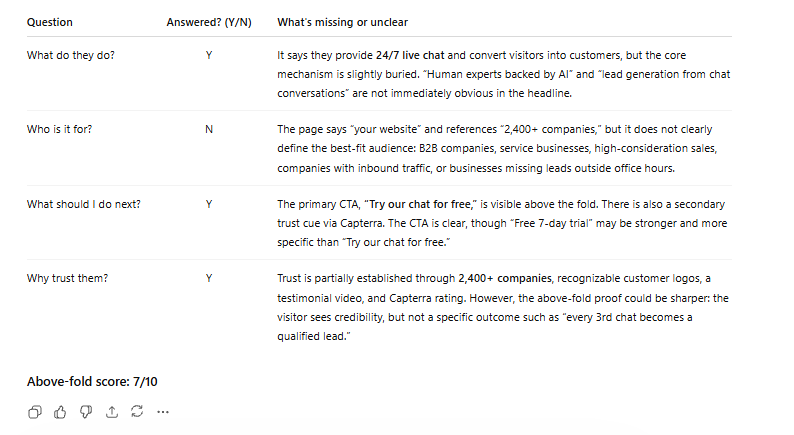
Example from running the prompt on Weply's homepage
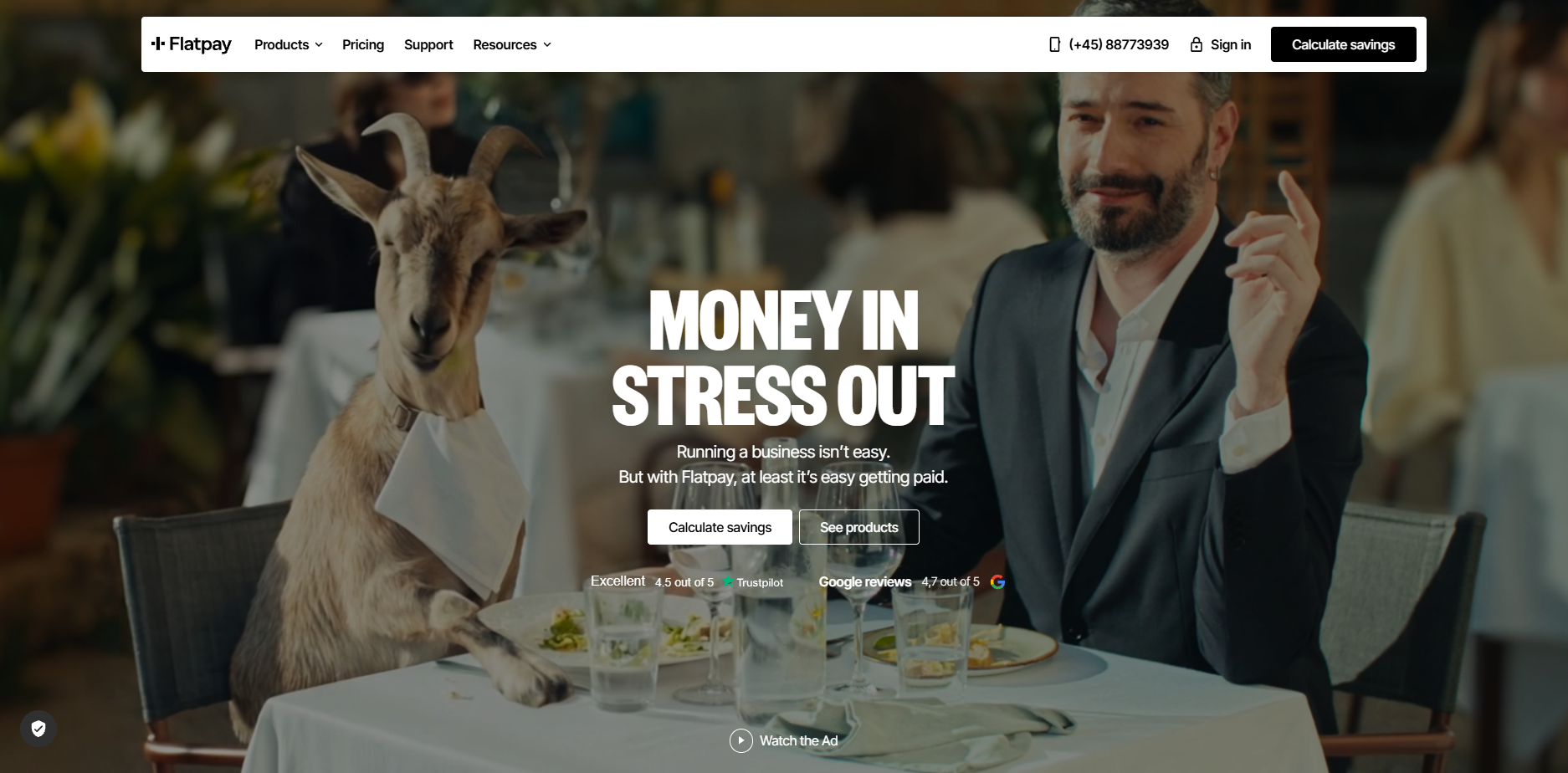
Now what we did was to run the full series of prompts on one of the most succesful current scaleups in Europe and one of the best at digital marketing, Flatpay.
This is the result from the first prompt:
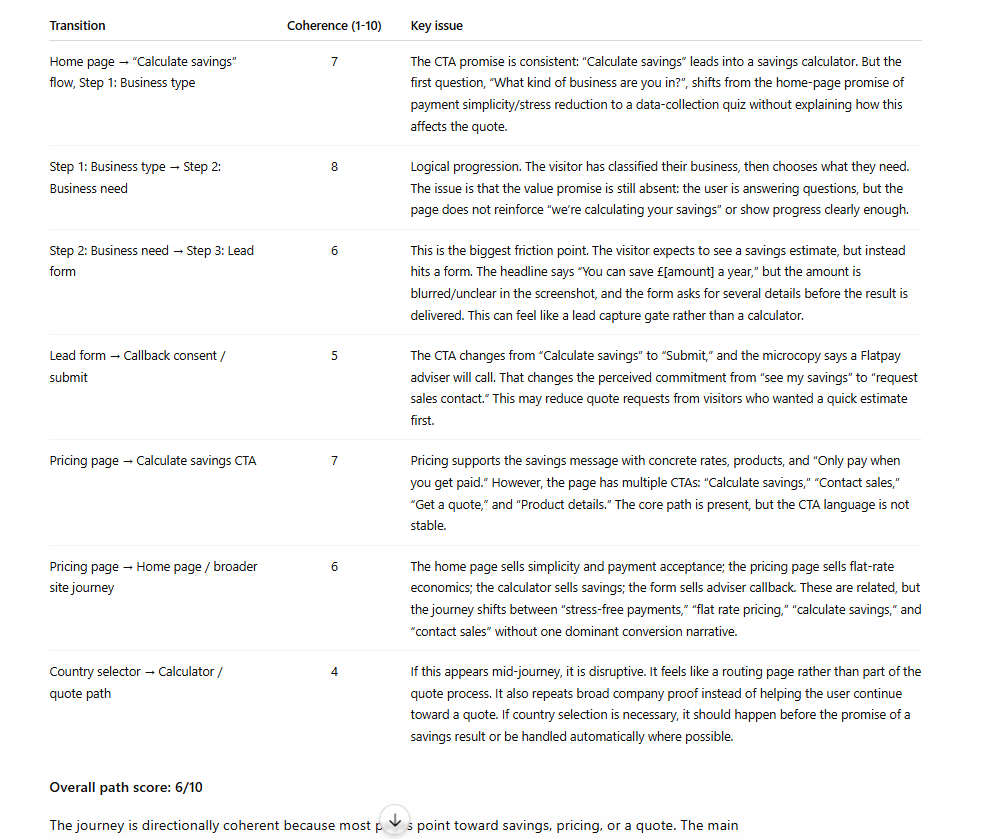
Prompt 2: The Conversion Path Coherence Audit # Conversion Path Coherence Audit ## Context These pages form a sequence that visitors move through. The biggest conversion leaks often live between pages, not on them. ## Your task Evaluate all screenshots as a connected journey:
1. Message consistency — Do promises made on one page carry through to the next, or do they shift? 2. CTA consistency — Is the call-to-action language stable across pages, or does it change confusingly? 3. Orientation — Are there pages where a visitor might feel lost or unsure what to do next? 4. Distractions — What elements pull visitors away from the conversion goal (unrelated links, social buttons, irrelevant navigation)?
## Output format Score each transition between pages: | Transition | Coherence (1-10) | Key issue | |-----------|:---:|-----------| | Page 1 to Page 2 | | | | Page 2 to Page 3 | | | | (continue as needed) | | |
Overall path score: X/10
What this reveals: Messaging fragmentation is the most common path-level problem, and it's also the least visible to the people who built the site. The homepage says "Get a free consultation." The service page says "Contact us for pricing." The contact page says "Send us a message." Three different implied offers. Three moments of micro-doubt. Each transition chips away at the visitor's confidence that they're in the right place. The path should feel like one continuous conversation.
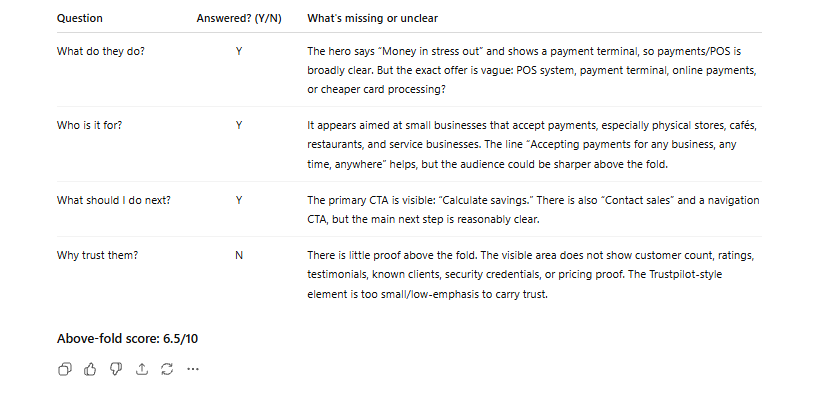
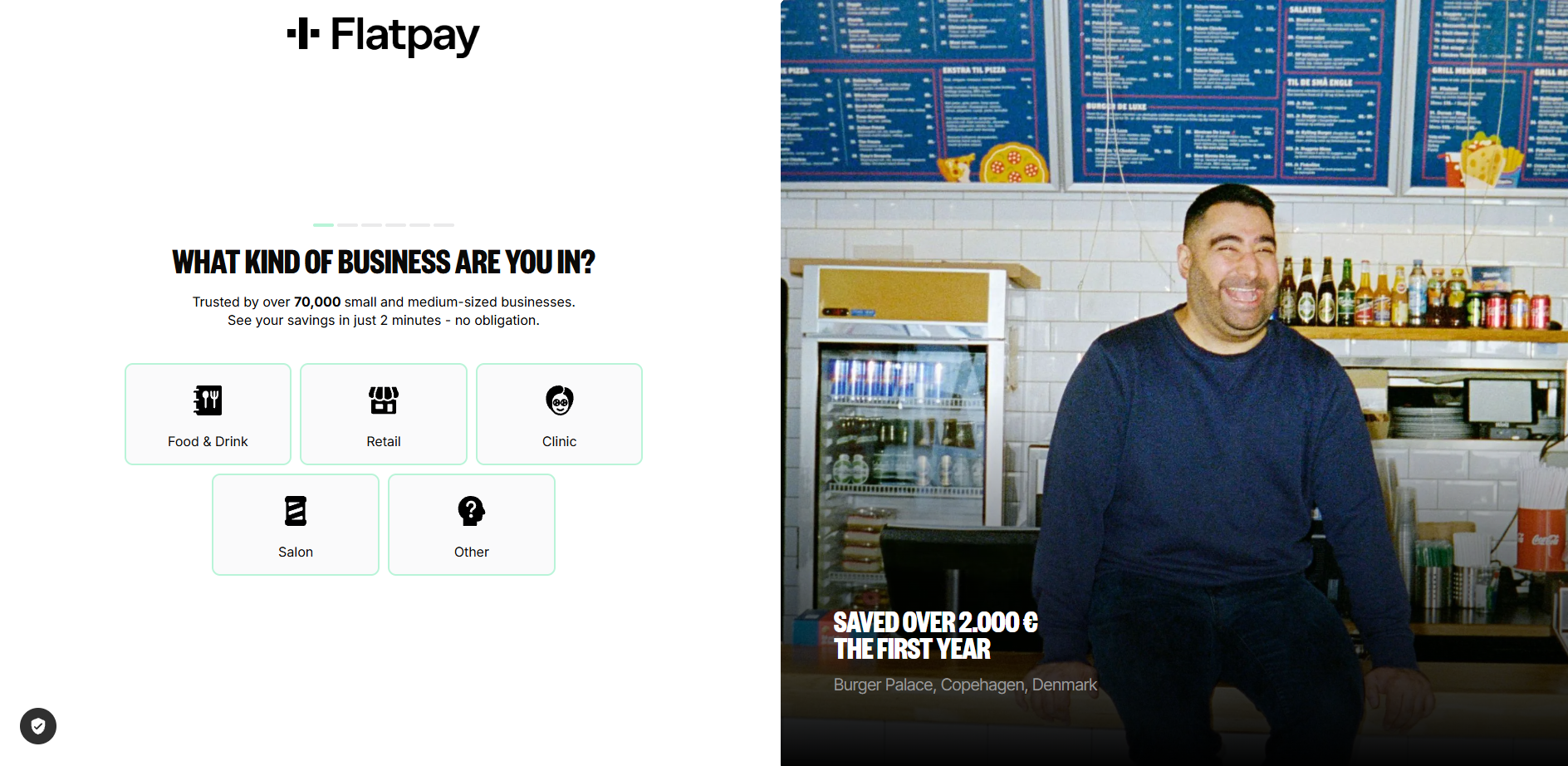
Flatpay uses a multi-step CTA journey for "calculate savings" or "get a quote", which most serves as a teaser as well as pre-qualifier for leads and Flatpay.
Flatpay results from prompt 2:
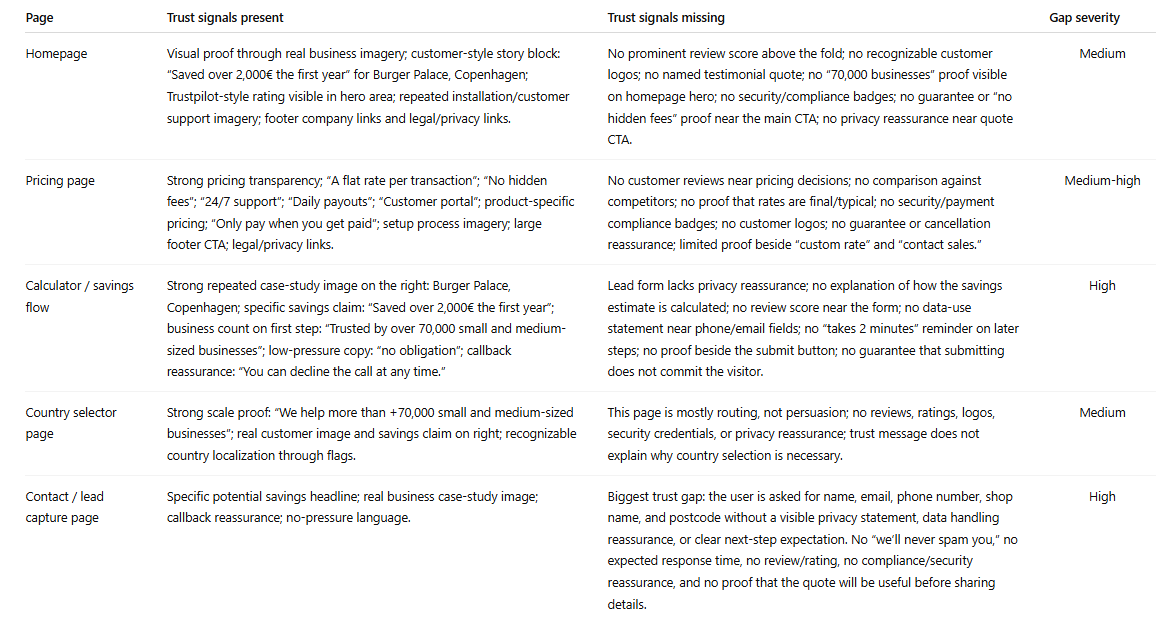
Prompt 3: The Trust Signal Inventory # Trust Signal Inventory ## Your task Across all pages, catalogue every trust signal present: customer logos, testimonials, reviews, case studies, certifications, team photos, years in business, guarantees, privacy assurances, awards, association memberships. Then evaluate:
1. Which pages have strong trust signals? 2. Which pages have weak or no trust signals? 3. Is there a trust gap specifically on the conversion page (contact or pricing page)? 4. What trust signals would you add, and where?
What this reveals: Trust signals cluster on homepages, where they're least needed, and disappear on contact pages, where they matter most. The moment a visitor is about to hand over their phone number is precisely when they need reassurance. They're asking: will someone actually reply to this? Have you done this for businesses like mine? Our chat data shows the most common questions visitors ask right before converting are trust questions: "How quickly will someone respond?" "Do you work with companies in my industry?" A single line on the contact page, "We typically respond within two hours," does more conversion work than most hero sections. Adding it takes five minutes. Flatpay results from prompt 3:
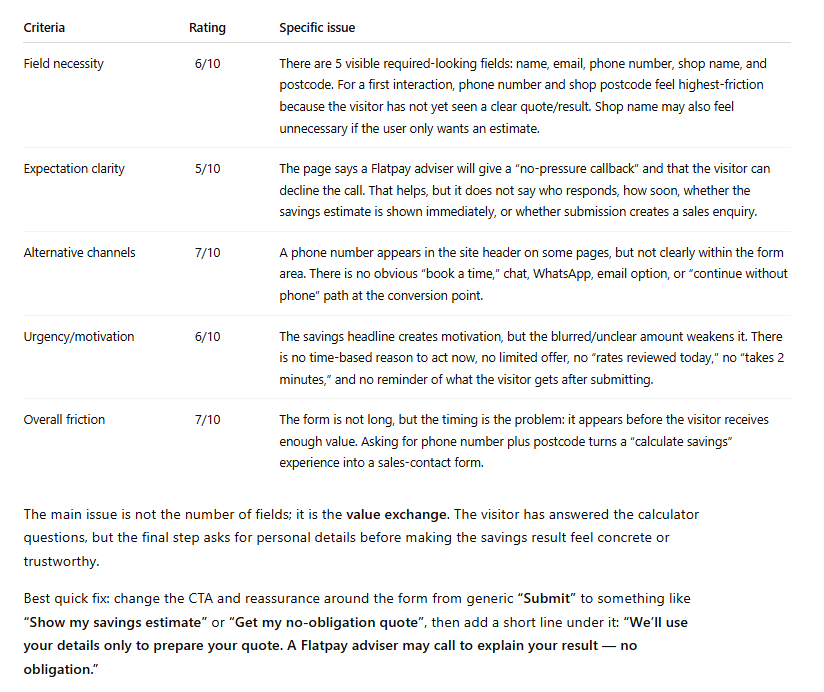
Prompt 4: The Dead Form Diagnosis # Lead Capture Form Diagnosis ## Context This is your final conversion point. A motivated visitor is about to become a lead, or quietly close the tab. ## Your task Evaluate the contact or lead form as a slightly hesitant potential customer who is ready to enquire:
1. Field count: How many fields? Which feel unnecessary for a first interaction? 2. Expectation setting: Does the page explain what happens after submission? Who responds? How soon? 3. Alternatives: Is there any option besides this form (phone, chat, booking link, WhatsApp)? 4. Urgency: Is there a reason to submit now, or could I come back to it later with no consequence? 5. Friction score: Rate 1 (effortless) to 10 (not worth the effort).
What this reveals: Forms are where conversions go to die, and the problem usually isn't the fields themselves. It's the silence around them. No indication of what happens after you submit. No alternative for the person who has a quick question but isn't ready to commit to a form submission. No urgency. Just a form floating on a page, asking for information and offering nothing in return. Our data shows that between 35 and 50 percent of chat conversations start because a visitor saw the form and decided they wanted to talk to a person instead. The form didn't convert them. A conversation did. Flatpay Results:
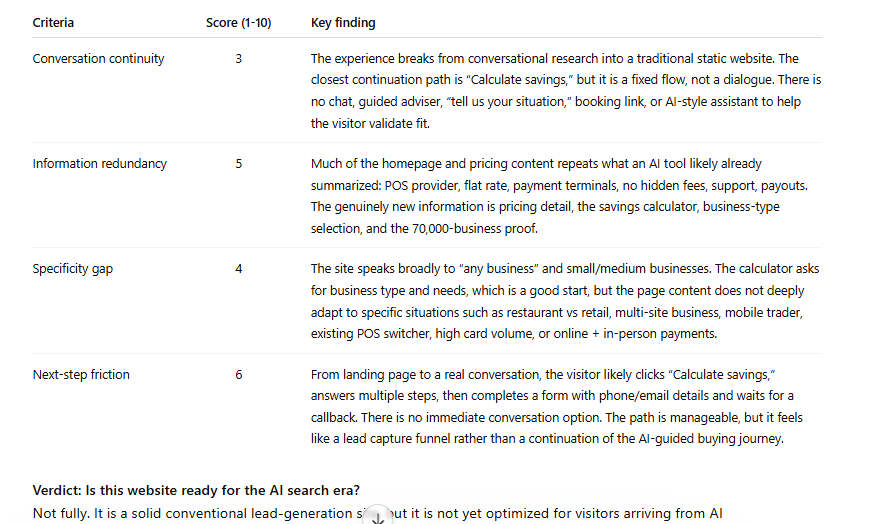
Prompt 5: The AI Search Visitor Test # AI Search Visitor Experience Audit ## Context A growing share of visitors now arrive from AI search tools (ChatGPT, Perplexity, Google AI Overviews, Claude). These visitors have been in a conversational research flow: asking questions, refining needs, receiving personalised guidance. They land here mid-dialogue, having just been told this website looks like a good match for their needs. ## Your task Evaluate these pages as an AI-referred visitor who was just told: "[Company] looks like a good option for your needs."
1. Conversation continuity. Can this visitor continue their dialogue, or does the experience break from conversation to static content? What engagement options exist? 2. Information redundancy. How much of this repeats what the AI tool likely already told them? What is genuinely new here? 3. Specificity gap. The visitor has a refined need. Does the site address specific use cases, or only general claims? 4. Next-step friction How many clicks stand between landing here and having a real conversation about their specific situation?
## Output format | Criteria | Score (1-10) | Key finding | |----------|:---:|-------------| | Conversation continuity | | | | Information redundancy | | | | Specificity gap | | | | Next-step friction | | | Verdict: Is this website ready for the AI search era? Single most impactful change:
What this reveals: An AI-referred visitor has been in an active dialogue. They arrive expecting to continue it. Instead they hit a static page and a form. It's like being mid-conversation with someone, then being walked to a colleague's office where that colleague hands you a clipboard. The AI will almost always point to real-time conversational engagement as the single most impactful change. Results from Flatpay analysis:
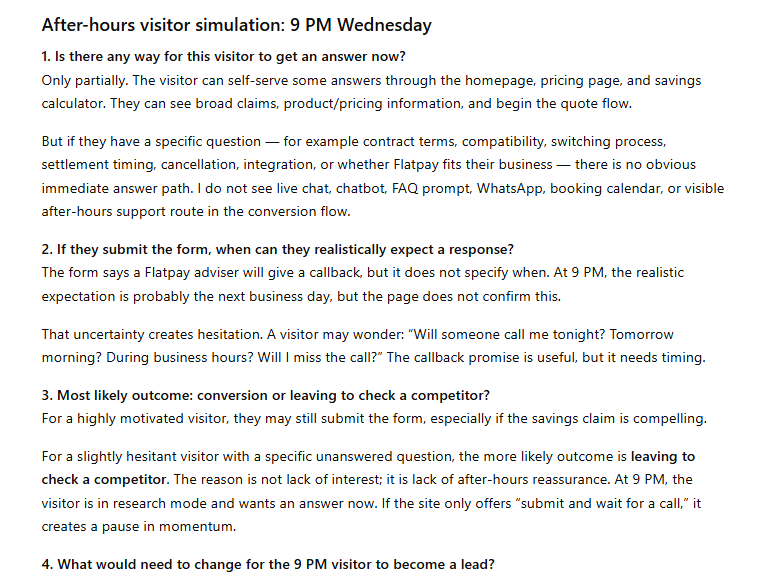
Prompt 6: The After-Hours Visitor Test # After-Hours Visitor Simulation ## Scenario It is 9 PM on a Wednesday. A potential customer lands on this website from a search. They're interested but have a specific question about the service. ## Your task
1. Is there any way for this visitor to get an answer now? 2. If they submit the form, when can they realistically expect a response? 3. What is the most likely outcome: conversion, or leaing to check a competitor? 4. What would need to change for the 9 PM visitor to become a lead?
What this reveals: Between 35 and 50 percent of high-intent traffic arrives outside business hours. The visitor at 9 PM with an urgent question, a pest control problem, an insurance query, a question about a dental procedure, is often your most motivated visitor. They're ready to act. Your website offers them a form that won't be read until tomorrow morning. By then, they've found a competitor who responded immediately. The after-hours visitor rarely shows up in your analytics as a lost lead. They show up as a lead that was never there.
Example from Flatpay conversion analysis. Prompt 6 answer form.
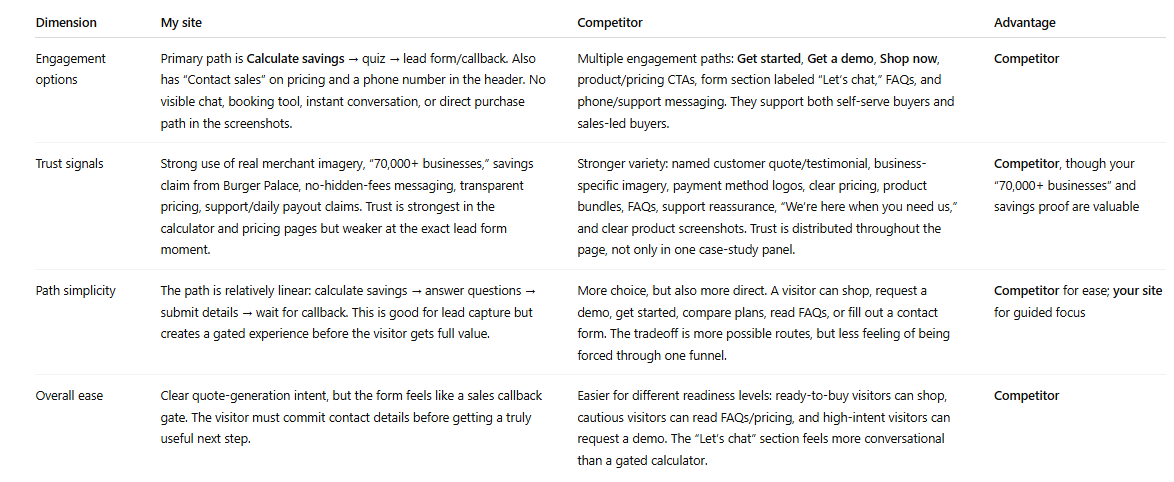
Prompt 7: The Competitor Comparison # Competitive Conversion Comparison ## Context I'm now uploading screenshots from a competitor's website. ## Your task Compare their conversion path to mine across four dimensions:
1. Engagement methods — Do they offer anything we don't? (chat, callback, WhatsApp, instant quote, booking tool) 2. Trust signals — Stronger, weaker, or different in type? 3. Path simplicity — Fewer or more steps to conversion? 4. If you were a potential customer comparing both, which makes it easier to take the next step? Why?
What this reveals: This is the prompt that makes abstract findings feel urgent. When the AI tells you "your competitor has live chat and a 60-second quote promise, you have a contact form," the gap stops being theory. It's a specific competitive disadvantage, described in plain language, sitting in a table. Running this against one or two competitors takes ten minutes. The output is more persuasive than any conversion audit report, because it shows exactly what a visitor experiences when they compare options, and most of the time, they are comparing options.
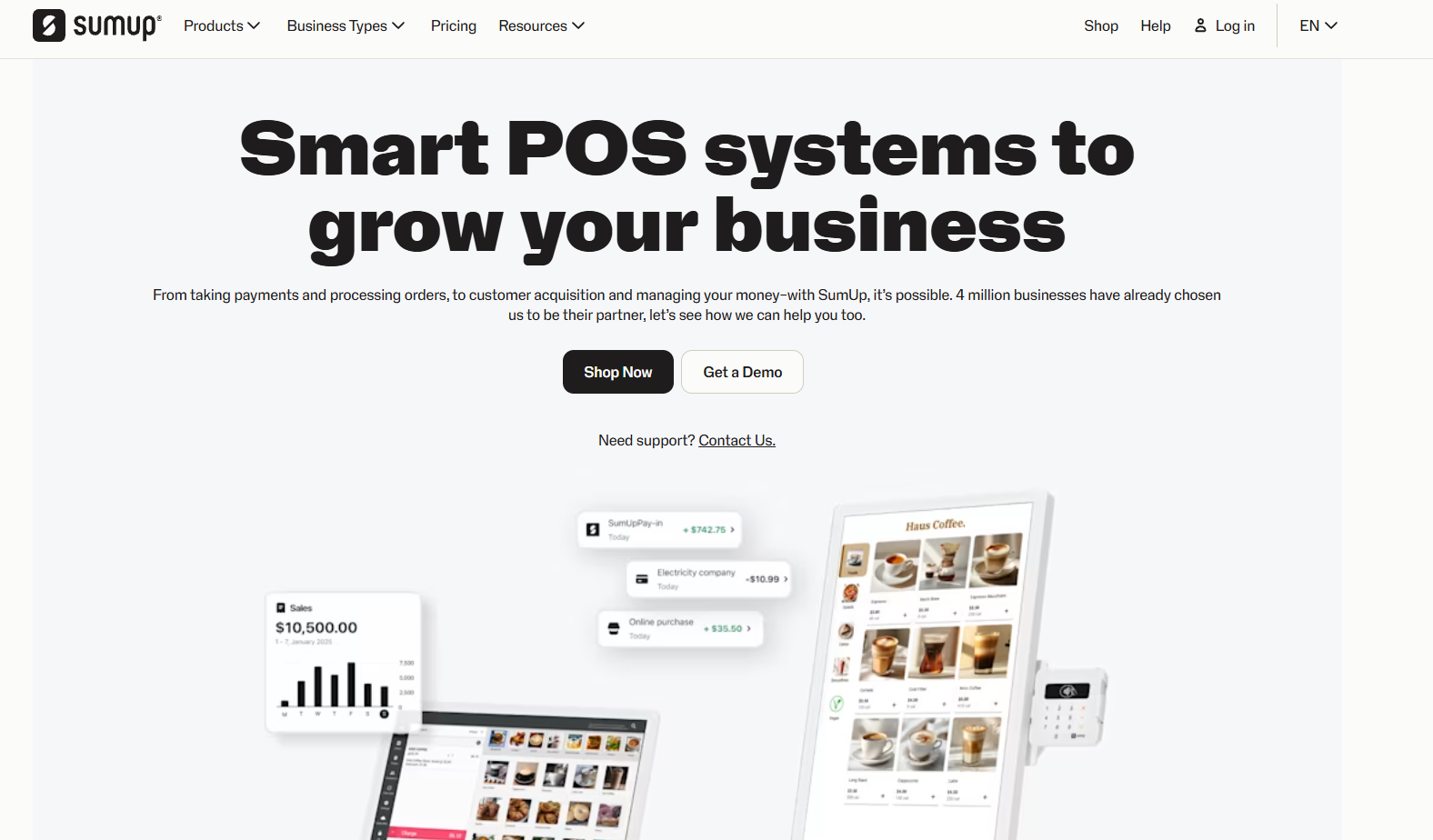
For this competitor comparison we used SumUp.
Response from ChatGPT on this prompt for comparison:
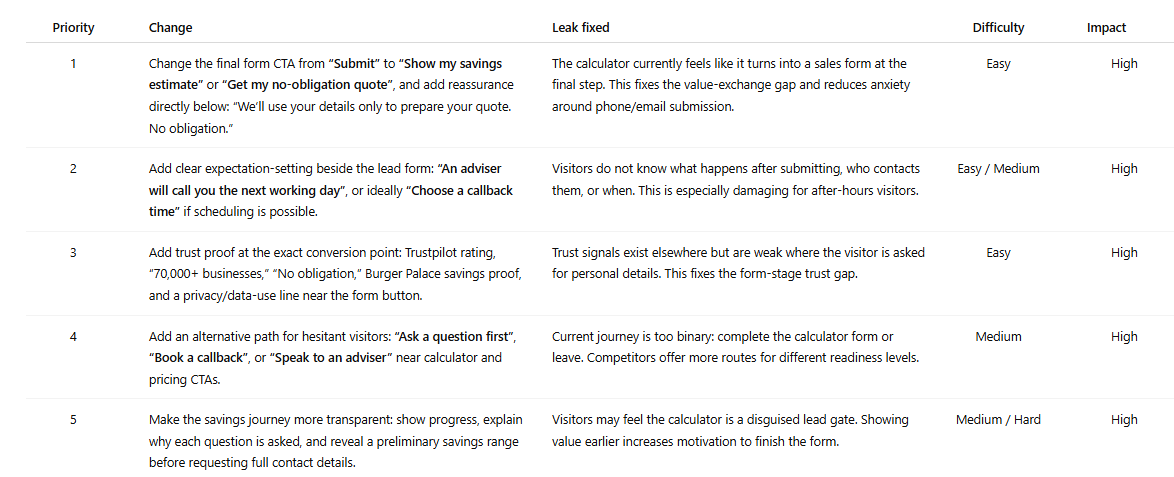
Prompt 8: The Priority Fix List # Prioritised Conversion Fix List ## Your task Based on everything analysed across all pages, give me the 5 most impactful changes to increase leads from this website.
For each recommendation:
1. The specific change 2. Which leak it fixes 3. Difficulty (easy / medium / hard) 4. Potential impact (low / medium / high)
What this reveals: This is the prompt that turns the audit into a to-do list. Flatpay priority fix list:
What to Do With Your Results
Most audits produce one of three finding patterns. Here's how to act on each.
Messaging and CTA inconsistencies. These are quick wins. Align the headline, the button text, and the implied offer across every page in the path so the visitor feels like they're moving through one coherent conversation. This costs nothing and can be done in an afternoon. It's also the change most businesses deprioritise because it doesn't feel significant enough. It is. Trust gaps on conversion pages. Add one or two trust signals directly to your contact page this week. A response-time commitment. A relevant testimonial. A count of businesses you've helped. Visitors about to submit a form need reassurance at that precise moment. Putting it on the homepage instead is like putting the "safe to drink" sign on the bottle rather than the glass. No real-time engagement option. This is the structural finding that shows up in almost every audit and sits at the top of almost every priority list. You have a few honest options: Managing chat yourself during business hours works for some businesses and isn't sustainable for most. An AI chatbot handles FAQ deflection and support reasonably well. It struggles with the nuanced, pre-purchase questions that are actually standing between a visitor and a conversion. It fails at custom lead qualification questions and collecting customer lead information. Managed live chat with human agents available around the clock, including evenings and weekends, is what Weply provides. It's the approach behind more than 250,000 qualified leads generated across our customer base in 2025. If the after-hours prompt produced an uncomfortable answer, it's worth a look.
The standard alternative is hiring a CRO agency. Budget: EUR 3,000 to 8,000. Timeline: four to six weeks. Deliverable: a PDF. The report is usually good. The process is slow, expensive, and produces findings that are already weeks old when they reach you. The process in this guide takes 30 minutes and produces an action plan from your own pages, in your own conversation thread, reviewable immediately. Run it quarterly. Run it after every redesign. Run it whenever traffic goes up and leads don't.
Try Weply for free for 7 days. Get qualifed leads, customer support and insights into the conversations that your webiste visitors have.
Read more
Articles
AI Hub
|
August 26, 2026
|
9
min
10 Best Chat Solutions for Customer Support and Lead Generation in 2026
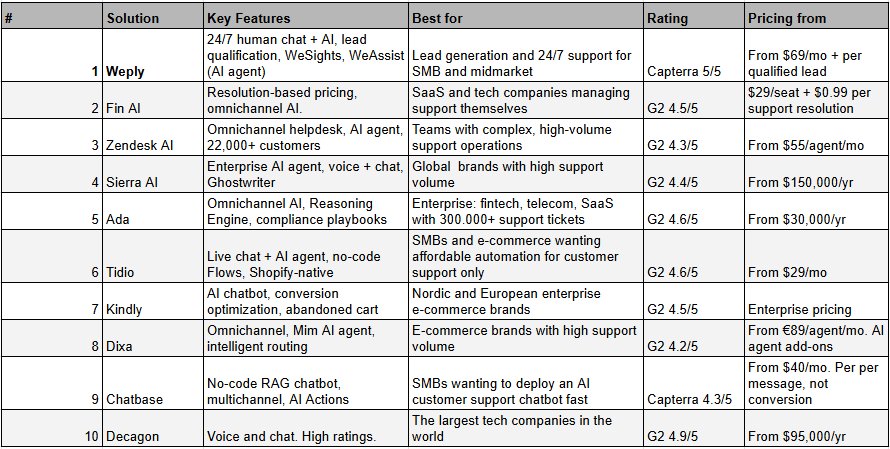
The right chat solution can turn your website traffic into paying customers and lift your customer support from reactive to proactive, or strengthen your lead generation and help grow your business. In the age of AI search having a chat solutions has become even more important. In this guide, we've reviewed the 10 best chat solutions available in 2026, including Weply, Intercom Fin, and Zendesk AI. We've looked at features, pricing, reviewsite ratings, and customer cases, so you don't have to. Here are our three top picks:
Looking for the best chat solution for your business?
Customers expect answers now. 63% of consumers prefer live chat over email or phone, and 46% of all leads are generated outside of normal business hours. With an ever-growing selection of solutions and increasing demands around GDPR compliance, data residency, and 24/7 availability, choosing the right chat solution has never been more important. The right solution helps you:
Convert anonymous visitors into named and qualified leads.
Give customers immediate help, 24/7.
Free up tiem for your team for other, more high-value interactions.
Comply with GDPR and data handling requirements within the EU.
Integrate with your existing CRM, helpdesk or e-com platform.
Why trust Weply?
We built Weply because we saw how businesses across Europe were losing potential customers on their websites, either because they had no chat at all, it was only availbale during operating hours, or because they put an AI support chat in front of high intent traffic and think it can convert it to qualified leads. Our platform combines trained chat consultants with AI and we generated over 250,000 qualified leads for more than 2,400 customers in 2025. We know this market inside out, from SMBs to enterprise. That gives us a unique position to evaluate which chat solutions actually deliver on the European and US markets. Finding the right solution is always about understanding your own needs first. Here's how some of our customers rate us:
Now, let's take a look at the 10 best chat solutions for 2026.
Now let's dive into each solution.
1. Weply
Weply is a Nordic 24/7 live chat solution that combines trained human chat consultants, lead conversion experts, with AI technology to generate and pre-qualify leads directly on your website. Founded in 2013 and headquartered in Copenhagen, Denmark, Weply has generated over 250,000 qualified leads for more than 2,400 customers in 2025, making it the largest Nordic operator in hybrid human-AI chat. Weply recently launched WeAssist, a support AI agent that chat consultants can activate for incoming support queries. What sets Weply apart from pure AI solutions is that your customers always interact with a real human being, backed by AI. That means meaningfully higher conversion rates and fewer missed interactions compared to fully automated chatbots. All support responses are also quality-checked by a human in real time, minimising the risk of AI hallucinations and ensuring answers are delivered with human empathy and nuance.
Key Features
24/7 Human Live Chat + AI (WeAssist): Trained chat consultants are available around the clock, complemented by WeAssist AI for standard support queries. You never miss a relevant customer interaction.
Sales-qualified leads delivered to your inbox: Weply pre-qualifies visitors based on your criteria and delivers warm leads, with name, phone number, and relevant context, directly to your CRM or inbox.
AI Co-pilot for internal chat agents: some customer run internal customer support agents using Weply outside normal opening hours or if overloaded, and those agents have access to AI WeAsssist co-pilot.
WeSights our analytics platform: Gives you insight into chat volume, chat context, campaign data, and conversion patterns, so you can continuously optimise your digital marketing, web, and lead strategy.
Dedicated Customer Success Manager: Every customer gets a dedicated CSM who helps with setup, optimisation, and ongoing strategy.
GDPR-compliant and EU-hosted: Data is processed in accordance with GDPR, with servers in the EU and full compliance with the ISO and EU AI Act.
Pricing
Pricing consists of a small monthly subscription starting from $69/mo, covering up to 100 monthly support chats with the WeAssist AI agent included. Beyond that, you pay only for success, a fixed price per qualified lead Weply generates, based on your unique lead qualification criteria. Weply offers a fully free 7-day trial, where all generated leads and answered support queries are free.
Pros
Human touch for your potential and existing customers 24/7, 365 days a year. Customers always talk to a real person, not just a bot.
Experts in lead conversion. If you're already spending money and time driving potential customers to your website, Weply is the only specialist. Typically converts minimum 50–80% more chat visitors into qualified leads than AI chatbots.
WeAssist is included in the subscription price, meaning you get an AI support chatbot verified in real time by humans. At a significantly lower cost than the alternatives.
Plug-and-play setup with CRM integrations, live quickly.
GDPR, AI Act, ISO. Verified with over 2,400 paying customers across the Nordics and Europe.
You get AI where AI is strong (support, but verified by humans) and humans where they're best (qualified lead generation).
Free 7-day trial, no credit card required, no commitment.
Cons
WeSights, the unique chat analytics tool, is an add-on.
Available as chat only, not yet on voice, email, or social channels.
Not ideal for public institutions where all traffic is support-related, or for chat behind a login wall as inside a SaaS support tool.
Rating
Capterra: 5/5. Trustpilot 4.4/5. Businesses consistently highlight that Weply delivers significantly more leads and better lead quality than AI chatbots, alongside 24/7 availability, easy setup, and a very high level of customer service.
2. Intercom Fin
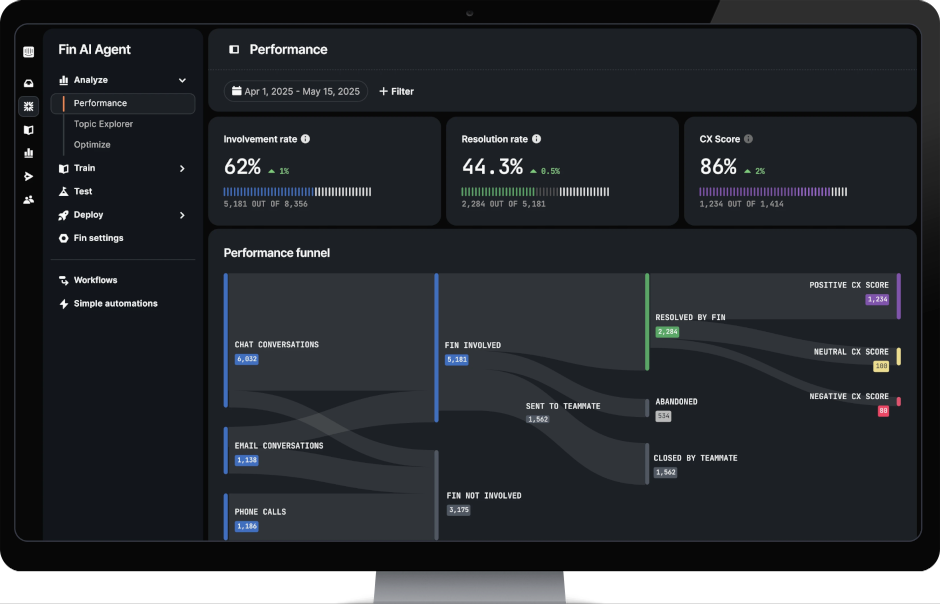
Intercom Fin is Intercom's AI agent, launched in 2023 and now one of the most widely deployed AI support platforms globally. Fin states it resolves an average of 60% of all queries automatically and supports all major channels: email, live chat, WhatsApp, Messenger, SMS, and voice.
Key Features
Outcome-based AI agent: Fin receives queries, responds using your knowledge base, and escalates to your support team when needed.
Omnichannel out-of-the-box: Fin works across email, live chat, WhatsApp, Messenger, SMS, and voice from a single platform.
Fin Copilot (agent assist): AI assistant for human agents in the inbox, generates reply suggestions, summarises case history, and retrieves knowledge in real time. $35/user/mo add-on.
AI-driven simulations and performance insights: Test Fin's performance against historical tickets before going live, and receive ongoing improvement recommendations.
Integrations: 450+ integrations including Shopify, Salesforce, Zendesk, and HubSpot.
Pricing
Fin AI Agent: $0.99 per resolution (min. 50 resolutions/mo = $49.50). Copilot is $35/user/mo as an add-on.
Example: 1,000 Fin resolutions/mo = $990 on top of seat costs. For 10 agents on the Advanced plan ($85/seat), the monthly total is approximately $1,840.
Pros
Outcome-based model is fair: you pay only for success.
Works standalone alongside Zendesk, Intercom and Salesforce.
Strong for SaaS and B2B support teams that manage their own helpdesk.
Cons
Pricing scales aggressively at high volumes: 1,000 resolutions/mo = $990 in AI costs alone.
Requires internal setup and optimisation. No dedicated CSM on lower plans.
Not suited for active lead generation, only customer support.
Fin Copilot is a paid add-on.
Some G2 reviewers report that what Intercom counts as a "resolution" doesn't always match real-world outcomes.
Rating
G2: 4.5/5. Users praise the modern interface and automation rate. Most criticism: pricing scales unpredictably, and advanced features require expensive plans.
3. Zendesk AI
Zendesk is still the world's most widely used customer service platform, with 22,000+ support teams globally and a well-established enterprise presence. Zendesk's AI capabilities including AI agents (chatbots), Copilot for human agents, and intelligent triage, are layered on top of its core omnichannel helpdesk and have been significantly expanded since 2024. Zendesk is used by teams ranging from fast-growing SaaS companies to large enterprise organisations across every industry. Zendesk's core strength is organisational scale: it handles email, live chat, voice, WhatsApp, Instagram, Facebook Messenger, X, and web forms in a single agent workspace, and routes tickets intelligently across large agent pools.
Key Features
AI agents and intelligent triage: Built-in AI agents handle common queries using your help centre content and can take basic actions.
Omnichannel unified workspace: Email, live chat, phone, WhatsApp, social media, and web forms in a single agent view. Routing ensures tickets reach the right agent based on skills, language, and current load.
Zendesk AI Copilot: Agent-side AI that suggests replies, surfaces relevant knowledge articles, and summarises long ticket threads in real time.
Knowledge base and help centre: AI-powered content suggestions for help centre articles, and a self-service portal that deflects tickets before they reach your support team.
Analytics and reporting: Pre-built dashboards and, on higher tiers, Explore for custom reports tracking response time, resolution rate, CSAT, and agent performance.
Pricing
Suite Team: $55/agent/mo (annual). Basic multichannel ticketing, help centre, AI agents with limited resolutions.
Suite Professional: $115/agent/mo (annual). Skills-based routing, community forums, HIPAA compliance, custom analytics.
Suite Enterprise: From $169/agent/mo (annual, negotiated). Custom agent roles, sandbox, advanced data protection.
Advanced AI add-on: ~$50/agent/mo extra. Required for Copilot, advanced triage, and generative AI features.
AI Agent resolutions: $1.50 per automated resolution (committed volume) or $2.00 pay-as-you-go.
For a 20-agent team on Suite Professional with Advanced AI, total annual cost approaches $40,000 before implementation.
Pros
The most established customer support platform globally. Deep integration ecosystem and proven enterprise track record.
Strong at scale: skills-based routing, SLAs, and omnichannel work well for 15+ agent teams.
Cons
Advanced AI features require a separate $50/agent/mo add-on.
Own support quality criticised consistently on G2: slow response times and link-heavy replies.
Some G2 reviewers describe being oversold during the buying process, real-world AI performance fell short of what was promised.
Per-agent pricing model means costs scale directly with headcount, with no outcome-based option on core plans. Expensive option.
Rating
G2: 4.3/5 (6,800+ reviews). Satisfaction correlates strongly with team size: large, multi-channel support teams tend to find the cost justified; smaller teams often feel they're paying for features they don't use.
4. Sierra.ai
Sierra.ai is an American enterprise AI company founded in 2023 by Bret Taylor (former co-CEO of Salesforce and current chairman of OpenAI's board) and Clay Bavor. Sierra has raised $950 million to date and is one of the most discussed AI companies globally. Sierra's customers include Sonos, SiriusXM, Weight Watchers, ADT, and Casper. The platform is built for large consumer brands with high inbound support volume across chat and voice.
Key Features
Empathetic AI agents: Sierra's agents are designed to mirror your brand's voice and tone precisely, handling complex interactions like returns, subscription changes, and account management autonomously.
Agent Studio + Agent SDK: No-code workflow builder for CX teams (Agent Studio) and a developer-focused SDK for custom integrations.
Ghostwriter: Automatically generates production-ready AI agents from SOPs, call transcripts, audio recordings, and whiteboard photos. Also runs an automatic improvement loop based on live interactions.
Multi-model "Constellation" architecture: Uses multiple AI models in parallel for accuracy-checking, reducing hallucination, but can introduce latency (700ms+) in voice environments.
Voice + chat across channels: Sierra's agents support web chat, mobile apps, and voice.
Pricing
Sierra publishes no pricing and has no pricing page. All contracts are enterprise agreements. Third-party estimates:
Annual contracts from $150,000+.
Implementation and onboarding fees: $50,000–$200,000.
Outcome-based model: payment per successful resolution (rate confidential, but with minimum commitment volumes).
Pros
One of the world's leading chat and voice agents for support.
Pricing makes it exclusive to the largest enterprises. SMBs and mid-market are entirely excluded.
Long and technically complex implementation.
Support only. No real lead generation capability.
Rating
G2: 4.4/5. Users praise the intuitive interface and empathetic AI interactions. Most common criticism: high price with unclear ROI, steep learning curve during onboarding.
5. Ada
Ada is an enterprise AI customer service platform founded in Toronto in 2016 by Mike Murchison and David Hariri. Ada has raised $200M+ and serves 350+ enterprise customers including Monday.com, Pinterest, Verizon, and YETI. The platform is built for high-volume, omnichannel AI deflection in industries including financial services, e-commerce, telecommunications, and SaaS. Ada's 2026 platform centres on its "Reasoning AI" which are agents that understand intent, follow compliance-sensitive playbooks, and execute multi-step workflows across chat, email, voice, SMS, and WhatsApp from a single platform.
Key Features
Reasoning AI engine: Ada's agents understand customer intent and follow structured playbooks, including compliance-sensitive flows for regulated industries, rather than simple script logic. Claims to resolve 80%+ of inquiries automatically.
Omnichannel coverage: Chat, email, voice, SMS, WhatsApp, and social messaging managed from a single platform. Handoff integrations with Zendesk, Salesforce, Freshworks, Genesys, Dixa, Gorgias, and more.
Coaching and feedback loops: Platform managers can provide precise, surgical guidance to the AI agent through a coaching interface, and verify outcomes through test scenarios before going live.
SOP-based playbooks: Ada can follow complex, multi-step workflows, including triggering refunds, extensions, or system updates, based on standard operating procedures. Well-suited to regulated industries.
Enterprise security: SOC 2 Type II, HIPAA, GDPR, and PCI compliant. Zero Data Retention option with all LLM providers.
Pricing
Ada does not publish pricing. Estimates from third-party sources:
Starting from ~$30,000/year.
Pricing model: typically $1–$3.50 per AI resolution, based on resolved conversations.
Pros
Strong omnichannel coverage across 10+ channels from a single platform.
Coaching interface gives platform managers strong control over AI behaviour.
Cons
Implementation timeline is measured in months.
Only for large global enterprises.
Pricing scales aggressively at high volume.
Rating
G2: 4.6/5. Platform administrators rate Ada highly for ease of use and coaching capability. Negative sentiment on Trustpilot: 1.8/5.
6. Tidio + Lyro
Tidio is a live chat and AI support platform primarily serving small businesses and e-commerce stores. Founded in Poland in 2013 and used by 300,000+ businesses globally, Tidio combines live chat, ticketing, a no-code chatbot builder and Lyro, its conversational AI agent, in a single platform. Tidio is particularly popular with Shopify merchants and SMBs that want to start with live chat and gradually layer in automation without switching tools.
Key Features
Lyro AI agent: Conversational AI that answers common customer questions based on your support content. Handles handoff to human agents when needed.
No-code Flows builder: Drag-and-drop chatbot builder for creating automated conversation paths: product recommendations, lead capture, FAQ automation, and more .
Live chat with live typing preview: Agents can see what customers are typing before they hit send, allowing faster, more prepared responses.
Multichannel inbox: Manages website chat, email, Instagram, Messenger, and WhatsApp in a single unified inbox.
Pricing
Starter: From $29/mo (annual). Includes live chat, ticketing, basic automation.
Growth: From $59/mo (annual). Includes Lyro AI conversations and advanced Flows.
Lyro AI add-on: Can be purchased separately from $39/mo for additional AI conversation quotas.
Pros
Among the most affordable live chat + AI combinations on the market for SMBs.
Conversation-based pricing is more predictable than per-seat models for smaller teams.
Very fast to set up. Live in minutes. Strong Shopify native integration.
Cons
Data processing: primarily EU-based, but some data is also transferred to the US.
Not well-suited for complex enterprise workflows, SLA management, or large multi-team operations.
Very limited lead generation capability. Can only be used for customer support.
Rating
G2: 4.6/5. Users consistently highlight ease of setup and Shopify integration. Most criticism relates to some agreesive prices increases.
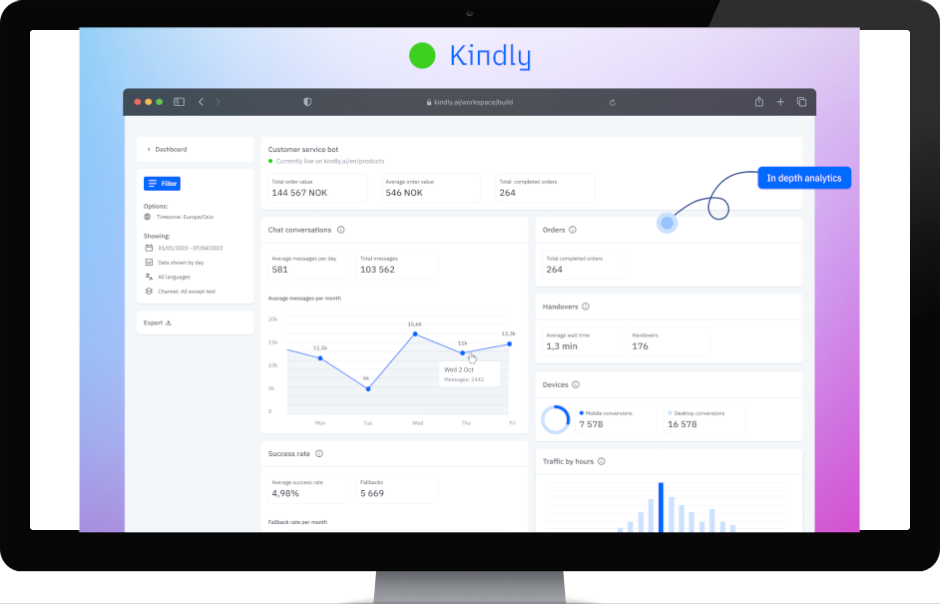
7. Kindly
Kindly is a Nordic AI chatbot platform founded in Oslo in 2016 and one of Europe's leading conversational AI providers for enterprise e-commerce and customer service.
Key Features
Generative AI chatbot with multilingual training: Train the chatbot in one language and it understands queries in 100+ languages automatically. Nordic language expertise is a core competency.
Conversion optimisation and abandoned cart: Kindly's platform can increase conversion rates by up to 12% and automates abandoned cart messages.
Visual product carousel in chatbot: Enables product search and displays products directly within the chat interface based on selections made in the chatbot.
Simple customisation without coding: No code required to match the chatbot to your brand identity, tone, and layout.
Support automation: Automates up to 80% of customer inquiries according to themselves.
Pricing
Kindly does not publish pricing. All agreements are reached via direct contact. Enterprise prices.
Pros
Deep Nordic and European market presence with proven language expertise.
Unique combination of AI chatbot, conversion optimisation, and support automation in one platform.
No public pricing. Expensive and only for enterprises.
Primary focus on e-commerce. Not tailored for public sector or regulated industries.
Only for customer support. Not suited for active lead generation.
Rating
G2: 4.9/5. Users highlight easy implementation, Nordic language expertise, and high automation rates.
8. Dixa
Dixa is a Danish-founded customer experience platform aimed at e-commerce brands that want to consolidate all customer communication in one system. Dixa is used by 850–1,000+ brands across 42 countries, including Rapha, Hobbii, Mejuri, and Miinto. In 2025, Dixa launched Mim, an agentic AI agent.
Key Features
Mim AI Agent: Dixa's AI agent handles end-to-end customer interactions, including order lookup in Shopify and Magento, refunds, and self-service, with intelligent escalation to interrnal human agents.
E-commerce focused: Built exclusively for e-commerce companies, with features and integrations tailored to these specific workflows.
Omnichannel native: Phone, email, live chat, WhatsApp, Instagram, Facebook Messenger, and SMS in a single Team Hub.
Intelligent routing and Flow Builder: Drag-and-drop routing engine that assigns interactions to the right agent based on skills, language, and workload.
Shopify + Magento + WooCommerce integrations: Deep e-commerce integrations mean agents see order history directly within the conversation window.
Pricing
Growth: From €89/agent/mo. All channels included.
Ultimate: From €139/agent/mo. Adds various AI features.
Prime: From €179/agent/mo. Enterprise functionality including SSO.
Mim AI agent is an additional cost on all plans.
Pros
All channels included as standard.
Danish-founded with strong Nordic support and understanding of European data requirements.
Mim AI Agent is one of the market's most mature agentic AI solutions for e-commerce.
Cons
Built specifically for e-commerce brands. Limited or no relevance for other verticals.
Mim AI agent access costs extra on top of the base subscription.
AI copilot is also an add-on.
Rating
G2: 4.2/5. Users praise the user-friendly interface and customer support, but criticise long contracts and minimum seat requirements.
9. Chatbase
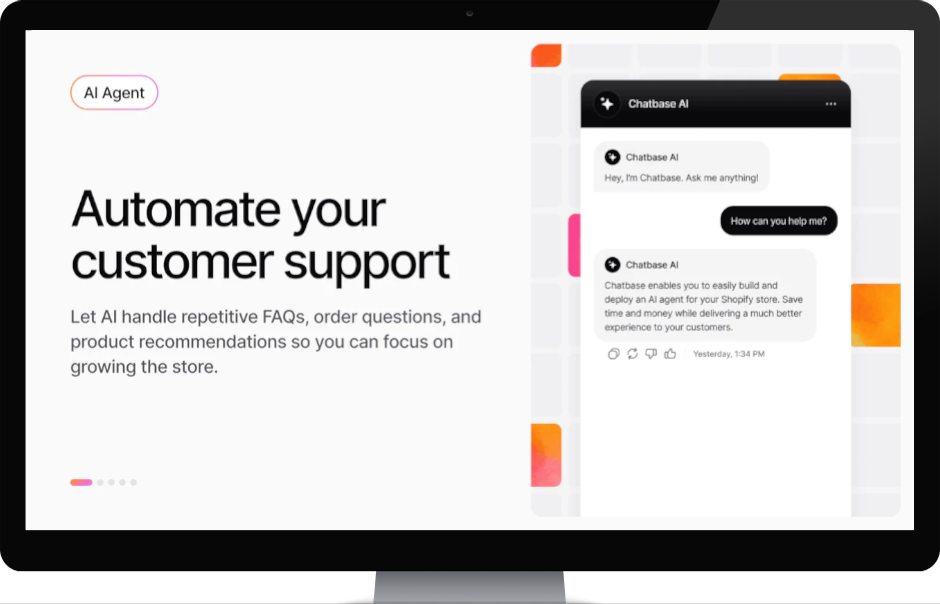
Chatbase is a no-code AI chatbot builder used by over 10,000 businesses globally. Chatbase lets you train an AI chatbot on your website, PDF documents, Notion pages, and internal knowledge sources, and deploy it on websites, Shopify, email, WhatsApp, Instagram, Facebook, and Slack. It is designed for SMBs and teams that want AI support without programming or developer resources.
Key Features
RAG-based knowledge training: Upload PDFs, link to URLs, or Notion pages. Chatbase automatically builds a knowledge foundation and uses it to answer queries accurately with source references.
Multichannel deployment: Deploy your chatbot on your website with a script tag, or connect to Shopify, WhatsApp, Instagram, Facebook Messenger, and Slack via native integrations.
AI Actions: The chatbot can take real actions via API as booking meetings in Calendly, updating subscriptions in Stripe, and so on.
Flexible AI model selection: Choose between economy LLM models (GPT-4o Mini, Claude Haiku) and premium models (Claude Sonnet) depending on quality and cost requirements.
Pricing
Prices start from $40/mo. You pay additional credits when your usage exceeds the amount included in your plan.
Note: Chatbase uses "messages" rather than "chat conversations" as its consumption metric. A single conversation can contain many messages, which can be difficult to control and therefore forecast costs. In theory one single chat can eat your entire budget.
Pros
Fastest time-to-live of any solution in this guide.
Multichannel deployment without any coding.
Flexible model selection (GPT-4o, Claude Haiku/Sonnet/Opus).
Cons
The free plan deletes the chatbot after 14 days of inactivity. Unreliable for production use.
Limited workflow logic. Not suited for complex escalation flows or multi-step automation.
Output quality depends heavily on which AI models you choose. The best models can make the solution expensive very quickly.
Priced per message, not per conversation. Many add-ons may be required.
Good for customer support. Not in the same league as Weply for active lead generation.
Data is processed in the US. Not EU compliant for most EU-based companies.
Rating
Capterra 4.3/5. Users praise easy setup and quick deployment. Most common criticism: pricing climbs quickly on higher plans and workflow capabilities are limited compared to alternatives.
10. Decagon
Decagon is an American enterprise AI customer service platform founded in 2023. Decagon has raised $481M across five rounds, reaching a $4.5B valuation in January 2026, and was named to the Forbes AI 50 list. Its customer list includes 100+ enterprise customers to date. Decagon's core concept is that AI agents should work like employees, not tools.
Key Features
Agent Operating Procedures (AOPs): Define agent workflows in natural language. A non-technical support manager can write instructions like "If a customer asks for a refund over $100, verify their purchase date and escalate to billing", and the AI follows that logic precisely, with full audit trails.
Decagon Voice 2.0: Inbound and outbound voice with sub-second latency, customisable tone and speed, interruption handling, and branded caller IDs.
Cross-channel memory: If a customer starts in chat and later calls, the voice agent already knows what was discussed. No information repeated, no disconnected experiences across channels.
Continuous self-learning: Decagon agents learn from new tickets and human replies, updating their own knowledge without manual retraining.
Enterprise security and version control: SOC 2 compliant, data residency options, strict guardrails for sensitive operations (identity verification, refunds).
Pricing
Esitamted annual platform fee: ~$50,000/year, regardless of usage volume.
Per-conversation fee: ~$0.99/conversation on top of the platform fee.
Effective starting cost: ~$95,000/year total. Median enterprise spend is estimated at ~$400,000/year at scale.
No public pricing page. All contracts are enterprise agreements with custom volume terms.
Pros
Voice 2.0 with sub-second latency and outbound capabilities is a genuine differentiator vs Sierra and Ada.
AOPs make complex workflow logic accessible to non-technical teams without sacrificing precision.
Very strong customer references for SaaS and tech enterprises globally.
Cons
Pricing makes it inaccessible for all but the largest tech enterprises.
Choosing the right chat solution for your business
The best chat solution depends on your company's size, industry, and primary purpose, whether that's lead generation, customer support, or both.
Do you need lead generation, because some of the traffic you drive to your website is genuinely purchase-ready? Then Weply is the only solution on this list that specialises in it, offering 24/7 human-led lead qualification backed by AI.
Are you a SaaS or tech company running your own helpdesk? Intercom Fin is a strong choice, with its outcome-based pricing and solid resolution rates.
Is your business an international enterprise with high support volume? Sierra.ai or Decagon are the natural candidates.
Are you an e-commerce brand wanting quick, affordable AI support? Tidio + Lyro is the best entry-level option.
Most visitors to a live chat prefer talking to a human. If you want to satisfy both potential and existing customers on that dimension, Weply is the only solution offering a hybrid between real human experts and a controlled AI agent, for both lead generation and support.
Whatever you choose, the most important thing is to start. Try Weply free for 7 days, no credit card, no commitment, and see what it means for your conversion rate and customer support this week.
FAQ: Chat Solutions for Support and Lead Generation
What is the best chat solution for lead generation?
Weply is the only chat solution in this guide specifically built for lead generation. The platform combines trained human chat consultants with AI agents and is available 24/7, including outside business hours, where 46% of all leads arise. With 2,400+ customers and 250,000+ leads generated in 2025, it's the most documented solution for active lead generation in Europe.
How much does a chat solution cost for a business in 2026?
Pricing varies significantly depending on solution type. Solutions are typically priced as a combination of a subscription and an outcome-based fee (per qualified lead or per resolved conversation). Enterprise platforms like Sierra.ai and Ada start from $30,000–$150,000+/year. SMB solutions like Weply start from $69/mo + per lead, while Tidio starts from $29/mo and Chatbase from $40/mo.
What's the difference between an AI chatbot and a live chat solution?
An AI chatbot answers questions automatically based on pre-programmed rules or AI training from your content. A live chat solution connects visitors to real team members in real time. Hybrid solutions like Weply combine both: AI handles standard queries with human experts in the loop and as the sender of every message, while human consultants take over complex conversations and real lead qualification and lead capture. The human layer ensures empathy, nuance, and accuracy in every response, as well as outperform AI on lead generation by 2x.
Which chat solution is best for e-commerce brands?
For e-commerce, Dixa and Kindly are strong choices depending on scale and geography. Dixa is built exclusively for e-commerce with all channels included as standard and a mature AI agent (Mim). Kindly offers deep European language expertise and strong conversion optimisation tools, with proven results at Elkjøp across the Nordics. For e-commerce companies selling high-value products, where lead qualification matters as much as support, Weply is commonly used as a complement.
Are AI chatbots GDPR-compliant?
Most professional chat solutions are GDPR-compliant, but data residency varies. Weply, Dixa, and Kindly store data on EU servers and are built with European data requirements in mind. Intercom, Zendesk, Chatbase, and Tidio are also GDPR-compliant, but may process data in the US under standard contractual clauses unless EU hosting is specifically selected on enterprise plans. Ada and Sierra offer EU hosting on enterprise agreements.
Can a chat solution replace my customer service team?
No, and it shouldn't. The best chat solutions free your team from repetitive, low-value queries so they can focus on complex cases and relationship-building. The hybrid model , AI for volume, humans for value, consistently produces the highest customer satisfaction scores. Weply's approach takes this further: humans remain in the loop on every AI-assisted support response, ensuring quality and empathy at every touchpoint.
|
June 24, 2026
|
9
min
8 Beste Chattløsninger for Kundesupport og Leadgenerering i Norge 2026
Sammendrag
Riktig chattløsning kan forvandle trafikken på nettstedet ditt til betalende kunder, og løfte kundesupporten fra reaktiv til proaktiv, eller styrke leadgenereringen og bidra til å vokse bedriften din. I denne guiden har vi gått gjennom de 8 beste chattløsningene på det norske markedet i 2026. Vi har sett på funksjoner, priser, G2-rangeringer og kundecaser, slik at du slipper å gjøre det selv. Her er våre tre toppvalg:
Leter du etter den beste chattløsningen for det norske markedet?
Norske forbrukere forventer svar nå. 63 % foretrekker live chat fremfor e-post eller telefon, og 46 % av alle leads genereres utenfor vanlig kontortid. Med et stadig større utvalg av løsninger og økende krav til GDPR-etterlevelse, norskspråklig support og lokal forankring, er valget av riktig chattløsning viktigere enn noen gang.
Den riktige løsningen hjelper deg med å:
Konvertere anonyme besøkende til navngitte, kvalifiserte leads.
Gi kundene øyeblikkelig hjelp. Også kl. 23 om kvelden.
Frigjøre medarbeiderne dine til komplekse supporthenvendelser.
Overholde GDPR med databehandling i EU.
Integrere med eksisterende CRM, netthandelsplattform og helpdesk.
Hvorfor stole på Weply?
Vi bygde Weply fordi vi så hvordan nordiske bedrifter mistet potensielle kunder på nettstedene sine, enten fordi de manglet chat, eller i de timene ingen var tilgjengelig. Vår plattform kombinerer opplærte chattkonsulenter med AI og genererte over 250.000 kvalifiserte leads til mer enn 2.500 nordiske og internasjonale kunder i 2025. Vi kjenner dette markedet ut og inn. Fra SMB til enterprise. Det gir oss et unikt utgangspunkt for å vurdere hvilke chattløsninger som faktisk leverer kvalitet i det norske markedet. Å finne riktig løsning handler alltid om å forstå egne behov og ønsker.
Slik vurderer noen av kundene våre oss:
La oss nå ta en titt på de 8 beste chattløsningene for det norske markedet.
La oss nå dykke ned i hver enkelt løsning.
1. Weply
Weply er en nordisk 24/7 live chat-løsning som kombinerer opplærte menneskelige chattkonsulenter, leadkonverteringseksperter, med AI-teknologi for å generere og forhåndskvalifisere leads direkte på nettstedet ditt. Selskapet ble grunnlagt i 2013 og har hovedkontor i København. Med mer enn 2.500 kunder og 250.000+ genererte leads i 2025 er Weply den største nordiske aktøren innen hybrid human-AI-chat. Nylig lanserte Weply WeAssist, en support-AI-agent som chattkonsulenter kan aktivere ved supporthenvendelser.
Det som skiller Weply fra rene AI-løsninger er at kundene dine alltid møtes av et ekte menneske, støttet av AI. Det betyr vesentlig høyere konverteringsgrader og færre tapte henvendelser sammenlignet med helautomatiserte chatboter. Alle supportsvar kvalitetssikres i tillegg av et menneske i sanntid, noe som minimerer risikoen for hallusinasjoner, og sikrer at svarene leveres med menneskelig empati og nyanser.
Nøkkelfunksjoner
24/7 menneskelig live chat + AI (WeAssist): Opplærte chattkonsulenter er tilgjengelige døgnet rundt, supplert av WeAssist AI for å håndtere standardhenvendelser. Du går aldri glipp av en relevant kundehenvendelse.
Salgskvalifiserte leads direkte i innboksen: Weply forhåndskvalifiserer besøkende basert på dine kriterier og sender varme leads, med navn, telefonnummer og relevant kontekst, direkte til CRM-et ditt eller innboksen.
WeSights analyseplatform: Gir deg innsikt i chattvolum, chattkontekst, kampanjedata og konverteringsmønstre, slik at du kan optimalisere din digitale markedsførings-, web- og leadstrategi løpende.
Dedikert Customer Success Manager: Alle kunder får en fast CSM som hjelper med oppsett, optimalisering og løpende rådgivning.
GDPR-kompatibel, ISO-sertifisert og nordisk forankring: Data behandles i henhold til GDPR, og selskapet er registrert i Danmark med virksomhet i hele Norden.
Priser
Prisen består av et lite månedlig abonnement som starter fra 599 NOK og dekker opp til 100 månedlige supportchatter, der AI-agenten WeAssist er inkludert. I tillegg betaler du bare per suksess: En fastpris per kvalifisert lead som Weply genererer, basert på hvert selskaps unike leadkvalifikasjonskrav. Weply tilbyr en helt gratis prøveperiode på 7 dager, der alle leads som genereres og supporthenvendelser som besvares er gratis for deg.
Fordeler
Menneskelig touch til dine potensielle og eksisterende kunder 24/7, 365 dager i året. Kunder snakker alltid med et ekte menneske, ikke en AI-bot.
Eksperter på leadkonvertering. Normalt konverterer Weply opp til 50–80 % flere chattbesøkende til kvalifiserte leads enn AI-chatboter.
WeAssist er inkludert i abonnementsprisen, noe som betyr at du får en AI-support-chatbot styrt og verifisert i sanntid av mennesker til en mye lavere pris enn alternativene.
Plug-and-play-oppsett, integrasjoner til CRM, live på kort tid.
Dedikert Customer Success Manager alltid inkludert, hjelper bedrifter med å oppnå best mulig resultater.
Nordisk forankring, GDPR, AI Act, ISO. Verifisert med over 2500 betalende kunder.
Du får AI der AI er sterk (supporten, men verifisert av mennesker) og mennesker der vi er best (leadgenerering).
Prisgunstig. Abonnement fra 599 kr og du betaler deretter bare per kvalifisert lead.
Gratis prøveperiode i 7 dager helt uten binding.
Ulemper
WeSights, det unike chatt-analyseverktøyet, er et tilleggskjøp.
Tilgjengelig kun som chat. Ikke voice, e-post eller sosiale kanaler.
Ikke ideell for offentlige institusjoner der all trafikk er supportrelatert, eller hvis du vil ha chat bak innlogging kun for eksisterende kunder i et SaaS-verktøy.
Rangering
Capterra: 5/5. Trustpilot Norge4.5/5: Bedrifter trekker konsekvent frem at Weply leverer markant flere leads og med bedre leadkvalitet enn AI-chatboter. De nevner også 24/7-tilgjengeligheten, enkelt oppsett og svært høyt servicenivå.
2. Kindly
Kindly er en norsk AI-chatbotplattform grunnlagt i 2016 i Oslo og en av Europas ledende leverandører av konversasjons-AI for netthandel og kundeservice for enterprises. Kindly er dypt forankret i det nordiske markedet med kunder som Elkjøp, Norwegian Air, og DNB.
Nøkkelfunksjoner
Generativ AI-chatbot med flerspråklig trening: Tren chatboten på ett språk og den forstår henvendelser på 100+ språk automatisk.
Konverteringsoptimalisering og forlatt handlekurv: Kindlys plattform øker konverteringsgraden med opptil 12 % for netthandel og automatiserer meldinger om forlatte handlekurver.
Visuell produktkarusell i chatbot: Muliggjør produktsøk og viser produkter direkte i chattgrensesnittet basert på valg gjort i chatboten, ideelt for netthandelsselskaper.
Enkel tilpasning uten koding: Ingen kodekunnskap kreves.
Automatisering av supporthenvendelser: Automatiserer kundehenvendelsene.
Priser
Kindly publiserer ingen priser på nettstedet sitt. Alle avtaler inngås via direkte kontakt. Enterprise-fokus.
Fordeler
Norsk selskap, grunnlagt i Oslo. Dyp nordisk markedsnærvær og språkekspertise.
Unik kombinasjon av AI-chatbot, konverteringsoptimalisering og supportautomatisering i én plattform.
Sterke norske kundecaser: Elkjøp, Norwegian Air, Kahoot, DNB, OBOS.
Ulemper
Ingen offentlige priser, krever offertprosess, enterprise-fokus.
Boost.ai er en norsk enterprise-AI-plattform og er Gartner Magic Quadrant Leader 2025 for Conversational AI Platforms. Boost.ai er særlig godt forankret i det norske markedet: DNB, SpareBank 1 SR-Bank, SpareBank 1 Østlandet, Nordea og Telenor er alle norske referansekunder med dokumenterte resultater.
Nøkkelfunksjoner
No-code conversation builder: Ikke-tekniske team kan bygge og vedlikeholde komplekse samtalemodeller med dra-og-slipp, ingen koding kreves.
Hybrid NLU + LLM-arkitektur: Boost.ai kombinerer tradisjonell NLU-nøyaktighet med generativ AI-fleksibilitet. Selskaper kan styre nøyaktig når LLM-genererte svar brukes. Avgjørende for compliance i regulerte bransjer.
Selvlærende AI med full kontroll: Plattformen foreslår automatisk nye intensjoner og treningsdata basert på faktiske samtaler, men krever menneskelig godkjenning før implementering. Ingen black box.
Omnichannel og Agent Assist: Støtter chat, voice og sosiale kanaler. Agent Assist gir menneskelige medarbeidere sanntidsforslag og kontekstoversikt under live-kommunikasjon.
Enterprise-sikkerhet og compliance: GDPR- og SOC2-kompatibel. Støtter dansk, nederlandsk, engelsk, finsk, fransk, tysk, norsk, spansk og svensk.
Priser
Boost.ai er enterprise-only og publiserer ingen priser. SelectHub og SoftwareFinder estimerer startprisen til $50 000/år, men faktiske kontrakter avhenger av kompleksitet og volum.
Fordeler
Gartner Magic Quadrant Leader 2025. Sterkeste validerte enterprise-AI-plattformen i Skandinavia.
Norsk selskap med dyp forankring i norsk finans, energi og offentlig sektor.
Godt dokumenterte resultater hos de største norske bankene og Telenor.
Ulemper
Prisen utelukker SMB og midmarked. Boost.ai er ikke realistisk under $50 000/år.
Krever dedikerte implementeringsressurser og teknisk onboarding, ofte med ytterligere konsultkostnader.
Rapportering og analytics har begrensede tilpasningsmuligheter ifølge G2-anmeldere.
Rangering
G2: 4.7/5. Brukere berømmer det intuitive grensesnittet, flytbyggerens kraft og den responsive supporten. Mest kritikk gjelder begrensede rapporteringsmuligheter og kompleksitet ved avanserte oppsett.
4. Puzzel
Puzzel er Europas ledende CCaaS-leverandør (Contact Centre as a Service), grunnlagt i Norge i 1998 og med hovedkontor i Oslo. Med 25 år i bransjen og en posisjon som nr. 1 i Norden er Puzzel en naturlig løsning for norske og nordiske kontaktsentre som vil samle alle kundekanaler i én sky-basert plattform.
Nøkkelfunksjoner
Omnichannel kontaktsenter: Voice, e-post, chat, SMS og sosiale medier samlet i ett grensesnitt. Intelligent ruting dirigerer henvendelser fra enhver kanal til den best kvalifiserte tilgjengelige agenten, basert på agentferdigheter, kundehistorikk og gjeldende arbeidsmengde.
AI-agenter på tvers av chat, e-post og voice: Virtuelle agenter håndterer standardhenvendelser automatisk på tvers av alle kanaler, med sømløs overlevering til menneskelige agenter ved komplekse saker.
Workforce Management (WFM): Nøyaktig bemanningsplanlegging og sanntidsstyring som sikrer riktig bemanning til rett tid.
Conversational Intelligence: Analyserer kundeinteraksjoner på tvers av kanaler og avdekker handlingsrettede innsikter om agentytelse, kundetilfredshet og trender.
Integrasjoner med over 40 partnerapplkasjoner: Native integrasjoner med Salesforce, Microsoft Teams og andre sentrale forretningssystemer. Puzzel inkluderer også SupWiz-teknologi for avansert AI-chatbot og voicebot-automatisering.
Priser
Puzzel publiserer ikke priser offentlig. Plattformen er abonnementsbasert med månedlig eller årlig fakturering per bruker, justert etter funksjoner og tillegg.
Fordeler
Nr. 1 i Norden med 25 års norsk og nordisk CCaaS-erfaring.
Inkluderer SupWiz-teknologi.
Bygget på nordiske verdier: enkelhet, tillit og innovasjon.
Ulemper
Primært rettet mot kontaktsentre og enterprise. Ikke ideell for SMB eller mid-market.
Ingen offentlige priser. Krever direktekontakt for tilbud.
Kan oppleves som kompleks å implementere for mindre organisasjoner.
Rangering
G2: 4.6/5. Brukere berømmer brukervennligheten, fleksibiliteten og supportkvaliteten. Vanligste kritikk: tredjeparts WFM-integrasjon (Verint) kan skape friksjon ved implementering.
5. Dixa
Dixa er en danskgrunnlagt customer experience-plattform rettet mot netthandelsmerker som vil samle all kundekommunikasjon i ett system. Dixa brukes av 850–1 000+ merker i 42 land, inkludert Rapha, Hobbii, Mejuri og Miinto. I 2025 ble Mim lansert, en agentisk AI-agent. Dixa skiller seg fra de fleste konkurrenter: de er fokusert mot én vertikal, og alle kanaler som telefon, e-post, live chat, WhatsApp, Instagram, Facebook Messenger og SMS, er inkludert i alle planer som standard, uten ekstra tillegg.
Nøkkelfunksjoner
Mim AI Agent: Dixas AI-agent håndterer end-to-end kundeinteraksjoner, inkludert ordresøk i Shopify og Magento, refusjoner og selvbetjening.
Netthandelsfokusert: Løsningen er bygget eksklusivt for netthandelsselskaper og funksjonene støtter disse spesifikke behovene.
Omnichannel nativt: Telefon, e-post, live chat, WhatsApp, Instagram, Facebook Messenger og SMS i ett Team Hub.
Intelligent ruting og Flow Builder: Dra-og-slipp-rutingmotor som fordeler henvendelser til riktig agent basert på kompetanse, språk og arbeidsbelastning.
Shopify + Magento + WooCommerce-integrasjoner: Dype netthandelsintegrasjoner betyr at agenter ser ordrehistorikk direkte i samtalevinduet.
Priser
Growth fra €89/agent/mnd: Inkluderer alle kanaler.
Ultimate fra €139/agent/mnd: Legger til ulike AI-funksjoner.
Prime fra €179/agent/mnd: Enterprise-funksjonalitet inkludert SSO.
Mim AI-agent er et tilleggskjøp utover ovenstående.
Fordeler
Alle kanaler inkludert som standard.
Danskgrunnlagt med sterk lokal support og nordisk forståelse.
Mim AI Agent er en av markedets mest modne agentiske AI-løsninger for netthandel.
Ulemper
Bygget spesifikt for netthandelsmerker.
Tilgang til Mim AI-agent koster ekstra.
AI-copilot er et tilleggskjøp.
Rangering
G2: 4.2/5. Brukere berømmer det brukervennlige grensesnittet og kundesupporten, men kritiserer lange kontrakter og minimumskrav til antall agenter.
6. Fin AI
Intercom Fin er Intercoms AI-agent, lansert i 2023 og nå en av de mest utbredte AI-supportplattformene globalt. Fin løser i gjennomsnitt 60 % av alle henvendelser automatisk og støtter alle større kanaler: e-post, live chat, WhatsApp, Messenger, SMS og voice.
Nøkkelfunksjoner
Outcome-basert AI-agent: Fin tar imot henvendelser, svarer med tilgang til en kunnskapsbase og kan eskalere til dine egne supportmedarbeidere når det er nødvendig. Du betaler kun ved vellykket resolusjon.
Omnichannel out-of-the-box: Fin fungerer på tvers av e-post, live chat, WhatsApp, Messenger, SMS og voice fra én plattform. Kan også brukes standalone med Zendesk, Salesforce og HubSpot.
Fin Copilot (agent-assist): AI-assistent for menneskelige agenter i innboksen som genererer svarsforslag, oppsummerer bakgrunn og henter kunnskap i sanntid.
Integrasjonsmuligheter: 450+ integrasjoner inkludert Shopify, Salesforce, Zendesk og HubSpot.
Priser
Fin AI Agent: $0,99 per resolusjon (min. 50 resolusjoner/mnd = $49,50). Copilot er $35/bruker/mnd som tillegg.
Eksempel: 1 000 Fin-resolusjoner/mnd = $990 i tillegg til setekostnadene.
Fordeler
Outcome-basert modell er rettferdig: du betaler bare ved suksess.
Fungerer standalone med Intercom, Zendesk og Salesforce. Trenger ikke bytte helpdesk.
Ulemper
Prisen skalerer aggressivt ved mange supportsamtaler: 1 000 resolusjoner/mnd = $990 bare i AI-kostnader.
Krever intern oppsett og optimalisering. Ingen dedikert CSM på lavere planer.
Ikke bra for kvalifisert leadgenerering. Kun support.
Rangering
G2: 4.5/5. Brukere berømmer det moderne grensesnittet og automatiseringsgraden. Mest kritikk: prisen skalerer uforutsigbart og avanserte funksjoner krever dyre planer.
7. Chatbase
Chatbase er en no-code AI-chatbot-bygger brukt av over 10 000 selskaper globalt. Chatbase gjør det mulig å trene en AI-chatbot på nettstedet ditt, PDF-dokumenter, Notion-sider og interne kunnskapskilder, og distribuere den på nettsteder, Shopify, e-post, WhatsApp, Instagram, Facebook og Slack på under én time.
Nøkkelfunksjoner
RAG-basert kunnskapstrening: Last opp PDF-er, lenk til nettadresser eller Notion-sider. Chatbase bygger automatisk et kunnskapsgrunnlag og bruker det til å besvare kundehenvendelser nøyaktig med kildehenvisninger.
Multikanal-distribusjon: Distribuer chatboten på nettstedet med et script-tag, eller koble den til Shopify, WhatsApp, Instagram, Facebook Messenger og Slack via native integrasjoner.
AI Actions: Chatboten kan utføre reelle handlinger via API som booke møter i Calendly, oppdatere abonnementer i Stripe, opprette saker i Zendesk eller hente ordredata fra Salesforce.
Valgbar AI-modell: Velg mellom economy-LLM-modeller (GPT-4o Mini, Claude Haiku) og premiummodeller (Claude Sonnet).
Priser
Priser starter fra $40/mnd. Du betaler ytterligere credits når forbruket ditt overstiger det som er inkludert i pakken din.
Merk at Chatbase bruker "messages", ikke "chattsamtaler", som forbruksparameter. Én chattsamtale kan naturligvis inneholde mange meldinger, noe som kan være vanskelig å kontrollere.
Fordeler
Raskest time-to-live av alle løsningene i denne guiden, typisk under én time.
Multikanal-distribusjon uten koding.
Fleksibelt modellvalg (GPT-4o, Claude Haiku/Sonnet/Opus).
Ulemper
Gratisplanen sletter chatboten etter 14 dagers inaktivitet. Upålitelig for produksjonsbruk.
Begrenset workflow-logikk. Ikke egnet for komplekse eskaleringsflytstup.
Utgiftskvaliteten avhenger av hvilke modeller du velger. De beste modellene kan raskt gjøre løsningen dyr.
Priset per melding, ikke per chattsamtale. Mange tillegg kan være nødvendig. Prisen stiger raskt.
Bra for kundesupport. Ikke på nivå med Weply for leadgenerering.
Data i USA.
Rangering
Capterra 4.3/5. Brukere berømmer enkelt oppsett og rask distribusjon. Vanligste kritikk: prisen stiger raskt på høyere planer og workflow-mulighetene er begrenset sammenlignet med konkurrentene.
8. Sierra.ai
Sierra.ai er et amerikansk enterprise-AI-selskap grunnlagt i 2023 av Bret Taylor (tidligere co-CEO i Salesforce og nåværende styreleder for OpenAI) og Clay Bavor. Sierra har nylig hentet inn $950 millioner og er ett av de mest omtalte AI-selskapene globalt. Sierra's kunder inkluderer Sonos, SiriusXM, Weight Watchers, ADT og Casper. Plattformen er bygget for store forbrukermerker med høy innkommende supportvolum på tvers av chat og voice.
Nøkkelfunksjoner
Empatiske AI-agenter: Sierras AI-agenter er designet for å speile merkevarerettens stemme og tone nøyaktig, og håndtere komplekse interaksjoner som returer, abonnementsendringer og kontoadministrasjon autonomt.
Agent Studio + Agent SDK: No-code workflow-bygger for CX-team (Agent Studio) og en developer-orientert SDK for tilpassede integrasjoner.
Ghostwriter: Automatisk generering av produksjonsklare AI-agenter fra SOPs, samtaletranskripter, lydopptak og whiteboard-bilder. Kjører også en automatisk forbedringssykel basert på live-interaksjoner.
Multi-model "Constellation"-arkitektur: Sierra bruker flere AI-modeller parallelt for nøyaktighetssjekk.
Voice + chat på tvers av kanaler: Sierras agenter støtter web-chat, mobilapper og voice.
Priser
Sierra publiserer ingen priser og har ingen prissside. Alle avtaler er enterprise-kontrakter. Tredjeparter estimerer:
Årsavtaler fra $150 000+.
Implementerings- og onboarding-gebyrer: $50 000–$200 000.
Outcome-basert modell: betaling per vellykket resolusjon.
Fordeler
En av verdens ledende chat- og voice-agenter for support.
Dokumenterte resultater hos globale forbrukermerker.
Ulemper
Prisnivået gjør det eksklusivt for de aller største enterprise-selskapene. SMB og midmarked er helt utelukket.
Lang og teknisk krevende implementering.
Utelukkende for support.
Rangering
G2: 4.4/5. Brukere berømmer det intuitive grensesnittet og de empatiske AI-interaksjonene. Vanligste kritikk: høy pris med uklar ROI, bratt læringskurve under onboarding.
Velg den beste chattløsningen for din bedrift
Den beste chattløsningen avhenger av bedriftens størrelse, bransje og primære formål: Enten leadgenerering, kundesupport eller begge deler.
Trenger du leadgenerering, fordi en del av trafikken du driver til nettstedet ditt er kjøpsinteressert? Da er Weply den eneste løsningen på listen som tilbyr dette out-of-the-box og som er ekspert på det området.
Er du et netthandelsmerke i Norden? Kindly er et sterkt valg med dyp norsk språkekspertise, konverteringsoptimalisering og dokumenterte resultater hos Elkjøp og Norwegian Air.
Driver du et kontaktsenter med høy innkommende volum? Puzzel er markedsledende i Norden med 25 års erfaring, og inkluderer SupWiz-teknologi for avansert AI-automatisering.
Er bedriften din et internasjonalt enterprise med behov for kundesupport? Da er Sierra.ai eller Boost.ai de selvfølgelige valgene. Særlig Sierra ved omnichannel-tilnærming.
Vil bedriften din ha en løsning som dekker både support og leadgenerering? Da er Weply et godt valg.
De fleste besøkende i en chat foretrekker å snakke med et menneske. Hvis dere som bedrift ønsker å tilfredsstille potensielle og eksisterende kunder på det området, er Weply de eneste som tilbyr en hybridløsning mellom ekte mennesker (chatt- og leadgenereringseksperter) og kontrollert bruk av AI-agenter.
Uansett hva du velger er det viktigste å komme i gang. Prøv Weply gratis i 7 dager, ingen kredittkort, ingen binding, og se hva det betyr for konverteringsgraden og kundesupporten din allerede denne uken.
Hva er den beste chattløsningen for leadgenerering i Norge?
Weply er den beste chattløsningen for leadgenerering i det norske markedet. Plattformen kombinerer opplærte menneskelige chattkonsulenter med AI-agenter og er tilgjengelig 24/7, også utenfor kontortid, der 46 % av alle leads oppstår. Med 2 400+ kunder og 250 000+ genererte leads i 2025 er Weply den mest dokumenterte løsningen for aktiv leadgenerering i Norden.
Hva koster en chattløsning for en norsk bedrift?
Prisen varierer mye avhengig av løsningstype. Løsningene er ofte priset med en kombinasjon av et abonnement og en suksessbasert pris (per kvalifisert lead eller per samtale). Enterprise-plattformer som Boost.ai og Sierra.ai starter typisk ved $50 000–$150 000/år. De fleste SMB-løsninger tilbyr en gratis prøveperiode. Abonnementsprisene for Weply og Chatbase ligger fra 599 NOK respektive $40/mnd.
Hva er forskjellen på en AI-chatbot og en live chat-løsning?
En AI-chatbot besvarer spørsmål automatisk basert på forhåndsprogrammerte svar eller AI-trening fra nettstedet ditt. En live chat-løsning kobler besøkende til ekte medarbeidere i sanntid. Hybridløsninger som Weply kombinerer begge: AI håndterer standardhenvendelser med eksperter in-the-loop og som avsender på hver melding, mens menneskelige konsulenter tar over komplekse samtaler og leadkvalifisering.
Hvilken chattløsning er best for norske netthandelsselskaper?
Kindly og Dixa er de sterkeste valgene for nordiske netthandelsselskaper. Kindly tilbyr dyp norsk språkekspertise, konverteringsoptimalisering og sterke norske referanser (Elkjøp, Norwegian Air, Kahoot). Dixa er rettet mot netthandel med alle kanaler inkludert og den agentiske AI-agenten Mim. For netthandelsselskaper som selger høyverdige produkter, der leadkvalifisering er like viktig som support, brukes Weply ofte.
Er AI-chatboter GDPR-kompatible i Norge?
De fleste profesjonelle chattløsninger er GDPR-kompatible, men det er forskjeller på hvor data behandles. Løsninger som Weply, Kindly og Puzzel lagrer data på EU-servere og oppfyller norsk GDPR-praksis. Internasjonale plattformer som Intercom og Chatbase er også GDPR-kompatible, men data kan behandles utenfor EU med mindre Enterprise-planer med EU-hosting velges spesifikt.
Articles
AI Hub
|
September 15, 2026
|
9
min
Lead response time: Den reelle prisen ved å svare for sent
Hva som skjer minutt for minutt
Ifølge en undersøkelse fra Optifai i 2026 tar det i gjennomsnitt 47 timer for en B2B-bedrift å svare på et nytt lead. Problemet er at vinduet der kjøperen fortsatt aktivt sammenligner leverandører, ofte lukkes etter fem minutter. Det er ikke bare en liten operasjonell ineffektivitet. Det er en av de største, men minst målte, lekkasjene i europeisk inbound leadgenerering. Og den blir bare større etter hvert som kjøpernes forventninger til rask respons øker. Når en potensiell kunde kontakter deg, er timingen avgjørende. De første minuttene er når intensjonen er høyest, konkurrentene ennå ikke nødvendigvis har grepet muligheten, og samtalen fortsatt er åpen.
Lead response time betyr ganske enkelt tiden som går fra et lead kontakter bedriften din til dere svarer med en reell og meningsfull kontakt, for eksempel en telefonsamtale, en chatmelding, en e-post eller et booket møte.
Hva skjer ved ulike tidsintervaller?
Kurven for tapt leadverdi er dokumentert på tvers av flere kilder: den opprinnelige Oldroyd/MIT-studien, publisert i Harvard Business Review, Velocifys senere data, Optifais benchmark fra 2026 og nyere bransjestudier som Hennessey Digitals analyse fra 2025. Tallene varierer fra bransje til bransje, men formen på kurven er den samme: close rates faller raskt.
Etter 1 minutt
Leadet er fortsatt varmt. Den besøkende har sannsynligvis fortsatt siden din åpen, og ofte også konkurrentenes. Velocifys data, referert i LeadAngel, viser betydelig høyere konvertering ved respons innen ett minutt sammenlignet med bare noen få minutters forsinkelse. Her kan chat med et ekte menneske hjelpe bedriften med å skille seg ut fra konkurrentene.
Etter 5 minutter
Dette er den mest kjente benchmarken. Optifai viser en close rate på 32% for leads som kontaktes innen fem minutter. Det er 2,6 ganger høyere enn leads som først kontaktes etter 24 timer. Den opprinnelige HBR-studien fant dessuten at bedrifter har langt større sannsynlighet for i det hele tatt å få kontakt med leadet etter fem minutter enn etter 30 minutter.
Etter 10 minutter
Engasjementet faller brått. Strolids analyse av 2,3 millioner leads i bilindustrien viste at kjøperengasjementet faller betydelig mellom fem og ti minutter. I praksis betyr det at hvert ekstra minutts ventetid i de første minuttene koster reell pipeline.
Etter 30 minutter
På dette tidspunktet er du ikke lenger først inn i samtalen. Ifølge HBR er sannsynligheten for å konvertere leadet betydelig lavere enn ved respons innen fem minutter.
Etter 1 time
Du kan fortsatt vinne leadet, men du er på defensiven. HBRs konklusjon gjelder fortsatt: bedrifter som kontakter leads innen én time, gjør det langt bedre enn de som venter lenger.
Etter 24 timer
Leadet er ofte i praksis tapt. Optifai viser at close rates faller til rundt 12% etter 24 timer. Samtidig viser Kixies gjennomgang av lead response-data at mange bedrifter først svarer etter flere dager. Hvis de i det hele tatt svarer.
Hvorfor blir problemet med svartid på leads verre?
Man skulle tro at CRM-systemer, marketing automation og AI-assistert salg hadde løst problemet. Det har de ikke. Den gjennomsnittlige responstiden er fortsatt altfor høy, og flere trender trekker i feil retning.
For det første har kjøpernes forventninger endret seg. Ifølge Zendesk forventer en stor andel yngre kjøpere rask eller umiddelbar respons fra bedrifter de kontakter. 24/7-tilgjengelighet har blitt avgjørende.
For det andre skjer flere henvendelser utenfor normal åpningstid. Mobile brukere, AI-henvist trafikk og research på kvelder og i helger betyr at flere leads oppstår når de fleste salgsteam ikke er online.
For det tredje kontakter kjøpere sjelden bare én leverandør. De innhenter ofte flere tilbud samtidig. I det øyeblikket handler konkurransen ikke lenger bare om produkt, pris eller merkevare, men om hvem som svarer først.
Hullet utenfor åpningstid
Det største tapet skjer ofte når ingen følger med.
Kvelder, netter og helger utgjør en stor del av uken. Likevel er mange bedrifter bare rigget for å reagere i kontortiden. Det betyr at en kunde som fyller ut et skjema tirsdag kl. 21:14, i praksis først blir kontaktet onsdag morgen. På det tidspunktet kan tre konkurrenter allerede ha svart. Housecall Pro/Apten peker på at en betydelig andel jobber innen home services bookes utenfor normal åpningstid. Neil Patel refererer også data som viser at en stor andel live chat-leads kommer etter normal arbeidstid. GreetNow fremhever at bedrifter med 24/7-respons konverterer betydelig bedre enn bedrifter som bare dekker 9–17.
Det viktige spørsmålet er derfor ikke om bedriften din har åpent om kvelden. Spørsmålet er om konkurrentenes responssystem har det. En løsning som Weply fungerer 24/7 og fanger alle relevante leads på nettsiden din.
Bransjer reagerer ulikt på langsom lead response time
Alle bransjer rammes av langsom lead response time, men ikke med samme hastighet.
Forsikring
Forsikringsleads blir fra enkelte kilder ofte sendt til flere tilbydere samtidig. Her handler det om å komme først inn i samtalen med det innkommende leadet. iOvox og SalesWings peker begge på hvor kritisk rask respons er i forsikringsbransjen.
Automotive
I bilbransjen er dataene spesielt tydelige. Strolid viser et kraftig fall i engasjement etter bare noen få minutter, selv om mange forhandlere og bilhus fortsatt reagerer for sent.
Håndverkere
Når en potensiell kunde har et akutt problem, for eksempel et tett avløp, skadedyr eller en lekk takrenne, kontakter kunden ofte flere leverandører. Den som svarer først, vinner ofte oppdraget.
Advokater
Juridiske innkommende leads har vanligvis rom for noe lengre betenkningstid enn for eksempel skadedyrbekjempelse eller VVS. Men ifølge Hennessey Digital måles vinduet fortsatt i minutter og timer, ikke dager.
B2B SaaS
Beslutningsprosessen er lengre, men respons betyr fortsatt mye. Revenue.io fremhever at B2B-kjøpere i stor grad vurderer leverandører ut fra hvor raskt og relevant de følger opp.
Hva koster det i praksis?
En lead decay-graf flytter sjelden budsjetter. Konkrete tall gjør det.
Se for deg en norsk forsikringsmegler med 200 inbound leads i måneden fra nettsiden. Hvis bedriften svarer etter 45 minutter i arbeidstiden og først neste morgen på kveldsleads, mister den en betydelig del av den potensielle konverteringen. Hvis close rate ved respons under fem minutter ligger rundt 32%, mens respons etter lengre tid ligger betydelig lavere, kan forskjellen raskt bli mange tapte poliser hver måned. Det samme gjelder et skadedyrfirma med 50 inbound leads i måneden. Hvis nesten halvparten kommer utenfor åpningstid, og bedriften først svarer neste dag, er en stor del av omsetningen allerede på vei til konkurrenten.
Hva kan du gjøre?
Gratis. Kan startes med det samme
Start med å hente ut timestamps på alle skjemaer, chatter og forespørsler om oppringning fra de siste 30 eller 90 dagene. Fordel dem etter time og ukedag. Finn ut hvor stor andel som kommer utenfor åpningstiden deres. Sett deretter opp en reell auto-acknowledgement på alle nettskjemaer. Ikke en generisk “takk for henvendelsen”, men en tydelig melding som bekrefter mottak, setter forventninger og tilbyr en raskere kanal ved hastesaker.
Moderat investering
Implementer live chat med menneskelige agenter i arbeidstiden. Data fra blant annet Intercom peker på at chatinteraksjoner kan løfte konverteringen, spesielt når leadet får svar raskt. Utenfor åpningstid kan en kvalifisert chatløsning sikre navn, kontaktinformasjon, behov, urgency og forventningsavklaring, slik at leadet ikke bare blir liggende passivt i en inbox.
Full dekning
Den sterkeste løsningen er 24/7-bemannet chat med AI-støtte. Ikke en AI-bot som står alene, men et menneskestyrt samtalelag der konverteringseksperter kan engasjere, kvalifisere og holde på leads hele døgnet. Det er denne typen løsning Weply tilbyr europeiske bedrifter: menneskelig leadkvalifisering støttet av teknologi, slik at bedrifter ikke betaler for trafikk med kjøpsintensjon uten å være til stede når kunden faktisk tar kontakt.
FAQ
Hva er en god lead response time?
Under fem minutter for kvalifiserte inbound leads med aktiv intensjon, for eksempel chatleads, tilbudsforespørsler, demobookinger og kontaktskjemaer. De beste teamene sikter helt ned mot under 60 sekunder.
Forbedrer live chat virkelig responstiden?
Ja. Live chat fjerner det asynkrone gapet mellom innsending av skjema og menneskelig oppfølging. Når chatten er riktig bemannet, kan leadet både engasjeres og kvalifiseres med det samme, samtidig som forventningene til videre respons avklares.
Er femminuttersregelen for svartid på leads basert på reelle data?
Ja, men med forbehold. Den opprinnelige forskningen stammer fra Dr. James Oldroyds studie, som senere ble omtalt i Harvard Business Review. Senere benchmarks fra blant annet Optifai og Hennessey Digital støtter retningen, selv om de nøyaktige multiplikatorene varierer etter bransje og kanal.
Hva hvis vi ikke er tilgjengelige utenfor normal åpningstid?
Da er spørsmålet hvem som svarer kunden mens dere har stengt. Det er sjelden nødvendig å bemanne et fullt salgsteam hele natten, men en form for sanntidskvalifisering og forventningsavklaring kan ofte lønne seg. Den beste måten er å la konverteringseksperter som Weply bemanne en chatfunksjon 24/7, 365 dager i året, slik at dere er sikre på at relevant nettrafikk blir konvertert til kvalifiserte leads.
Betyr responstid mest i B2C eller B2B?
Svartid betyr mye begge steder, men på ulike måter. B2C har ofte raskere beslutningsprosesser og høyere decay-hastighet. B2B kan ha litt lengre toleranse, men tapet per mistet lead er ofte større fordi verdien av et lead normalt er betydelig høyere.
Konklusjon
To salgsteam kan ha de samme leadene, det samme produktet og den samme prisen, men ende med helt ulike resultater kun på grunn av responstid. Bedriftene som vinner, er de som måler sin egen inbound-data, forstår hvor stor andel av leadene som kommer utenfor åpningstid, regner på tapet ved langsom svartid og velger den dekningen tallene kan forsvare. Tallene har vært tydelige i årevis. Spørsmålet er om du handler på dem før konkurrentene gjør det.
Thank you! Your submission has been received!
Oops! Something went wrong while submitting the form.
News
Lead Gen Hub
|
August 26, 2026
|
9
min
Unlocking the Secret to Winning More Customers
Are you losing potential customers without even realizing it? The harsh truth is that modern consumers have changed dramatically, and businesses that fail to adapt are watching their conversion rates plummet.
The Customer Evolution You Can't Ignore
Today's customers are impatient, disloyal, skeptical, and high-maintenance. That's not an insult—it's reality, backed by data from over 12 million chat interactions across European businesses.
Consider these eye-opening statistics:
45% of customers now prefer chat over email and phone in buying situations
49% will investigate your competitors if they can't reach you through their preferred channel
Only 7% will try to contact you again if their first attempt fails
50% of all customer chats happen outside normal office hours
The message is clear: if you're not available when and how your customers want to engage, you're leaving money on the table.
The Four Customer Types Killing Your Conversion Rate
1. The Impatient Customer
Modern customers demand instant access to information. They won't wait on hold or sit around for email responses that take days. In fact, 67% of Millennial and Gen Z customers prefer chatting with businesses over any other communication method.
But here's what most businesses miss: customer impatience also shows in retry attempts. If they can't connect with you on the first try, they're gone.
2. The Disloyal Customer
Brand loyalty is dying. Customers prioritize their immediate needs and preferences over long-standing relationships with brands. The internet's transparency makes it ridiculously easy for them to find and switch to competitors who offer faster, better communication.
When visitors land on your website, you have one shot to convert them. That's it.
3. The Skeptical Customer
Only 0.5% of customers actually want to chat with bots over humans. Let that sink in. Despite the chatbot revolution, customers remain deeply skeptical of automated interactions. In fact, 78% of people who start with a chatbot end up needing a human agent anyway.
Customers have countless frustrating experiences with chatbots that can't solve their problems, forms that demand too much information upfront, and lengthy response times that waste their time.
4. The High-Maintenance Customer
Your customers want to feel valued and receive complete attention—which is exactly why they choose chat communication. They expect you to be available not just during traditional business hours, but evenings and weekends too.
Over 20% of all chat activity happens on weekends alone. If your business is closed, those potential customers are reaching out to your competitors instead.
The Hidden Cost of Doing Nothing
Here's what happens when you ignore these trends:
Reduced website engagement and higher bounce rates
Lower conversion rates from existing traffic
Missed revenue opportunities from after-hours visitors
Damaged brand reputation from poor customer experience
Competitive disadvantage as rivals adapt faster
The Solution That's Driving Real Results
The data reveals a clear path forward, and businesses that follow it are seeing remarkable transformations:
300% increase in chat dialogues when barriers to entry are removed
48% of leads captured outside traditional office hours
16% of chats convert to hot leads with the right approach
79% of businesses report increased loyalty, sales, and revenue after implementing human-based live chat
Your 7-Step Action Plan (Revealed in Our Full Report)
We've distilled insights from over 12 million chat interactions into a comprehensive 7-step strategy that addresses each of the four customer types. This isn't theory—it's a battle-tested playbook that's helping European companies stop losing customers and start driving serious growth.
The full report reveals:
✓ Exactly when to ask for customer information (get this wrong and lose 52% of potential leads) ✓ The optimal response time that keeps customers engaged (hint: it's faster than you think) ✓ Why your chatbot might be costing you money instead of saving it ✓ The perfect timing for lead generation based on interaction analysis ✓ How to be available 24/7 without burning out your team ✓ Industry-specific insights from automotive to logistics ✓ Real case studies showing 48% of leads captured outside office hours
What You'll Gain
By implementing the strategies in our comprehensive report, you'll achieve:
Increased Engagement: Visitors stay longer on your site with 24/7 personal communication, improving SEO metrics
Higher Conversion Rates: Turn more of your existing traffic into paying customers with instant guidance during the buying process
Stronger Customer Loyalty: Build relationships that turn one-time buyers into repeat customers and brand advocates
Valuable Business Insights: Learn what your customers really want through chat interaction data and improve your overall experience
Don't Let Another Customer Slip Away
Every day you wait is another day of lost opportunities. Your competitors are already adapting to these customer behavior shifts. The question is: will you lead or follow?
Download the Full Report: "Unlocking the Secret to Winning More Customers"
Inside, you'll discover:
The complete 7-step action plan with implementation details
Data-backed insights from 12 million chat interactions
Real customer success stories with measurable results
Industry benchmarks and comparison data
Specific tactics for each of the four customer types
Ready-to-use frameworks for immediate implementation
This comprehensive analysis of customer behavior on websites focuses on chat services, complemented by survey research from a representative population of 1,047 respondents.
Read more
News
Lead Gen Hub
|
August 26, 2026
|
9
min
How to create a Content Marketing Strategy
Are you working with content marketing today, but experiencing challenges in publishing content regularly, creating consistent content or finding a clear purpose in your creative process? Without a clear strategy, it's easy to lose track of your communications, which is why we've created this guide. Get tips on how to create a content strategy that will helpyour business grow in the long term.
Content marketing is a marketing method that's becoming increasingly common, regardless of industry. If you don't show up, you don't exist, right? In today's digitized world, brands can easily meet their target audience in their everyday lives online through different content marketing activities. Whether it's social media, podcasts, newsletters - or traditional channels for that matter, you should build your brand for both potential and current customers through content that they find interesting, educational or entertaining.
It may sound simple to post a message on Instagram every now and then or put some links in a newsletter once a quarter. But without a clear strategy, goals and continuity, you'll be spending your resources with no results. Did you know that 60% of the most effective marketers actively work with documented strategies? Let the statistics speak for themselves. Let's go!
Understand your target audience
First, you need to get a clear picture of your target audience. Your content should be tailored to your recipients' preferences, so if you don't know where your target audience is, what format they prefer to consume or what their needs are, it will be a challenge for you to communicate interesting enough content. We recommend that you always keep your personas in mind, no matter what channel or format you are working with. If you haven't defined your audience in terms of personas yet, you can read more about it in our article here.
Once you know who your target audience is, it's time to dig deeper into what they need, expect and what drives them. Review content from competing players in the industry. What are they writing about on their socialmedia channels? What topics do theyhighlight in their blog posts and what are the biggest headlines on their websites? Be inspired by the content that generates the most engagement. For example, if you work in recruitment, a guide on how to write a salesy CV or 5quick tips for the interview could be rewarding content for your job-seeking audience.
Also, read through user comments, and see if you can define patterns. What content attracts the most engagement and what questions arecommon? Write down your ideas and insights on a piece of paper, you'll use it when developing your long-term content plan. But more on that later.
Goal setting
Without a clear objective, it becomes a challenge to know if you're doing a good or not so good job. The motivation for your creation should lie in the purpose. For example, you publish a post to drive traffic to a specific product. Or you sponsor a post, with the ambition that more potential leads will book a consultation. Often you don't have just one goal but several, you can of course work on these in parallel, as well as working towards the same goal through several communication channels. Let your platforms sync and collaborate. For example, if you want to increase traffic to your website, you should review your SEO, in parallel with creating traffic-driving ads on socialmedia. This way, you'll be both visible organically when users search for products in your segment, and visible in your target audience's feed through paid marketing. Read more about how you can work with SEO here and ads here.
Develop a content plan
To avoid any question marks around production week afterweek, or longer breaks in publishing, you need to develop a clear content plan for your channels. A well-crafted content plan includes the following steps:
Content pillars
Content pillars, or content categories, usually consist of4-5 topics that you want to highlight regularly in your communications. For example, if you work in recruitment, CVs, interviews, networking, skills development and rhetoric may be relevant headings for your content production.It could also be about your brand, employees, features or industry statistics.What do you want to communicate to your recipients? Do you want to entertain, educate or inspire? Choose the categories that you think are most relevant to your brand and services.
Channels
Write down the channels you are and/or want to be active on in the future. For example, social media, newsletters, blog posts and podcasts.You can also set a plan for the channels you want to add in the coming year, such as a new social media channel.
Publishing schedule
Create a publishing schedule, which includes the publication dates for the channels, the format and the categories. Also clarify your CTA(call to action) or purpose for each piece of content. This will make it easier for the production team, as it will be clear what to produce, why and when. It will also make it easier for you to create varied and relevant content. Put your plan into an excel document, for example, which is both clear and easy to share with everyone in the marketing team.
Production
Once you have your plan ready, it's time to start producing your content. We recommend you start with the "big" content first,i.e., articles, interviews, whitepapers and blog posts that require a lot of information. You can then break this down into social media posts, video content for your website or podcasts.
Copy also helps you boost your SEO efforts, thereby increasing organic traffic to your website. But with that said, don't forget to include images to your copy productions, statistics show that text combined with images is viewed on average 94% more often.
Optimize your content with AI content production
You should consider using AI to assist you in drafting content. You will need multiple well-written prompts to create content that you can use. It is best practise to break it into small individual prompts, which also allows you give the LLM that you use different roles. For instance you might want a quote-inserter prompt to scan you draft article for relevant quotes in the web that can support you written content or an NLP agent prompt to make the text sound less AI. Before you hit publish, you should always proof read and optimize your content. This is to ensure the readability of the article, you want the text to flow and be clear with interesting headings, prefaces and supporting images. You also want to rank as high as possible in the search engines.Through the Google Keyword Planner, you can find suggestions for keywords that can improve your SEO. This is especially important for your Meta descriptions and headlines. Read more about how you can optimize organic traffic here.
Scheduling tool
Scheduling tools will save you time, help you work long-term and streamline your workflow. Set aside one to two days every three months, where you produce all the content that will go out on your social media.Research new information, statistics, industry trends and write down everything that will happen in your company in the future. Will you be working on campaigns, launching a new product or starting a collaboration? Get all the evidence you need to cover your communications for three months ahead and then spread this over the coming weeks. Depending on the social media channels you work with, you can adapt the choice of your scheduling tool accordingly.
Monitor performance
Follow up your marketing activities afterwards with statistics. Analyze if any topic is doing better or worse? Which publishingtime or day is preferable? Is there a format that appeals to recipients more or less? There are several aspects to reflect on when it comes to results, often small adjustments can make a big difference. You can access overall statistics on your website through Google Analytics, as well as in the individual channels you choose to work with. Compile the data each month and note opportunities for improvement for each channel. This will help you reach out better with your communications and get closer to your overall goals going forward.
A well-thought-out content marketing strategy will help you create consistent, well-produced and relevant content that creates value for your recipients. By actively working on the purpose and relevance of your content, you can generate more traffic to your website, convert more leads and increase brand awareness - the plan is tailored to your brand's objectives.
The most important thing is that you take the time to develop a well thought out plan, which can work towards your long-term goals.Start small and add more channels as you go. We don't work on quantity; we work on quality! Don't forget that all forms of communication become the face of your brand. So, make sure the image you send out is representative of what yourbrand stands for and wants to communicate.
Read more
Resources
Lead Gen Hub
|
August 26, 2026
|
9
min
Weply vs. Intercom
Både Weply og Intercom er leverandører av livechat, og utvikler chatter for bedrifter som bemannes av ekte mennesker. Det er jo nærliggende å tro at de er ganske like. Og de har noen av de samme funksjonene, men det er likevel to veldig forskjellige løsninger. Weply skiller seg ut ved å tilby en komplett chat-pakke hvor chatten din er bemannet døgnet rundt, og du får kvalifiserte leads sendt direkte til din innboks.
Personlig bemannet chat
I likhet med Weply gjør Intercom det mulig for bedrifter å samhandle med besøkende på nettstedet gjennom live chat. Intercoms Business Messenger er for deg, som ønsker å bemanne din egen chat. Du kan også legge til en chatbot-funksjon, som vil prøve å svare på kundenes henvendelser før de overføres til en faktisk ansatt. Som Weply-kunde vil profesjonelle chat-agenter bemanne din live chat, slik at du ikke trenger å løfte en finger selv. Våre chatagenter er ansatt internt hos oss og blir kontinuerlig opplært. Generelt er omsetningen av chatagenter lav, noe som betyr at du kan forvente at det vil være de samme chat-agentene som vil håndtere chatten din gjentatte ganger.
Pålogget 24/7
I motsetning til Intercom er du garantert 24/7 365 online tilgjengelighet med Weply. Det vil alltid være et ekte menneske som er klar til å samhandle med besøkende på nettstedet ditt. Med Intercom vil tilgjengeligheten din avhenge av dine egne ressurser når det gjelder å dekke chatten enten deg selv, dine ansatte, eller betale for eksterne chat-agenter. Vi vet med sikkerhet hvor viktig virksomhedernes tilgjengelighet på nettet er. Våre data viser at +50% av alle kunders chatter kommer utenfor perioden 08.00-16.00, og mer enn 23% av alle chatter er i helgene. Derfor er tilgjengelighet døgnet rundt en del av Weplys chat-løsning.
Dyp forståelse av online dialoger
I motsetning til Intercom er du garantert 24/7 365 online tilgjengelighet med Weply. Det vil alltid være et ekte menneske som er klar til å samhandle med besøkende på nettstedet ditt. Med Intercom vil tilgjengeligheten din avhenge av dine egne ressurser når det gjelder å dekke chatten enten deg selv, dine ansatte, eller betale for eksterne chat-agenter. Vi vet med sikkerhet hvor viktig virksomhedernes tilgjengelighet på nettet er. Våre data viser at +50% av alle kunders chatter kommer utenfor perioden 08.00-16.00, og mer enn 23% av alle chatter er i helgene. Derfor er tilgjengelighet døgnet rundt en del av Weplys chat-løsning.
Ta chatten din til et nytt nivå med leadgenerering
Å få massevis av kundehenvendelser via telefonsamtaler, e-post eller et kontaktskjema på nettstedet er enhver bedriftseieres drøm. Det ender imidlertid opp med å bli et mareritt hvis flertallet av dem ikke er relevante. Du ender opp med mye bortkastet arbeidstid. Du kan unngå dette med Weplys chat-løsning. Vi samler inn, sorterer og videresender potensielle kunder på kunder som lever opp til dine kundekrav. For eksempel kan du ha hovedkravet om at kunder skal gi opp et telefonnummer, e-post og bo i et bestemt område. Weply er den eneste på markedet som tilbyr denne typen leadgenerering 24/7.
Enkel og rask implementering
Å sette opp Weply Chat tar bare 5 minutter - ingen komplekse installasjonsprosedyrer! Derfra vil chatten din bli bemannet 24/7 av ekte mennesker som spesialiserer seg på online dialoger og konverterer besøkende på nettstedet til potensielle kunder. I motsetning til Intercom krever Weply ingen interne ressurser for å ha en velfungerende chat. Siden chatten er bemannet av eksterne chat-konsulenter, trenger du ikke bruke tid eller ressurser på å trene dine ansatte i hvordan de skal svare på chatter og bruke plattformen.
Chatten Google kommer til å belønne
Chat-løsninger påvirker SEO-rangeringer på nettstedet. De fleste chat-tjenester vil ha en negativ effekt ettersom de reduserer nettstedets sidehastighet. I motsetning til andre leverandører, vil Weplys raske og lette widget faktisk forbedre nettsteders SEO-vurdering. Weplys chat vil øke nettstedets sideautoritet gjennom økt engasjement, noe som vil forbedre rangeringen i Google. Dette vil tilføre verdi til virksomheten din ettersom den til slutt genererer mer trafikk til nettstedet ditt. Du kan derfor implementere Weplys widget uten å bekymre deg for å forringe noen av SEO-parametrene dine.
Read more
Resources
Lead Gen Hub
|
August 26, 2026
|
9
min
Weply vs tawk.to
Både Weply og tawk.to er leverandører av livechat, og utvikler chatter for bedrifter som bemannes av ekte mennesker. Det er jo nærliggende å tro at de er ganske like. Det er de også, på noen punkter, men til syvende og sist er det to vidt forskjellige løsninger. Weply skiller seg ut ved å tilby en komplett chatpakke der bedrifter ikke trenger å løfte en finger eller betale en ekstra avgift for å få fullt utbytte av personlige dialoger.
Personlig bemannet chat
Med Weply kan du være trygg på at det alltid er et ekte menneske som er klar til å svare på dine besøkendes henvendelser i chatten. Våre chatagenter er ansatt internt og er kontinuerlig opplært. Også, de blir bedre og raskere til å svare på chatter når de blir kjent med virksomheten din og kundene dine. Tawk.to er et gratis chatverktøy som lar deg svare på dine egne chatter, men hvis du vil ha ekstern bemanning, koster det 1$ per time per chat-agent.
24/7 Garantert
I motsetning til tawk.to er du garantert 24/7 365 online tilgjengelighet med Weply. Det vil alltid være et ekte menneske som er klar til å samhandle med besøkende på nettstedet ditt. Med tawk.to vil tilgjengeligheten din avhenge av dine egne ressurser når det gjelder å dekke chatten enten selv eller betale ekstra for eksterne chat-agenter. Avgiften for chatagenter gjennom tawk.to er 1$ per time, mens gjennomsnittsprisen er 0,2$ på Weply. Vi vet med sikkerhet hvor viktig virksomhedernes tilgjengelighet på nettet er. Våre data viser at +50% av alle kunders chatter kommer utenfor perioden 08.00-16.00, og mer enn 23% av alle chatter er i helgene. Derfor er tilgjengelighet døgnet rundt en del av Weplys chat-løsning.
Dyp forståelse av online dialoger
Weply og tawk.to mener begge at det å samhandle personlig med kunder på nettet er nøkkelen. Ingen chatbots, bare ekte mennesker. Det er imidlertid stor forskjell i hva slags ekstern bemanning de to chatleverandørene tilbyr. Tawk.to tilbyr chatagenter som håndterer chatter på engelsk, der Weply tilbyr agenter som kommuniserer på både engelsk, svensk og dansk. Vi vet hvor viktig og praktisk det er for kundene å samhandle på sitt eget morsmål. Weplys agenter er også spesialister på online dialoger, ettersom de er opplært i spørsmålsteknikker, speiling, dialogstyring og metakommunikasjon. Med dette ferdighetssettet kan chatagentene justere hver eneste chat-dialog til den spesifikke kunden. Dette vil heve besøkendes opplevelse på nettstedet ditt, noe som fører til lykkeligere og mer lojale kunder.
Lead-generasjonsklar
Å få massevis av kundehenvendelser er enhver bedrifts drøm. Men hva om flertallet av disse potensielle kundene ikke er relevante for deg? Det er da bortkastet arbeidstid hoper seg raskt opp.
Det er her Weplys chat-løsning kommer godt med. Vi samler inn, sorterer og videresender potensielle kunder på kunder som lever opp til dine leadkrav. For eksempel kan du ha hovedkravet om at kunder skal gi opp et telefonnummer og bo i et bestemt område. En lignende tjeneste eksisterer ikke på tawk.to - faktisk er Weply den eneste på markedet som tilbyr denne typen leadgenerering 24/7.
Rask og enkel å sette opp
Chatten din kan være i gang innen 5 minutter fra å snakke med oss. Nettstedet ditt vil bli bemannet 24/7 av ekte mennesker som spesialiserer seg på online dialoger og konverterer besøkende til potensielle kunder.
I motsetning til tawk.to, Weply krever ingen interne ressurser for å ha en velfungerende chat. Siden chatten er bemannet av eksterne chat-konsulenter, trenger du ikke bruke tid eller ressurser på å trene dine ansatte i hvordan de skal svare på chatter og bruke plattformen
Chat og SEO: En kamp laget i himmelen
Nettstedet ditt kan ha den beste SEO i verden, men hvis det er tregt, kommer du til å miste kunder.
Weplys chat-widget er rask og lett, noe som betyr at den ikke vil bremse nettstedet ditt og faktisk vil forbedre SEO-vurderingen din på Google.
Dette betyr at du kan implementere Weply uten å bekymre deg for å forringe noen av SEO-parametrene dine. Faktisk vil det faktisk øke nettstedets sideautoritet gjennom økt engasjement, noe som til slutt forbedrer rangeringen i Google og genererer mer trafikk til nettstedet ditt!
Read more
Resources
|
August 20, 2026
|
9
min
Why You Should Create a Customer Journey Map
Today's consumers are increasingly discerning and selective, challenging even the most established brands.
But how can you keep customers on your side?
Through a deeper understanding of their needs and motivations, you can create a map of the customer journey tailored to your specific audience.
But that's not the only benefit.
Just when your marketing activities seem to hit the mark, new channels, trends and technologies emerge to take you back to square one. Understanding how customers think, feel and are motivated by can be a challenge.
One study shows that 70% fill their shopping baskets, but don't complete the purchase.
So potential buyers spend time finding the products but lack the motivation to buy them. Why does it take several steps and turns for prospects to become customers, when one step should be enough?
What is a customer journey?
The customer journey describes the process by which customers interact with a brand to fulfil a particular need.
From the moment the customer becomes aware of your brand on social media, for example, to the moment they start subscribing to your newsletter, to the moment they click through to your website.
The customer journey can seem very simple. Brands offer a product or service, which customers then buy.
But it's more complex than that.
A study has shown that 80% of today's consumers value their customer experience as highly as the products they buy.
This shows why it's important to understand the customer journey and tailor it to the target audience. From the moment customers pay attention to your brand to the moment they buy a product, their experience should live up to their expectations.
But it's not enough to just understand the customer journey. You need to visualize the whole process. You do this by making a map of the customer journey.
The map will help you pinpoint the most crucial steps and increase the chances of them making it all the way through the purchase.
Benefits of a customer journey map
Now you may be thinking that this isn't necessary for you and your business.
But when you map out the customer journey step by step with a concrete goal, you have the opportunity to improve both the customer experience and the bottom line. The aim is to solve your customers' problems and meet their needs.
1. Inbound is better than outbound
Instead of focusing on finding customers through outbound marketing, your customers can find your products through inbound marketing.
Outbound marketing requires a lot of resources. By mapping out the customer journey, you can gain a better understanding of both what piques consumers' interest and what causes them to become bored. This will give you clear guidelines for future production.
2. Relevant target audience
If you lack insights into the customer journey, you probably don't have enough information about your target audience. You risk wasting both time and money creating marketing activities that target the wrong audience.
By identifying your target audience's customer journey, motivations and needs, you have more opportunities to create activities that generate results.
3. Customer service that sells
A map of the customer journey says something about the customer experience. It shows you what they're happy with, but also where things can go wrong in the process.
It helps you prevent miscommunication or lack of information through accessible customer service.
Live chats, for example, can improve your customer service. Not least when it comes to accessibility and quick response. It will help you build trust and deepen your relationship with customers.
4. Improve the customer experience
When you have a clear insight into the customer journey, it's easier to identify areas that need improvement. This will lead to more customers staying with you and prevent them from taking an interest in competing businesses.
Research shows that as many as 33% of customers switch brands after a bad experience. That's why it's important to work as preventively as possible.
When you have a clear insight into the customer journey, it's easier to identify areas that need improvement. This will lead to more customers staying with you and prevent them from taking an interest in competing businesses.
A map of the customer journey can identify where things go wrong in the process, making it easier for you to prevent it happening again. In other words, you have the opportunity to stay one step ahead.
5. Create a customer-focused mentality
As your brand grows, it's important not to forget about the core of your success - your customers. It's important that all departments, whether it's marketing, sales or support, are customer-centric in their work.
Wrapping up
Share the customer journey with your employees. A map of the customer journey can usefully be shared with all departments. The advantage of the map is that it defines each step of the customer journey. From first contact to completed purchase. This means that everyone is involved in the process in one way or another and can relate.
A map of the customer journey can help you gain deeper insights into your customers' experiences, motivations and needs. It gives you deeper insights into behaviour and how you can work proactively to both convert them into customers and retain them.
Isn't that enough motivation to get started?
Read more
Resources
|
July 14, 2026
|
9
min
Weply vs Zendesk
Hos Weply mener vi at chat-løsninger skal være en komplett pakke som skaper verdi på flere parametere, og ikke bare være en levering av programvare. Weply er en 24/7 personlig bemannet live chat som spesialiserer seg på leadgenerering. Det er det perfekte multiverktøyet for både deg og dine kunder.
Eksternt bemannet chat
Muligheten til å samhandle med bedrifter på nettet med et ekte menneske har gått fra å være noe vi håpet å være noe vi forventer er mulig. Personlige bemannede chatter er kommet for å bli. I motsetning til Zendesk, styrer Weply chatten selv. Vi har et korps av trente, utdannet, og serviceinnstilte chat-konsulenter som vil være din digitale resepsjonist. Ved å la Weplys chat-konsulenter håndtere online kundehenvendelser kan du, uten å løfte en finger, sikre at kundene dine får en god opplevelse på nettstedet ditt.
24/7 Tilgjengelighet
Nettsteder er butikkene i den digitale tidsalderen. De har ingen åpningstider, så det er viktig å være tilgjengelig døgnet rundt. Og akkurat som en fysisk butikk uten ansatte i åpningstiden er uhørt, gjelder det samme for nettsteder som ikke er tilgjengelige og åpne 24/7. Derfor er Weplys chat-konsulenter tilgjengelige 24 timer i døgnet, 365 dager i året, for å ønske besøkende på nettstedet velkommen og håndtere henvendelsene deres. Med Zendesk avhenger tilgjengeligheten din av dine interne ressurser. Og vår erfaring er at ikke mange selskaper er i stand til å dekke en prat utenfor normal arbeidstid.
Vi vet hemmeligheten bak vellykkede online samtaler
Hos Weply vet vi at ingen mennesker er like. Så hvorfor skal kundeservicen din være annerledes?
Vi vet at hvert menneske har en unik måte å kommunisere på, og det er vår jobb å forstå hele konteksten til kundenes spørsmål, slik at du kan gi dem best mulig svar. Vi vet også at ikke alle kan gi gode svar som bidrar til en god kundeopplevelse. Derfor har vi et team av chatagenter som er spesialister på online dialoger gjennom chat- og samtalepsykologi. De er opplært i spørsmålsteknikker, speiling og metakommunikasjon - blant annet - slik at de kan hjelpe deg med å tilby best mulig service for kundene dine.
Gjør chatten din til en leadgenereringsmaskin
Nettsteder er butikkene i den digitale tidsalderen. De har ingen åpningstider, så det er viktig å være tilgjengelig døgnet rundt. Og akkurat som en fysisk butikk uten ansatte i åpningstiden er uhørt, gjelder det samme for nettsteder som ikke er tilgjengelige og åpne 24/7. Derfor er Weplys chat-konsulenter tilgjengelige 24 timer i døgnet, 365 dager i året, for å ønske besøkende på nettstedet velkommen og håndtere henvendelsene deres. Med Zendesk avhenger tilgjengeligheten din av dine interne ressurser. Og vår erfaring er at ikke mange selskaper er i stand til å dekke en prat utenfor normal arbeidstid.
Det er raskt og enkelt å komme i gang
Å få Weply-chatten din i gang er like enkelt som det høres ut. Du kan ha en fullt bemannet, 24/7 chat i gang på 5 minutter.
Og hvorfor skulle du? Fordi Weply gir deg noe som Zendesk ikke kan: en partner som spesialiserer seg på online dialoger, som vil samarbeide med deg for å konvertere besøkende på nettstedet til potensielle kunder. I motsetning til Zendesk krever Weply ingen interne ressurser for å ha en velfungerende chat. Siden chatten er bemannet av eksterne chat-konsulenter, trenger du ikke bruke tid eller ressurser på å trene dine ansatte i hvordan de skal svare på chatter og bruke plattformen. Weply vil være din eksterne partner som føles som en ekstra intern ansatt.
SEO kommer til å elske deg for dette
Chat er et kraftig verktøy for å forbedre din tilstedeværelse på nettet. Men mange chat-tjenester kan faktisk bremse nettstedet ditt og til og med skade SEO-rangeringene.
I motsetning til andre leverandører er Weplys widget rask og lett, så den vil faktisk forbedre nettstedets SEO-vurdering. Sideautoriteten din kan øke på grunn av mer engasjement, noe som til slutt vil gi mer verdi til virksomheten din, da det kan hjelpe nettstedet ditt til å bli mer synlig i nettsøk. Så det er ingen grunn til å bekymre deg for en potensiell negativ effekt på SEO-ytelsen din.

![How to Find Your Website's Lead Conversion Leaks with ChatGPT [including 8 prompts to use]](https://cdn.prod.website-files.com/687998866aa498f98160dbb6/6a86366654f54f6e36601151_your-website-leaking-leads.png)